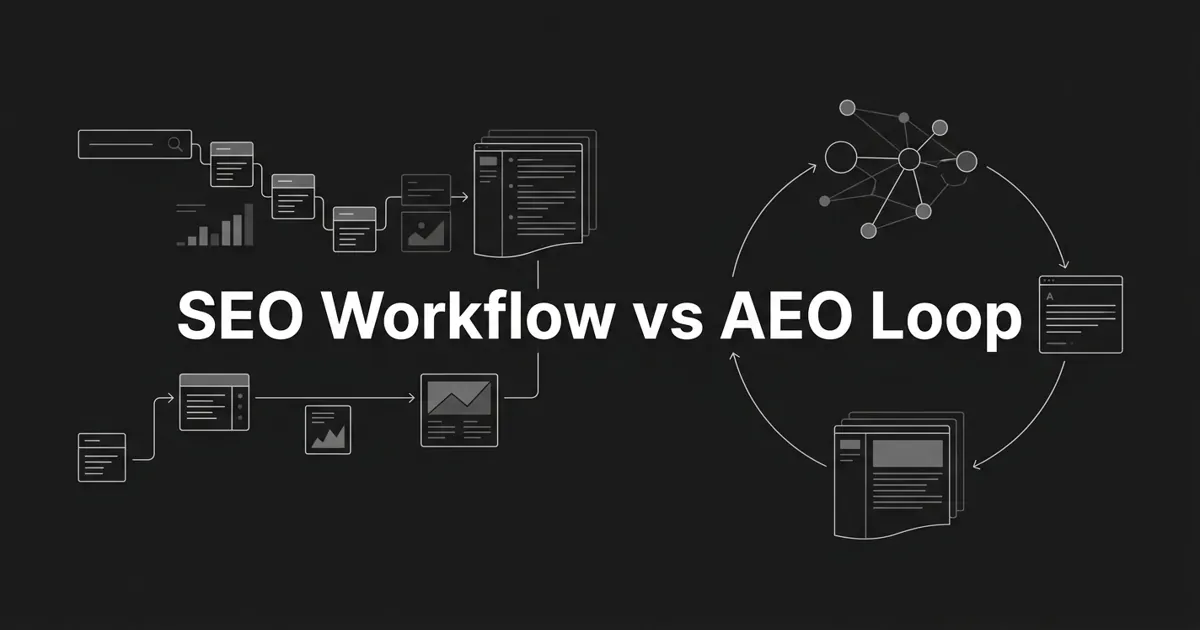
Most teams that arrive at a DeepSmith vs Scalenut comparison are not choosing between two versions of the same tool. They are choosing between two different theories of what content production is for. Scalenut treats production as an SEO workflow: research a keyword, build a brief, generate a draft, optimize it against a score, publish. DeepSmith treats production as the second half of a measurement loop: track what AI engines say about the brand, find the prompts and pages where the brand is absent, then produce the content that closes those gaps.
Both products now use the language of AI search. Scalenut positions itself as a generative engine optimization platform with an AI Brand Visibility tracker layered onto its writing workflow, and DeepSmith is AI search analytics and content production in one system. The distinction that matters is which half of the loop each was designed around, because that determines what the team spends its week doing.
Whether DeepSmith or Scalenut is the better investment depends less on feature counts than on which theory matches the team's actual bottleneck. This comparison covers production models, engine coverage, brand context, distribution, pricing, and the situations in which each tool is defensible, including the case where a team evaluating a Scalenut alternative is really evaluating a different category of product.
DeepSmith vs Scalenut at a Glance
| Dimension | Scalenut | DeepSmith |
|---|---|---|
| Category | SEO content workflow with a GEO overlay | AI search analytics plus content production |
| Primary production mode | Cruise Mode, a guided six-step long-form workflow | Autowrite scheduled production, or review and publish in Produced Content |
| Output type | Long-form draft that needs editing and humanizing | Publish-ready, on-brand article |
| AI engines tracked | ChatGPT and Google AIO on Starter and Plus; Perplexity added on Professional | ChatGPT (Pro), plus Perplexity (Grow), plus Gemini (Scale); all ten engines on Enterprise |
| Brand context system | Tone of voice settings and keyword clusters | Deep IQ: structured company, product, persona, voice, content type, and visual context |
| Internal linking | Interlinking suggestions in the GEO editor | Content Map-aware internal linking at write time |
| Distribution | Social Upreach on Plus and above | Apps Library for LinkedIn, X, Medium, Substack, newsletter, Reddit, and more |
| Service model | Self-serve tiers plus a VIP done-for-you service | Self-serve, with multi-workspace isolation for agencies |
| Entry price | $59 per month Starter | $99 per month Pro |
| Free trial | 7 days | 7 days |
| Publishing targets | WordPress and Shopify | WordPress, Webflow, Strapi, Sanity, Contentful, webhooks, Markdown and HTML export |
| Best fit | SEO-led teams wanting one guided tool from keyword to publish | AEO-led teams wanting citation measurement and production on one data backbone |
The Underlying Difference: SEO Content Workflow vs AEO Production
Search engine optimization aims at a ranking and a click. Its success metrics are rankings, impressions, click-through rate, and traffic, and its optimization levers are keyword coverage, backlinks, domain authority, and technical health. Answer engine optimization aims at something structurally different: being named or cited inside a generated answer. Its metrics are mention rate, citation rate, AI referral traffic, and share of voice within the answer set, and its levers are content structure, answer clarity, entity precision, and retrievability.
The two disciplines are not rivals. AEO is better understood as an evolution layered on top of SEO rather than a replacement for it, and teams that run both in parallel tend to do better than teams that treat the choice as either-or. What changes is the instrumentation. A keyword rank tracker cannot tell a marketing lead whether ChatGPT names their brand when a buyer asks which tool to use. That requires per-prompt tracking against specific engines, which is a different data collection problem.
The market data explains why the category exists. AI Overviews now appear on roughly a quarter of Google searches, up from around 13 percent in early 2025, and the top organic result sees materially lower click-through when they appear. Zero-click searches reached record levels in 2025, with the majority of US and EU searches ending without a click. AI chatbot traffic grew sharply year over year, and referral volume from ChatGPT and Gemini both climbed through late 2025. The traffic that does arrive from AI surfaces tends to be more engaged, with longer sessions than organic search visitors.
Those conditions do not make SEO obsolete. They do mean that a content program measured only by rankings is instrumented for one channel while a second channel quietly reallocates attention. That is the practical question underneath the DeepSmith vs Scalenut decision.
Scalenut: The Guided SEO Content Workflow

Scalenut began as an AI writer and SEO optimizer and has repositioned around generative engine optimization. The product pairs AI content production with an AI Brand Visibility tracker and a done-for-you service tier staffed by GEO strategists and a set of specialized agents covering strategy, content, visibility, authority, Reddit, and publishing.
Cruise Mode and the production path
Cruise Mode is the flagship workflow and the clearest expression of the product's design center. It moves through six steps: keyword and location, context setting with article type and references from a prompt library, title selection from generated or top-ranking options, outline building, content generation, and final optimization in the GEO editor. That last step covers prompt coverage, key terms, schema, interlinking, and featured snippet readiness.
The workflow includes NLP key terms, content grading, a proprietary GEO Score, an image generator, SERP data integration, and LLM optimization intended to make the article citable by AI engines. Typical output is a long-form post of 1,500 words or more. The marketer drives each step, and the result lands in the editor as a draft to polish.
AI Brand Visibility
Scalenut's AEO layer tracks brand presence, mentions, citations, and AI-driven traffic, and surfaces prompt insights including sentiment, query fanouts, and citation intelligence. Coverage is tiered: Starter and Plus track ChatGPT and Google AIO with 10 and 25 prompts respectively on a weekly refresh, and Professional adds Perplexity with 100 prompts. Platform marketing names a wider engine set including Grok and Claude, so coverage is worth confirming against the specific tier under consideration.
Where Scalenut is strong, and where reviewers push back
The strengths are consistent across vendor material and independent reviews: an all-in-one span from keyword research through publishing, fast first-draft generation, robust SERP analysis and keyword clustering, a large template library, a backlinks marketplace, and integrations with Semrush, Grammarly, Copyscape, WordPress, and Shopify. Cruise Mode's guided structure lowers the barrier for teams without a dedicated SEO specialist.
Independent reviews converge on a narrower set of complaints: variable writing quality with a robotic tone, unnatural keyword integration that occasionally tips into stuffing, and output that does not always hit the tool's own recommended SEO targets. One reviewer counted the same promotional phrase used nine times in a single 3,000 word article. Reviewers also flag inconsistent AI image quality, a non-intuitive interface, support responsiveness issues, and a gap finder that failed to surface content gaps under test. The fair characterization is that Scalenut AI content generation produces a fast draft that expects meaningful human editing. Buyers evaluating Scalenut AI content output during a trial should judge the second and third article rather than the first, since tone drift becomes visible across a batch.
DeepSmith: Track-and-Write on One Data Backbone

DeepSmith is an AI search analytics and content production platform in one. It tracks how AI engines answer questions about a brand, identifies where the brand is invisible or losing, and produces on-brand content to close those gaps from the same data. It is a production engine rather than a writing assistant, with publish-ready output instead of a first draft to rescue.
The AEO module
The visibility side reports mention rate, citation rate, share of voice, sentiment, and visibility trend, with a per-platform breakdown, a competitor leaderboard, and the sources AI cites most often. The Prompts view holds the tracked questions with per-prompt mention and citation rates and full answer history, and Discover Prompts generates a starter set from stored product, persona, and buyer-stage context. The Pages view shows which of the brand's own pages AI actually cites and what share of total citations each contributes. Competitor citations show which rival wins a given prompt, on which exact page, and how that performance varies by platform.

Engine coverage rises by tier. Pro tracks ChatGPT across 50 prompts. Grow adds Perplexity at 100 prompts. Scale adds Gemini at 200. Enterprise and Custom cover all ten named engines: ChatGPT, Gemini, Perplexity, Claude, Google AI Overviews, Google AI Mode, Grok, Meta AI, Microsoft Copilot, and DeepSeek.
Content Studio, the Writer, and Autowrite
Production runs through Content Studio, where ideas move from New Ideas to Planned Content to Produced Content. New Ideas is fed by Opportunity Agents that read the tracked prompts and the Content Map, each idea arriving with the data point that justifies it, so the queue is stocked by the same data that reports the visibility gaps. The Writer turns one planned idea into a finished article, researched, internally and externally linked, with a cover image and publish-ready metadata. Autowrite runs that pipeline on a scheduled date with no one in the application, which is the difference between a calendar that describes intent and a calendar that executes it. Finished articles can be reviewed and revised in Produced Content, then published to WordPress, Webflow, Strapi, Sanity, Contentful, or custom webhooks, with Markdown and HTML export as a fallback.

Deep IQ and the brand context layer
Deep IQ stores what the platform knows about the company and feeds every other module: positioning with claims to make and avoid, a profile per product, buyer personas, brand voice settings, visual guidelines, and reusable content types with a trusted-sources list. Content Map brings published pages onto one enriched topic taxonomy alongside competitor sites, which powers internal linking, coverage signals, and ideation dedup. Context is configured once rather than re-briefed per article.
Honest limitations
Tiered engine coverage is a real constraint. A team on Pro sees ChatGPT only, and Perplexity or Gemini requires Grow or Scale, with the remaining engines reserved for Enterprise and Custom; ChatGPT accounts for roughly three quarters of AI referral traffic, however, so Pro still covers the highest-volume AI surface before any upgrade. The platform measures visibility and produces content designed to improve it; it does not control or guarantee rankings, citations, traffic, or revenue. Publish-ready output still benefits from editorial review on high-stakes pieces.
Production Model: Guided Wizard vs Scheduled Pipeline
Cruise Mode is a step-by-step workshop that produces a draft. The Writer and Autowrite form a scheduled production line that produces a finished article. Both paths can generate a long-form post of comparable length. The variables that actually differ are who sits in the loop, how much editing the output assumes, and what triggers writing in the first place: a sequence of human actions in one case, a calendar entry that fires on its own in the other.
That difference compounds at volume. A guided wizard scales linearly with the operator's available hours, since every article requires the same six passes of attention. A scheduled pipeline decouples output from operator hours, which is the constraint most marketing leads describe when they say they have become the bottleneck in their own process.
Engine Coverage and Tracking Depth
Total breadth and tier placement are two separate questions here. Scalenut's tracker leads with ChatGPT and Google AIO, adding Perplexity at the Professional tier. DeepSmith tracks ten engines in total, leading with ChatGPT, adding Perplexity at Grow and Gemini at Scale, with Enterprise and Custom covering the full set: Claude, Google AI Overviews, Google AI Mode, Grok, Meta AI, Microsoft Copilot, and DeepSeek included. So for most surfaces the practical question is not whether DeepSmith reaches them but at which tier. Teams whose single visibility priority is Google AI Overviews can reach it on a cheaper Scalenut tier, though those tiers track only 10 to 25 prompts on a weekly refresh. Teams that want the wider engine set with per-page citation attribution will find DeepSmith's structure closer, provided the budget reaches the tier that includes the relevant engine.
Tracking depth is the second axis. Both products report competitor benchmarking. DeepSmith adds page-level citation attribution, showing which of the brand's pages earn citations and which competitor page wins a prompt the brand loses. That level of detail is what turns a visibility report into a specific writing assignment rather than a general concern.
Brand Context and Voice Enforcement
Scalenut offers tone of voice settings, unlimited on Plus and above, applied at generation time. DeepSmith maintains structured brand context as a persistent layer that every module reads. The distinction is between a setting and a knowledge base. A setting shapes one generation; a knowledge base accumulates, so product claims, persona detail, and voice rules stay consistent across a year of output rather than depending on how each brief was written.
For teams whose stated fear is publishing content that sounds like every other AI-written article, this is the most consequential difference in the comparison. It is also the least visible one during a trial, because voice drift shows up across dozens of articles rather than in the first.
Distribution and Repurposing
Scalenut's distribution surface is limited, with Social Upreach on Plus and above and no built-in channel-native rewriting for LinkedIn, X, newsletters, or Reddit. DeepSmith ships every finished article with social posts already written, and the Apps Library generates platform-native versions across LinkedIn, X, Medium, Substack, newsletter and nurture email, Reddit, Facebook, Instagram, and messaging channels, adapted to each channel's length and tone.
Distribution is the step most content calendars quietly drop. Teams that publish consistently but never get to the LinkedIn post or the newsletter section are describing a workflow problem rather than a capacity problem, and the two products treat it differently: one leaves it downstream, the other makes it an output of the article itself.
Pricing and What Each Tier Actually Buys
Scalenut starts at $59 per month for Starter, with Plus at $89 and Professional at $199, plus a VIP service tier priced on request. A substantial promotional discount with doubled limits has been running on the self-serve tiers, so displayed pricing at the time of reading may differ. DeepSmith starts at $99 per month for Pro, with Grow at $199 and Scale at $399, or $80, $160, and $299 respectively on annual billing, plus custom Enterprise pricing. Both offer a 7-day free trial, and DeepSmith adds no long-term contracts and no cancellation fees.
Sticker price is the least informative comparison here. The variables that move total cost are articles per month, prompts tracked, engines covered, seats, and whether distribution and internal linking are included or handled manually. A cheaper tier that produces drafts requiring two hours of editing each can carry a higher effective cost per published article than a more expensive tier that does not.
Publishing, Integrations, and Service Model
Scalenut publishes one-click to WordPress and Shopify on Plus and above and integrates with Semrush, Grammarly, and Copyscape, plus a Chrome extension for rewriting elsewhere. DeepSmith publishes to WordPress, Webflow, Strapi, Sanity, Contentful, or custom webhooks, with Markdown and HTML export as a fallback. Scalenut's integration surface is broader on the SEO tooling side; DeepSmith's is broader on modern and headless CMS targets.
The service models diverge as well. Scalenut's VIP tier is a managed engagement with a dedicated strategist, writers and editors, agent-run execution, monthly technical audits, defined SLAs, and weekly reporting. DeepSmith is a self-serve platform with multi-workspace isolation for agencies and multi-brand teams. This is a fit question rather than a quality question: some teams want to hire the outcome, others to operate the system.
Which Should You Choose
Scalenut is the stronger choice for teams whose primary production goal is SEO-led long-form content and who prefer a guided workflow covering keyword research, brief, draft, optimization, and publishing in one place. It also suits teams that want ChatGPT and Google AI Overviews tracking at the lowest entry price rather than on an Enterprise plan, teams publishing to Shopify, teams that value deep SEO tool integrations, and teams that would rather buy a done-for-you GEO program than run one. It is the cheapest entry point here for organizations comfortable with the limits at the Starter tier.
DeepSmith is the stronger choice when AEO is a strategic priority rather than an experiment, and citation tracking needs to function as a measured channel instead of a one-off audit. It fits teams that need to know which specific prompts competitors win and which exact pages earn those citations, teams that need publish-ready articles in a consistent brand voice without spending hours per piece on linking, imagery, metadata, and distribution, agencies needing isolated workspaces per client, and teams that want scheduled hands-off production so the calendar survives a busy quarter.
Neither product is the right answer in a few cases. Organizations whose primary channel is paid social or email, with no meaningful AI search exposure yet, should start with content fundamentals. Teams needing backlink analysis, technical audits, and rank tracking at the depth of a full SEO suite should treat both products as production systems used alongside that suite. Teams requiring complex multi-author approval chains and granular permissions will need an editorial workflow layer regardless of which production tool they select.
A team searching for a Scalenut alternative because the drafts arrive fast but require heavy editing, and because visibility in AI answers has become a board-level question, is describing the problem DeepSmith was built around. Teams satisfied with their SEO output and looking only to add tracking are in a different position, and the Scalenut alternative worth testing there may be an add-on rather than a replacement.
The 7-day free trial provides real data and real drafts before payment, which is the only reliable way to judge whether the output clears the bar. Start a DeepSmith free trial and evaluate the tracking and the articles against the current workflow.