If you run a SaaS company, your product page, your pricing page, and your integrations page do most of the buying work before a prospect ever books a call. Now those same pages have a second job: answering questions inside ChatGPT, Perplexity, and Google's AI answers, where a founder is asking "what does this cost" or "does it connect to Salesforce" without ever clicking through to your site. This guide walks you through how to make product pages citeable, so an AI assistant can name your product correctly, quote your pricing without getting it wrong, and describe your integrations the way they actually work today. The steps that make product pages citeable are the same ones that make your pricing and integration pages easier to trust: clear entities, self-contained facts, and one current source of truth. By the end you'll have a repeatable way to check saas product page aeo on your own site and fix what's broken, one page at a time.
What you need: access to edit your product, pricing, and integration pages, and about an hour to map the buyer questions those pages should answer.
Step 1: Map the questions each page has to answer
Before you touch any copy, figure out which page owns which question. This sounds obvious, but most sites answer half their commercial questions in three different places and the other half nowhere.
What to do: Write down the real questions a buyer asks about your pricing, and your integrations. For the product page, that's things like what the product is, who it's for, what job it does, and what makes it different from the alternative they're already considering. For pricing, it's the plans that exist, what each one costs, whether that price is monthly or annual, what's included, and whether there's a free trial. For integrations, it's whether you connect to a specific tool by name, what that connection actually does, and whether it needs a certain plan or a bit of setup.
Once you have the list, assign each question to one page and one section on that page. If "is there a free trial" could be answered on your homepage, your pricing page, and a footer FAQ, pick one of those as the real answer and treat the others as pointers to it, not competing answers.
How to tell it's done: You can build a simple three-column list: the question, the page that should answer it, and roughly where on that page the answer lives. If two rows point to the same question with different answers, you're not done yet.
Where people go wrong: Teams write a product page that talks up a category keyword without ever plainly stating what the product does. Or they leave pricing questions to a sales FAQ while the actual numbers sit behind a form. Or they list integration logos in a strip at the bottom of the homepage without saying what any of those connections do.
If you're not sure which buyer questions actually matter to your market, this is one place DeepSmith's AEO area helps before you write a word. Its Prompts tool lets you track the exact questions buyers ask and see how often AI engines answer them correctly, and Discover Prompts can put together a starter list based on your product, your persona, and your buyer stage. It won't tell you what's true about your pricing or your integrations. That part is still yours.
Pro tip: Do this mapping exercise before you rewrite anything. It's much faster to fix three pages you know are supposed to answer specific questions than to rewrite everything and hope it's more citeable.
Step 2: Build one canonical record for product, pricing, and integration facts
Once you know which page answers which question, you need a single, current source of truth behind it. This step feels like busywork until the day your pricing changes and five different pages say five different things.
What to do: Create one internal record for your product facts (name, category, one-sentence definition, who it's for, core features, supported plans, and what you can and can't claim), one for pricing (plan names, monthly and annual price, billing unit, what each plan includes, trial terms, and cancellation rules), and one for each integration (exact partner name, whether it's live or in beta, what it can do, which plan it requires, and when you last checked it still works). It doesn't need to be fancy. A shared doc or spreadsheet that someone actually owns beats a beautiful system nobody updates.
How to tell it's done: A writer, a salesperson, and a support rep should all give the same answer to the same commercial question, because they're all pulling from the same record. If your pricing table, your sales deck, and your integration page can ever disagree, the record isn't doing its job yet.
Where people go wrong: The most common mistake is treating the live website as the source of truth even though nobody owns keeping it current. A close second is updating the pricing table but forgetting the plan cards, the FAQ, and the sales copy that quotes the old number.
Common mistake: Don't let an AI writer fill in a missing plan limit or an unconfirmed integration capability just to complete a sentence. If you don't know it, mark it unknown or leave it out. A guess that gets quoted back to a prospect is worse than a gap.
Step 3: Rewrite product pages as self-contained fact blocks
This is where saas product page aeo actually gets built into the copy itself. An AI assistant usually pulls one paragraph or one section out of your page, not the whole thing, so each block needs to make sense completely on its own.
What to do: Open with a direct, one-sentence definition: your product name, its category, who it's for, and the outcome it delivers. Skip the scene-setting and get to that sentence fast. Follow it with a short answer summary, then one section per core capability, each starting with a plain statement of what that capability does before you explain the mechanism or the benefit. Name the product again rather than leaning on "it" for three sentences in a row, since a pronoun-only paragraph loses its subject the moment it's lifted out of context.
Keep each feature section to roughly 50 to 80 words if you can. That's not a hard rule an algorithm enforces, but it's a useful target for a block that still makes sense once it's separated from the page around it. State availability and limits close to the capability they belong to, not three clicks away on the pricing page. And if you cite a number or a study, name the source and the date next to it rather than letting the number float unattributed.
How to tell it's done: Copy a feature section into a blank document by itself. A reader should still be able to tell which product this is, what the feature does, who it's for, what it gets them, and whether there's a catch.
Where people go wrong: The direct answer gets buried below a long animated hero section, or a whole feature is explained only through a screenshot with no text describing what it does. Another common one: one paragraph tries to carry the capability, the benefit, the availability, and a customer quote all at once, so none of it can be lifted cleanly.
DeepSmith's Content Studio is where this kind of rewrite actually gets produced without you doing every sentence by hand. The Writer researches the page, drafts it, adds internal and external links, and hands back something publish-ready rather than a first draft you still have to rescue, so a founder rewriting a batch of product pages isn't starting from a blank screen each time.
Step 4: Make your pricing page hard to misquote
Pricing is the fact an AI assistant gets wrong most often, mostly because it's the fact that changes the most and gets buried the deepest. If you only fix one page from this guide, make it this one, because getting pricing page ai citations wrong in front of a buyer costs you more than almost any other mistake on the site. Everything below is aimed at one goal: pricing page ai citations that match what your sales team would say on a call.
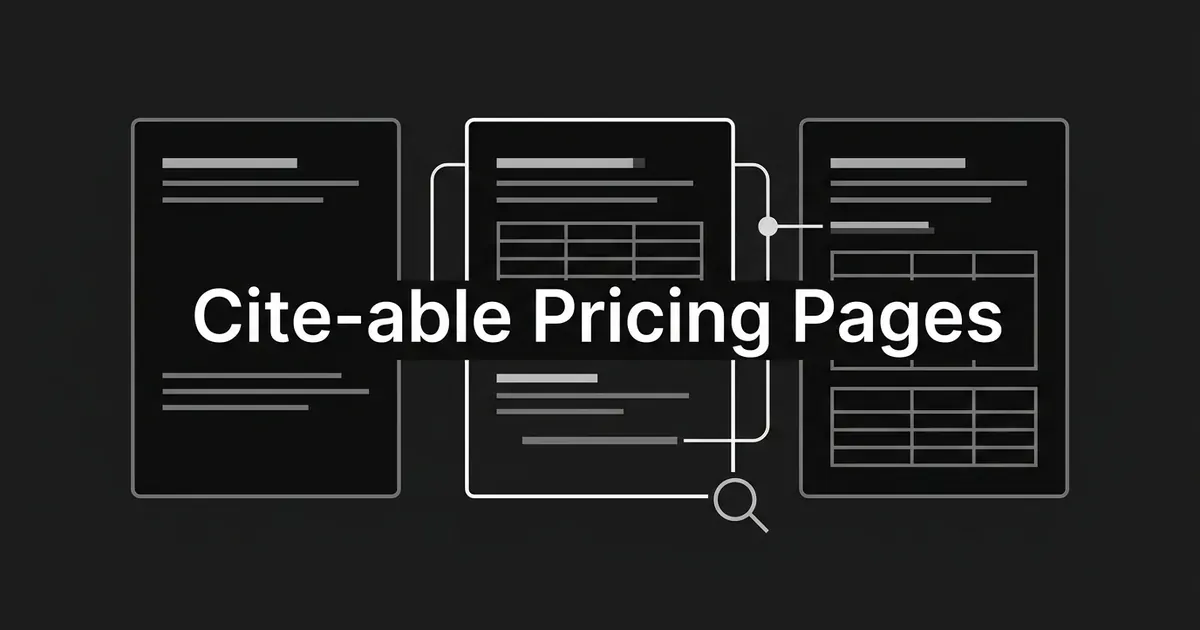
What to do: Put the actual numbers in the page's initial HTML, not behind a form or a script that only loads after a click. Open with a short summary: how many plans you have, the starting price, and whether it's billed monthly, annually, per seat, or by usage. Follow it with a full plan comparison table covering price, billing cadence, what's included, seats, and any limits. Then repeat the most important numbers in plain sentences too, since a table alone doesn't always survive being lifted out of the page.
Say plainly whether an annual price is billed yearly rather than just labeling it "monthly" next to a lower number. Explain what happens when someone hits a plan's limit. Label a custom or enterprise plan as custom rather than leaving the cell blank or inventing a number to fill it. And if you can maintain it, add a visible "last updated" date near the pricing table, so both a reader and an AI assistant have a way to judge how current the numbers are.
How to tell it's done: Hand the rendered page to someone who's never seen it and ask them to answer: what's the cheapest plan, what does it cost monthly and annually, what's included, and is there a trial. If they have to open a form or reconcile two different numbers to answer any of that, the page isn't ready.
Where people go wrong: The pricing table loads only after JavaScript runs, so a crawler sees an empty shell. Or the visible table shows monthly prices while the FAQ underneath describes annual billing, with nothing tying the two together. A plan gets called "unlimited" in the hero and then given a hard cap two sections down.
Common mistake: Treat every pricing change as its own small release. When you change a number, check the plan cards, the comparison table, the FAQ, the metadata, and any in-app upgrade prompt in the same pass, not weeks later when someone notices the mismatch.
DeepSmith's own pricing page follows this pattern for a reason: four plans, Pro at $99 a month, Grow at $199, Scale at $399, and a custom Enterprise tier, each with a plain annual rate and a stated list of what's included, so an AI assistant summarizing it has one clean table to draw from rather than three conflicting ones.
Step 5: Turn your integration list into something searchable
A logo wall tells a visitor you connect to a lot of tools. It tells an AI assistant almost nothing, because there's no text attached to any of those logos describing what the connection does. Getting picked up for integration page ai search means naming the capability, not just the partner, and doing it on the page an AI assistant can actually read rather than in a slide deck.
What to do: Build an integration hub that states plainly what your product connects to and why, groups those tools by the workflow they serve (CRM, analytics, support, and so on), and lets someone search or filter by name. Mark any "featured" set as featured, not as the complete list, and give a clear path to the full catalogue if the landing page only shows a handful.
For the integrations that matter most to your buyers, give them their own page. Name both products in the heading, state in one sentence what the connection lets someone do, list the specific actions and data it supports, say whether the connection is native, API-based, or webhook-based, and note any plan requirement or setup step. Say plainly if it's still in beta or if it has a known limitation, and if a tool isn't supported yet, give visitors a way to ask for it.
How to tell it's done: Someone searching for a specific integration by name should be able to tell, without emailing support, whether it exists, what it does, how it connects, and what's required to turn it on. That's the whole bar for integration page ai search: a real answer, not a logo.
Where people go wrong: Partner logos get listed with no explanation of the actual capability behind them. A single generic integrations page tries to cover every tool with the same three sentences. An API gets described as if it were a ready-made native integration, or a dedicated page for a deprecated integration just sits there uncorrected.
Inside DeepSmith, this same idea shows up in how published articles connect to your CMS. Produced Content can publish straight to WordPress, Webflow, Strapi, Sanity, or Contentful, or through your own webhooks, with Markdown and HTML export as a fallback, and each of those connections is described as a specific, named capability rather than a logo with no context attached.
Step 6: Make the pages crawlable and consistent
You can write the clearest fact blocks in the world and still lose the citation if the page itself is hard for a crawler to read or contradicts itself somewhere else on the site.
What to do: Confirm nothing in your robots settings blocks the pages that matter, and that the important facts exist as real text rather than only inside an image, a video, or a hover state that never gets rendered for a crawler. Check the page as it actually renders, not just the source template, and if you use structured data, make sure it matches the visible copy exactly rather than asserting a price or feature the page doesn't show. Use the same product name, plan names, and integration names everywhere on the site. If you've ever called yourself an "AI visibility platform" on one page and a "content tool" on another, pick one description and use it consistently.
How to tell it's done: The page should still make sense with scripts turned off, and the commercial facts a buyer or an AI assistant needs should be sitting in the HTML that gets delivered to the browser, not hidden behind an interaction.
Where people go wrong: Teams check the desktop page visually and never look at what actually gets rendered as text. Structured data quietly goes stale because nobody remembered to update it alongside the visible copy. And it's worth saying plainly: Google doesn't require a special AI file or a special schema type to appear in AI Overviews or AI Mode. A page still has to meet ordinary search requirements first, and no markup by itself will rescue a page with vague copy or hidden pricing.
Step 7: Test, monitor, and refresh as your product changes
None of this is a one-time project. Your pricing changes, your integrations change status, and features ship or get retired, so the page work has to keep pace or the citations you earned start quoting something that's no longer true.
What to do: Put together 10 to 15 real buyer questions covering product definition, features, pricing, trial terms, and your most important integrations. Ask those questions across the AI assistants your buyers actually use, and record whether your product shows up, whether the right page gets cited, and whether the facts quoted back match your current records. Where it's available, use page-level citation data to see which URLs are actually getting picked up and which grounding phrases are tied to them, but treat that as a trend to watch rather than a precise count of every mention, since the reporting groups similar phrases together rather than showing exact prompts.
Set a rule for when a page gets revisited: right after a pricing change, right after a feature ships or gets removed, and right after an integration's status changes, plus a regular check on everything else at whatever pace matches how often your product actually changes.
How to tell it's done: The product is named and defined correctly, the major feature blocks still make sense on their own, pricing is visible and internally consistent, and a human reading the page and an AI assistant summarizing it would both hand you back the same core facts. Someone specific owns keeping it that way.
Where people go wrong: Teams measure whether the brand gets mentioned at all and stop there, without checking whether the cited page actually says the right thing. Others treat a citation as proof of traffic or revenue when it's neither. And almost everyone forgets to re-test right after the release that made the old answer wrong.
DeepSmith's AEO area is built for exactly this loop: it tracks mention rate, citation rate, and which of your pages are actually getting cited, and its Opportunity Agents can turn a spotted gap, like a competitor winning the citation you used to hold, into a specific, evidence-backed content idea rather than a vague to-do. It's a way to see the gap and act on it faster. Deciding what's true about your own pricing and features still has to come from you.

The five steps in this guide form a loop rather than a one-time project: a pricing or feature change should trigger an update to the canonical record, which triggers a rewrite of the affected page, which gets tested against real buyer questions, which feeds back into checking which pages actually get cited, and a citation gap found there points straight back to the next product change worth making.

What to do next
Pick one product page, one pricing page, and one integration page, run them through this checklist, and test them against a handful of real buyer questions before you move to the next batch. You don't need to fix your whole site in a week. A few pages done properly, with someone responsible for keeping them current, will do more for how AI quotes pricing accurately than a hundred pages rewritten once and left alone. That's really the whole test for whether ai quotes pricing accurately on your site: can it find one clean answer, or does it have to guess between several.
If you'd rather have a platform that tracks where you're showing up in AI search and turns the gaps it finds into grounded, on-brand content, DeepSmith's free trial gives you real data and real drafts before you pay anything.