You checked AI Mode for one of your money questions, and a competitor's page was sitting in the answer instead of yours. That stings. It also does not mean your content is bad.
It usually means your page answered a question nobody in that thread was asking.
This guide walks you through google ai mode optimization step by step: how the surface picks sources, what to change on your pages, and how to tell it worked. By the end you will have a working plan to get cited in ai mode on the questions your buyers actually ask, not a checklist you abandon in week two.
Eight steps. You can start the first one today.
What changes when search becomes a conversation
AI Mode is Google's conversational search surface. It lives behind its own tab or button inside Google Search and the Google app, separate from the standard results page. A Gemini-family reasoning model reads the live web index, the Knowledge Graph, and real-time feeds, then writes an answer with links.
Here is the part that matters most. AI Mode does not run its own index. It reads the same web index that powers classic Search, then layers a generative response on top. Your existing pages are already candidates. Nothing needs to be rebuilt from scratch.
The scale is real. AI Mode passed 1 billion monthly active users roughly a year after its May 20, 2025 launch in the United States, following a Labs preview in March. It is available in nearly 200 countries and around 100 languages, and usage grew at roughly 40 percent month over month through late 2025 and into 2026. Its share of Google search sessions moved from about 0.25 percent in early May 2025 to just over 1 percent by early July 2025.
Small share, steep curve. That is the window you are working in.
Three behaviors separate this surface from anything you have optimized for before.
People ask longer, messier questions. The average AI Mode query runs about 7.22 words, compared with roughly 4 words for a traditional Google search. These are sentences, not keywords.
Almost every answer cites something. Around 97 percent of AI Mode responses include at least one source link, pulling from about 7 unique domains per response. There is room in there for you.
Most sessions end without a click. Zero-click behavior in AI Mode sits around 91 to 94 percent, against roughly 43 percent for AI Overviews and about 34 percent for traditional results. External click-through runs near 6 to 8 percent.
Read that last one carefully before you panic. Yes, clicks are scarcer here. Being named in the answer is now a large share of the return, and AI Mode names roughly 3.3 brands or entities per response versus about 1.3 in an AI Overview. More seats at the table, fewer people walking over to your house.
One quick note on ai mode vs ai overviews, because the question always comes up. Only about 13.7 percent of URLs cited for the same query overlap between the two surfaces. They are cousins, not twins. The head-to-head differences deserve their own treatment, so we are staying on AI Mode here.
How query fan-out decides who gets cited
Query fan-out is the mechanic behind everything else in this guide. Learn it once and the rest of the steps stop feeling arbitrary.
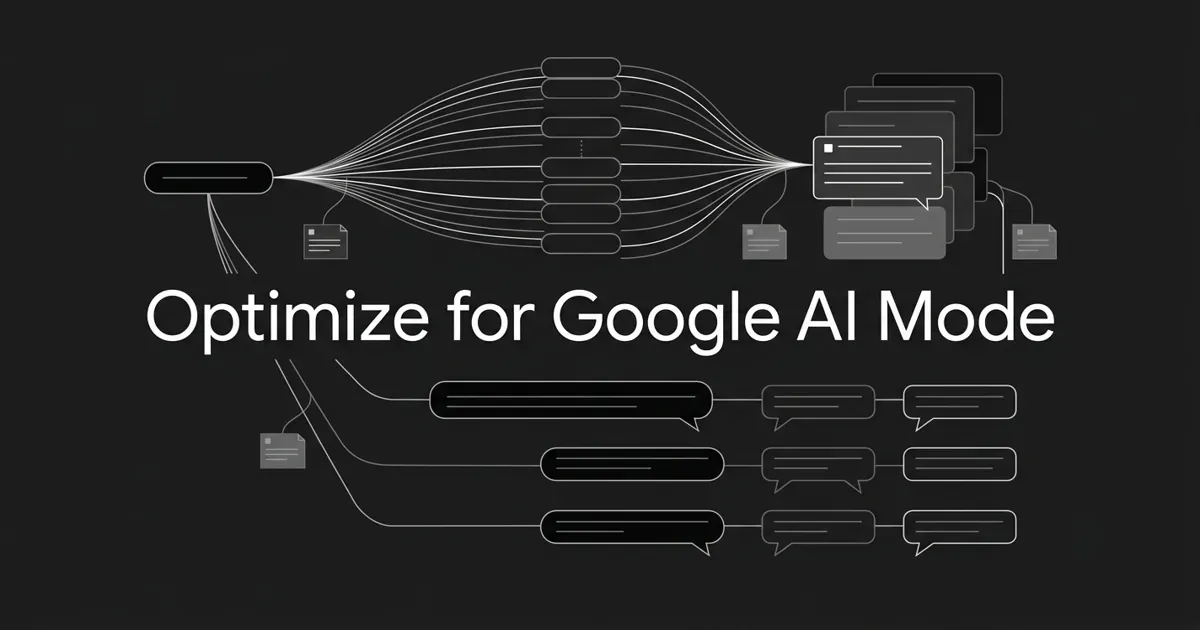
When someone types a question into AI Mode, the model does not run that one search. It breaks the question into subtopics the user never spelled out, then fires many searches at the index in parallel.
The sequence looks like this:
- Decomposition. The model reads intent and splits it into implicit sub-questions. Ask for the best plants for a shaded border that gets hit by footballs, and it quietly asks about shade tolerance, drought tolerance, foot-traffic durability, and low maintenance.
- Parallel retrieval. Every sub-query hits the same search index at once.
- Expansion. Each sub-query picks up synonyms, related entities, and freshness filters along the way.
- Scoring. Results are judged on traditional ranking signals plus reasoning about which passage best answers that specific sub-question.
- Synthesis. Winning sources are stitched into one cited response.
- Carry-over. On a follow-up, the thread history goes back into the model and a new fan-out runs, informed by what was already covered.
Do you see what that does to your strategy? You no longer need to win the broad head term to earn a citation. You need to be the best available answer to one sub-question inside the fan-out. To optimize for ai mode is to stop chasing the question a user typed and start owning the questions the model asked on their behalf.
That is genuinely good news for smaller sites. A focused page that nails one narrow sub-question often gets cited where a sprawling pillar page does not.
Then the follow-ups arrive, and the game changes again. AI Mode surfaces suggested follow-up chips, and each tap re-triggers fan-out with the previous turn as context. Studies of multi-turn threads show the URLs cited on turn two and turn three frequently differ from turn one. A page that missed the opening answer can still win the second one.
So the target is not a query. It is a conversation.
Step 1: Map the prompts your buyers ask, and the turns that follow
Start with a prompt map, not a keyword list. Organize it by buyer intent (problem-aware, solution-aware, vendor-aware) and by stage (awareness, consideration, decision). For each prompt, write down the literal phrasing a human would type, the follow-up turns likely to come next, and where in the journey it sits.
Where do you find them? People Also Ask, Google autosuggest, sales call recordings, support tickets, Reddit threads, Quora, and the prompts where competitors already show up. Your sales team is sitting on the best source in the building.
Remember the 7.22-word average. Write your prompts as full sentences, the way people speak.
You are done when you have 50 to 150 documented prompts per core topic, sorted by intent and stage, each with at least two or three plausible follow-up turns beneath it.
Where people go wrong: mapping only head terms. Most AI Mode citations are won on the long-tail follow-on questions, and those never show up in a volume-sorted keyword export.
If that number feels heavy, it is normal to feel that way. Start with the ten prompts closest to revenue and grow the map weekly. DeepSmith's Discover Prompts generates a starter set from your product, persona, and buyer-stage context, which is a decent shortcut when you are staring at an empty spreadsheet.
Step 2: Baseline where you get cited today
Do not change a single page yet. Measure first, or you will never know what worked.
Run each priority prompt through AI Mode and log four things: which URLs were cited, whether your domain appeared at all, which competitors were cited, and what shape the response took (paragraph, list, or table). Then run the follow-up turns and log those separately, because the sources shift.
Repeat weekly for a month. One snapshot tells you nothing about a surface this volatile.
You are done when you have a baseline showing citation rate, citation share, and the top three competitors per prompt category, with at least four weekly readings behind it.
Where people go wrong: skipping the baseline entirely, optimizing on instinct, then having no way to prove the work paid off when leadership asks.
Manual logging works fine at ten prompts. At a hundred, across weekly runs and multiple turns, it quietly eats a day a month. This is where DeepSmith does the work: it tracks mention rate, citation rate, and share of voice on a defined prompt set across ChatGPT, Gemini, Perplexity, Claude, and Google AI Mode, with engine coverage rising by plan tier and Google AI Mode included at the Enterprise tier. The Pages view shows which of your URLs earn citations, and the competitor view shows exactly which of their pages beat you and on which prompts.
Step 3: Build clusters that cover the whole conversation
Fan-out rewards coverage. One page cannot answer four sub-questions well, and it certainly cannot answer the three turns that follow.
For each pillar topic, build one comprehensive pillar page plus 8 to 15 supporting pages. Each supporting page owns exactly one sub-question from the fan-out. Link them in both directions with descriptive anchor text, so the cluster reads as one body of work rather than a pile of posts.
Then walk the conversation. For every seed prompt, name the follow-up questions a real person would ask next, and check that some page in the cluster answers each one cleanly enough to be cited on its own.
Length matters here, though not in the way people assume. Pages of 1,500 words or more with well-structured extraction blocks earn citations at a meaningfully higher rate than thin pages. Depth plus structure, not length for its own sake.
You are done when every pillar has at least 8 interlinked supporting pages, and you can name three follow-up questions that each supporting page also answers.
Where people go wrong: writing standalone posts aimed at broad head terms. AI Mode infers authority from how completely and coherently a site covers a topic, and disconnected pages give it nothing to infer from.
This is the step that stalls most teams, and it is a production problem rather than a strategy problem. Nobody is short on cluster ideas. They are short on the hours to write 12 supporting pages with structure, internal links, schema, and metadata already in place. DeepSmith exists for that gap: gaps found in tracking flow into an idea backlog, and the writing pipeline produces publish-ready articles with those elements built in during creation instead of bolted on afterward.
Step 4: Put the answer in the first 60 words
Every priority page should open with a direct 40 to 60 word answer to its primary question. No warm-up. No scene-setting. The answer, in a block a model can lift whole.
Under that, build the page out of extractable parts:
- H2 and H3 headings phrased as questions when it reads naturally.
- Bullet lists for enumerations, tables for comparisons, numbered blocks for procedures.
- Short paragraphs, two to four sentences.
- A closing FAQ block of three to six adjacent sub-questions.
Treat your media as content too. Descriptive file names, alt text that actually describes the image, captions that name entities, transcripts for video and audio, and VideoObject schema where video is involved. Multimodal sessions reward pages that give the model something to read around the visual.
You are done when the first 100 words of every priority page contain a clean, self-contained answer to that page's main question, and at least one list, table, or step block appears in the body.
Where people go wrong: narrative intros. If your answer arrives in paragraph four, the model has already lifted someone else's paragraph one.
Pro tip: read your opening paragraph out loud with no context around it. If it still makes sense as a standalone answer, it is extractable. If it needs the rest of the page to mean anything, rewrite it.
Step 5: Clear the technical floor
None of the above earns a citation if the page cannot be crawled, parsed, or trusted. Most google ai mode aeo advice jumps straight to content structure. This is the floor underneath it, and it is unglamorous work that gates everything else.
The non-negotiables:
- Pages must be indexable and eligible to appear with a snippet in classic Search. Noindex directives, cloaking, soft 404s, and some paywall implementations disqualify a page outright.
- Core Web Vitals should pass, with clean rendering on mobile and desktop.
- HTTPS across the whole site.
- Semantic HTML: one H1 per page, a logical heading tree, descriptive alt text, descriptive link anchors.
- Valid JSON-LD structured data for the content type: Article, FAQPage, Product, Organization, Person for author bylines, BreadcrumbList. Validate with the Rich Results Test.
- Entity identifiers connected through sameAs links to authoritative profiles such as Wikipedia, Wikidata, LinkedIn, and Crunchbase.
- Server logs and crawl stats clear of systemic issues.
Two myths worth retiring while you are here. There is no special AI schema, and Google has been explicit that there is no separate optimization for its AI features beyond standard Search Essentials. llms.txt is optional and ignored by Google as a ranking signal. If a vendor is selling you either, keep your money.
Structured data is not a direct ranking factor. It helps the model work out which entity you are, which is a different and still useful job.
You are done when every priority page passes Rich Results validation for its applicable types, renders with a snippet in classic Search, and uses a single H1 with a clean hierarchy.
Where people go wrong: stuffing schema types that do not apply, and skipping the sameAs connections that let Google verify who you are.
Step 6: Make your expertise visible on the page
AI Mode leans on the same trust signals classic Search has always used, and it leans harder because it has to decide whose sentence to put in front of a billion people.
Make each of the four E-E-A-T signals visible rather than implied:
- Experience: original screenshots, first-hand testing, real case studies, examples only someone who did the work would have.
- Expertise: author bylines with credentials, author pages that link to verifiable professional profiles, a visible track record on the topic.
- Authoritativeness: mentions and citations from other credible sources in your space.
- Trustworthiness: HTTPS, findable contact details, an editorial policy, correction practices, a real About page.
You are done when every content page carries a visible author byline with credentials, links to an author page with verifiable profiles, and holds at least one original asset such as data, an image, or a worked example.
Where people go wrong: treating E-E-A-T as a compliance checklist. Adding a byline to a page that clearly nobody with expertise wrote does not move anything. The signals are supposed to be evidence, not decoration.
Freshness belongs here too. AI Mode leans on recency more than classic organic results, especially for anything involving prices, launches, or news. Old and correct still loses to current and correct on time-sensitive prompts.
Step 7: Earn mentions on the sources AI Mode already trusts
Your own site is only half the picture. Source selection also draws on the off-site entity graph, meaning what the rest of the web says about you and how consistently it says it.
Look at your baseline from step 2 and list the third-party domains that keep appearing in your priority prompts. Those are your targets. Across both Google AI surfaces, the frequently cited names include Google properties like Maps and YouTube, plus Wikipedia, Reddit, Indeed, Amazon, and major publishers.
The work is ordinary and it compounds:
- Consistent brand, product, and author names everywhere they appear.
- Presence on the review sites and industry publications your buyers read.
- Genuine participation in the communities that come up in your prompts.
- Accurate entries wherever your entity is described, including Wikidata where it qualifies.
- Video and podcast appearances that put your named experts on other people's platforms.
You are done when a quarterly audit shows your brand or your experts mentioned on the top ten third-party sources cited for your priority prompts.
Where people go wrong: pouring everything into on-page work and ignoring the entity graph. Mentions on high-authority, topically relevant third-party sites materially increase citation probability, and no amount of on-page tuning substitutes for them.
Step 8: Track, refresh, and iterate
AI Mode moves. Pages drop out of citations for reasons that have nothing to do with anything you did, and the only defense is a cadence.
Set up prompt-level tracking for every priority prompt and watch four numbers: citation share, citation position, prompt-level share of voice, and volatility. Volatility is the one people forget. A prompt that swaps sources every week needs a different response than one that has been stable for two months.
Refresh high-value pages every 60 to 90 days with updated data, new examples, and tighter answers. When a page falls out of the answer, audit it in this order: structure first, then freshness, then entity coverage.
You are done when a monthly report shows citation share on priority prompts and your refresh cadence is holding across the cluster.
Where people go wrong: set-and-forget publishing. This surface rewards maintenance more than any channel you have worked before, and stale pages lose citations quickly.
What to do next
Do not attempt all eight steps this quarter. Pick the one that unblocks the rest.
If you have no baseline, start at step 2. Everything else is guesswork without it. If you have data but no coverage, step 3 is your bottleneck. If you have plenty of pages that nobody cites, spend a week on step 4 and watch what happens.
Google ai mode aeo is not a separate discipline bolted onto your existing work. It is the same craft, aimed at sub-questions and conversational turns instead of keywords and rankings. You are closer than you think.
When you are ready to optimize for ai mode without adding headcount, you can start a DeepSmith free trial and see tracked prompts and produced articles against your own domain before you pay. Seven days, no long-term contract.