You asked ChatGPT which tool it recommends in your category, and it named three competitors instead of you. Then you opened the ChatGPT citation sources under the answer and your site wasn't one of them. That stings. It's also the clue you needed.
Here's the good news: ChatGPT was probably never going to cite your product page in the first place. Around 85 percent of brand mentions in AI answers come from third-party pages rather than the brand's own site, and one analysis of more than 25 million links put earned media at roughly 84 percent of all AI citations. So the job isn't rewriting your homepage. It's earning a place on pages ChatGPT already trusts.
This guide walks you through that, step by step. You'll map which sources ChatGPT cites for your own buyer prompts, find where you're missing, and pick the one or two channels worth your next quarter. It's written for a marketing lead who has to choose, not for someone reading a survey.
One scope note before we start. This is ChatGPT only. Perplexity and Google's AI Overviews read the web on different rules, so a playbook tuned for them will point you the wrong way here. We'll stay on one engine and go deep.
The short answer: seven families of sources ChatGPT leans on
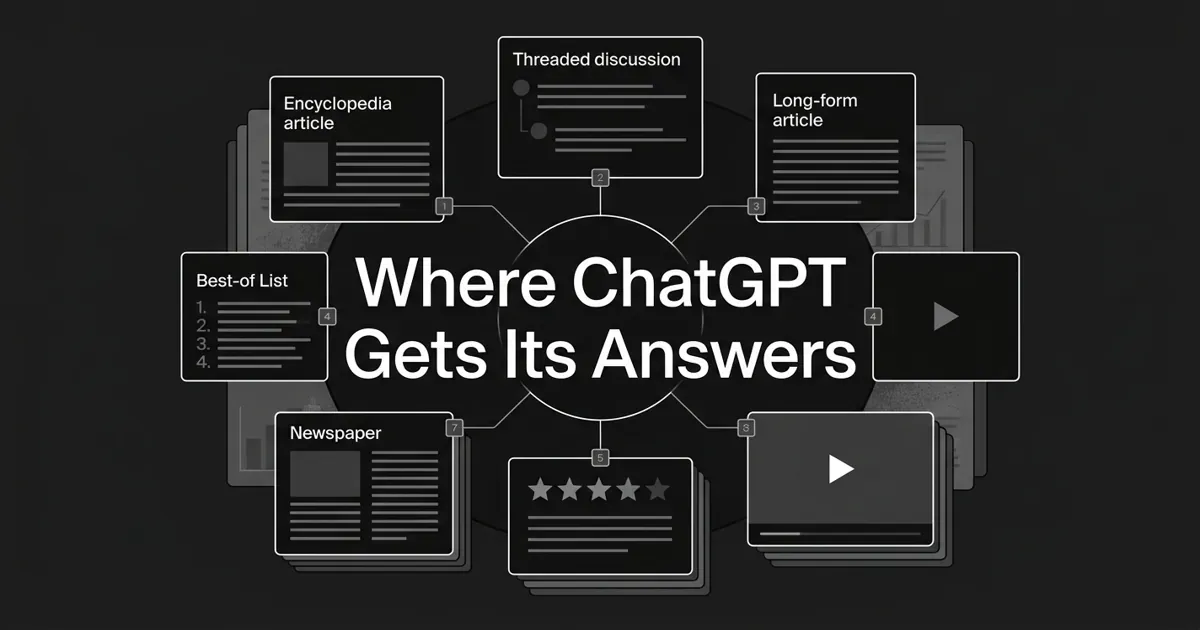
Before the steps, here's the map. When ChatGPT answers questions about brands, its ChatGPT off-domain sources cluster into seven families:
- Wikipedia. The single most cited source for factual and "what is" prompts. One May 2026 study put Wikipedia at nearly half of ChatGPT's top factual citations in the US, while a broader citation cut measured its share far lower. Both are true inside their own definitions. Read it as "Wikipedia dominates factual queries," not as one magic percentage.
- Reddit. Its share swings from a couple of percent across a general citation mix to somewhere in the 34 to 40 percent range on recommendation-style prompts. Prompt type drives the spread. About 99 percent of Reddit citations are individual discussion threads, not subreddits or profiles.
- LinkedIn. It shows up in roughly 14 percent of ChatGPT Search answers, and Articles and Pulse posts account for something like half to two thirds of that share.
- YouTube. Cited around 200 times more than any other video platform, with about a 20 percent citation share on video-leaning queries.
- Software review platforms. G2, Capterra, TrustRadius, and Trustpilot. Their share is bimodal: modest in general question cuts, much higher on bottom-of-funnel prompts like alternatives and comparisons. Trustpilot was named the fifth most-cited site by ChatGPT in one B2B SaaS measurement.
- Tier-1 earned media. Forbes is the one traditional outlet cited by AI engines across every sector at scale, with more than 10,000 citation instances in one analysis.
- Third-party roundups. Best-of lists, comparison pages, and "alternatives to X" pages published by someone other than you.
Two engine quirks shape everything below. ChatGPT's browsing layer queries Bing's index, not Google's. And roughly 80 percent of ChatGPT's most-cited pages don't rank in Google's top 100, a gap wide enough that your rank tracker will quietly understate your citation potential.
Feeling like that's a lot of channels? It is. You're not going to work all seven. The next few steps are about picking.
Step 1: Map the sources ChatGPT already cites for your buyer prompts
Start with evidence, not instinct. You cannot fix a gap you haven't seen.
Write out your top 20 buyer prompts. Not keywords, actual questions: "best X for mid-market teams," "alternatives to [competitor]," "is X worth it for a small team," "X vs Y." These are the questions your buyers type when they're deciding.
Run each one through ChatGPT with browsing on. For every answer, record two things: whether your brand was named, and every source URL listed underneath. Then sort those ChatGPT citation sources into the seven families above.
What you end up with is a map. One row per prompt, one column per source family, and a very clear picture of which sources ChatGPT cites when your category comes up.
How to tell it's done: you can point at any of your 20 prompts and name the exact pages ChatGPT pulled from.
Where people go wrong: running the audit in Perplexity or Gemini because it's faster or already open. Those engines weight Reddit and news differently, and the map you'd build from them would send you to the wrong channel. Only 11 percent of sites get cited by both ChatGPT and Perplexity. Stay on one engine.
Doing this by hand once is genuinely useful. Doing it every month for 20 prompts is the kind of chore that falls off your calendar by week three. DeepSmith's AI Visibility module runs your tracked prompts on a schedule and reports mention rate and citation rate per prompt, with full answer history, so the map stays current without anyone re-typing questions into a chat window. Pro tracks ChatGPT at $99 a month, which is the tier that matches this exact job.
Step 2: Score each prompt for a citation gap
Now turn the map into a shortlist. Not every prompt deserves your quarter.
Score each prompt one of three ways. Cited: ChatGPT links to a page that features you. Mentioned only: it names your brand but links elsewhere. Absent: you're not in the answer at all.
Mentioned-only is the most encouraging result on the list, and most teams misread it. It means ChatGPT already knows you exist. It just has no trustworthy page to point at. That's a source problem, not an awareness problem, and it's usually the fastest thing to fix.
Then rank. Put commercial intent first. A gap on "best [category] for [your ICP]" is worth more than a gap on a definitional prompt where nobody buys anything.
How to tell it's done: you have a ranked list, and the top five gaps are prompts you'd genuinely want to win a deal on.
Where people go wrong: chasing share of voice instead of citations. Mention rate and citation rate are separate numbers. ChatGPT citing one Reddit thread that features you does more work than it naming you in ten answers with no link attached. If you only watch the aggregate, you'll celebrate the wrong wins.
DeepSmith splits those metrics on purpose. The Prompts view shows mention rate and citation rate per prompt, the Pages view shows which of your pages actually earn citations, and the Competitors view shows who's winning your prompts and on which exact page. That last one matters here, because a competitor's cited page tells you which source family to attack.
Step 3: Match each gap to a channel, not to a to-do list
You have your top five gaps. Now assign each one a channel. One primary, one backup. That's it.
The mapping is fairly clean once you know the source families:
- Factual or "what is" gap: Wikipedia notability plus tier-1 earned media.
- Recommendation gap ("best X," "alternatives to Y"): Reddit threads and third-party roundups.
- Expert or "who should I listen to" gap: LinkedIn Articles from a named author.
- Comparison or alternatives gap in software: G2, Capterra, TrustRadius, Trustpilot.
- How-to or setup gap: YouTube.
- News or credibility gap: tier-1 press, pitched one reporter at a time.
How to tell it's done: every top gap has one primary channel and one backup, written down, with a name next to it.
Where people go wrong: copying a Reddit-first playbook that was written for a different engine. Reddit is real for ChatGPT on recommendation prompts, but it is not the whole answer the way it is elsewhere. For ChatGPT, the winning shape is a blend: Wikipedia and earned media for trust, LinkedIn and YouTube for expertise, review sites and roundups for the bottom of the funnel.
Pro tip: pick two channels, not six. A ChatGPT AEO third-party program that ships two channels well beats one that opens six and finishes none.
Step 4: Earn Reddit and LinkedIn placements first
These two are your fast lanes. They're the channels where a small team can move a citation inside a quarter.
Reddit. Find the five to ten subreddits where your buyers ask pre-purchase questions. Search them for "alternatives," "vs," "best," and "worth it" threads. Those are the threads ChatGPT reaches for on recommendation prompts.
Then contribute for real. The pattern that gets cited is "long-time user reports a specific outcome," with numbers, screenshots, and configuration detail. Build ten or more genuinely useful comments on a sub before you mention your own product at all.
Where people go wrong: parachuting in. A new account posting a branded thread gets downranked by the community and ignored by the model. ChatGPT pulls from threads that read like consensus, not from threads that read like marketing.
LinkedIn. Write Articles, not posts. Long-form Articles and Pulse pieces carry the bulk of LinkedIn's AI citation share, and they land roughly twice as often as short posts on the same topic.
Title them like an essay with a search-aligned headline, not like a hook. Front-load a self-contained answer in the first 60 to 120 words, because the retrieval layer lifts the first clear span it finds. Use real subheadings and numbered lists. Publish under a founder or senior practitioner with a verifiable professional history.
Here's the reassuring part: reactions barely matter. Analysis of ChatGPT's citation behavior on LinkedIn found it weights subject matter and structure, not social proof. You do not need a viral post. You need a well-structured article by a credible human.
How to tell it's done: you have at least one Article live from a named author, and a real comment history on two target subreddits.
Step 5: Work review platforms and third-party roundups for buying prompts
This is where deals get decided, and it's the part most content teams skip because it doesn't feel like content.
Review platforms. Treat G2, Capterra, TrustRadius, and Trustpilot as citation surfaces, not just lead sources. Their citation share climbs as buyer intent climbs. On "what is Slack" they barely register. On "what's a Slack alternative" they show up often.
The work: complete your profile properly, run a real review-acquisition program, and build out your alternatives, comparison, and "vs" pages on those platforms. Those structured comparison tables are exactly what ChatGPT lifts for recommendation prompts. Trustpilot suits products with consumer or prosumer adoption. TrustRadius tends to win the B2B buyer's review-summary niche.
Where people go wrong: two mistakes, both common. First, stuffing the vendor profile with marketing copy and demo CTAs. Review platforms favor neutral, third-person descriptions, and so does the model. Second, incentivizing reviews. Bias shows up across a dataset, and both humans and AI systems flag it.
Third-party roundups. Your own "best tools" post on your own domain is not the play here. ChatGPT pulls roundups through Bing-indexed third-party signals, and self-published best-of lists rarely surface in its recommendations.
So get listed on someone else's. Credible trade publications, niche vertical lists, directory sites, comparison pages on review platforms. When you pitch for inclusion, hand the editor a description-style entry with category, key features, pricing tier, and a clear "best for" line. Logo-only or caption-style entries get ignored. Description entries get quoted.
Pro tip: one tier-1 roundup mention that ChatGPT cites compounds further than five pages on your own domain, because it carries third-party trust that your domain structurally cannot supply.
How to tell it's done: your review profiles are complete with recent verified reviews, and you've pitched at least three third-party roundups.
Step 6: Start the long-game channels now, even though they're slow
Wikipedia, tier-1 earned media, and YouTube take months. That's exactly why you start them in parallel with the fast lanes rather than after.
Wikipedia. It only works if you meet notability, which means significant coverage in reliable independent sources. If you don't have that yet, your goal isn't a Wikipedia page. It's earning the coverage that would justify one. Write neutrally, source every claim to independent press, and expect scrutiny. Wikipedia discourages brand-written content and flags conflict-of-interest editing, so this is a slow, careful, sourced-out build or it's nothing.
Tier-1 earned media. Pitch specific reporters on their actual beat, one at a time. Blast emails don't build placement velocity, replies do. Save wire distribution for genuinely newsworthy announcements: funding, acquisition, a launch with named partners, a named customer win. One study of cable-distributed press releases found more than 99 percent were cited by ChatGPT or Claude, but a separate analysis found syndicated and newsroom content sitting on company-owned domains accounted for only about 18 percent of ChatGPT citations. Distribution architecture is the difference. A release parked on your own newsroom rarely lands.
YouTube. Ship 8 to 20 minute tutorials and comparison walkthroughs with clean audio and a human-written transcript in the description. Title them like a search query. Add chapter timestamps, because section-level retrieval maps neatly onto chapters. Put a named expert on camera rather than running a faceless brand channel.
Where people go wrong: one-and-done PR. A single press release almost never moves ChatGPT. Earned media compounds across multiple outlets over quarters, and treating it as a one-time campaign is why most teams conclude "PR doesn't work for AI" when what actually happened is they ran it once.
How to tell it's done: each long-game channel has an initiative launched with a quarterly cadence. Launched, not finished. That's the bar for this step.
Step 7: Shape the content you do own so it's liftable
You still control your own pages, and they still matter. They just have to be shaped for extraction rather than for scrolling.
Six things do most of the work:
- Front-load a self-contained 60 to 120 word answer under each heading.
- Write declarative, query-matching titles. Title and URL precision is one of the strongest signals in how ChatGPT picks one page over another.
- Match the content shape to the prompt shape. Comparison table for "vs," listicle for "best X," single-product explainer for "what is X."
- Use real H2 and H3 scaffolding, lists, and tables so the retrieval layer can extract a clean span.
- Add schema, including FAQ schema where the prompt shape fits.
- Keep a visible "last updated" date, because recency carries weight on any prompt with temporal intent.
Where people go wrong: burying the answer. A 600-word warm-up followed by one line of substance gets de-weighted, every time. If a reader has to scroll to find your point, so does the model.
There's a second reason to structure content this way, and it's defensive. One academic study found only about 44 percent of ChatGPT citations were both real and correct, with roughly a fifth outright fabricated. Well-sourced, clearly structured pages with FAQs and cited primary sources are harder to misrepresent. Structure protects your story as well as promoting it.
This is the repetitive part, and it's the part DeepSmith automates. Content Studio's Writer builds those format defaults into every article, grounded in your stored brand context through Deep IQ, so keyword coverage, heading structure, schema, internal linking, and metadata are part of the draft instead of a checklist you run afterward. Then the Apps Library turns the finished piece into LinkedIn, Reddit, and newsletter versions, which is how one article feeds several of the channels above without a separate project.
Step 8: Check Bing, then measure monthly and adjust the mix
Two closing habits, and they're both small.
Check Bing. ChatGPT's browse layer runs on Bing's index, so Bing Webmaster Tools is more directly relevant to your ChatGPT visibility than Search Console. Submit your sitemap there, confirm your key pages are crawled and indexed, and make sure your robots.txt isn't disallowing GPTBot or OAI-SearchBot. Blocking either one removes your pages from ChatGPT's retrieval index entirely.
That last one is worth a five-minute check today. Plenty of sites disallowed AI crawlers during a defensive moment in 2024 and never revisited the decision. If that's you, nothing else in this guide can work until it's undone.
Measure monthly. Re-run your prompt audit on the same schedule, re-rank the gaps, and look at per-prompt citation rate change rather than a single overall number. That's the metric that tells you whether the Reddit work or the roundup pitching actually moved anything.
How to tell it's done: you can show prompt-level citation performance month over month and tie a change to a specific campaign.
Where people go wrong: measuring weekly and reacting to noise. AI answers move on their own. Give a channel a quarter before you judge it.
What to do next
Take one hour this week. Run ten of your buyer prompts through ChatGPT, write down every source it cites, and sort them into the seven families. Ten prompts is plenty to show which ChatGPT off-domain sources own your category. That single hour tells you more about your ChatGPT AEO third-party position than any general AEO audit will.
Then pick two channels. Not six. The fast lanes if you need a win this quarter, the long-game channels if you're building for next year, and honestly, one of each is a good balance for most teams.
You're closer than this list makes it look. Most teams have never checked which sources ChatGPT cites for their own category, which means the map you build in an hour is already an advantage.
When you're ready to stop doing the audit by hand, start a free DeepSmith trial. It tracks your prompts across ChatGPT on a schedule, shows you which pages earn citations and which competitors are taking them, and produces the on-brand content that closes the gaps it finds, all from the same data. Seven days, real data, no contract.