
Summary
GTM Buddy drives 512 monthly organic visits from a small but argument-heavy 137-page library that doubles as the company's category-building thesis. The architecture is an editorial-led publication organized around a 46-URL Revenue Activation editorial program, a 9-page competitor displacement set, and a tactical playbooks strand of 37 posts covering AI role play, digital sales rooms, RFP responses, and methodology. 17.4% of GTM Buddy's 98 ranking positions sit in the top 10 across 10 indexed (location, language) combinations, with another 18% in positions 11-20, the most actionable optimization slot. The library is small enough that the entire content surface sits under a single cluster, with five micro-topics doing the work of separating subject matter inside it.
Key facts:
- Library size: 137 indexable pages organized into 1 topic cluster with 5 micro-topics; 57.7% blog/editorial
- Largest micro-topic: Revenue Activation & Agentic Sales Editorial (46 URLs, 33.6% of library), the manifesto-anchored thought-leadership program
- Flagship content asset: Revenue Activation Manifesto, a 46-URL editorial program built around 4 pillar pages (Manifesto, SCALE persona model, 5 levers, top-rep replication vs activation) plus long-form essays on agentic AI, architecture, market commentary, and buyer behavior
- Search performance: 0.5K monthly visits across 98 ranking positions; 17.4% in top 10; ~4 visits per page (low efficiency)
- Notable gap: Zero Research/Reports URLs and zero Podcast/Audio Series URLs (no compounding multi-year asset); one Glossary URL versus 492 at Seismic
Company Overview
GTM Buddy at a Glance
| Company | GTM Buddy, Inc. |
| Founded | 2020 · Durham, North Carolina, USA |
| Category | Sales Enablement / Revenue Activation |
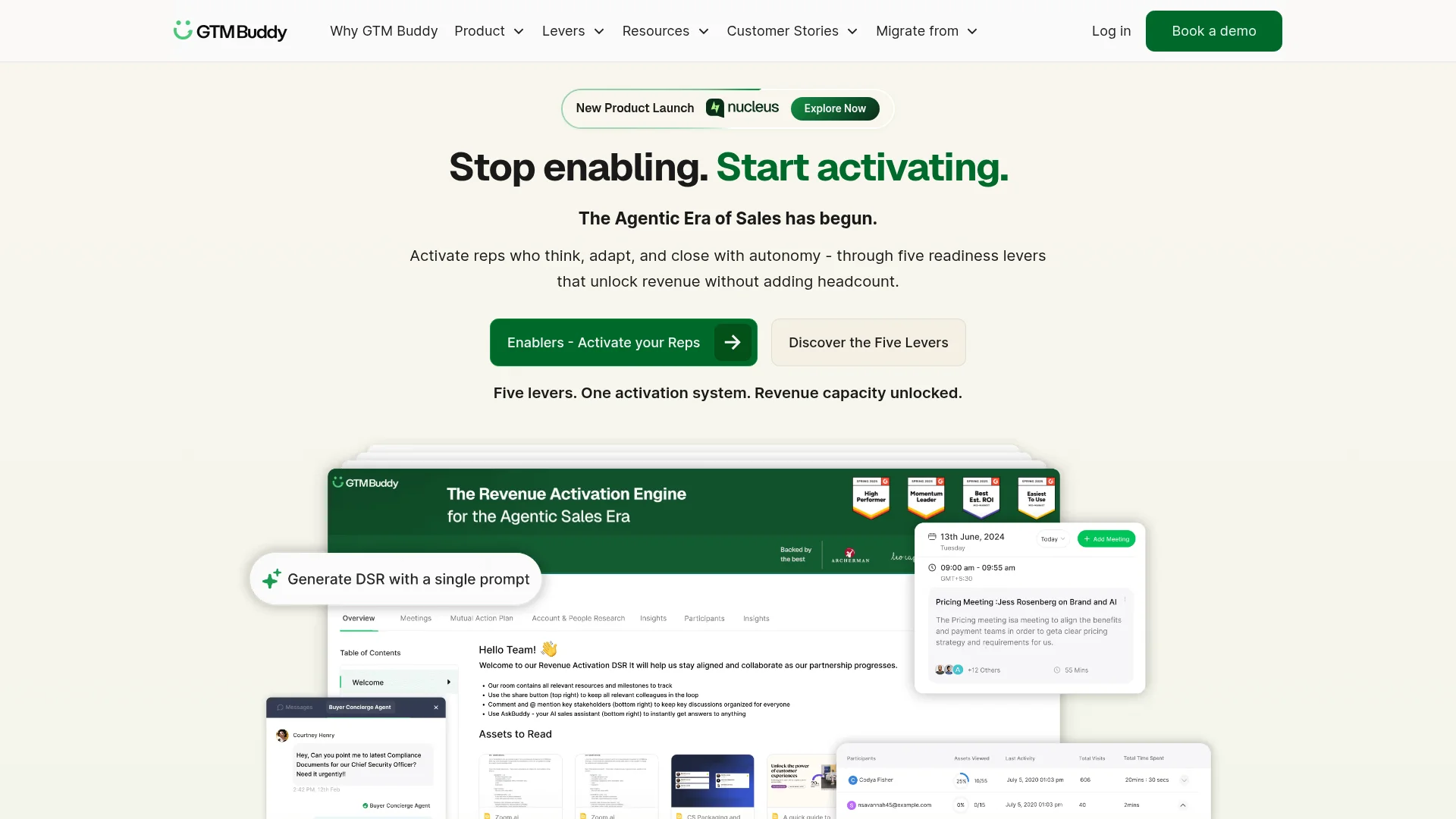
| What They Do | GTM Buddy is an AI-powered revenue enablement platform that delivers just-in-time content, coaching, and deal guidance to B2B sales reps inside their existing workflows. It positions itself as a revenue activation engine for the agentic sales era, spanning content management, digital sales rooms, AI role plays, an AI copilot (Ask Buddy), RFP automation, meeting prep, an LMS, and partner portals. Named customers include MoEngage, LeanData, Bizzabo, Replicant, CyberCube, and Darwinbox. |
| Funding | $10M raised total; last round Series A (April 2024, $8M, led by Archerman Capital with Leo Capital, Stellaris Venture Partners, and Neon Fund) |
| Headcount | 11-50 (LinkedIn band) |
| Monthly Organic Visits | Traffic Value (PPC equiv.) | Ranking Positions |
|---|---|---|
| 0.5K | $5,849 | 98 |
Ranking positions reflect total positions across 10 indexed (location, language) combinations, not unique keywords.
GTM Buddy's content operation is small and editorial-heavy. 137 indexable pages, 79 of which (57.7%) are blog or editorial content. The architecture concentrates on a manifesto-style narrative argument (46 URLs framing the move from "sales enablement" to "revenue activation"), supplemented by tactical editorial content, a small case-study library, and 9 head-to-head competitor migration pages. There is no podcast, no first-party research franchise, and only one glossary URL. These are structural gaps that are normal for a Series A company at this stage but worth flagging against category peers.
The company sits in an interesting strategic position relative to the rest of the sales enablement category. Allego, Bigtincan, Highspot, Mindtickle, Seismic, and Showpad each operate libraries an order of magnitude larger, with documentation surfaces, multi-year research franchises, recurring podcast or webinar cadence, and hundreds of named customer logos. GTM Buddy is competing against those incumbents with roughly 1/10th the content volume, no compounding formats, and a Series A balance sheet. What the library has instead is editorial coherence: a named framework (SCALE), a coined category vocabulary (revenue activation), a small but consistent set of named customer logos, and a head-to-head migration program aimed directly at the largest competitors. The bet is that argument density and explicit displacement framing can do work that broad SEO volume can't.
Content Architecture
What Does GTM Buddy's Content Engine Look Like?
GTM Buddy's main website hosts 137 indexable pages organized into a single broad topic cluster, subdivided into 5 topic clusters at the micro-topic level. The architecture is editorial-first and tactically focused: blog content dominates, and the cluster shape collapses to a single editorial library because none of the candidate sub-themes individually clears the 100-URL threshold that would justify standing as its own top-level cluster.
Content Type Distribution
| Content Type | Count | Share | Notes |
|---|---|---|---|
| Blog / Editorial | 79 | 57.7% | Dominant content type; the engine of the manifesto and playbook program |
| Other | 16 | 11.7% | Legal, careers, author archives, blog index, demo-booking, newsroom |
| Product & Feature Pages | 13 | 9.5% | One page per product module: Nucleus, Ask Buddy, AI Role Plays, DSR, CMS, LMS, etc. |
| Case Studies / Customer Stories | 10 | 7.3% | 8 named customers plus customers index and wall-of-love |
| Comparison Pages | 9 | 6.6% | Migration hub plus 8 head-to-head competitor pages |
| Free Tools | 4 | 2.9% | Revenue calculator, cost calculator, tools directory, jobs board |
| Guides & Resources | 4 | 2.9% | Long-form pillar pages classified as guides |
| Events / Webinars / Sessions | 1 | 0.7% | A single customer co-hosted webinar (Spectrio) |
| Glossary / Definitions | 1 | 0.7% | "The Definitive Glossary of Revenue Activation Terms" |
| Podcast / Audio Series | 0 | 0.0% | No podcast or audio-first content |
| Documentation | 0 | 0.0% | No public docs in main sitemap |
| Research / Reports | 0 | 0.0% | No first-party research franchise |
Key finding: Blog/Editorial is 57.7% of every page GTM Buddy publishes, the highest editorial share of any peer in the sales enablement category. The absence of any Research/Reports URL and any Podcast URL is the more telling architectural choice. GTM Buddy is competing in a category where Highspot (198 reports, 208 podcast episodes), Seismic (281 reports), and Dock (514 podcast episodes) all run compounding multi-year franchises. GTM Buddy currently does not. The 13 Product & Feature Pages and 9 Comparison Pages are also notable: at 9.5% and 6.6% of the library respectively, both are several times the category-peer share, reflecting a deliberate concentration of authority budget on the conversion-stage surfaces a Series A company most needs to convert intent-heavy traffic into pipeline.
Content Strategy Archetype
GTM Buddy operates an editorial-led, manifesto-first single-cluster library. The primary content asset is a 46-URL Revenue Activation editorial program (pillar pages plus essays) that argues for a category-level repositioning. Surrounding it sits a 37-post tactical playbooks strand (AI role play, DSR, sales enablement how-tos), a 24-URL company-and-comparison wrapper, 19 product and tools pages, and 11 customer stories. This shape is common among Series A companies trying to claim category vocabulary before competitors settle on it: invest editorial weight in the argument, defer compounding investments (podcast, research, glossary) until later rounds.
The shape also tells a stage story. A 137-URL library reflects a company that has prioritized voice over volume. The editorial program is dense enough to feel coherent on a single visit, but thin enough that the long tail of search demand goes uncaptured. Most of GTM Buddy's pages are between six months and two years old; few have had time to accumulate the backlink authority that would lift them from positions 21-100 into the top 10. The architecture rewards readers who arrive at a manifesto or pillar page and stay for an hour, less so readers who arrive from a specific long-tail query and want a definitive answer. That trade-off is intentional, but it caps the per-URL traffic ceiling until either the editorial program earns broader citation or the company invests in a compounding format (research, podcast, or a comprehensive glossary) that scales beyond essay cadence alone.
Search Performance Quality
Where GTM Buddy Ranks
The DataForSEO domain rank overview shows GTM Buddy ranking in 98 positions across 10 indexed locale combinations. The distribution is bottom-heavy: most ranking positions sit deep in the SERP rather than on the first page.
| Position | Count | Share |
|---|---|---|
| #1 | 4 | 4.1% |
| #2–3 | 3 | 3.1% |
| #4–10 | 10 | 10.2% |
| #11–20 | 18 | 18.4% |
| #21–50 | 43 | 43.9% |
| #51–100 | 20 | 20.4% |
17.4% of GTM Buddy's ranking positions are in the top 10, meaningfully lower than category leader Highspot at 55.7% and similar to Dock at 17.4%. Another 18.4% of positions sit in the 11-20 range, the most actionable optimization slot. Roughly two-thirds of ranking positions are in spots 21-100, indicating a library that's been indexed but hasn't yet earned the authority signals to compete at the top of the page.
Per-URL traffic efficiency is low at roughly 4 visits per page across 137 URLs (~512 monthly visits). For context, Dock reaches 37 visits per URL and Trainual 34. Both run libraries an order of magnitude larger with proportionally more compounding traffic. GTM Buddy's content is recent and argument-led; per-page authority typically lags publication date by 6-18 months as backlinks accumulate.
The 17.4% top-10 share is a more interesting signal than the absolute visit number. It means roughly one in six ranking positions is already on the first page, even though the library has had relatively little time to accumulate authority. That ratio is similar to Dock at the same stage and suggests the editorial program is producing pages search engines consider relevant; what's missing is the link velocity and brand-citation volume that would push them from rank 4-10 into rank 1-3 where the bulk of click-through happens. The standard playbook to lift that ratio is some combination of recurring digital PR moments (an annual report or original survey is the cleanest), guest writing in target newsletters and analyst publications, and a deliberate refresh program on the 18 pages currently sitting in positions 11-20.
Content Deep Dive
What Is GTM Buddy Actually Publishing, and How?
GTM Buddy's content sits inside a single primary topic cluster that holds the full 137-URL surface. The cluster is broken into five micro-topics that describe what's actually on the site: a manifesto-led thought-leadership program, a tactical playbooks strand, the product and tools pages, the customer stories library, and a wrapper of competitor migration pages plus company and legal pages. The single-cluster shape reflects the library's size. None of the sub-themes individually clear the 100-URL bar to stand as their own top-level cluster, but each micro-topic carries its own editorial logic and conversion role.
That shape has a practical consequence for how the library reads. A larger peer like Highspot or Seismic supports a content team that can run five or six parallel topic surfaces (sales enablement strategy, sales coaching, content management, sales performance, customer success, market research) each as its own franchise with hundreds of pages. GTM Buddy can't. The discipline forced by the small library is editorial focus: every URL has to either advance the activation argument, capture a specific tactical search, prove the product works, or move a prospect toward migration. There's no room for orphan content or experimental side surfaces. Looking at the five micro-topics below in order, you can see how each one is doing a different job in that compressed system.
1. GTM Buddy Content Library
Pages: 137 · Share of library: 100.0%
The full public content surface from gtmbuddy.ai. Five micro-topics organize the cluster: pillar essays and market commentary that argue for revenue activation as the successor to sales enablement; practitioner playbooks on AI role play, digital sales rooms, RFP responses, and sales methodology; product module pages and the calculators, glossary, and jobs board that round out the conversion-stage surface; named customer case studies and testimonial pages; and the competitor migration set alongside newsroom, legal, careers, and author pages.
Content-type mix: Blog/Editorial 58% · Other 12% · Product & Feature Pages 10% · Case Studies 7% · Comparison Pages 7% · Free Tools 3% · Guides & Resources 3% · Webinars 1% · Glossary 1%
Micro-topics within this cluster
Revenue Activation & Agentic Sales Editorial (~46 Pages)
GTM Buddy's flagship editorial program. Pillar pages and long-form essays framing the move from legacy sales enablement to "revenue activation" in the agentic AI era, plus market commentary on the Highspot-Seismic merger and the economics of activation. The four named-framework pillars sit at the root rather than at /blog/, which signals they are intended as canonical references rather than dated posts. Naming a framework (SCALE) is the most defensible category-creation move available to a Series A company. Every competitor that adopts the vocabulary reinforces the original author's authority on the concept. The supporting essays carry a recognizable "44-person company" signature written from the founder's seat about building an AI-native organization at the company's actual headcount, which gives the cluster a founder-blog texture that's hard for larger competitors to manufacture.
Sample pages:
- The Revenue Activation Manifesto | A New Frame for GTM
/why-gtmbuddy - The Agentic Persona Model (SCALE) | Beyond Job Titles
/agentic-persona-model - Revenue Activation: The 5 Levers to Unlock Sales Capacity
/revenue-activation - Top Rep Replication vs Activation: What Scales?
/top-rep-replication-vs-activation
Sales Execution Playbooks & Tactics (~37 Pages)
Practitioner-facing how-to and use-case posts on digital sales rooms, AI role play, RFP responses, battle cards, mutual action plans, sales methodology, meeting prep, sales kickoffs, and onboarding for new enablement hires. Tactical content that captures bottom-funnel "how do I do X" intent. "How to create a sales deck" and "mutual action plans" are durable head terms that compound over time even without major linkbuilding investment, and the heavy concentration of AI role play posts (roughly a dozen pieces in this micro) treats an emerging format as its own content category to claim the search surface before competitors settle on canonical terminology. The strong evergreen search intent on these posts is what makes them the SEO floor of the library. The cluster also doubles as audience-of-one content for the first sales enablement hire at a growing SaaS company: the 90-day-onboarding guide, the SKO checklist, and the "top influencers to follow" post all map cleanly to a single high-intent buyer persona moving through their first quarter in the seat.
Sample pages:
- New Sales Enabler? Master Your First 90 Days [Free Actionable Template]
/blog/90-days-guide-for-a-new-sales-enabler - Adaptive Competitive Intelligence Is Replacing Static Battle Cards
/blog/adaptive-competitive-intelligence-rethinking-battle-cards - Crafting Mutual Action Plans to Streamline Complex B2B Sales
/blog/how-to-create-mutual-action-plans-to-streamline-b2b-sales - The 5 Must-Have AI Role Play Features Buyers Need in 2025
/blog/ai-role-play-features-buyers-framework
Product, Platform & Free Tools (~19 Pages)
One page per product module: Nucleus, Ask Buddy, AI Role Plays, Digital Sales Room, CMS, LMS, Content Analytics, Meeting Prep, RFP Automation, Partner Portal. The product surface is unusually broad for an 11-50 person company. Each module gets its own URL with a discrete capability story, signalling a platform-rather-than-point-tool positioning. The naming pattern leads with the named asset ("Ask Buddy," "Nucleus") rather than the generic capability, which makes the URLs brand-defensible but harder to rank for the unbranded capability search. Alongside the product modules sit the implementation and integrations pages, the revenue and cost calculators (both tied to manifesto vocabulary rather than generic ROI naming), the revenue activation glossary, a sales tools directory, the jobs board, and the demo page titled "Diagnose Your Activation Gap" rather than the generic "Book a Demo." Every standalone resource in the micro ties its name back to the editorial program rather than to a generic capability label, which keeps the activation vocabulary visible at the moments a prospect is most likely to be evaluating or sharing.
Sample pages:
- Revenue Activation Engine for Agentic Sales | GTM Buddy
/ - Calculate Your Revenue Capacity Gap | GTM Buddy
/cost-calculator - Book a Demo | Diagnose Your Activation Gap with GTM Buddy
/book-a-demo - The Ultimate Sales Tools Directory for 2025
/b2b-sales-tools-directory
Customer Stories & Testimonials (~11 Pages)
Individual case study pages for MoEngage, Darwinbox, CyberCube, Replicant, Bizzabo, LeanData, Keelvar, and an anonymous cybersecurity firm, plus the customers index, wall-of-love testimonials, and a Spectrio co-hosted webinar. The customer mix skews toward Indian-headquartered SaaS (MoEngage, Darwinbox) and US mid-market tech, matching where the founding team's network and early sales motion are densest. Titling is descriptive rather than outcome-led ("Cybercube Customer Story" rather than "Cybercube Increased Win Rate 30%"), which leaves headline numbers in the body rather than the URL. A stylistic choice that trades scannable outcome-filtering for a softer narrative tone, but for a company that uses competitor displacement as a content lever, the case-study library is the single most credible counter-argument against the rip-and-replace risk a Highspot or Seismic customer fears. The Spectrio co-hosted webinar slotted into this micro rather than into its own webinar surface is a deliberate choice that treats the session as customer proof first, format second.
Sample pages:
- Real-World Wins: GTM Buddy Customer Success Stories
/customers - Learn How Bizzabo Cuts Content Chaos with AI-Driven Enablement
/customers/bizzabo - Cybercube Customer Story | GTM Buddy
/customers/cybercube - Customer Testimonials – Wall of Love | GTM Buddy
/wall-of-love
Competitor Migration, Newsroom & Company (~24 Pages)
Head-to-head competitor migration pages for Spekit, Paperflite, Highspot, Seismic, Showpad/Bigtincan, Letter.AI, Trumpet, and Hyperbound under the /migrate-from-legacy-enablement-platforms/ subtree, plus the migration hub, the newsroom and three press releases, the careers page, blog index, three author archive stubs, and the standard B2B SaaS legal footprint (privacy, terms, DPA, Google API user-data policy, AWS Marketplace request). The URL path itself ("/migrate-from-legacy-enablement-platforms/") frames the comparison pages as migration destinations rather than neutral comparisons, which is more aggressive than the category norm. Most peers run "X vs Y" pages, not "migrate from X" pages. The title formula ("Highspot Alternative for 2026: From Storage to Activation") consistently leads with the manifesto vocabulary, tying every comparison page back to the editorial program. The three author archives currently render with the placeholder title "GTM Buddy - 2026," sitemap residue worth cleaning. The competitor set chosen for the program (legacy enablement platforms, the merged Showpad/Bigtincan, two AI-native portal startups, and Hyperbound on the AI role play side) maps the displacement narrative across both the incumbents GTM Buddy wants to replace and the emerging competitors trying to win adjacent budget.
Sample pages:
- Stop Being Held Hostage by Legacy Sales Tech | Migrate to GTM Buddy
/migrate-from-legacy-enablement-platforms - Highspot Alternative for 2026: From Storage to Activation
/migrate-from-legacy-enablement-platforms/highspot-alternatives-competitors - Showpad vs GTM Buddy | Consolidation Is Not Activation
/migrate-from-legacy-enablement-platforms/bigtincan-showpad-alternatives-competitors - GTM Buddy Raises $8 Million Series A to Fix "Leaky" B2B Sales Funnels
/company/newsroom/gtm-buddy-raises-8-million-series-a-to-fix-leaky-b2b-sales-funnels
Strategy insight: The five micro-topics work as a coherent system because each plays a different role in the funnel and they share the same vocabulary. The Revenue Activation editorial program defines the category. The playbooks strand captures tactical search intent and feeds early-stage research traffic. The product pages and calculators carry the conversion-stage messaging. The case studies provide proof. The migration set turns the editorial argument into commercial pressure on incumbent vendors. Combined with the 8 dedicated competitor migration pages plus the in-blog "is X bad for sales enablement" essays (SharePoint, Google Drive, content-heavy enablement), GTM Buddy is running a roughly 15-URL displacement program against named competitors. That's disproportionately heavy for a 137-page site, and it's the single most visible commercial bet in the library. The risk: with only 4 visits per URL across the site, each comparison page is currently a low-traffic asset; the strategic bet is that they convert intent-heavy traffic rather than capture broad search volume. The thin Customer Stories micro (11 URLs) is the immediate gap to close if the displacement program is going to scale. The other obvious investment, based on how the rest of the category competes, is a single recurring research asset (an annual State of Revenue Activation report would be the natural fit) that gives the editorial program a backbone competitors couldn't quickly replicate and earns the kind of year-over-year backlink accumulation that turns 4 visits per page into 15.
Key Observations
What Stands Out About GTM Buddy's Content Strategy
Eight observations stand out from the data: an unusual editorial concentration, a coherent manifesto program, an aggressive competitor displacement strategy, low per-URL traffic efficiency, a deliberate AI role play land grab, two structural format gaps, a thin customer-proof shelf, and a single-cluster library shape that reflects the company's stage.
The library is editorial-led at 58% blog/editorial, the highest editorial share among sales enablement peers
79 of 137 URLs are blog or editorial content, the highest editorial share in the category against peers running 19% (Dock) to 58% (Mindtickle). This is a Series A company treating the content surface as a publication for buyers and operators, not a documentation or asset repository. The downside of the share is the absence of any compounding format. No podcast (0 versus 514 at Dock), no research reports (0 versus 281 at Seismic), no documentation. Every editorial URL has to earn its own authority without a recurring asset behind it, which puts the entire growth burden on essay cadence and individual-post quality rather than on a topic cluster strategy that compounds across years. The choice is also visible in voice: the editorial program reads like a publication with a distinctive house style (the "44-person company" framing, the activation vocabulary, the Highspot-Seismic merger commentary cadence) rather than like a templated content marketing operation. That voice is the library's biggest defensive moat, and it's also why a Highspot or Seismic content team can't easily clone the program even though they have ten times the page budget to throw at it.
A 46-URL Revenue Activation editorial program is the strategic spine of the library
The Revenue Activation micro-topic (4 pillar pages plus 42 essays, 33.6% of the library) is unusually coherent for a Series A company. Most companies this size publish manifesto posts as one-offs; GTM Buddy structures them as a program with anchor pillars (the SCALE persona model, the 5 levers, the Manifesto, top-rep replication versus activation) and supporting essays around them. The vocabulary-level reframing of "revenue activation" as the successor to "sales enablement" is the most defensible category-creation move available to a company this size, because every competitor that adopts the term reinforces the original author's authority on it. The shape mirrors how analyst firms build category-defining bodies of work: a small set of named frameworks at the top, a wider essay layer that applies them to specific decisions, and a steady cadence of market commentary that ties the framework to current events (the Highspot-Seismic merger coverage being the clearest example). The structural fragility is that there's no recurring asset (research, podcast) compounding behind the editorial program, so the entire spine rises and falls on essay cadence and individual-post quality.
Competitor displacement is a roughly 15-URL program disguised across two parts of the library
9 dedicated competitor migration pages (6.6% of the library, proportionally 4-10x the comparison-page share at category peers) plus several editorial posts arguing against legacy stacks (SharePoint, Google Drive, content-heavy enablement) add up to a coherent displacement program targeting Highspot, Seismic, Showpad, Bigtincan, Letter.AI, Spekit, Paperflite, Trumpet, and Hyperbound. The URL framing ("/migrate-from-legacy-enablement-platforms/") is more aggressive than the category norm of "X vs Y", which signals explicit migration framing rather than neutral comparison. A high-conviction commercial bet for a small library, and one that depends on the customer-stories shelf carrying the rip-and-replace credibility load. The titling formula is also disciplined: each competitor page leads with the manifesto vocabulary ("Highspot Alternative for 2026: From Storage to Activation", "Hyperbound Alternative for 2026: Solve the Knowing-Doing Gap"), which ties the comparison surface back to the editorial program rather than letting it function as standalone bottom-of-funnel content. That consistency is what makes the displacement program look like a deliberate strategy rather than nine one-off comparison pages bolted onto a blog. The question for the next twelve months is whether the same logic gets extended to a "vs Hyperbound for AI role play" or "vs Dock for digital sales rooms" set as the underlying product categories converge.
Per-URL traffic efficiency is low at ~4 visits per page
512 monthly visits across 137 URLs lands GTM Buddy at the bottom of the category on traffic efficiency. Dock reaches 37 visits per URL on a 1,203-page library; Trainual 34 on 2,414 pages; Highspot 18 on 4,752 pages. The low efficiency is partially explained by stage. Most content is recent and hasn't yet accumulated backlink authority. It's also partially explained by the manifesto-led editorial choice, which targets a small high-conviction audience rather than broad search volume. The 18 ranking positions in the 11-20 range are the most actionable optimization slot to push into top-10, and an honest content audit of those pages would likely surface a small set of quick wins. The harder question is what to do about the 43 positions in spots 21-50. Those pages are ranked but not pulling their weight on traffic; refreshing each one for E-E-A-T signals, expanding the body where the SERP rewards depth, and adding internal links from the manifesto pillars would be the standard playbook to move them up. Without that work, the per-URL number stays low because growth in content volume is outpacing growth in per-page authority.
AI Role Play is being treated as a dedicated content sub-category, not just product messaging
Roughly a dozen URLs on AI role play sit inside the playbooks micro-topic, which is a deliberate land-grab on an emerging format where category vocabulary isn't settled. Competitors in the AI role-play space (Hyperbound, Second Nature, Quantified) are also publishing in the space, and the early mover that establishes the canonical "AI role play scenarios," "AI role play features," "AI role play implementation" search surface earns the long-tail compounding traffic. The thin foundational explainer set (only two "what is AI role play" style pieces) is the gap to close if the goal is to win AEO citations for top-of-funnel definitional queries. If the AI role play strand continues to grow at the current cadence, it will cross the 100-URL threshold within the next year and could be promoted out of the shared playbooks micro into a dedicated cluster of its own, with sub-themes for use cases, implementation, scoring, and coaching dashboards. That promotion would be a useful signal that GTM Buddy is broadening from "we sell a role play module" to "we run the canonical resource for the AI role play category."
No first-party research franchise and no podcast (two structural gaps competitors exploit)
Zero Research/Reports URLs and zero Podcast/Audio Series URLs in a category where Highspot anchors its strategy cluster around the State of Sales Enablement report and Dock built its library around the Grow & Tell Podcast (514 episodes, 42.7% of its library). Both formats compound: a recurring annual report earns backlinks year over year and gives an editorial calendar a backbone; a podcast builds long-tail editorial volume and a guest-alumni network. For a company positioned as a category-shaping voice, the absence is the natural next investment. The same gap shows up in the glossary count: a single "Definitive Glossary of Revenue Activation Terms" URL versus 492 at Seismic, 1,223 at Guru, and 45 at Mindtickle. The one-URL choice likely contains many definitions but loses the per-term AEO surface that one-URL-per-term competitors capture, which matters more every quarter as generative search assistants shift from blue-link aggregation to per-term citation.
Customer-proof library is small at 10 case studies (material relative to the displacement strategy)
10 named case studies (MoEngage, Darwinbox, CyberCube, Replicant, Bizzabo, LeanData, Keelvar, plus an anonymous cybersecurity firm) is at the bottom of the category. Highspot has 338, Showpad 61, Allego 17. For a company running a displacement program against Highspot, Seismic, and Showpad, the case-study library is the single most credible counter-argument to the rip-and-replace risk every prospective migrator weighs. Expanding to 20-30 named cases, especially from named-customer migrations, would materially strengthen the displacement program's conversion math. The titling style is also worth a second look. Most current case-study URLs use descriptive titles ("Cybercube Customer Story") rather than outcome-led titles ("Cybercube Cut Sales Cycle 40% with GTM Buddy"). Outcome-led titles travel further in social and analyst commentary because the headline number is the share-worthy element. A small refactor of the existing 10 cases plus deliberate outcome-led drafting on every new addition would compound over time as backlinks, citations, and analyst quotes start pulling those headline numbers into wider commentary.
The library architecture concentrates into a single cluster shape
The 137-URL library is small enough that, under a strict 100-URL-per-cluster floor, the whole site sits inside one cluster with five micro-topics underneath. The shape reflects the library's stage rather than a strategic choice. A 137-page site can't support six independent clusters and still have each one meet a reasonable depth threshold. The practical implication for GTM Buddy is that the topical surface is concentrated rather than diversified; for an internal linking program, that concentration is an advantage because there are no sub-clusters competing for the same authority signals, but it also means there's no second narrative shelf that can stand alongside the activation editorial when the manifesto thesis loses novelty. A reasonable two-year roadmap would be to grow the library to 300-500 URLs in three or four distinct sub-clusters, each anchored by a flagship asset of its own (the SCALE persona model for the activation cluster, an annual State of Revenue Activation report for the research cluster, a Grow-and-Tell-style podcast for an interview cluster, and a dedicated AI role play cluster pulled out of the playbooks strand once it has 100+ URLs). That path is the standard growth shape for a Series A enablement company moving toward Series B scale.
More analyses in Sales Enablement
Highspot
How Highspot uses 2,530 blog posts, a 208-episode podcast, and 338 case studies to drive 86K monthly visits in sales enablement. 4,752 pages, 7 clusters.
Mindtickle
How Mindtickle uses 457 blog posts and a 102-URL AI Role Play franchise to drive 15K monthly visits in sales enablement. 787 pages, 6 clusters.
SalesHood
How SalesHood uses 176 blog posts, 100 webinars, and a cross-format MEDDICC franchise to drive 3K monthly visits in sales enablement. 440 pages, 3 clusters.
Seismic
How Seismic uses 1,483 blog posts, a 492-term glossary, and 281 research reports to drive 76K monthly visits in sales enablement. 3,954 pages, 10 clusters.
Methodology: This analysis is based on GTM Buddy's full public sitemap (137 URLs, sourced from robots.txt), enriched with each URL's title and meta description. URLs were classified into a 12-bucket content type taxonomy and grouped into 1 topic cluster with 5 micro-topics using LLM-assisted classification, with cluster boundaries set by a 100-URL minimum that the library could only satisfy at the single-cluster level. The micro-topics inside the cluster each carry at least 10 URLs and describe a distinct subject-matter strand inside the library. Company facts came from public web research across Crunchbase, LinkedIn, and the company's own About and blog pages. Traffic metrics (monthly organic visits, traffic value, ranking positions, position distribution) came from DataForSEO's domain rank overview, aggregated globally across 10 locale combinations. The position-distribution analysis treats each (location, language) ranking as a distinct position rather than deduplicating to unique keywords, which means the 98 ranking positions number is a footprint measure rather than a unique-keyword count. All counts reflect the GTM Buddy sitemap as of 2026-05-22.