

Summary
Sprout Social drives 2,187,389 monthly organic visits from a 2,155-page library organized into 9 topic clusters and 30 micro-topics. The architecture is editorial-led and franchise-concentrated. The Sprout Insights Blog, split across four thematic clusters, accounts for 1,431 URLs or 66% of every page Sprout publishes, anchored by the annual Sprout Social Index research franchise. Per-URL traffic efficiency is high at ~1,015 visits per page, the highest among editorially-led peers in social media management and roughly 30% above Buffer (824) and Hootsuite (776). The library runs on a single English locale, which makes the per-URL economics directly comparable to peers without locale inflation.
Key facts:
- Library size: 2,155 indexable pages organized into 9 topic clusters; 70.5% Blog / Editorial
- Largest cluster: Insights Blog: Industry, Culture & General Trends (512 URLs, 23.8% of library)
- Flagship content asset: Sprout Social Index, the annual flagship research franchise (now at Edition XX with the 2025 release), sitting inside a 195-URL Webinars, Customer Stories & Research cluster that includes vertical benchmark and consumer-and-executive research
- Search performance: 2.2M monthly visits across 84.3K ranking positions; 23.4% in top 10; ~1,015 visits per page
- Notable gap: Only 1 comparison page across the entire 2,155-URL library, a modest defensive footprint for a brand other vendors target heavily in alternatives queries
Company Overview
Sprout Social at a Glance
| Company | Sprout Social, Inc. |
| Founded | 2010 · Chicago, IL, USA |
| Category | Social Media Management / Social Intelligence |
| What They Do | Sprout Social is a social media management and intelligence platform that consolidates publishing, engagement, customer care, analytics, employee advocacy, and influencer marketing for enterprise and mid-market brands. The audience spans marketing, customer care, and communications teams managing multi-network social presence, with named customers including Shopify, Grammarly, Subaru, NBCUniversal, Glassdoor, and Trek Bicycles. |
| Funding | $261.5M raised; last round IPO (Dec 2019, $150M priced at $17/share on NASDAQ:SPT). Investors included Lightbank, New Enterprise Associates, Goldman Sachs, and Future Fund. FY2024 revenue: $405.9M, 22% YoY growth. |
| Headcount | 1,000–1,500 (Macrotrends estimate) |
| Monthly Organic Visits | Traffic Value (PPC equiv.) | Ranking Positions |
|---|---|---|
| 2.2M | $5.83M | 84.3K |
Ranking positions reflect total positions across 117 indexed (location, language) combinations, not unique keywords. A keyword ranking in multiple locales is counted multiple times.
Sprout's content operation is dense and editorially concentrated: 2,155 indexable pages on a single English locale, of which 70.5% are Blog / Editorial. The bulk of the library lives under one path. 1,934 of the 2,155 URLs sit beneath /insights/. That makes the Sprout Insights Blog the structural anchor of the entire content engine, supported by a 127-URL guides-and-templates library, a 112-entry glossary, a 24-episode Social Creatures podcast, and the multi-year Sprout Social Index research franchise.
Content Architecture
What Does Sprout Social's Content Engine Look Like?
Sprout Social's main website hosts 2,155 indexable pages organized into 9 topic clusters. The architecture is built around a long-running editorial blog feeding a downloadable resource library, with a research franchise as the anchor authority asset.
Content Type Distribution
| Content Type | Count | Share | Notes |
|---|---|---|---|
| Blog / Editorial | 1,519 | 70.5% | Dominant type; concentrated in the four Insights Blog clusters |
| Other | 113 | 5.2% | Mostly author profile pages and standard utility |
| Glossary / Definitions | 112 | 5.2% | Dedicated /glossary/ section, unusually deep for an SMM vendor |
| Events / Webinars / Sessions | 98 | 4.6% | Sprout Sessions plus on-demand strategy and tactical webinars |
| Free Tools | 80 | 3.7% | Templates, worksheets, calculators, and visual asset packs |
| Case Studies / Customer Stories | 58 | 2.7% | Named brand, higher ed, and public-sector cases under /insights/case-studies/ |
| Product & Feature Pages | 56 | 2.6% | Feature pages, integrations, audience and industry pages |
| Guides & Resources | 55 | 2.6% | Long-form strategic guides at /insights/guides/ |
| Research / Reports | 39 | 1.8% | Sprout Social Index plus vertical and consumer benchmarks |
| Podcast / Audio Series | 24 | 1.1% | Social Creatures podcast episodes |
| Comparison Pages | 1 | 0.05% | Single canonical comparison surface, an extremely light footprint |
| Documentation | 0 | 0.0% | Not present in the www sitemap |
Key finding: Blog / Editorial accounts for 70.5% of every page Sprout publishes, even higher than typical editorially-led peers in this category. The architecture is built for marketing and customer care practitioners researching how to operate on social, not for technical buyers or developers. The 112-entry glossary is the standout structural choice: most SMM vendors treat definitional content as a few /resources/ stubs, while Sprout has built it into a dedicated path with its own URL prefix and its own sub-formats (per-language sentiment analysis pages, per-platform feature definitions).
Content Strategy Archetype
Sprout Social operates an editorial-led, franchise-concentrated practitioner authority model. The primary content asset is the Sprout Insights Blog, split across four thematic clusters that together hold 1,431 long-form posts targeting marketers, customer care teams, and communications leads. Supporting assets cluster tightly around two compounding pillars: a downloadable resource library (127 URLs of guides and templates) and the annual Sprout Social Index research franchise. The top two clusters account for 42% of the library, which sits in a balanced range. Sprout has chosen to spread its editorial depth across thematic beats rather than crowd everything into one giant blog bucket, and the four-way blog split is the structural expression of that choice.
Search Performance Quality
Where Sprout Social Ranks
The DataForSEO domain rank overview shows Sprout Social ranking in 84,293 positions across 117 indexed (location, language) combinations. The distribution is broad-and-shallow: the long tail of positions in 21-100 is meaningfully larger than the top-10 share, reflecting a library big enough to surface widely but not concentrated enough to dominate page one.
| Position | Count | Share |
|---|---|---|
| #1 | 1,953 | 2.32% |
| #2–3 | 3,690 | 4.38% |
| #4–10 | 14,051 | 16.67% |
| #11–20 | 18,523 | 21.97% |
| #21–50 | 31,409 | 37.26% |
| #51–100 | 14,667 | 17.40% |
23.4% of Sprout Social's ranking positions are in the top 10, broadly in line with peers like Buffer (23.5%) and Hootsuite (22.3%) in the social media management category. The standout figure is the 11-20 band: 18,523 positions, nearly 22% of the library's ranking footprint, sit one page below where they need to be. That's the most actionable optimization slot in any rankings table. Content already on Google's second page that focused work could push into top-10 visibility.
Per-URL efficiency is the second story. At ~1,015 visits per page across the 2,155-URL library, Sprout produces more traffic per published URL than Buffer (824), Hootsuite (776), and Brandwatch (76), the largest editorial-blog-led players in the category. Only Later (2,269) beats it, and Later runs a leaner, more Instagram-concentrated library. Visits-per-URL at this scale signals that Sprout's per-page bar is high. The library size hasn't outrun the quality bar yet.
Content Deep Dive
What Is Sprout Social Actually Publishing, and How?
Sprout Social's content organizes around 9 primary topic clusters. Each cluster is described below with content-type composition, the micro-topics inside it, and concrete example URLs. Cluster and micro-topic groupings reflect a per-URL classification of the full sitemap. Counts are exact, not approximate.
1. Insights Blog: Industry, Culture & General Trends
Pages: 512 · Share of library: 23.8%
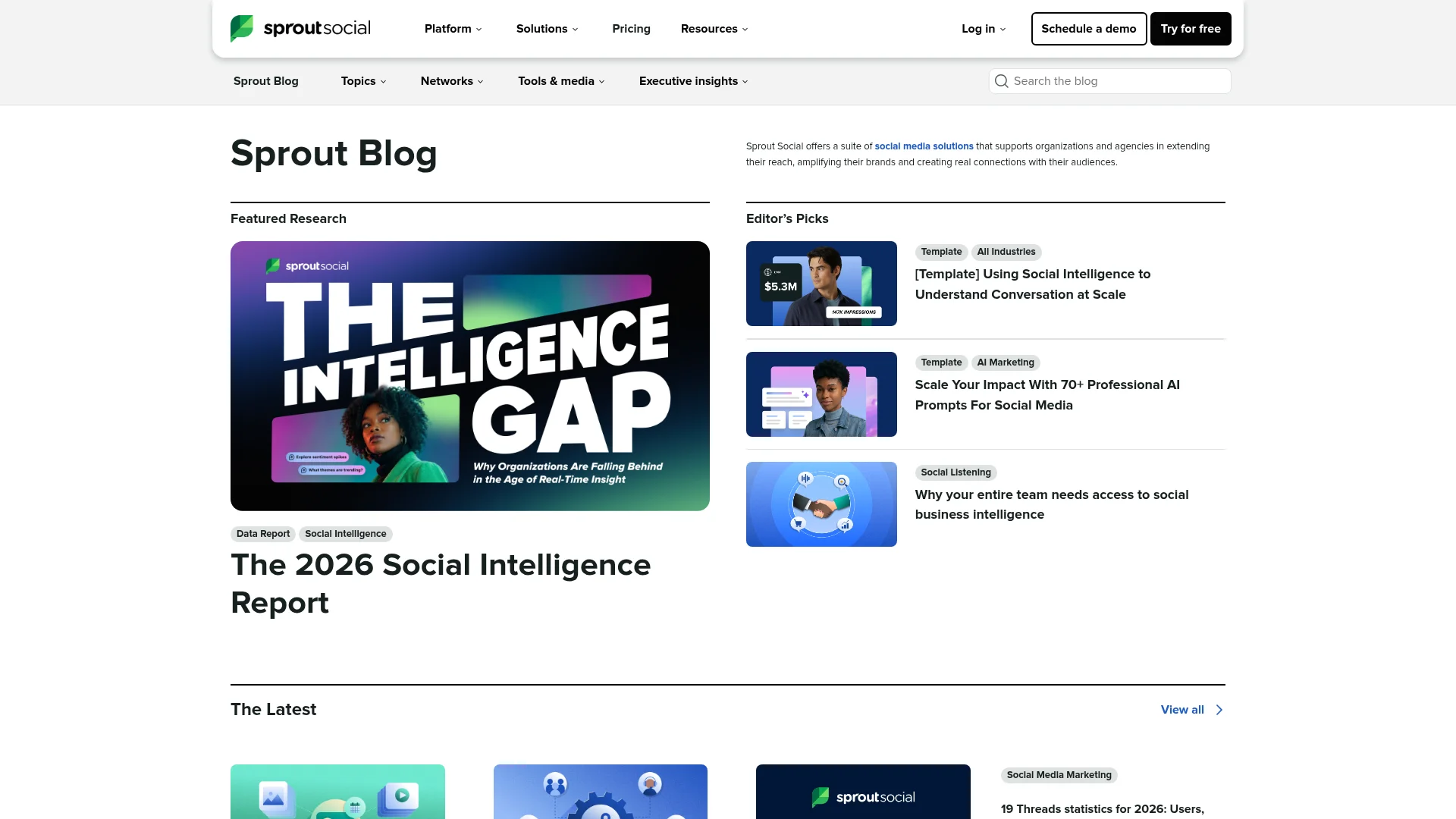
The connective tissue of the Sprout Insights blog. Cross-platform best-practice content, industry-cut playbooks that mirror Sprout's solutions pages, and the employer-brand thread typical of public-company blogs. This is the largest single cluster in the library, anchored by a deep bench of general-tactics posts that target top-of-funnel search demand without committing to a single network or theme. The cluster reads as the "everything else" workhorse of the blog, with two narrower sub-themes (vertical playbooks and culture) layered on top.
Content-type mix: Blog / Editorial 100%
Micro-topics within this cluster
General Tactics & Trends (~394 Pages)
The largest sub-theme by a wide margin. Broad how-tos, trend recaps, seasonal campaigns, holiday marketing, and best-practice posts that span multiple networks. Cross-platform content captures top-of-funnel "how to" and "social media trends" search intent without committing to a single network's vocabulary, and the volume here reflects how much of the blog leans on that pattern for SEO. The bucket size is also a tell about taxonomy drift: many of these posts could plausibly belong to one of the more focused clusters but ended up here because the topical taxonomy hasn't been refreshed at the rate the editorial calendar has moved.
Sample pages:
- Social Media Insights | Sprout Social
/insights/ - The CMO's Social Media Marketing Agenda for 2024 | Sprout Social
/insights/2024-cmo-social-media-marketing-agenda/ - AdWords Quality Score: What Marketers Need to Know | Sprout Social
/insights/adwords-quality-score/ - 13 Agorapulse Alternatives to Check Out in 2026 | Sprout Social
/insights/agorapulse-alternatives/
Industry & Vertical Playbooks (~74 Pages)
Vertical-specific social playbooks for healthcare, higher education, retail, financial services, government, and other industries. The footprint roughly mirrors Sprout's industry solutions pages (healthcare, higher ed, retail, public sector), which means vertical editorial content does the discovery work that funnels into the conversion-stage solution pages. Higher ed and the public sector are the two verticals that show up in both blog and case studies, a sign of where Sprout's commercial traction is most repeatable.
Sample pages:
- Advancing DEI through the Sprout Social UNCF Scholarship Program | Sprout Social
/insights/advancing-dei-through-the-sprout-social-uncf-scholarship-program/ - What is Affiliate Marketing? How Partnerships Drive Revenue | Sprout Social
/insights/affiliate-marketing/ - 7 Alumni Engagement Best Practices for Universities | Sprout Social
/insights/alumni-engagement-best-practices/ - B2B brand storytelling through thought leadership | Sprout Social
/insights/b2b-brand-storytelling/
Life at Sprout, Careers & Culture (~44 Pages)
Posts about Sprout team culture, careers, workplace awards, DE&I reports, and life at Sprout. A distinct internally-facing editorial thread, common for public companies that use blog real estate for employer branding and talent acquisition. The mix of award announcements ("Fortune Best Workplaces in Technology") and behind-the-scenes content treats employer brand as content infrastructure, not just HR collateral.
Sample pages:
- Sprout Social Named to 2023 Fortune Best Workplaces in Technology List
/insights/2023-fortune-best-workplaces-in-technology/ - Behind-the-Scenes Content: Examples and Why It Works | Sprout Social
/insights/behind-the-scenes-content/ - Sprout Named One of Chicago's Best Places to Work | Sprout Social
/insights/best-places-to-work-in-chicago/ - Sprout Social named a Chicago Tribune Top Workplace four years in a row | Sprout Social
/insights/chicago-tribune-top-workplace-2018/
Strategy insight: This cluster is the largest in the library because 77% of it (394 URLs) lives in the General Tactics & Trends micro-topic. That sub-theme functions as the broad surface that catches cross-platform search demand the more focused clusters can't claim. The size of that bucket is also a tell about taxonomy hygiene: the editorial calendar has accumulated faster than the topical taxonomy has stayed clean. A focused content audit could re-classify a substantial share of those URLs into the platform, strategy, or AI clusters, which would surface clearer authority signals to search engines without losing any of the underlying ranking equity.
2. Insights Blog: Strategy, Analytics & Listening
Pages: 389 · Share of library: 18.1%
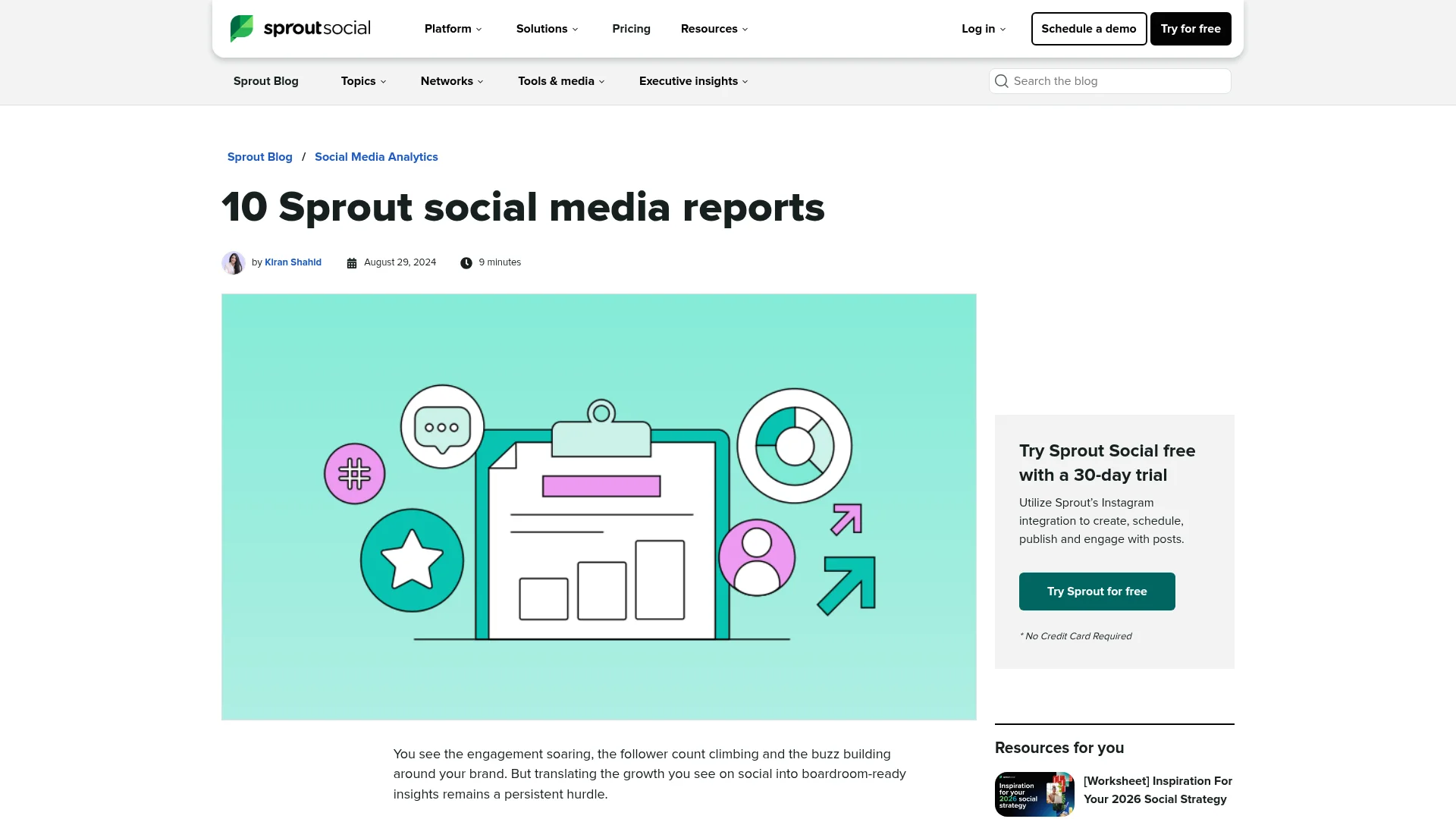
The strategic backbone of the blog. Editorial posts on how to plan, measure, listen, and respond on social. These four sub-themes map directly to the higher-ACV product surfaces Sprout sells into: the analytics suite, the listening and brand-intelligence stack, and the social customer care surface. Where the General Trends cluster captures broad top-of-funnel interest, this cluster builds editorial credibility on the topics that drive procurement conversations.
Content-type mix: Blog / Editorial 100%
Micro-topics within this cluster
Analytics, ROI & Measurement (~137 Pages)
Social media analytics, reporting, KPIs, attribution, executive-facing dashboards, and proving the value of social. This sub-theme maps tightly to Sprout's positioning as a measurement and intelligence platform, not just a publishing tool. The recurring theme of "how to measure," "how to report," and "how to prove ROI" speaks to enablement leaders and CMOs who need to justify social budgets internally. The strategic role is clear: this is the content that bridges practitioner readers to executive buyers when it's time for procurement.
Sample pages:
- 10 Sprout Social Media Reports | Sprout Social
/insights/10-sprout-social-media-reports/ - How to Measure (and Grow) Your B2B Social Media ROI | Sprout Social
/insights/b2b-social-media-roi/ - Brand Mentions: Guide for Tracking and Monitoring | Sprout Social
/insights/brand-mentions/ - A Marketer's Guide to Bluesky Social Analytics | Sprout Social
/insights/bluesky-social-analytics/
Strategy & Planning (~129 Pages)
Strategy frameworks, social media plans, goal setting, audits, content calendars, and brand voice on social. The conceptual layer beneath everything else: content for the marketer scoping a program before they start tactical work. Sprout's editorial cadence here mixes evergreen pillar pieces (audit playbooks, brand-voice frameworks) with seasonal refreshes (regional Black Friday strategies), the kind of mix that compounds back-link equity across years.
Sample pages:
- How Sprout Built A 10,000-Member Strong Community | Sprout Social
/insights/arboretum-membership-milestone/ - The Best Brands on Social Media | Sprout Social
/insights/best-brands-on-social-media/ - Black Friday Social Media Strategy UK | Sprout Social
/insights/black-friday-social-media-strategy-uk/ - How to Create Black Friday Social Media Campaigns | Sprout Social
/insights/black-friday-social-media-strategy/
Listening & Brand Intelligence (~63 Pages)
Social listening, sentiment analysis, brand monitoring, competitive intelligence, and consumer insights drawn from social conversation. The sub-theme connects directly to Sprout's listening product line (Premium Analytics, Tagger acquisition, Repustate sentiment work). The vocabulary of "brand health," "perception," and "monitoring" matches the language enterprise CMOs use when they evaluate intelligence tools rather than publishing tools, which makes this content the bridge to higher-ACV procurement conversations.
Sample pages:
- What Is Brand Health Tracking? A 2026 Guide | Sprout Social
/insights/brand-health-tracking/ - 8 Best Brand Monitoring Software to Grow your Brand in 2026 | Sprout Social
/insights/brand-monitoring-software/ - What is Brand Monitoring and Why Is It Important? [+ Tools] | Sprout Social
/insights/brand-monitoring/ - How to Audit Your Brand Perception with Social Data | Sprout Social
/insights/brand-perception/
Customer Care & Engagement (~60 Pages)
Social customer service, response time, community management, comment moderation, and engagement playbooks. The sub-theme lines up with Sprout's social customer care product positioning, and with the Salesforce partnership announcement on customer-care integration. Customer care is one of the few topics where buying conversations move from marketing budgets to customer-service budgets, which makes this content the cross-functional surface where two procurement paths overlap.
Sample pages:
- How Atlassian Uses Sprout to Enhance Social Media ROI | Sprout Social
/insights/atlassian-customer-story/ - How Customer Care Influences Brand Perception | Sprout Social
/insights/building-your-brand-through-customer-care/ - 9 Chatbot builders to enhance your customer support in 2026 | Sprout Social
/insights/chatbot-builder/ - Chatbot marketing: Drive engagement and growth | Sprout Social
/insights/chatbot-marketing/
Strategy insight: This is the cluster doing the most strategic work for the entire content engine. Its sub-themes map directly to the product surfaces with the highest ACV (analytics, listening, customer care), and the editorial vocabulary here reads as enterprise procurement language rather than practitioner how-to. The 137-URL analytics-and-ROI bucket is the standout. Most SMM peers run 30 to 60 ROI posts; Sprout has built more than twice that footprint, which is consistent with a company that needs editorial content to do the budget-justification work that the sales team would otherwise carry by itself.
3. Insights Blog: Platform Marketing
Pages: 313 · Share of library: 14.5%
The platform-cut slice of the Sprout Insights blog. Editorial coverage of marketing tactics on each major social network: Instagram, Facebook and Meta, TikTok and short-form video, X/Twitter, LinkedIn, YouTube, and the long tail of emerging networks. Each platform has enough dedicated posts to read as its own beat, and the platform-cut framing matches how social practitioners actually plan campaigns. Splitting by network rather than by parent company also lines up with the buyer query patterns that drive most platform-specific searches.
Content-type mix: Blog / Editorial 100%
Micro-topics within this cluster
X, LinkedIn, YouTube & Emerging Networks (~127 Pages)
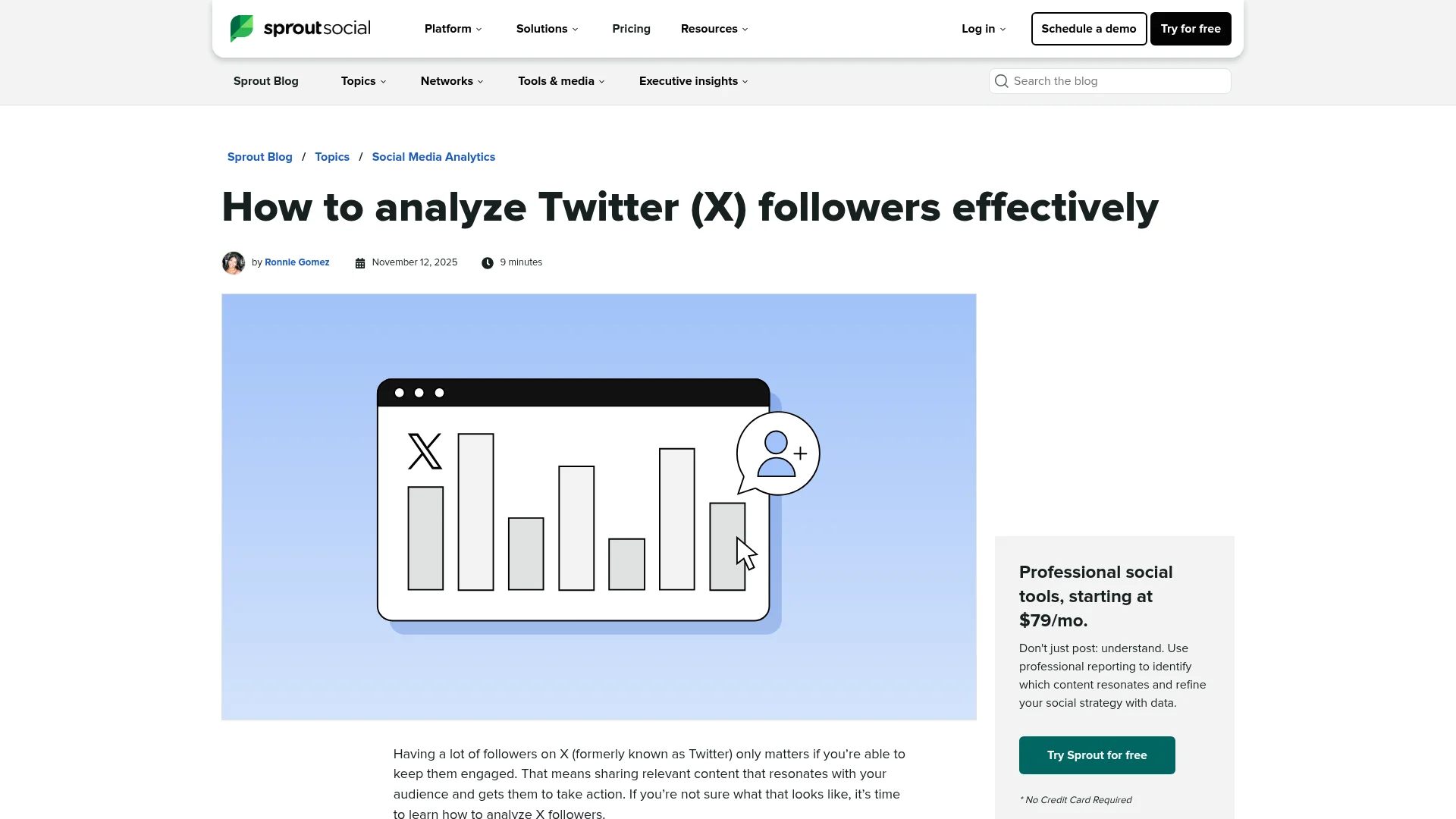
The combined coverage of every network outside Sprout's top three (Instagram, Facebook, TikTok). X/Twitter editorial threads outlasted the platform's ownership and naming changes, with the URL slugs preserving Twitter-keyword equity even as titles shifted to X branding. LinkedIn coverage exists to surface the platform without trying to outrank LinkedIn-native specialists in B2B-specific search. YouTube and long-form video run lighter than the short-form work despite YouTube being a larger platform overall, a likely tell about which network Sprout's audience asks about most. The emerging-networks coverage (Pinterest, Snapchat, Threads, Bluesky, Reddit, WhatsApp, BeReal, Mastodon) is selective and timely, with new networks appearing in the blog soon after they reach commercial momentum.
Sample pages:
- How to Analyze Twitter (X) Followers Effectively | Sprout Social
/insights/analyze-twitter-followers/ - Top 5 Benefits of a Pinterest Business Account | Sprout Social
/insights/benefits-of-pinterest/ - 4 Benefits of Twitter | Sprout Social
/insights/benefits-of-twitter/ - What's the Appeal of BeReal? | Sprout Social
/insights/bereal-social-media-authenticity/
Instagram Tactics (~96 Pages)
Instagram-specific posts covering features, formats, scheduling, growth, and brand presence on Instagram. Instagram is the single most-covered network on the blog, anchored by the "Best Times to Post on Instagram" pillar that consistently shows up as a high-volume evergreen ranker, with regional spin-offs (UK, Australia) extending the same template across English-speaking markets. The volume reflects which network Sprout's audience treats as primary: marketers running brand presence on Meta platforms.
Sample pages:
- Best Times to Post on Instagram in 2026 [Updated] | Sprout Social
/insights/best-times-to-post-on-instagram/ - Best times to post on social media in Australia [Updated March 2026] | Sprout Social
/insights/best-times-to-post-on-social-media-australia/ - Best times to post on social media in the UK [Updated March 2026] | Sprout Social
/insights/best-times-to-post-on-social-media-uk/ - 20 Business Instagram Ideas for Australian Brands | Sprout Social
/insights/business-instagram-ideas-australia/
Facebook & Meta Marketing (~46 Pages)
Facebook Pages, Meta Business Suite, Facebook Ads, Messenger, and Meta platform tactics. Distinct from the Instagram bucket despite the shared parent company. Sprout maintains separate editorial threads for each Meta property because the buyer query patterns differ. Facebook is more ad- and audience-targeting heavy; Instagram is more creative-and-format heavy. Splitting the coverage by network rather than by parent company lines up with how marketers actually plan campaigns.
Sample pages:
- Facebook Branded Content Tag | Sprout Social
/insights/add-branded-content-tag-verified-facebook-page-posts/ - Best Times to Post on Facebook in 2026 [Updated] | Sprout Social
/insights/best-times-to-post-on-facebook/ - Customer Zero: SOV [Facebook] | Sprout Social
/insights/customer-zero-sov-facebook/ - 12 Facebook ad examples and why they work | Sprout Social
/insights/facebook-ad-examples/
TikTok & Short-Form Video (~44 Pages)
TikTok playbooks, short-form video tactics, Reels, and creator-style content across short-form networks. The cluster has grown steadily as TikTok matured into a primary commercial network for consumer brands. The "Best Times to Post on TikTok" piece functions like the Instagram timing pillar: a search-intent magnet that compounds back-link equity across multiple years of refreshes.
Sample pages:
- Best Times to Post on TikTok in 2026 [Updated] | Sprout Social
/insights/best-times-to-post-on-tiktok/ - 6 Brands on TikTok to Invigorate your Strategy | Sprout Social
/insights/brands-on-tiktok/ - Health TikTok: How brands can be an ethical influence | Sprout Social
/insights/health-tiktok/ - How to Edit TikTok Videos: 20 Clever Tips
/insights/how-to-edit-tiktok-videos/
Strategy insight: The platform cluster's investment shape is telling. Instagram and TikTok together hold 140 URLs, more than the combined coverage of X, LinkedIn, YouTube, and every emerging network put together. That weighting maps cleanly to Sprout's audience: consumer-brand marketers running multi-network campaigns where Meta and short-form video are the primary commercial surfaces. The bundle of smaller networks isn't a gap. It's a deliberate way to surface every platform a Sprout buyer might search for while concentrating editorial depth on the two that drive most of the campaigns.
4. Insights Blog: AI, Influencer & Paid Social
Pages: 217 · Share of library: 10.1%
A coherent cluster of newer or higher-velocity beats that map to product surfaces Sprout has built or acquired into recently: Sprout AI, the Tagger Media influencer-marketing acquisition, and the Employee Advocacy platform. Where the strategy cluster anchors the established product narrative, this cluster captures category vocabulary before competitors lock it in. 217 URLs across three sub-themes is the most explicit example of editorial investment doubling as land-grab strategy in the library.
Content-type mix: Blog / Editorial 100%
Micro-topics within this cluster
Influencer & Creator Marketing (~123 Pages)
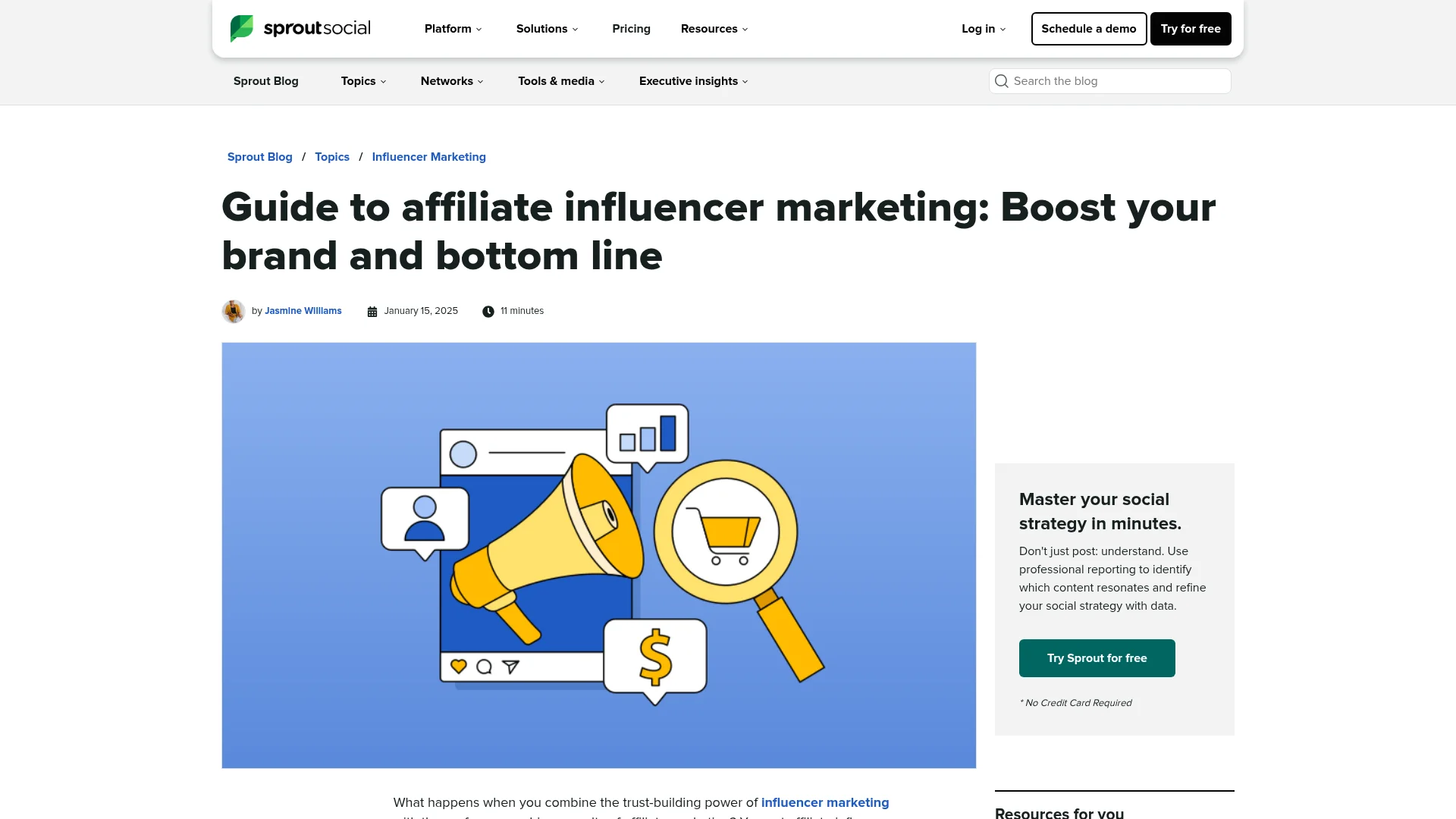
Influencer programs, creator partnerships, UGC, TikTok and Instagram creator economy plays, and Tagger-style influencer-marketing playbooks. The volume grew significantly after Sprout's acquisition of Tagger Media. 123 URLs is a substantial commitment to a topic that competitors like Later and Hootsuite also publish heavily on. The bet is category-shaping: Sprout is positioning influencer marketing as adjacent to (not separate from) core social media management, which lines up with the unified-platform product narrative.
Sample pages:
- The 2026 Guide to Affiliate Influencer Marketing | Sprout Social
/insights/affiliate-influencer-marketing/ - Affiliate Marketing vs. Influencer Marketing in 2026 | Sprout Social
/insights/affiliate-marketing-vs-influencer-marketing/ - 29 Top Australian Influencers 2026 | Sprout Social
/insights/australian-influencers/ - The Importance of Authenticity in Influencer Marketing | Sprout Social
/insights/authenticity-in-influencer-marketing/
AI on Social Media (~68 Pages)
AI use cases on social: generative content, AI-assisted workflows, AI for listening, automation, and ethical considerations. A rapidly growing thread that reflects both market shift and Sprout's own AI product launches. The naming pattern is telling. Titles like "How Agentic AI is Changing Social Media Management" claim category vocabulary before competitors settle on it. AI is treated as a content category in its own right, not just product messaging dressed up as editorial.
Sample pages:
- How Agentic AI is Changing Social Media Management | Sprout Social
/insights/agentic-ai-for-social-media/ - 7 AI tools for data analytics: A marketer's guide | Sprout Social
/insights/ai-analytics-tools/ - AI Analytics: The Future of Data Analysis | Sprout Social
/insights/ai-analytics/ - AI Automation: Leverage AI with Intelligent Automation | Sprout Social
/insights/ai-automation/
Paid Social & Employee Advocacy (~26 Pages)
Paid social campaigns, network-specific ad reporting, integrated paid + organic strategies, plus employee advocacy programs, executive social, and Bambu/Employee Advocacy platform context. Two adjacent monetization angles grouped together as the smaller, conversion-adjacent slices of the blog. 26 URLs against 1,431 in the broader blog says Sprout is largely ceding paid-media educational content to platforms more directly focused on ad operations, and that employee advocacy editorial volume has not kept pace with the product investment in that surface.
Sample pages:
- Brand Safety: How to Protect Your Brand on Social | Sprout Social
/insights/brand-safety/ - Customer Zero: Employee Advocacy [Instagram] | Sprout Social
/insights/customer-zero-employee-advocacy-instagram/ - Reintroducing Our Employee Advocacy Platform | Sprout Social
/insights/employee-advocacy-by-sprout-social/ - Complete Employee Advocacy Content Strategy Guide | Sprout Social
/insights/employee-advocacy-content/
Strategy insight: Treating AI and influencer marketing as dedicated editorial categories (68 and 123 URLs respectively) is the strongest strategic gambit visible in Sprout's content engine. Both topics are still settling in terms of category vocabulary, and the company that publishes the most coherent body of work on them collects the back-link and AI-citation equity before the rest of the market catches up. The Paid Social & Employee Advocacy micro is the contrast case. 26 URLs is light cover for a topic where Sprout owns a dedicated product surface, which leaves employee-advocacy search demand under-served relative to the product investment.
5. Webinars, Customer Stories & Research
Pages: 195 · Share of library: 9.0%
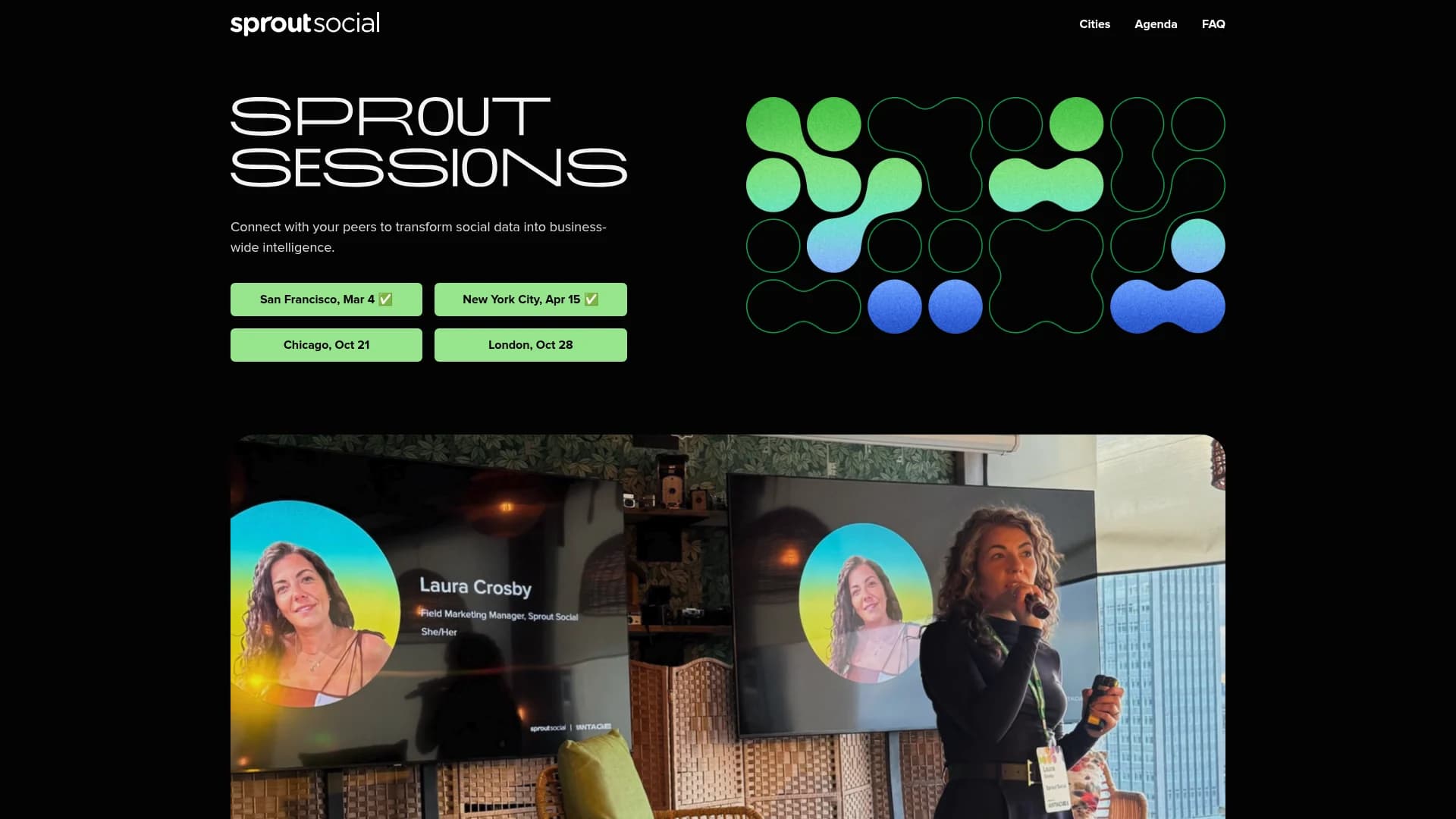
Three high-trust content formats Sprout uses to support mid- and bottom-funnel buying conversations. On-demand and live webinars, named customer case studies, and original Sprout-produced research. These formats are smaller in URL count than the editorial blog but disproportionately influential. Research generates the citation density and back-link equity that anchors the rest of the library, case studies do the social-proof work for procurement-stage readers, and webinars run as a parallel publishing engine with its own production cadence.
Content-type mix: Events / Webinars / Sessions 50.3% · Case Studies / Customer Stories 29.7% · Research / Reports 20.0%
Micro-topics within this cluster
Webinars & Live Events (~98 Pages)
Recorded and live webinars, regional and localized webinars in Spanish, French and Portuguese, and Sprout Sessions live event programming. The bulk of the archive is strategy and tactical training, with titles like the AI bootcamp series and "Building Data-Powered Social Strategies" that target the practitioner reader who's willing to commit 30 to 60 minutes to a structured walkthrough. The on-demand archive functions as a long-tail SEO and lead-gen surface; old webinars still pull form submissions years after they were originally recorded. The handful of localized webinars in Spanish, French, and Portuguese sit inside an otherwise English-only library, which is a pragmatic compromise between full library translation and a single-locale strategy.
Sample pages:
- Sprout Sessions | Sprout Social
/sprout-sessions-2021/ - Webinars | Sprout Social
/insights/webinars/ - Sprout Social: Social Media Management Tool
/sprout-sessions-2021/live/ - 2024's Top Trends: Your 2025 Strategy | Sprout Social
/insights/webinars/2024-in-review/
Customer Case Studies (~58 Pages)
Named customer case studies under /insights/case-studies/ across enterprise brands, higher education, agencies, and public-sector and nonprofit organizations. Most case studies cover enterprise-scale brand customers (America's Test Kitchen, Atlanta Hawks, Atlantic Lottery, Benefit Cosmetics), which aligns with Sprout's stated audience profile. The higher-ed sub-set (Dartmouth, Indiana University, Keele, Marquette) is one of the verticals where Sprout's solution pages, blog content, and case studies all overlap. The public-sector cut (Las Vegas citizen engagement, Make-A-Wish, Boingo Wireless) is small but recurring. Agency coverage is the thinnest, with just a single case study despite agencies being a stated customer segment.
Sample pages:
- Case Studies | Sprout Social
/insights/case-studies/ - How America's Test Kitchen Connects With New Consumers | Sprout Social
/insights/case-studies/americas-test-kitchen/ - Inside the Atlanta Hawks' Slam Dunk Social Strategy | Sprout Social
/insights/case-studies/atlanta-hawks/ - How Sprout Made Implementation a Pain-free Process for Atlantic Lottery
/insights/case-studies/atlantic-lottery/
Research & Benchmark Reports (~39 Pages)
Original Sprout-produced research: the annual Sprout Social Index (now at Edition XX with the 2025 release), vertical benchmark reports for higher ed, healthcare, agency pricing, and content benchmarks, consumer and executive research like the annual Social Media Content Strategy Report, and the data and stats archives. Small in URL count but disproportionately influential. Branded research compounding across years is the single hardest content asset for a competitor to replicate, which is why Sprout keeps extending the Index series rather than refreshing it. The vertical benchmark layer adds a land-and-expand mechanism. Each benchmark gives Sprout a credible third-party-style citation in a specific vertical that doubles as sales-team ammunition when meeting with prospects in that vertical.
Sample pages:
- Data Reports Archive | Sprout Social
/insights/data/ - Interactive Archive | Sprout Social
/insights/interactive/ - Stats Archive | Sprout Social
/insights/stats/ - The 2024 Social Media Content Strategy Report | Sprout Social
/insights/data/2024-social-content-strategy-report/
Strategy insight: 195 URLs is a deep customer-proof library for a category where most peers run one of the three formats, not all three. The strategic compounding is in the layering. Research (Index plus vertical benchmarks) earns the citations that lift back-link equity for the editorial blog; case studies do the procurement-stage proof work; webinars carry the long-form lead-gen load. Each format reinforces the other two. New entrants without comparable customer relationships or research history cannot replicate this footprint quickly, which makes the cluster one of the strongest defensive moats in the library.
6. Press, Author & Corporate Communications
Pages: 189 · Share of library: 8.8%
Two corporate-communications surfaces that share the same internal/IR audience and the same /insights/ URL infrastructure. Structured press releases under /insights/press/ and the author archive that supports the editorial library. Standard public-company press infrastructure, but the editorial discipline in the press archive is interesting. Most releases are structured to surface a marketable third-party data point or research finding rather than purely product news.
Content-type mix: Other 53.4% · Blog / Editorial 46.6%
Micro-topics within this cluster
Author Profile Archives (~101 Pages)
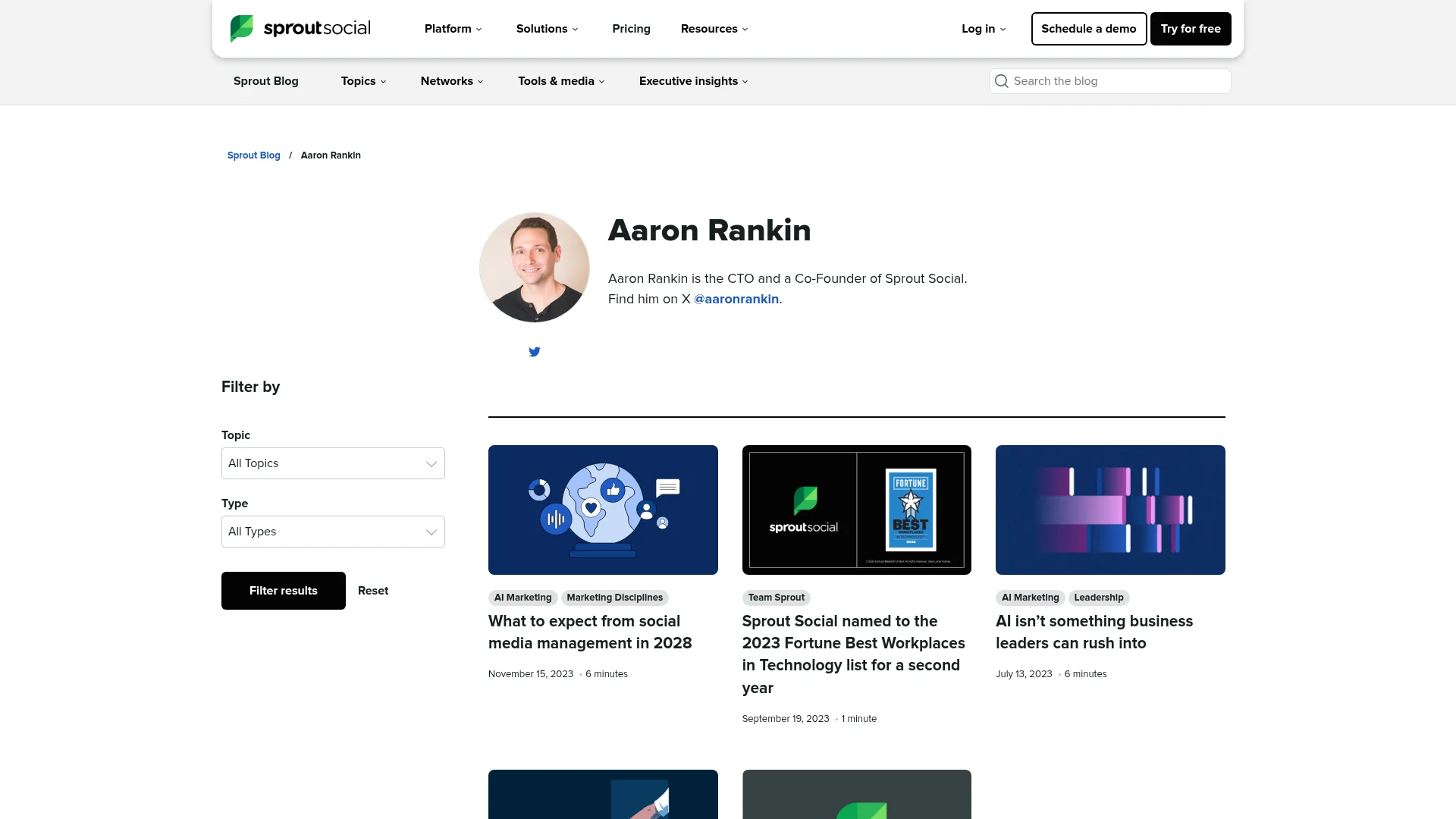
WordPress-style author archive pages under /insights/author/: one URL per Sprout staff member or guest contributor. Sitemap infrastructure rather than strategy content. The 101 author URLs are roughly 5% of the indexable footprint, which is heavier than necessary. Most CMS-driven author archives are de-indexed because they offer thin content. Sprout leaves them indexable, which inflates the apparent library size and contributes to long-tail noise in search results.
Sample pages:
- Aaron Rankin, Author at Sprout Social
/insights/author/aaron/ - Aisha Quas, Author at Sprout Social
/insights/author/aishaquas/ - Alan Boyce, Author at Sprout Social
/insights/author/alan-boyce/ - Alicia Johnston, Author at Sprout Social
/insights/author/alicia-johnston/
Corporate News, Awards & Partnerships (~56 Pages)
Press releases on industry awards, workplace recognition, G2 badge announcements, partnerships and acquisitions (Repustate, Tagger, NewsWhip, Salesforce, Simply Measured), financial milestones, and leadership changes. The IR-facing thread of the press archive: third-party validation, M&A, and corporate-event communications grouped together. The acquisition cadence is the strategic story. Sprout has built listening (Repustate), influencer marketing (Tagger), and predictive intelligence (NewsWhip) through acquisition rather than organic build, which the press releases telegraph clearly to financial audiences. The G2-badge releases double as both award news and SEO surface for branded-comparison queries.
Sample pages:
- Press Archive | Sprout Social
/insights/press/ - New Research from Sprout Social Finds Social Media is the Top Place Gen Z Turns to for Search | Sprout Social
/insights/press/new-research-from-sprout-social-finds-social-media-is-the-top-place-gen-z-turns-to-for-search-surpassing-traditional-search-engines/ - New research reveals business leaders agree continued investment in social media is critical for long-term success | Sprout Social
/insights/press/new-research-reveals-business-leaders-agree-continued-investment-in-social-media-is-critical-for-long-term-success-driven-by-social-datas-growing-value-in-business-intelligence/ - Salesforce and Sprout Social partner to manage full social media presence | Sprout Social
/insights/press/salesforce-and-sprout-social-partner-to-manage-full-social-media-presence/
Product Launch Announcements (~32 Pages)
Press releases announcing new products, features, and product expansions. Sprout treats product launches as press events with formal announcement releases, not just blog posts. That's the public-company posture: financial analysts and IR audiences expect structured press release infrastructure, which a private competitor wouldn't necessarily build out. Many of the launch releases tie back to the research franchise, which gives them an editorial half-life beyond the announcement cycle.
Sample pages:
- 8 Questions for Sprout Social's Justyn Howard | Sprout Social
/insights/press/8-questions-for-sprout-socials-justyn-howard/ - Introducing The Sprout Social Index | Sprout Social
/insights/press/introducing-sprout-social-index/ - New Research Indicates a Shift in What Consumers Find Memorable on Social Media | Sprout Social
/insights/press/new-research-indicates-a-shift-in-what-consumers-find-memorable-on-social-media/ - New Research Reveals Influencer Marketing as Critical to Brands' Social Strategies | Sprout Social
/insights/press/new-research-reveals-influencer-marketing-as-critical-to-brands-social-strategies/
Strategy insight: Two distinct things are happening in this cluster. Press content is doing dual duty as both IR communication and SEO surface, with most releases structured around a quantifiable third-party data point or research finding. That's a deliberate editorial discipline that gives the releases a longer half-life than typical product news. The 101 author archives are the second story, and the more interesting one for internal linking hygiene. Either E-E-A-T-grade author bios with topical specialization (which would justify the indexable footprint) or a blanket
noindexwould yield clearer ranking signals than the current middle ground.
7. Guides, Templates & Resource Library
Pages: 127 · Share of library: 5.9%
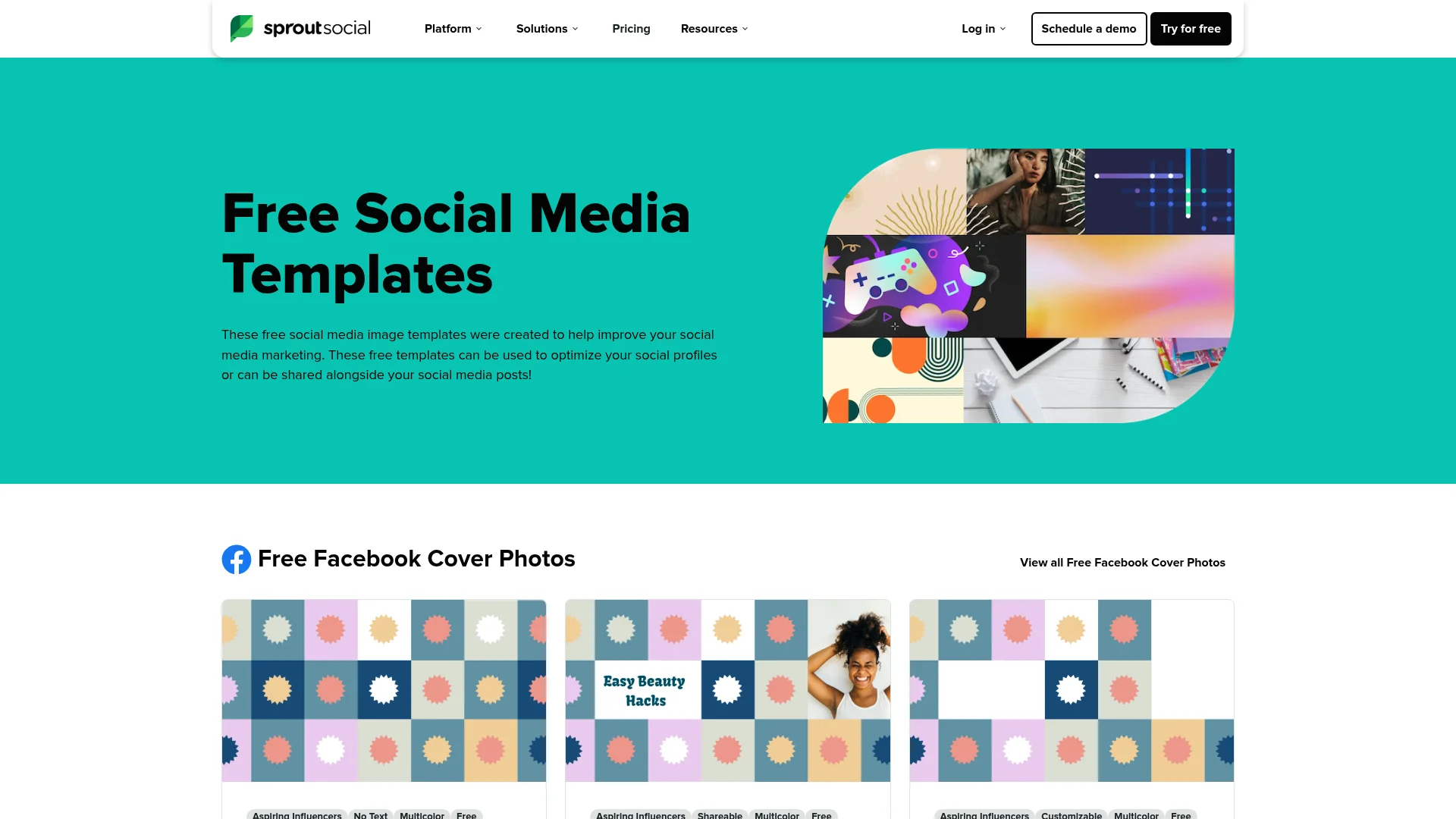
Long-form strategy guides, downloadable templates, worksheets, visual asset packs, and the year-round social media holidays calendar. Practitioners use these as off-platform working assets, which is what differentiates the cluster from the editorial blog. Where blog posts inform, these assets get used. Sprout's /insights/guides/, /insights/templates/, /templates/, and /social-media-holidays/ surfaces together form a download-driven resource library distinct from editorial blog posts.
Content-type mix: Free Tools 56.7% · Guides & Resources 43.3%
Micro-topics within this cluster
Templates, Worksheets & Visual Packs (~75 Pages)
Free templates, worksheets, checklists, briefs, and visual asset packs for cover photos, banners, post and story templates. Sprout's lead-magnet engine: downloadable working assets and visual templates designed for non-designer marketers to use day-to-day. The lead-magnet role is obvious, but the more interesting pattern is the recurring "workbook" and "framework" naming in the worksheet sub-set. Sprout produces templates that are operating documents, not just one-page checklists. That's the kind of asset enablement leaders pin to their browser bookmarks, which compounds returning traffic without paid distribution. The visual packs (free Instagram post templates, free Facebook cover photos) target high-intent searches that convert visitors directly into newsletter signups and product trials.
Sample pages:
- Free Social Media Templates | Sprout Social
/templates/ - Guides | Sprout Social
/insights/guides/ - Templates & Tools | Sprout Social
/insights/templates/ - Free Facebook Cover Photos | Sprout Social
/templates/facebook-cover-photos/
Long-Form Strategy Guides (~27 Pages)
Pillar-shaped strategy guides at /insights/guides/ covering social for specific verticals, audiences, and use cases: franchise marketing, B2B social data, the CMO planning guide. Heavier and more pillar-shaped than the blog's strategy content, with titles that read like operating manuals ("How to Turn B2B Social Data Into a Revenue Driver"). These guides are the cluster's evergreen SEO anchors: long-shelf-life content that ranks for category-defining queries that the shorter blog posts can't capture alone.
Sample pages:
- How to Turn B2B Social Data Into a Revenue Driver | Sprout Social
/insights/guides/b2b-social-data/ - How to Use Social Data like a Pro [40 Examples] | Sprout Social
/insights/guides/best-ways-to-use-social-data/ - 2026 CMO Social Media Planning Guide | Sprout Social
/insights/guides/cmo-planning/ - The Complete Guide to Franchise Marketing | Sprout Social
/insights/guides/franchise-marketing-guide/
Social Media Holidays Calendar (~25 Pages)
The Sprout social media holidays calendar and its individual day-themed entries at /social-media-holidays/. A coherent year-round content series used as content-planning fuel: Black Cat Appreciation Day, Constitution Day, Festivus, and dozens more. The series operates as a perpetual evergreen surface. Search interest for individual social-media-holiday queries spikes annually on a predictable schedule, and Sprout's pages have accumulated back-link equity that's hard for new entrants to overtake. The mechanism is structural: own the calendar, own the search.
Sample pages:
- Complete Social Media Holidays Calendar [2022] | Sprout Social
/social-media-holidays/ - Black Cat Appreciation Day: What Is It & How to Celebrate | Sprout Social
/social-media-holidays/black-cat-appreciation-day/ - Constitution Day: When it is and How to Celebrate | Sprout Social
/social-media-holidays/constitution-day/ - Festivus: What it is, when it is and how to celebrate | Sprout Social
/social-media-holidays/festivus/
Strategy insight: This cluster is the structural partner to the editorial blog, taking practitioners from "I read about this" to "I can apply it tomorrow." The two compounding mechanisms inside it are the downloadable templates (which capture email signups and convert to product trials) and the holidays calendar (which accumulates back-link equity through annual republishing cycles that competitors can't easily replicate without years of accumulated authority). The 27-URL strategy guides bench is the third leg. It anchors category-defining queries with operating-manual-length content that no individual blog post can rank for on its own.
8. Social Media Glossary
Pages: 112 · Share of library: 5.2%
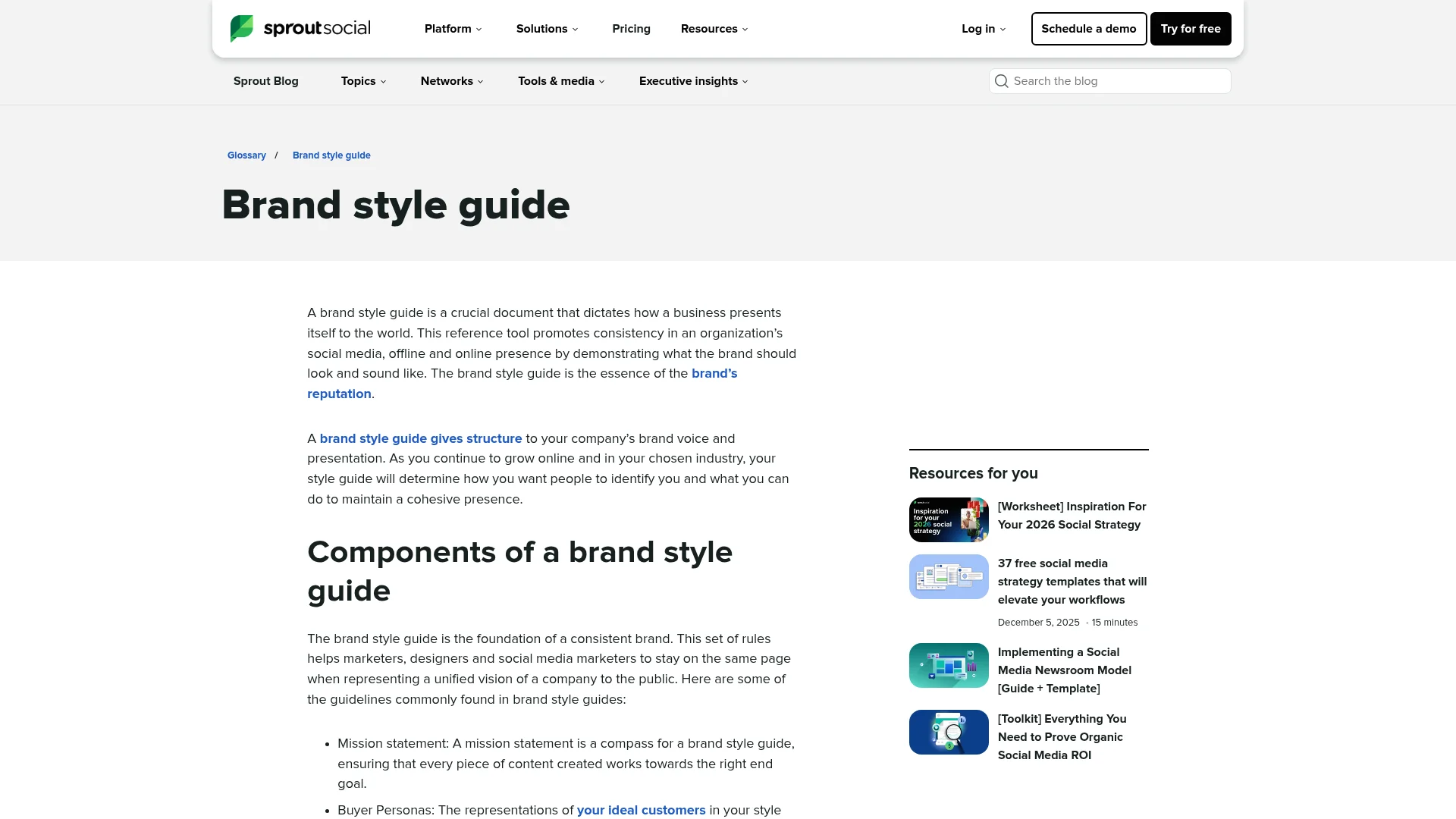
The /glossary/ section providing definitional "what is X" entries for social media, marketing, and analytics terms. A dedicated 112-entry glossary is unusually deep for a social media management vendor. Most peers run a few dozen scattered definition stubs inside their blogs. Sprout has built it into a discoverability surface in its own right, with its own URL prefix, taxonomy, and recurring sub-formats.
Content-type mix: Glossary / Definitions 100%
Micro-topics within this cluster
Marketing & Advertising Terms (~46 Pages)
Definitions for general marketing, advertising, and conversion concepts: CTAs, CPC, CTR, retargeting, lookalike audiences, brand style guides, business objectives. The largest slice of the glossary sits in general marketing rather than social-specific terms, which broadens the topical surface beyond Sprout's immediate category. The reach trade-off is intentional. A brand-style-guide definition ranks for an audience adjacent to but not identical to Sprout's buyers, which feeds top-of-funnel discovery from queries that wouldn't otherwise touch a social media management vendor.
Sample pages:
- What is a brand style guide? | Sprout Social
/glossary/brand-style-guide/ - What is a business objective? | Sprout Social
/glossary/business-objective/ - What is a call to action (CTA)? Sprout Social
/glossary/call-to-action-cta/ - What is a carousel ad? | Sprout Social
/glossary/carousel-ads/
Sentiment, Analytics & Other Concepts (~34 Pages)
Per-language and per-platform sentiment analysis pages (Arabic, French, German, Italian, Spanish, plus Bluesky and TikTok), definitions for analytics, AI, machine learning, content formats (memes, microblogs, GIFs, live streaming), influencer and community terms, and the glossary hub. The programmatic sentiment-analysis sub-series is the most distinctive single template here, applying one definitional pattern across languages and platforms. Sentiment analysis is technical product territory that Sprout entered via the Repustate acquisition, and these pages exist to capture intent from buyers searching for specific language coverage as a procurement requirement. The analytics and AI definitions (OSINT, SOCMINT, machine learning for business intelligence) target a different intent: enterprise procurement vocabulary that maps to higher-ACV conversations.
Sample pages:
- Social Media Glossary | Sprout Social
/glossary/ - Arabic sentiment analysis | Sprout Social
/glossary/arabic-sentiment-analysis/ - Basics of aspect-based Sentiment Analysis | Sprout Social
/glossary/aspect-based-sentiment/ - Bluesky sentiment analysis | Sprout Social
/glossary/bluesky-sentiment-analysis/
Platform Features & Mechanics (~32 Pages)
Definitions for platform-specific features: Reels, Stories, Tweets, Pins, BeReal, EdgeRank, Facebook Ads Manager, Facebook Boost Post. These entries target a different intent than the marketing-terms slice. Someone searching "what is EdgeRank" is mid-task in a platform-specific workflow, not researching the category. The dual-intent design (broad marketing terms + narrow feature definitions) lets the glossary serve both early-funnel discovery and in-task reference reads.
Sample pages:
- What is BeReal? | Sprout Social
/glossary/bereal/ - What is EdgeRank? | Sprout Social
/glossary/edgerank/ - What Is Facebook Ads Manager? | Sprout Social
/glossary/facebook-ads-manager/ - What is a Facebook Comment? | Sprout Social
/glossary/facebook-comment/
Strategy insight: The glossary is one of the most distinctive structural assets across the social media management category. The combination of breadth (112 entries) and the programmatic sentiment-analysis series (cycling across languages and platforms) functions as an AEO play. Definitional content is exactly what AI search engines like ChatGPT, Perplexity, and Google AI Overviews pull from for citation. Most SMM peers leave this surface effectively empty, which means Sprout's glossary is winning citations and answer-box appearances that would otherwise belong to a competitor that bothered to build it.
9. Product, Solutions & Utility Pages
Pages: 101 · Share of library: 4.7%
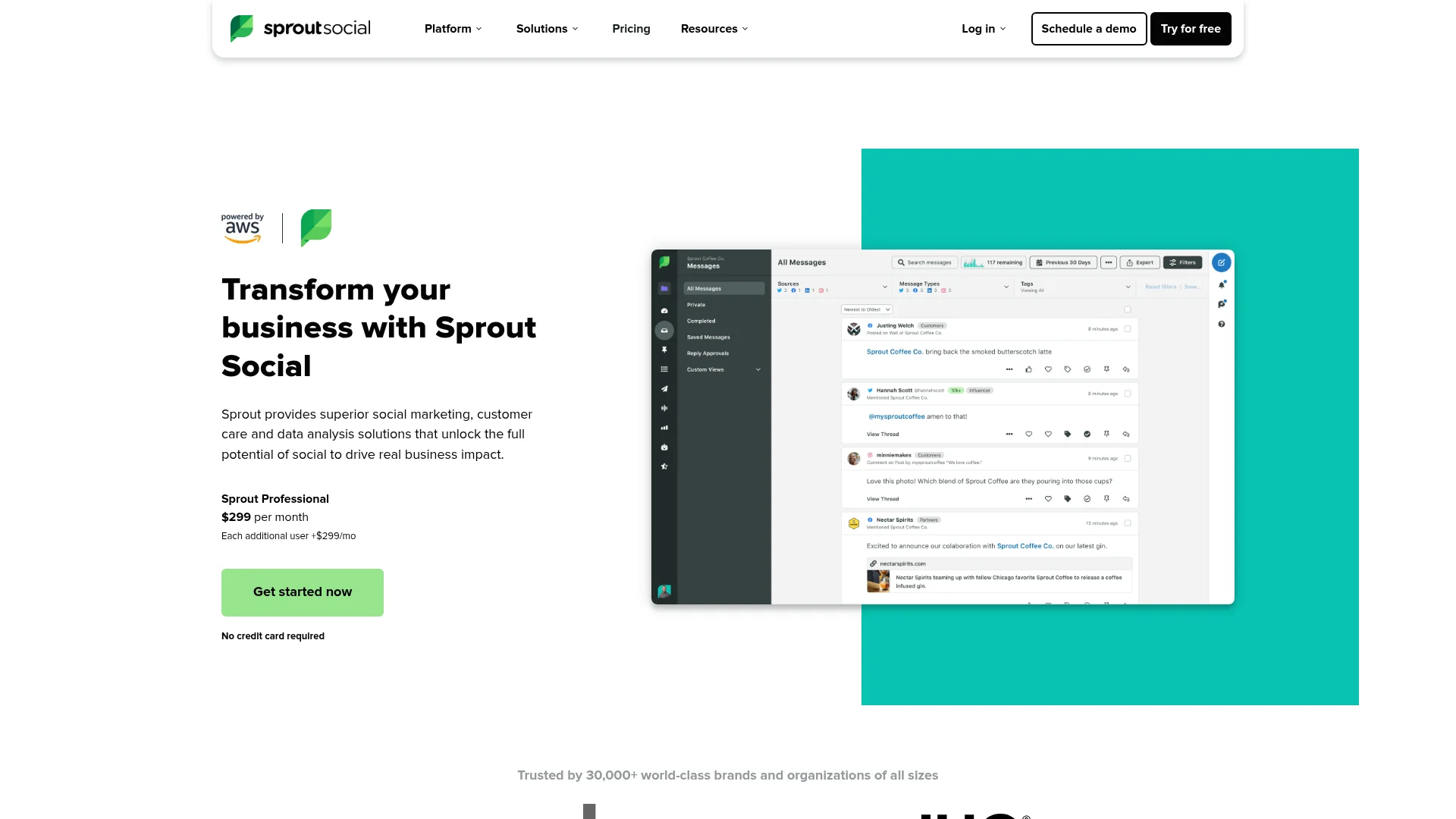
The conversion-stage and infrastructure surfaces of the marketing site. Sprout Social product, feature, integration, and solution pages, the Social Creatures podcast, free utilities (Landscape image resizer, Advocacy ROI Calculator), and standard company, trust, legal, and navigational pages. Small in URL count, structurally distinct from editorial content, and the bottom-funnel surface that turns editorial demand into procurement conversations.
Content-type mix: Product & Feature Pages 55.4% · Podcast / Audio Series 23.8% · Other 11.9% · Free Tools 7.9% · Comparison Pages 1.0%
Micro-topics within this cluster
Product Features & Integrations (~44 Pages)
Feature pages under /features/ covering Smart Inbox, scheduling, analytics, ViralPost, automation, and competitive analysis, plus integration pages for Facebook, Instagram, TikTok, LinkedIn, YouTube, Pinterest, Salesforce, Shopify, and other connected systems. Each named feature gets its own URL rather than being collapsed into a single product page. That's a deliberate SEO choice. Feature-specific search queries ("social media scheduling tool," "social media analytics") need their own ranking surfaces, and Sprout's per-feature page strategy targets those queries individually. The integration pages do similar work for partner-brand search terms ("Sprout Social Salesforce integration") and signal ecosystem depth to buyers comparing platforms on integration coverage as a procurement criterion.
Sample pages:
- Amazon Web Services | Sprout Social
/amazon-web-services/ - Blackboard | Sprout Social
/blackboard/ - Competitive Analysis | Sprout Social
/competitive-analysis/ - Social Media Features | Sprout Social
/features/
Social Creatures Podcast Episodes (~24 Pages)
Episodes of Sprout's Social Creatures interview podcast under /insights/podcasts/, profiling brands and creators behind notable social media moments: interviews with Mob, Ambassador Theatre Group, Unit London, Black Country Living Museum, and other brands on social strategy, creative work, and community building. The format leans editorial rather than product. Episodes profile the brand's social work rather than Sprout's tooling, which lines up with the named-asset positioning of "Social Creatures." A 24-episode catalogue is enough to surface the franchise but sits below the 30-URL threshold that typically signals a category-leading audio investment.
Sample pages:
- Social Creatures Podcast Episodes | Sprout Social
/insights/podcasts/ - Ambassador Theatre Group: Where a multi-faceted social strategy takes centre stage | Sprout Social
/insights/podcasts/socialcreatures/ambassador-theatre-group-where-a-multi-faceted-social-strategy-takes-centre-stage/ - Contemporary Art and Social Media: Unit London | Sprout Social
/insights/podcasts/socialcreatures/art-social-media-unit-london/ - Black Country Living Museum: Where history meets pop culture for TikTok domination | Sprout Social
/insights/podcasts/socialcreatures/black-country-living-museum-where-history-meets-pop-culture-for-tiktok-domination/
Free Tools & Utility Pages (~21 Pages)
Standalone free utilities (Landscape image resizer, Advocacy ROI Calculator and its multi-step sub-flows, free-tools hub, certification programs), plus standard company, trust center, security, sustainability, privacy hub, legal, and navigational utility pages. Two functionally different surfaces grouped together as the marketing site's non-content infrastructure. The Advocacy ROI Calculator is the most interesting of the free tools. Each step in the calculator gets its own URL, which helps the flow rank for individual sub-intents ("employee advocacy ROI calculator") and creates a longer dwell-time signal as users move through the steps. The trust-and-utility pages (privacy hub, security, sustainability, BAA, cookie notices) are the standard B2B SaaS footprint required by enterprise procurement.
Sample pages:
- Sprout Social: Social Media Management Tool
/ - About Us | Sprout Social
/about/ - Advocacy ROI Calculator Tool | Sprout Social
/advocacy-roi-calculator-tool/ - Certification | Sprout Social
/certification/
Solutions, Audience & Conversion Pages (~12 Pages)
Industry and vertical solution pages (healthcare, higher ed, retail, travel, government, software), audience-tier pages (SMB, enterprise, agency, premier success), the Sprout AI product positioning page, and pricing, demo, and contact pages. Twelve URLs is a tight conversion-stage footprint relative to the editorial library that feeds into it. Vertical-editorial content does the discovery work that funnels into a tight conversion surface, which is a deliberate architectural choice. A more elaborated landing page network per industry would be a low-risk expansion if vertical-led demand keeps growing.
Sample pages:
- Sprout AI: The Social-Powered AI Engine for Modern Business | Sprout Social
/ai/ - Contact Us | Sprout Social
/contact-us/ - Demo Request | Sprout Social
/demo/ - Enterprise Social Media Management | Sprout Social
/enterprise/
Strategy insight: Just one canonical comparison page across the entire product cluster is the most unusual structural choice on the page. Competitors in social media management run displacement campaigns against Sprout on "Sprout Social alternatives" and "Sprout vs X" terms, but Sprout has chosen not to defend that surface on its own site. A tighter defensive comparison-page footprint (canonical comparisons for the top 5 to 8 named competitors) is the most actionable BOFU expansion available. The investment is low (typically one templated page per competitor) and the defensive yield is high. The Social Creatures podcast at 24 episodes is the second flag in this cluster. If Sprout wanted the podcast to function as a multi-year compounding asset on the scale of the Index, the cadence would need to roughly triple.
Key Observations
What Stands Out About Sprout Social's Content Strategy
The library is editorial-first and spread across four blog clusters
Seventy percent of every page Sprout publishes is Blog / Editorial, the highest editorial concentration among editorially-led peers in the social media management category. Rather than pile every editorial post into one giant cluster, Sprout splits the 1,431-URL Insights blog across four thematic beats: Industry/Culture/General Trends (512), Strategy/Analytics/Listening (389), Platform Marketing (313), and AI/Influencer/Paid (217). For practitioners researching how to operate on social, the architecture works. For buyers comparing tools on alternatives queries, the comparison surface is effectively undefended at just one canonical comparison page.
Per-URL traffic efficiency is the highest among editorial-led peers
At ~1,015 visits per page across 2,155 URLs, Sprout produces meaningfully more traffic per published URL than Buffer (824), Hootsuite (776), and Brandwatch (76). Only Later (2,269) beats it in the category, and Later runs a leaner Instagram-concentrated library. Sustaining ~1,015 visits per page at this scale signals that Sprout's editorial bar has stayed high as the library has grown. The per-page quality threshold hasn't slipped with volume.
The 11-20 ranking band is the single largest optimization opportunity
18,523 ranking positions sit in positions 11-20: 22% of Sprout's entire ranking footprint, and roughly matching the entire top-10 count (19,694). That's content already on Google's second page that focused refresh work could push into top-10 visibility. Sprout's library has the authority to support this push; the ranking distribution suggests the editorial calendar has outpaced the optimization-and-refresh calendar. A systematic content audit of 11-20 URLs would be a high-yield investment.
The 112-entry glossary is a distinctive AEO play
A dedicated /glossary/ section with 112 definitional entries, including a programmatic sentiment-analysis sub-series across languages and platforms, is unusually deep for a social media management vendor. Most peers leave definitional content as scattered blog stubs. Sprout has built it into a structured discoverability surface that's well-suited for AI search citation. Among the most under-imitated structural choices visible in this category.
Comparison-page investment is exceptionally light
One canonical comparison page across the entire 2,155-URL library. For a company that other vendors target heavily in alternatives queries, and for a public company with the resources to defend its commercial position, this is the most actionable hidden gap. The fix is templated and low-cost: build canonical comparison pages for the top 5 to 8 named competitors. Each one would cost a fraction of a single Index edition and would close a defensive surface that's currently wide open to displacement campaigns.
The Sprout Social Index is a multi-decade compounding asset
The 2025 Index is listed as Edition XX, the 20th edition of the franchise. Branded research compounding across 20+ years is structurally hard for a competitor to replicate quickly. Combined with the vertical benchmark layer (higher ed, healthcare, agency pricing, content benchmarks) inside the Webinars, Customer Stories & Research cluster, Sprout has built two distinct research arcs in parallel: a flagship annual narrative and a portfolio of vertical-specific proof points that fuel sales conversations in named industries.
AI and influencer marketing are treated as dedicated editorial categories
217 URLs across AI on Social Media (68), Influencer & Creator Marketing (123), and Paid Social & Employee Advocacy (26) represent a deliberate land-grab on category vocabulary. Both AI and influencer marketing are still settling in terms of category vocabulary, and the company that publishes the most coherent body of work on them collects the back-link and AI-citation equity before the rest of the market catches up. Sprout's Tagger Media acquisition (influencer) and Sprout AI product launches (AI) line up directly with the editorial investment, which keeps product narrative and editorial signal in step.
The `/insights` URL prefix carries too many distinct content types for clean section authority
1,934 of the 2,155 URLs sit under the single /insights/ path, spanning nine different content types: blog editorial, webinars, case studies, research, press, author pages, free tools, guides, and podcasts. Nine content types sharing one URL prefix structurally dilutes section authority signals and makes URL-based content audits harder. Splitting into dedicated paths (/blog/, /webinars/, /case-studies/, /research/, /press/, /podcasts/) would yield clearer ranking signals and a cleaner information architecture, though the migration cost (redirects, internal link rewrites, sitemap regeneration) is non-trivial.
More analyses in Social Media Management
Agorapulse
How Agorapulse uses 2,872 blog posts and a 421-URL multi-podcast network to drive 175K monthly visits in social media management. 4,086 pages, 7 clusters.
Brandwatch
How Brandwatch uses 3,844 blog posts and a 453-URL research franchise to drive 534K monthly visits in social media management. 7,072 pages, 7 clusters.
Buffer
How Buffer uses 2,029 blog posts and the Open Buffer transparency library to drive 2.5M monthly visits in social media management. 2,982 pages, 7 clusters.
Hootsuite
How Hootsuite uses 629 guides and a 129-URL research franchise to drive 2.97M monthly visits in social media management. 3,826 pages, 9 clusters.
Methodology: This analysis is based on Sprout Social's full public sitemap (2,155 URLs, sourced from robots.txt), enriched with each URL's title and meta description via lightweight HTTPS fetches. URLs were classified into a 12-bucket content type taxonomy and grouped into 9 topic clusters with 30 micro-topics using LLM-assisted classification. Company facts came from public web research across Crunchbase, LinkedIn, Macrotrends, and the company's own About, investor-relations, and blog pages. Traffic metrics (monthly organic visits, traffic value, ranking positions, position distribution) came from DataForSEO's domain rank overview, aggregated globally across 117 locale combinations. All counts reflect the Sprout Social sitemap as of 2026-05-26.