
Summary
Buffer drives 2,456,393 monthly organic visits from a 2,982-page library that runs as an editorial publication first and a product site second. 68% of every page is Blog or Editorial content. The architecture spans 7 topic clusters and 30 micro-topics across a single English locale, with two signature content surfaces no peer matches at scale: the 160-URL Open Buffer transparency cluster (salaries, revenue, shareholder updates, monthly ops reports, plus first-party research) and the 44-post Overflow Engineering sub-blog folded into Buffer Culture & Remote Work. 23.4% of Buffer's 101,102 ranking positions sit in the top 10. That's the highest top-10 share among the ten companies tracked in the social media management category. Per-URL efficiency runs at 824 visits per page.
Key facts:
- Library size: 2,982 indexable pages organized into 7 topic clusters and 30 micro-topics; 68.0% Blog/Editorial
- Largest cluster: Social Media Strategy & Content (1,294 URLs, 43.4% of library)
- Flagship content asset: Open Buffer transparency cluster. 160 URLs covering published salaries, revenue, shareholder updates, monthly ops reports, and first-party research stretching back over a decade
- Search performance: 2.5M monthly visits across 101.1K ranking positions; 23.4% in top 10, the highest top-10 share in the social media management category (~824 visits per page)
- Notable gap: Zero Case Studies and zero Events/Webinars in the main sitemap, despite named customers (Microsoft, Shopify, GitHub, Trello) and a fully remote team that runs many live sessions
Company Overview
Buffer at a Glance
| Company | Buffer, Inc. |
| Founded | 2010 · San Francisco, CA, USA (fully distributed; no physical office since 2015) |
| Category | Social Media Management |
| What They Do | Buffer is a social media management platform that lets creators, small businesses, and brands schedule, publish, and analyze content across multiple social networks from a single dashboard. Its audience spans creators, small businesses, and lean marketing teams managing organic social presence, with named customers including Microsoft, Shopify, GitHub, Trello, and Huckberry. The company is known for its fully remote team and its long-running practice of publishing salaries, revenue, and other operating metrics openly. |
| Funding | $4.07M raised across all rounds; last round Series A (Dec 2014, $3.5M, with Collaborative Fund, Bossa Invest, Stage One Capital) |
| Revenue | ~$21.48M ARR (publicly reported by CEO Joel Gascoigne, March 2025) |
| Headcount | 50-100 (per Buffer's public team page) |
| Monthly Organic Visits | Traffic Value (PPC equiv.) | Ranking Positions |
|---|---|---|
| 2.5M | $5.2M | 101.1K |
Ranking positions reflect total positions across 117 indexed (location, language) combinations, not unique keywords. A keyword ranking in multiple locales is counted once per locale.
Buffer's content operation is dense, editorially-led, and deeply concentrated. 2,982 indexable pages organize into 7 topic clusters, with editorial weight pooled into a single 1,294-URL strategy-and-content cluster and a unified 486-URL Per-Network Playbooks cluster. The library has no public Documentation, no Case Studies, and no Events or Webinars in the main sitemap, yet hosts a 160-URL Open Buffer transparency cluster and a 44-post Overflow Engineering sub-blog. These are content categories no direct peer maintains. Almost everything sits under one URL prefix: 2,777 of the 2,982 URLs share the /resources path.
Content Architecture
What Does Buffer's Content Engine Look Like?
Buffer's main website hosts 2,982 indexable pages organized into 7 topic clusters. The architecture is editorial-first and brand-led, built around a long-running publication rather than a product reference site.
Content Type Distribution
| Content Type | Count | Share | Notes |
|---|---|---|---|
| Blog / Editorial | 2,029 | 68.0% | Dominant content type; bulk of the /resources path |
| Other | 367 | 12.3% | Navigation, taxonomy, /author/ archives, system pages |
| Guides & Resources | 324 | 10.9% | Pillar guides, how-to roundups, tool comparisons |
| Glossary / Definitions | 116 | 3.9% | Includes the 105-URL Social Media Glossary at /social-media-terms/ |
| Product & Feature Pages | 55 | 1.8% | Network landing pages, feature pages, vertical landers |
| Research / Reports | 34 | 1.1% | Includes State of Remote Work and State of Social Media Engagement |
| Comparison Pages | 22 | 0.7% | Limited canonical "vs" and "alternatives" coverage |
| Podcast / Audio Series | 21 | 0.7% | Buffer Podcast, Breaking Brand, Buffer Overflow, Snackchat |
| Free Tools | 14 | 0.5% | Hashtag generators, AI post creator, UTM builder |
| Case Studies / Customer Stories | 0 | 0.0% | Not present in main sitemap |
| Events / Webinars / Sessions | 0 | 0.0% | Not present in main sitemap |
| Documentation | 0 | 0.0% | Not present in main sitemap |
Key finding: Three content categories (Case Studies, Events/Webinars, and Documentation) are entirely absent from the main sitemap. For a 2,982-page library with named enterprise customers and a fully remote team that runs many live sessions, that's a structural choice, not an oversight. Buffer is choosing editorial breadth and brand transparency over the customer-proof and lead-capture surfaces most peers maintain.
Content Strategy Archetype
Buffer operates an editorial-led, transparency-anchored content publication. The primary asset is a long-running blog at /resources targeting creators, small businesses, and lean marketing teams, supplemented by two signature surfaces (Open Buffer transparency content and the Overflow Engineering sub-blog) that no direct peer publishes at comparable scale. The 7-cluster taxonomy concentrates editorial weight into fewer, deeper buckets: the Social Media Strategy & Content cluster alone holds 43.4% of the library, with Per-Network Playbooks taking another 16.3%. The architecture is built for breadth and brand depth, not for documentation lookup or sales-led conversion.
Search Performance Quality
Where Buffer Ranks
The DataForSEO domain rank overview shows Buffer ranking in 101,102 positions across 117 indexed (location, language) combinations. The position distribution is long-tailed. Buffer has many ranking positions, but the bulk of them sit below the top 10.
| Position | Count | Share |
|---|---|---|
| #1 | 1,752 | 1.7% |
| #2–3 | 4,250 | 4.2% |
| #4–10 | 17,706 | 17.5% |
| #11–20 | 19,747 | 19.5% |
| #21–50 | 37,227 | 36.8% |
| #51–100 | 20,420 | 20.2% |
23.4% of Buffer's ranking positions are in the top 10, the highest top-10 share among the ten companies tracked in the social media management category, narrowly ahead of Sprout Social (23.36%) and Hootsuite (22.32%). Another 19.5% of positions sit in the 11-20 range. That's 19,747 individual ranking positions one focused optimization pass away from page one of Google. It's the largest single optimization sweet spot in Buffer's footprint.
Per-URL traffic efficiency is high at ~824 visits per page across 2,982 pages. Among peers in the category, only Later (2,269) and Sprout Social (1,015) run a higher visits-per-URL ratio, and both have substantially smaller libraries. Buffer's combination of scale (2,982 URLs) and per-page yield (824 visits) is unusual. Most libraries this size dilute per-page performance as they grow.
Content Deep Dive
What Is Buffer Actually Publishing, and How?
Buffer's content organizes around 7 primary topic clusters. Each cluster is described below with content-type composition, the micro-topics inside it, and concrete example URLs. Cluster and micro-topic groupings reflect a per-URL classification of the full sitemap. Counts are exact, not approximate.
1. Social Media Strategy & Content
Pages: 1,294 · Share of library: 43.4%
Cross-network strategy and craft content: content calendars, planning, analytics, engagement, content creation, paid social, trend forecasts, and AI and tool roundups that span every social network rather than targeting one. The library's center of gravity. One in every 2.3 pages on buffer.com sits in this cluster, and it holds the platform-agnostic editorial that powers most of Buffer's broad-query rankings.
Content-type mix: Blog/Editorial 83% · Guides & Resources 14% · Comparison Pages 1% · Research/Reports 1% · Free Tools <1% · Glossary <1%
Micro-topics within this cluster
Strategy & Planning (~527 Pages) Brand strategy, content calendars, posting schedules, repurposing playbooks, and overall social media planning. The cluster's largest sub-theme and the workhorse of Buffer's organic traffic. Titles span planning-heavy how-tos and inspirational-quote roundups, signaling a long editorial back-catalog where evergreen planning posts have been left in the index alongside older lifestyle content. The mix doubles as an SEO floor: planning queries are top-of-funnel for almost every social media buyer, and a 527-URL footprint is enough to compete for both head and long-tail intent.
Sample pages:
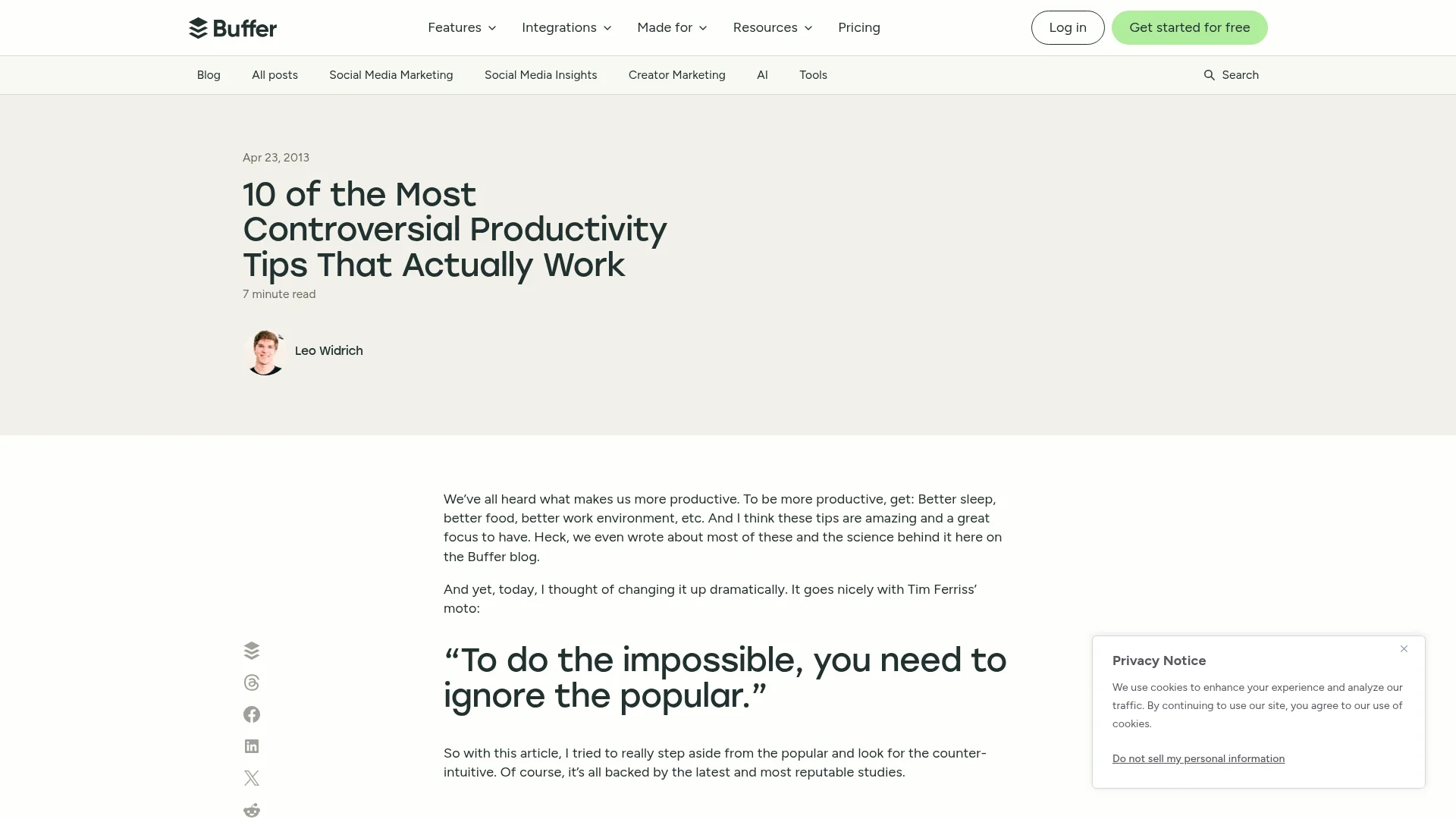
- 10 of the Most Controversial Productivity Tips That Actually Work
/resources/10-of-the-most-controversial-productivity-tips-you-will-read-today/ - 10 Counterintuitive Pieces of Advice on Business
/resources/10-of-the-most-counterintuitive-pieces-of-advice-from-famous-entrepreneurs/ - 10 Motivational Quotes to round up your Friday
/resources/10-motivational-quotes-to-round-up-your-friday/
Social Marketing Fundamentals (~379 Pages) Broad how-to playbooks for marketing on social, channel selection, and the basics of social media as a discipline. The second-largest sub-theme in the cluster, and the bulk of Buffer's top-of-funnel definitional surface. When someone searches "marketing plan template" or "how to start social media marketing," this is where they land. The volume here also explains how Buffer sustains its high visits-per-URL ratio: these are the broad-query rankers that compound over years.
Sample pages:
- My New Business Hit $1 Million in Sales in One Year: Here's My Playbook
/resources/1-million-business-playbook/ - 5 Customer Experience Metrics for Successful Companies
/resources/10-customer-experience-metrics-every-successful-company-tracks/ - 10 Marketing Blogs For Intermediate and Advanced Marketers
/resources/10-marketing-blogs-intermediate-advanced-marketers/
Content Creation & Engagement (~174 Pages) Writing captions, hooks, copywriting, design, visual content, video, plus engagement tactics, community management, and DM handling. This micro-topic folds together craft and engagement because both describe how content performs once it ships, distinct from the strategy-and-planning layer above. The mix runs from evergreen copywriting essays to community-tactic posts adjacent to Buffer's Engage product, plus a long tail of older lifestyle and creator content the back-catalog hasn't pruned.
Sample pages:
- 10 Simple Ways To Get more Customers Using Psychology
/resources/10-simple-ways-to-get-more-customers-using-psychology/ - 10 Things Your Customers Wish You Knew About Them
/resources/10-things-your-customers-wish-you-knew-about-them-infographic/ - Do 3rd-Party Social Media Tools Negatively Affect Reach & Engagement?
/resources/3rd-party-social-media-tools/
Analytics & Measurement (~102 Pages) Tracking metrics, benchmarks, ROI, KPIs, and analytics frameworks. The interesting feature here is that Buffer's own annual "X in Numbers" recap posts ("Buffer's 2017 in numbers," "Buffer's 2018 in Numbers") sit inside this micro-topic, making the company's own transparency reports double as analytics editorial. Analytics queries are also one of the few places Buffer's product capability (the Analyze module) maps directly to a search-intent the editorial content captures.
Sample pages:
- 9 Social Media Goals You Can Set and Track for Your Business
/resources/10-social-media-goals/ - Reflecting on Buffer's 2017 in numbers
/resources/2017-in-numbers/ - LinkedIn Analytics: Key Metrics to Track
/resources/linkedin-analytics/
Trends, AI & Paid Tactics (~112 Pages) Annual trend forecasts, original social research, AI for content creation, marketing tool roundups, paid social, and seasonal campaign content. Combines time-bound and tool-focused content that refreshes on an annual or quarterly cadence, distinct from the evergreen planning and craft material. Posts like "28 AI Marketing Tools to Save Time" and "7 Best Hootsuite Alternatives" live here, alongside Buffer's annual prediction roundups and Black Friday campaign coverage. The micro-topic acts as Buffer's soft competitive-positioning surface, since tool-roundup posts often compare Buffer to direct peers without maintaining a dedicated /compare/ section.
Sample pages:
- 28 AI Marketing Tools to Save Time and Boost Performance
/resources/ai-marketing-tools/ - 7 Best Hootsuite Alternatives for 2026 (Free + Paid)
/resources/alternatives-to-hootsuite-free-how-buffer-and-hootsuite-compare/ - A Crash Course in Custom Audiences for Your Social Media Ads
/resources/a-crash-course-in-custom-audiences-for-your-social-media-ads/
Strategy insight: At 1,294 URLs (43% of the library), this cluster is the engine room of Buffer's traffic. It's where the broad-query, evergreen rankings live. The Strategy & Planning sub-theme alone (~527 URLs) is larger than entire content libraries at smaller peers like Loomly (482 total URLs). The shape of the cluster also reveals an editorial philosophy: Buffer prunes very little, so older planning, productivity, and inspirational-quote posts sit alongside current strategy content. That back-catalog inflates the URL count but doesn't appear to hurt per-page efficiency. Folding AI, tool roundups, and paid tactics into a single Trends, AI & Paid Tactics micro-topic also reveals which content Buffer treats as time-bound versus evergreen.
2. Per-Network Playbooks
Pages: 486 · Share of library: 16.3%
Platform-specific growth, algorithm, format, monetization, and feature coverage for every social network Buffer supports, organized by network family. The second-largest cluster, and the surface where Buffer's "X million posts analyzed" proprietary-data flagship pattern shows up across every major platform.
Content-type mix: Blog/Editorial 76% · Guides & Resources 21% · Research/Reports 2% · Comparison Pages <1% · Glossary <1%
Micro-topics within this cluster
Instagram Tactics (~107 Pages) Reels, Stories, carousels, captions, algorithm guidance, growth, monetization, and Instagram-specific features and engagement. Buffer's deepest single-network coverage area after X. Format-specific guidance compounds as Instagram adds features, which is why this micro-topic has the highest publish-cadence and the most recent dates. The "Best Time to Post on Instagram" and "How Often Should You Post on Instagram in 2026? What Data From 2 Million Posts Tells Us" pages are head-term rankers anchored by Buffer's product telemetry, the kind of post that lives at the top of search results for years because the data anchor is hard to replicate.
Sample pages:
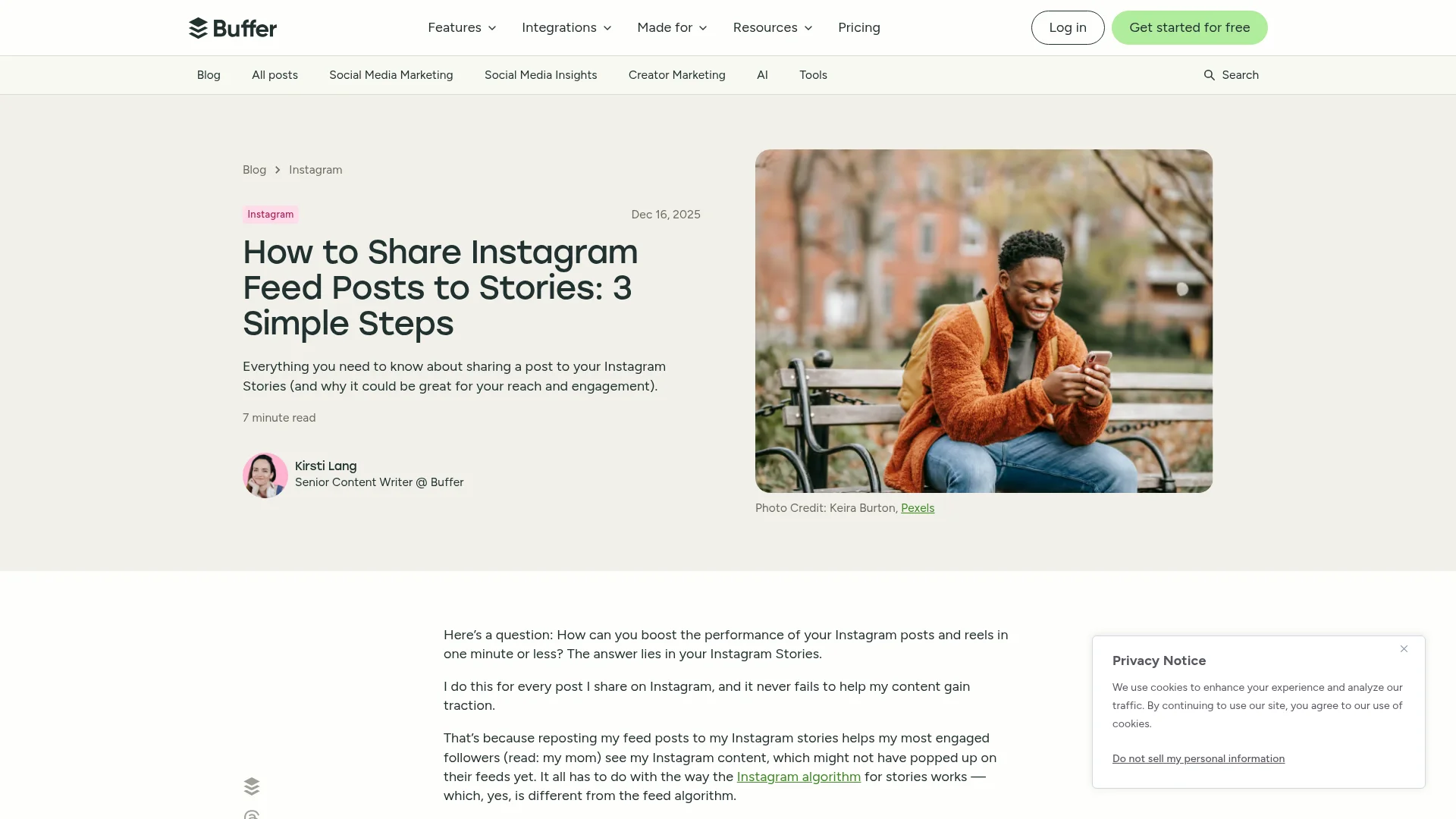
- How to Add a Post to Your Story on Instagram: 3 Simple Steps
/resources/add-instagram-post-to-your-story/ - I Turned $75/Day in Ad Spend Into 1 Million Views on My Reel
/resources/ad-spend-instagram-reels/ - Introducing a Better Way to Engage With Your Instagram Audience
/resources/buffer-engagement/
X (Twitter) & Facebook Tactics (~179 Pages) Growth, algorithm, ads, content formats, and feature coverage for X (formerly Twitter) and Facebook, the two largest text-and-link networks in Buffer's history. The largest single micro-topic inside Per-Network Playbooks. Twitter content stretches back to Buffer's earliest days when it was a Twitter-first product, and the X rebrand happened without restructuring the editorial back-catalog. Facebook coverage is mature and steady: foundational head-term content (best time to post, algorithm guides, beginner ads guides) plus a customer-success post that doubles as editorial ("How Business Insider Grew Its Facebook Page to 1M+ Fans With Buffer").
Sample pages:
- 10 Surprising New Twitter Stats for Marketers
/resources/10-new-twitter-stats-twitter-statistics-to-help-you-reach-your-followers/ - How to Use Twitter/X: The Complete Guide for 2026
/resources/how-to-use-twitter/ - Best Time to Post on Facebook, New Data from 14M Posts
/resources/best-time-to-post-on-facebook/
LinkedIn Tactics (~64 Pages) Growth, content formats, algorithm guidance, personal branding, newsletter strategy, and LinkedIn-specific features. B2B-leaning, with the most first-person creator stories of any network playbook ("How I Grew LinkedIn Audience to 42k+ Followers"). The "Best Time to Post on LinkedIn in 2026: 4.8M Posts Analyzed" page is another instance of Buffer's proprietary-data flagship pattern, and one of the highest-volume LinkedIn queries Buffer ranks for. Coverage tilts toward personal-brand and growth content rather than enterprise marketing-team ad mechanics, which reflects who Buffer's audience is on LinkedIn.
Sample pages:
- 30 Days of LinkedIn Post Prompts to Help You Build Your Following + Personal Brand
/resources/30-linkedin-prompts/ - Best Time to Post on LinkedIn in 2026: 4.8M Posts Analyzed
/resources/best-time-to-post-on-linkedin/ - LinkedIn Marketing in 2026: The Complete Guide
/resources/linkedin-marketing/
TikTok & YouTube Tactics (~77 Pages) Growth, algorithm, monetization, Shorts, format craft, and feature coverage for TikTok and YouTube. Both networks reward short-form vertical video and creator-style production, so their tactical content groups together more naturally than with the text-led platforms. TikTok content scaled up from 2020 onward, almost entirely growth-and-monetization focused, with proprietary post-volume data anchoring the head terms ("Best Time to Post on TikTok | Data from 7M Posts"). YouTube is the most under-invested of the major networks: 26 URLs against 107 for Instagram, a deliberate choice given that YouTube content production demands video-creator depth Buffer's text-based editorial doesn't naturally produce.
Sample pages:
- Best Time to Post on TikTok in 2026 | Data from 7M Posts
/resources/best-time-to-post-on-tiktok/ - TikTok Has Landed Me $160K in Brand Partnerships and a 6-Figure Book Deal: Here's How I Did It
/resources/tiktok-brand-partnerships/ - Best Time to Post on YouTube: Data from 1.8M Shorts + Long-form Videos
/resources/best-time-to-post-on-youtube/
Emerging Networks Coverage (~59 Pages) Coverage of newer or smaller networks where Buffer has dedicated editorial bets: Threads, Bluesky, Pinterest, Mastodon and the Fediverse, Snapchat, and BeReal. A coordinated launch pattern shows up: where Buffer's product integrates with a network, the editorial coverage gets meaningful volume. Threads (~15 URLs) and Bluesky (~10 URLs) scaled up alongside Buffer's product integrations. Mastodon and the Fediverse get coverage out of brand-fit rather than commercial scale, fitting Buffer's transparency-aligned posture. Pinterest (~20 URLs) is the largest sub-bucket inside this micro-topic, anchored by the /buffer-for-pinterest product page.
Sample pages:
- What Is Bluesky? Here's What You Should Know
/resources/bluesky-social/ - Buffer for Threads is Here: Plan, Schedule, Cross-post, and Analyze Your Content
/resources/buffers-threads-integration/ - Introducing Buffer for Mastodon
/resources/mastodon-scheduling/
Strategy insight: Folding seven networks into one cluster keeps Buffer's per-network editorial concentration visible without fragmenting the architecture. The "X million posts analyzed" research format that appears in every micro-topic is a Buffer signature: by using its own product data to anchor "best time to post" and algorithm posts, the company builds a moat that pure-editorial competitors can't match. The cluster's content-type mix (21% Guides & Resources, the highest of any subject cluster) reflects pillar-style guides built on top of the older blog back-catalog. The shape of the data also reveals where product investment leads editorial: every network with a dedicated /[network] landing page has a meaningful tactical content footprint, and where it doesn't, the network only surfaces in the glossary or in one-off posts.
3. Creator Economy & Personal Brand
Pages: 217 · Share of library: 7.3%
Creator-focused content: personal branding, audience-building across platforms, monetization paths, creator and small-business stories, and Buffer's audio shows and interviews. The newest editorial bet. Coverage scales up sharply post-2022 as Buffer's product positioning shifted toward creators.
Content-type mix: Blog/Editorial 79% · Guides & Resources 10% · Podcast/Audio Series 10% · Glossary 1% · Comparison Pages <1%
Micro-topics within this cluster
Small Business & Agency on Social (~91 Pages) How small businesses, agencies, and solo operators use social media to grow. The cluster's largest sub-theme, and the buyer-aligned anchor: Buffer's primary audience (creators, small businesses, lean marketing teams) maps directly onto this sub-theme. The mix of small-business listicles and operator profiles reads like editorial calibrated to the buyer Buffer wants to convert. Posts like "21 Small Business Brands We Love" and "How I Use AI (Responsibly) to Power My Content Marketing" anchor the micro-topic with operator-voice editorial.
Sample pages:
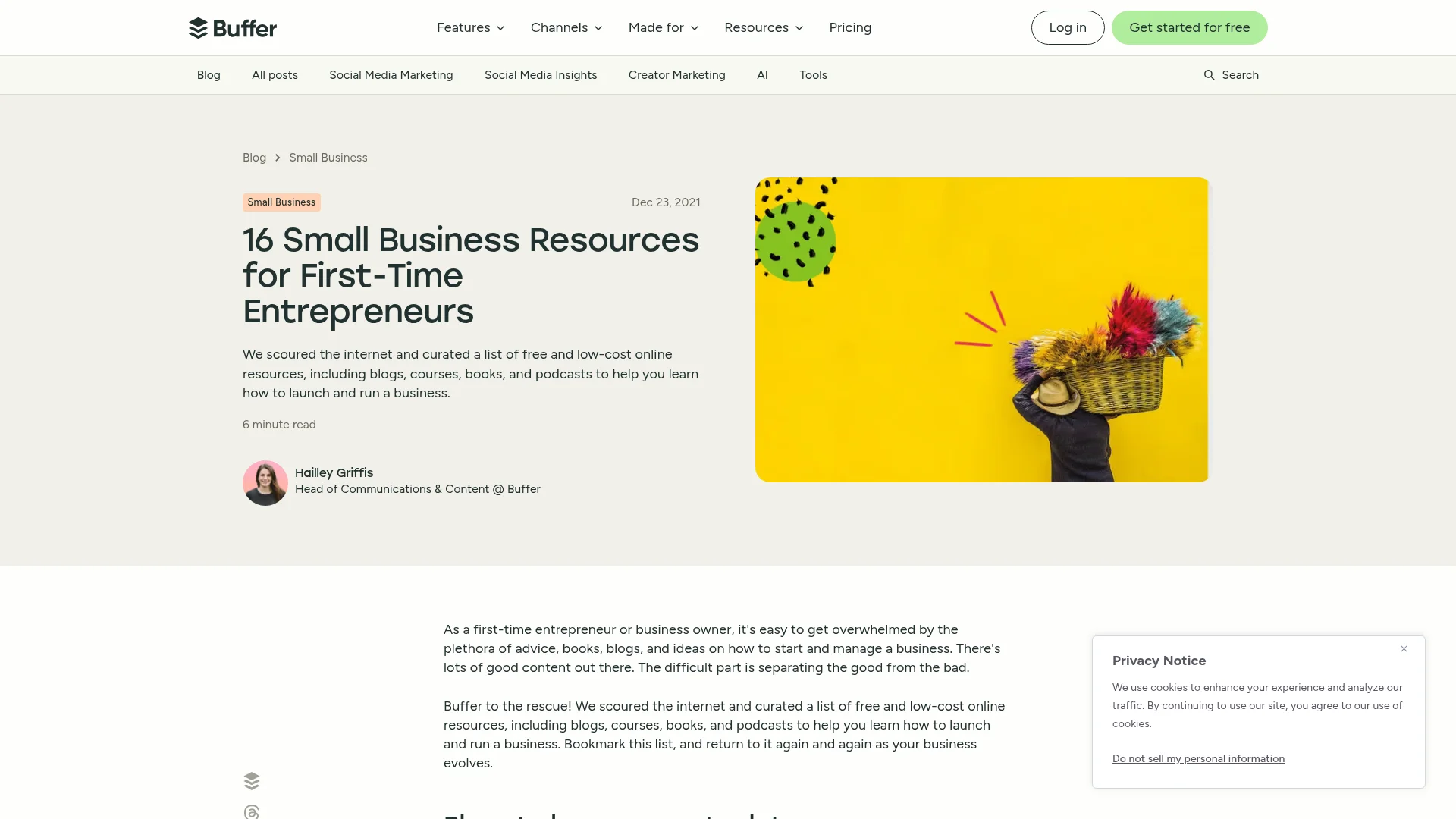
- 16 Small Business Resources for First-Time Entrepreneurs
/resources/16-small-business-resources-for-first-time-entrepreneurs/ - 21 Small Business Brands We Love
/resources/21-small-business-brands-we-love/ - How I Use AI (Responsibly) to Power My Content Marketing and Triple My Creative Output
/resources/ai-tools-content-marketing-agency/
Personal Branding & Thought Leadership (~60 Pages) Building a personal brand, positioning, executive presence, and thought leadership. The connective tissue between Buffer's product (a posting tool for individuals) and the creator-economy positioning. Titles like "Affiliate Marketing 101: How to Get Started As an Influencer" and "A Neurodivergent's Guide to Content Creation" target a specific creator-audience profile that's broader than the social-media-manager persona, and the first-person voice in this micro-topic doubles as both editorial and a creator E-E-A-T signal.
Sample pages:
- Affiliate Marketing 101: How to Get Started As an Influencer
/resources/affiliate-marketing/ - Yes, You Can Create Content: A Neurodivergent's Guide to Getting Started
/resources/a-neurodivergents-guide-to-content-creation/ - The AI Mindset Shift: How I Use AI Every Day
/resources/ai-mindset-shift/
Creator Stories, Monetization & Habits (~41 Pages) First-person creator interviews, monetization paths, brand partnerships, sponsorships, and posts on creator consistency and sustainable habits. Functions as Buffer's substitute for the Case Studies cluster the library doesn't maintain. Instead of named-customer business case studies, Buffer publishes named-creator personal stories with concrete revenue numbers in titles ("I Don't Do Paid Ads: How I Grew My Business to $270K+ in Revenue"). The pattern is consistent across the cluster and trades the proof-point register from "enterprise customer using Buffer" to "creator building a business with social media."
Sample pages:
- How I Built a 15,000-Person Community In Under 2 Years
/resources/build-a-community/ - I Don't Do Paid Ads: How I Grew My Business to $270K+ in Revenue
/resources/business-growth-without-paid-ads/ - Form a Content Creation Habit in 30 Days with Creator Camp
/resources/creator-camp-announcement/
Buffer Audio Shows & Interviews (~25 Pages) Episodes and notes from Buffer's podcast and audio surfaces: Science of Social Media (Buffer Podcast), Breaking Brand, Buffer Overflow Podcast, Snackchat video series, and how-to guides for starting a podcast. Audio sits inside the creator cluster because it shares the interview and personal-story format that defines the rest of the creator surface. For a brand with Buffer's editorial reputation, 25 audio URLs across four series is thin: enough to flag the category but not enough to compete for podcast-discovery searches the way a podcast-led peer would.
Sample pages:
- Podcasts
/resources/podcasts - Breaking Brand
/resources/breaking-brand/ - Announcing The Buffer Overflow Podcast
/resources/announcing-the-buffer-overflow-podcast/
Strategy insight: The 217-URL footprint for creator content is a deliberate pivot. Most of these posts publish from 2022 onward, which tracks Buffer's positioning shift from social-media-manager tool to creator-and-small-business tool. The Creator Stories, Monetization & Habits sub-theme acts as Buffer's substitute for traditional Case Studies (zero of which exist in the main sitemap), which is a defensible architectural choice for a creator audience but leaves a gap when convincing enterprise buyers who expect named-customer proof. The audio sub-theme is the strategic question mark: either commit to expanding it into a meaningful podcast surface or accept that podcast discovery happens primarily off-domain on Spotify and Apple Podcasts where episode-level indexing isn't a priority.
4. Buffer Culture & Remote Work
Pages: 298 · Share of library: 10.0%
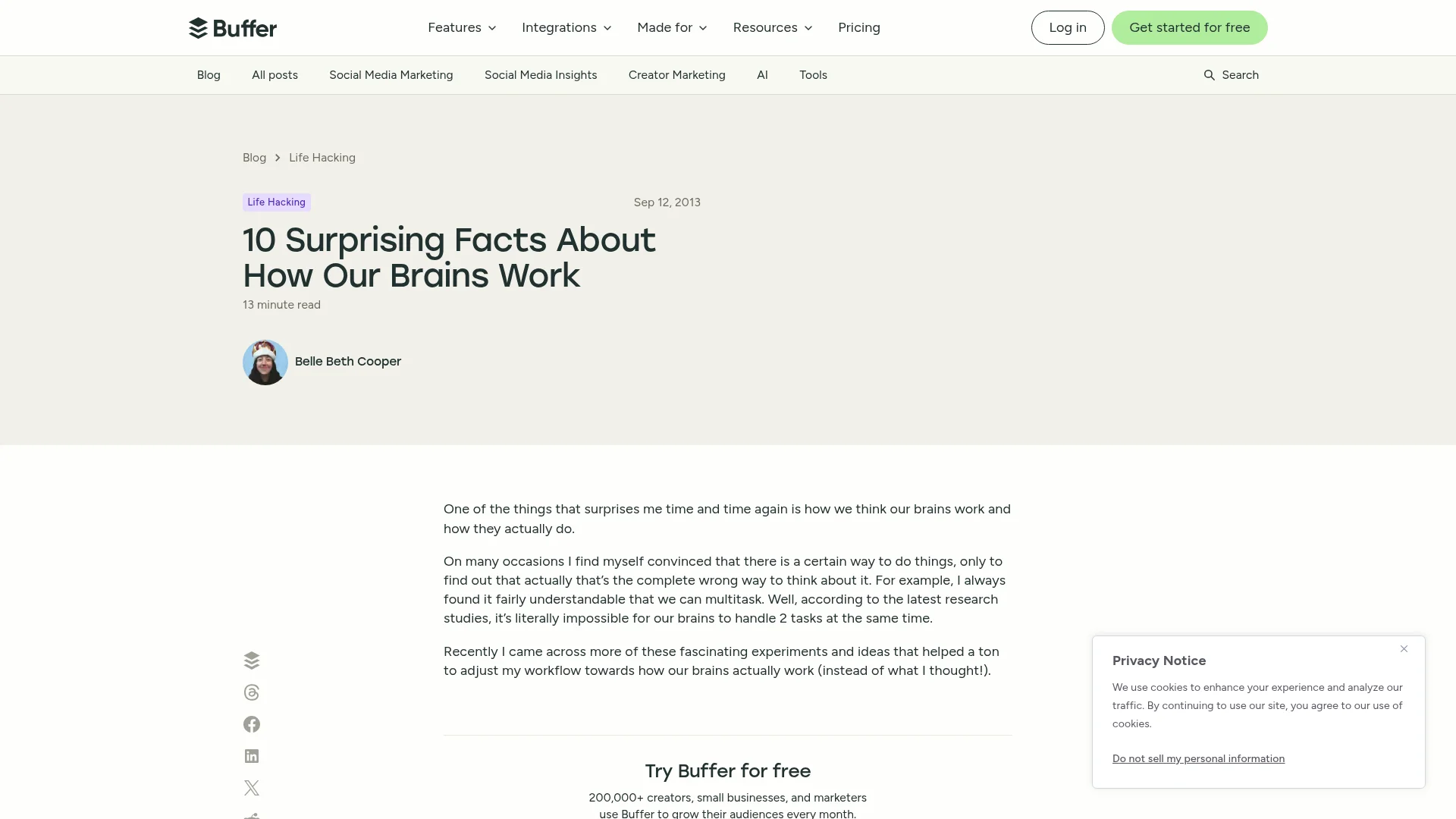
Distributed work, four-day week, sabbaticals, hiring philosophy, productivity, leadership values, and the engineering culture and technical posts from Buffer's Overflow Engineering sub-blog. A signature editorial surface that defines Buffer as an editorial brand and earns most of its backlinks from outside the social media management category.
Content-type mix: Blog/Editorial 95% · Guides & Resources 4% · Glossary <1% · Other <1% · Product & Feature Pages <1% · Research/Reports <1%
Micro-topics within this cluster
Leadership, Management & Values (~122 Pages) Leadership lessons, management philosophy, Buffer values, and operating principles. The cluster's largest sub-theme, but the most editorially diffuse. Titles range from CEO operating reflections to broad lifestyle content like "10 Ways to Be Happy with Yourself, Backed by Science." That mix is the tell: this is where Buffer's earliest editorial DNA shows up, when the blog was a mix of company-building posts and broad self-improvement content meant to attract readers who'd later become users.
Sample pages:
- How Our Brain Works: 10 Surprising Facts
/resources/10-surprising-facts-about-how-our-brain-works/ - Behind the Scenes of Buffer's 10th Retreat in San Diego, CA
/resources/10th-buffer-retreat/ - Digital Nomad Diary: Highs and Lows of 3 Months of Travel
/resources/11-cities-in-3-months-the-highs-and-lows-of-being-a-digital-nomad/
Remote & Distributed Work (~69 Pages) Building and operating a distributed team, async work, all-hands routines, and remote-work research. The editorial backbone of Buffer's brand identity as a remote-first company and one of the strongest backlink magnets on the site. The 69 URLs span operational how-tos (running all-hands meetings, async training) and broader cultural commentary, a content surface that runs through and around Buffer's brand identity. Pairs with the State of Remote Work research franchise in Cluster 5 as Buffer's most consistent multi-year content thesis.
Sample pages:
- 92 Pieces of Advice on Being Productive No Matter Where You Are, Working Remotely, and Digital Nomading
/resources/advice-productive-working-remotely-digital-nomading/ - How We Hold an Engaging All Hands Meeting as a Remote Team
/resources/all-hands/ - How We Offer Async Training To Our Fully-Distributed Customer Advocacy Team
/resources/async-training-customer-advocacy-team/
Hiring, Time Off & Wellbeing (~63 Pages) Hiring philosophy, new-hire introductions, onboarding, four-day workweek experiments, sabbaticals, time-off policy, and productivity and burnout content. Posts about how Buffer staffs, rests, and sustains its team cluster together as the people-operations layer above company values. The "I joined Buffer" introductory posts turn each senior hire into a piece of recruiting-funnel content, while the four-day workweek series is one of the most syndicated story arcs on the Buffer blog, referenced widely in mainstream business press when remote-work coverage spikes.
Sample pages:
- Transparent Time Off Dashboard
/timeoff - 4-Day Work Weeks: Results From 2020 and Our Plan for 2021
/resources/4-day-workweek-2021/ - We're Trying a 4-Day Workweek for the Month of May
/resources/4-day-workweek/
Engineering Culture & Overflow Blog (~44 Pages) Posts from Buffer's Overflow Engineering sub-blog: Android and iOS development, Kubernetes, data architecture, deployment, accessibility, and engineering practices. A distinctly-branded sub-blog with its own editorial voice. The technical specificity is the tell: these posts target a working-engineer audience, not a marketing audience. They function as recruiting content and as engineer-brand for a company whose product is mobile-heavy. The publication cadence has slowed (most posts publish in the 2015-2018 window), but the back-catalog continues to pull developer-community backlinks.
Sample pages:
- A brief look at Koin on Android - Overflow Buffer
/resources/a-brief-look-at-koin-on-android/ - How Does Buffer Deploy Code to Kubernetes - Overflow Buffer
/resources/buffer-deploy-code-kubernetes/ - Buffer's Data Architecture: How We Analyze 500M Records in Seconds
/resources/buffers-new-data-architecture/
Strategy insight: This cluster is what gives Buffer's editorial library its distinctive shape. The remote-work editorial cadence is the moat: 298 URLs of accumulated thinking on distributed work, four-day weeks, async operations, and engineering practices represents a back-catalog competitors can't replicate quickly, and it draws backlinks from outside the social media management category. Finance, HR, startup-strategy, and mainstream business press cite Buffer's remote-work posts reflexively. Folding the Overflow Engineering sub-blog inside the same cluster makes the recruiting-and-employer-brand strategy visible as one editorial bet rather than two parallel surfaces. Most direct peers don't maintain dedicated engineering content at all, which makes the 44-post engineering footprint structurally distinctive.
5. Open Buffer & Transparency
Pages: 160 · Share of library: 5.4%
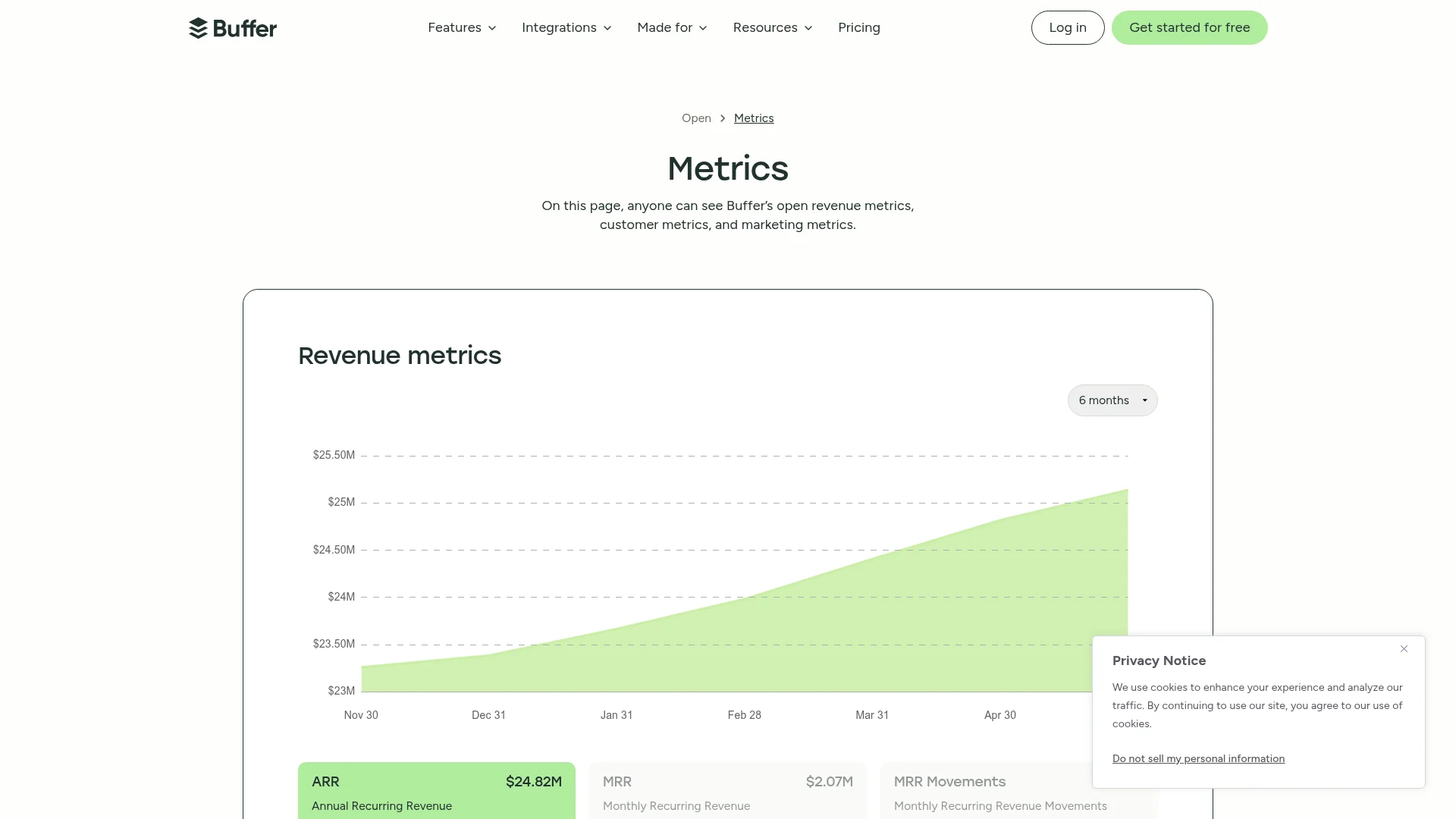
Buffer's signature transparency content: published salary formula, revenue and MRR reports, shareholder updates, transparent pricing and roadmap, monthly operations reports, and original research like State of Remote Work and State of Social Media Engagement. A 5%-of-library investment in content categories no direct peer maintains at scale.
Content-type mix: Blog/Editorial 86% · Research/Reports 7% · Guides & Resources 3% · Product & Feature Pages 3% · Free Tools 1% · Other 1%
Micro-topics within this cluster
Revenue, MRR & Financials (~68 Pages) Revenue reports, MRR updates, budgets, fundraising posts, and financial transparency. The cluster's largest sub-theme. Buffer has been publishing operating financials publicly since the early 2010s, and the back-catalog reflects a near-continuous monthly cadence in the company's first decade. The live /metrics and /open dashboards extend the same transparency practice into the present. No social media management peer publishes anything close to this.
Sample pages:
- Transparent Metrics Dashboard
/metrics - Buffer Open
/open - Reflecting on 10 Years of Building Buffer
/resources/10-years/
Team Ops & Monthly Reports (~38 Pages) Monthly operational reports across engineering, happiness, people-ops, and content marketing. A discontinued series (the cadence tapered in the late 2010s), but the back-catalog remains indexed because the posts pull steady backlinks from startup-strategy publications referencing Buffer's operating transparency. Keeping this archive live is a low-cost authority play.
Sample pages:
- The Buffer April Content Marketing Report: 729,832 Uniques, 22,291 Email Subscribers
/resources/april-content-marketing-report/ - Buffer Happiness Report: July 2013
/resources/buffer-happiness-report-july-2013/ - Buffer August Update: $4M ARR, Exploring New Funding
/resources/buffer-august-2014-investor-update/
Salaries, Pay & Shareholder Updates (~31 Pages) Salary formula, transparent pay analyses, gender-pay-gap reporting, compensation philosophy, and quarterly shareholder communications published publicly. The live /salaries and /shareholders pages anchor this micro-topic alongside annual pay-analysis reports. The salary formula posts are some of the most-cited Buffer content in HR and people-ops publications. Most private SaaS companies treat shareholder communications as confidential. Publishing them turns each update into a content asset, and the URL pattern (/shareholders/[slug]) signals an ongoing series rather than a one-off experiment.
Sample pages:
- Transparent Salaries
/salaries - Shareholder updates
/shareholders - 2021 Pay Analysis: How We've Lowered Our Gender Pay Gap From 15% to 5.5%
/resources/2021-pay-analysis/
Transparent Pricing, Roadmap & Original Research (~23 Pages) Pricing transparency, public product roadmap, plus first-party research like State of Remote Work, State of Social Media Engagement, and rolling platform benchmarks at /insights. Forward-looking transparency sits alongside original research because both extend Buffer's transparency practice into surfaces beyond financial reporting. State of Remote Work in particular is the single most-cited Buffer asset outside the social media management category, and one of the strongest backlink magnets in the library.
Sample pages:
- Transparent Pricing
/transparent-pricing - State of Remote Work Reports
/state-of-remote-work - Social Media Insights, Data, Benchmarks and Research, Powered by Buffer
/insights
Strategy insight: Open Buffer is the content asset that earns Buffer its outsized brand share-of-voice relative to its $21.48M ARR scale. 160 URLs of published financials, salaries, shareholder updates, operating reports, and first-party research is a category-of-one investment in social media management. No peer maintains anything comparable. The strategic payoff isn't search traffic (these URLs don't compete for high-volume social-media queries); it's brand authority, recruiting, and a steady stream of backlinks from outside the category. Folding the State of Remote Work and State of Social Media Engagement research franchises into the same cluster as the operating-data transparency reveals the underlying strategy clearly: every transparency surface compounds across years because it can't be replicated by a competitor publishing for the first time today.
6. Social Media Glossary
Pages: 105 · Share of library: 3.5%
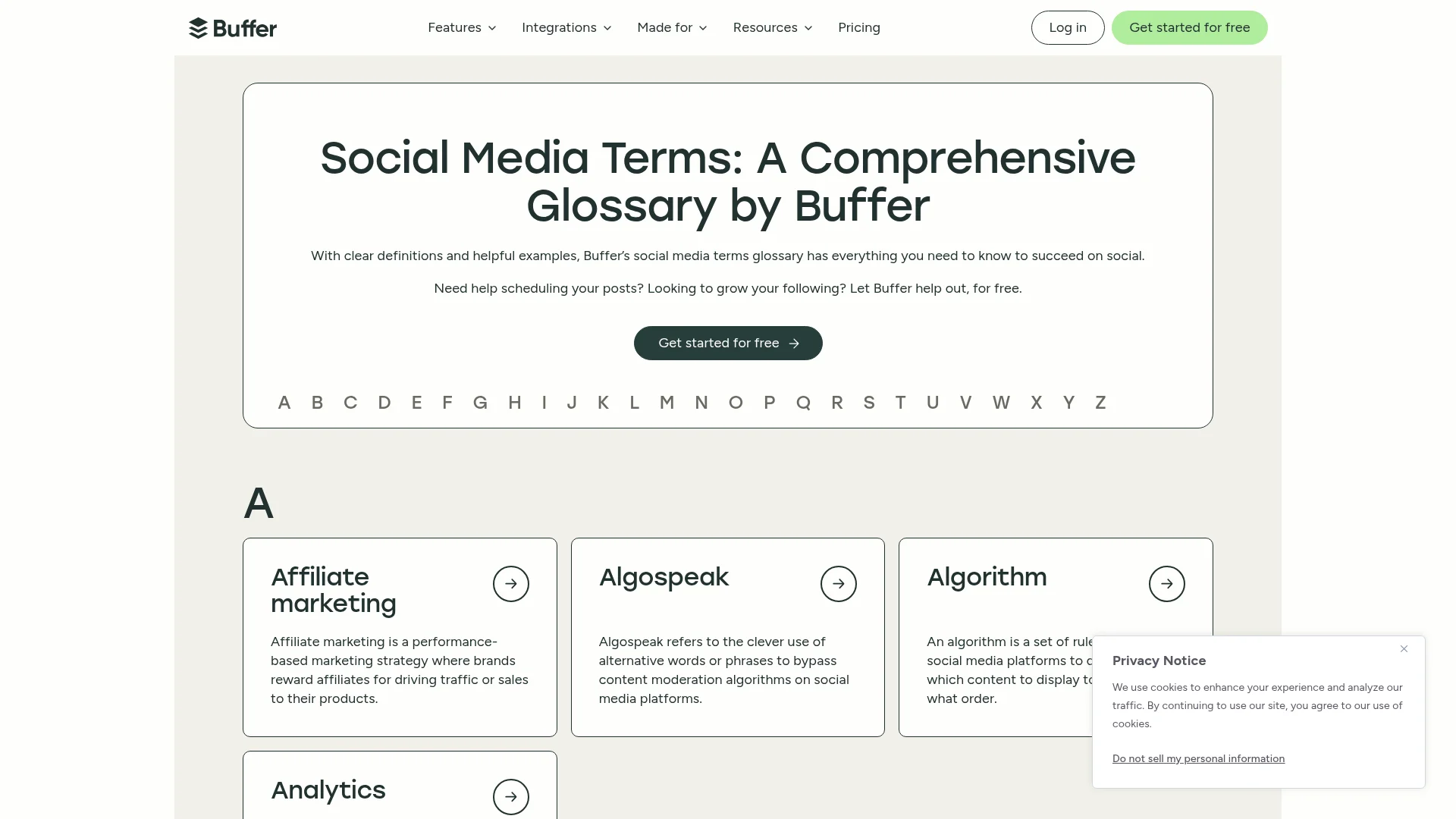
Buffer's glossary of social media terms: "What is X" definitional pages under /social-media-terms/. A clearly-bounded definitional surface built for AEO and head-term capture.
Content-type mix: Glossary/Definitions 100%
Micro-topics within this cluster
Marketing & Strategy Terms (~62 Pages) Definitions of marketing concepts: brand awareness, content pillars, campaigns, KPIs. The cluster's largest sub-theme. These are the head-term definitional searches ("what is content marketing," "what is engagement rate") that AI engines cite reflexively. A 62-URL footprint is enough to compete for category-vocabulary citations, which is a different game from blog SEO.
Sample pages:
- Social Media Terms: A Comprehensive Glossary by Buffer
/social-media-terms - What is Affiliate Marketing?
/social-media-terms/affiliate-marketing - What is Social Media Analytics?
/social-media-terms/analytics
Platform & Feature Terms (~28 Pages) Definitions of platforms (Bluesky, BeReal) and platform features (boosted post, Boomerang). Platform-name definitional pages compound as new networks emerge. Buffer can spin up a /social-media-terms/bluesky page faster than long-form coverage, which makes this micro-topic an early-adopter capture surface for emerging-network search demand.
Sample pages:
- What is an Algorithm?
/social-media-terms/algorithm - What is BeReal?
/social-media-terms/bereal - What is Algospeak?
/social-media-terms/algospeak
Creator, Community & Tactics Terms (~15 Pages) Definitions tied to creators and community (creator economy, community manager, CFBR) plus tactical and format vocabulary (batching, cross-posting, content pillars). Smaller but vocabulary-targeted at Buffer's creator-economy positioning, and at specific tactical concepts that pair with how Buffer's product is used.
Sample pages:
- What is Batching?
/social-media-terms/batching - What is a Content Pillar?
/social-media-terms/content-pillars - What is a Community Manager?
/social-media-terms/community-manager
Strategy insight: 105 definitional URLs is a meaningful AEO investment. Buffer has built a clean, single-template glossary surface that AI engines cite naturally. The expansion opportunity is significant: the social media management category has dozens of high-volume "what is X" searches Buffer hasn't covered yet (e.g., specific algorithm names, niche platform features, emerging-network jargon). At 116 total Glossary URLs across the library, Buffer is meaningfully ahead of peers like Hootsuite (whose Glossary footprint is smaller) but well short of saturating the AI-citation surface this format opens up.
7. Product Pages & Company Hub
Pages: 422 · Share of library: 14.2%
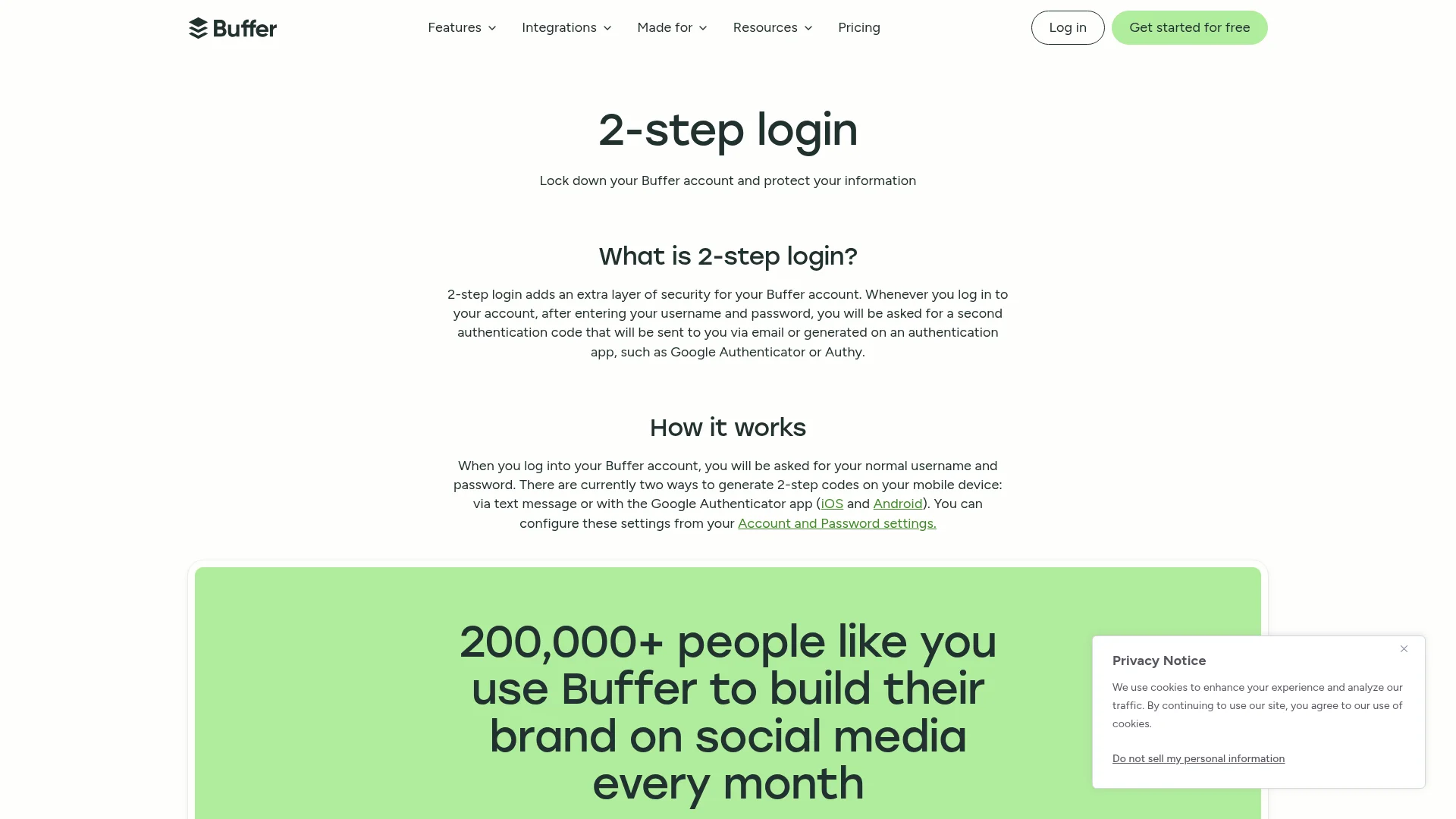
Buffer's commercial and corporate surface: product feature pages, per-network landing pages, free trial and competitor-alternative landers, vertical pages for agencies and nonprofits, free tools, plus all legal, about, careers, and navigation pages. Non-editorial pages that exist for conversion, corporate communication, or site navigation rather than search or thought leadership.
Content-type mix: Other 86% · Product & Feature Pages 12% · Free Tools 2% · Guides & Resources <1%
Micro-topics within this cluster
Navigation, Taxonomy & System Pages (~346 Pages) Author archives, paginated indexes, RSS endpoints, template placeholders, 404 and login pages, and other system URLs. Sitemap infrastructure inherited from a long-running WordPress blog: the bulk of the indexable URL count without meaningful editorial content. 82% of this cluster (and 12% of the entire indexable footprint) is taxonomy and navigation pages, mostly /author/ archives and paginated blog indexes.
Sample pages:
- Buffer | 2-Step Login
/2step - Mobile Redirect
/mobile-redirect - Sitemap
/sitemap
Product Feature Pages (~17 Pages) Feature pages: Publish, Analyze, Create, Engage, Start Page, Extensions, Developer API. Each Buffer product module gets its own URL: a standard SaaS product-page footprint. These are the conversion endpoints the rest of the library funnels readers toward.
Sample pages:
- Buffer: Social media management for everyone
https://buffer.com - Social Media Analytics & Reporting Made Simple
/analyze - Social Media Collaboration Tools for Creators and Teams
/collaborate
Network Landing Pages (~11 Pages) Per-network product landing pages (Instagram, TikTok, LinkedIn, Bluesky, Facebook, Google Business Profile, etc.). Each supported network gets a dedicated conversion-oriented landing page that mirrors Buffer's multi-network product positioning. The network sweep covers every major surface.
Sample pages:
- Schedule Instagram Posts, Stories, and Reels
/instagram - Schedule your Bluesky posts with Buffer
/bluesky - Schedule Google Business Profile Posts
/google-business-profile
Free Trial & Competitor Landing Pages (~15 Pages) Free-trial landing pages under /free-trial/ including competitor-alternative landers. The competitor-alternative landers are notable: Buffer maintains direct displacement landing pages despite a thin formal Comparison Pages cluster (22 URLs total). The free-trial pattern with embedded competitive positioning is a paid-search-style landing-page approach repurposed for organic, and several of the 15 URLs are competitor-displacement landers (free Hootsuite alternative, etc.).
Sample pages:
- Buffer | Start Your Free Trial Today
/free-trial - Buffer: #1 Free Hootsuite Alternative To Manage Your Social
/free-trial/free-hootsuite-alternative - Buffer | Instagram Scheduler, Free Forever
/free-trial/free-instagram-scheduler
Corporate, Vertical & Free Tool Pages (~33 Pages) About, press, careers, legal, accessibility, partner programs, vertical pages for agencies and nonprofits, and free utilities like the hashtag generator and UTM builder. Standalone corporate and utility surfaces that exist for compliance, recruiting, partnerships, and free-tool acquisition rather than editorial reach. Each free tool is a top-of-funnel acquisition surface that hands off to Buffer's product.
Sample pages:
- Buffer | About Us
/about - Social Media Management Tool for Agencies
/agency - Free Social Media Marketing Tools
/free-tools
Strategy insight: Buffer maintains a denser network of /free-trial competitor-alternative landing pages than its formal Comparison Pages cluster suggests. Six of the 15 free-trial URLs are competitor-displacement landers, which means Buffer has more competitive content than the 22-URL Comparison Pages count surfaces, just routed through a different URL pattern. The split between /compare-style pages and /free-trial-style pages is a categorization quirk worth noting for anyone benchmarking competitive content footprint. The 346 navigation/taxonomy URLs are sitemap noise: they inflate the apparent library size by 12% and contribute the bulk of the URL count without contributing search value, though Buffer's 824 visits/URL average suggests the noise doesn't materially affect per-page traffic efficiency.
Key Observations
What Stands Out About Buffer's Content Strategy
The library is editorial-led, with two clusters carrying 60% of all pages
68% of every page Buffer publishes is Blog or Editorial content, and the library concentrates into a 1,294-URL Social Media Strategy & Content cluster plus a 486-URL Per-Network Playbooks cluster. Together those two clusters hold 59.7% of the library. The Strategy & Planning sub-theme alone (~527 URLs) is larger than the entire content libraries at smaller peers like Loomly (482 URLs total). This is an editorial publication, not a documentation channel, and the concentration reflects how heavily Buffer has bet on cross-network and per-network editorial as the engine of its organic footprint.
Open Buffer transparency is a category-of-one compounding asset
160 URLs of published salaries, revenue and MRR reports, shareholder updates, monthly ops reports, transparent-pricing pages, and first-party research like State of Remote Work, plus live dashboards at /salaries, /metrics, /open, and /transparent-pricing. No other company in the social media management category publishes operating data at this depth. The series stretches back over a decade and earns recurring backlinks from finance, HR, and startup-strategy publications well outside Buffer's core audience. New entrants can't replicate this in a quarter; the back-catalog itself is the moat.
Per-URL efficiency runs at challenger levels despite leader-sized library
824 visits per URL across 2,982 pages is high. Only Later (2,269) and Sprout Social (1,015) run higher visits-per-URL ratios in the category, and both have substantially smaller libraries. Most libraries this size dilute per-page performance as they grow. Sustaining a working ratio at this scale signals either disciplined editorial pruning (which doesn't appear to be the case given the long-tail back-catalog visible in the data) or sustained traffic compounding on a relatively narrow set of head-term rankers. The proprietary-data flagship posts ("X million posts analyzed") look like the most likely engine.
19,747 ranking positions sit in the optimization sweet spot
23.4% of Buffer's ranking positions are in the top 10, the highest top-10 share in the social media management category. But 19.5% of positions (19,747 individual rankings) sit in positions 11-20, the single largest optimization opportunity Buffer has. Focused work on those URLs could push individual pages onto page one of Google without requiring new content investment. For a library already running at 824 visits per URL, even modest improvements on that 19,747-position layer translate into measurable traffic compounding.
Three structural gaps (Case Studies, Events/Webinars, and Documentation) are entirely absent
Zero URLs in the main sitemap for Case Studies, Events/Webinars, and Documentation. Each is a deliberate architectural choice rather than oversight: Buffer substitutes creator stories for case studies, runs no live sessions surface despite a fully remote team that could produce them at low cost, and keeps any developer-facing technical content off the main domain. The Case Studies gap is the most strategically interesting. Buffer has named customers like Microsoft, Shopify, GitHub, and Trello that would anchor enterprise-credibility proof, and the substitution of creator stories trades a different audience signal for that proof.
Comparison-page investment is light for a category leader
22 canonical Comparison Pages across a 2,982-URL library is roughly 0.7% of the footprint. Thin for a market leader whose direct competitors run aggressive "Buffer alternatives" displacement campaigns. Some of the gap is recovered by competitor-alternative landing pages under /free-trial/ (e.g., /free-trial/free-hootsuite-alternative), but the formal head-to-head comparison surface is modest. Challengers running displacement campaigns against Buffer have a wider longer-tail surface than Buffer has chosen to defend.
The /resources URL prefix overloads architecturally
2,777 of Buffer's 2,982 URLs share the /resources path: 93% of the indexable footprint, spanning 8 content types and 6 of the 7 topic clusters. The prefix does multiple jobs at once: blog posts, glossary entries (though most glossary URLs sit at /social-media-terms/), tool roundups, transparency reports, engineering posts, and creator interviews all live there together. This URL-architecture flatness may dilute search engines' understanding of section authority. Splitting Open Buffer, the Overflow Engineering posts, and the per-network playbooks into dedicated paths would be a sitemap-clarity improvement that surfaces editorial structure to crawlers as cleanly as it surfaces to readers.
The audio surface is thinner than Buffer's brand reputation suggests
25 podcast and audio URLs across four series (Buffer Podcast, Breaking Brand, Buffer Overflow, Snackchat) is enough to flag the category but not enough to dominate any specific podcast-discovery search. Compared to dedicated podcast-led peers in adjacent SaaS categories, the gap is large. Either the audio program is run as a brand experiment alongside the editorial core (which the URL count suggests), or distribution happens primarily off-domain on Spotify and Apple Podcasts where episode-level indexing isn't a priority. For a company with Buffer's editorial reputation, the gap is one of the few obvious investment imbalances in the library.
More analyses in Social Media Management
Hootsuite
How Hootsuite uses 629 guides and a 129-URL research franchise to drive 2.97M monthly visits in social media management. 3,826 pages, 9 clusters.
Later
How Later uses 674 blog posts, a 281-term glossary, and a 58-episode podcast to drive 3.6M monthly visits in social media management. 1,572 pages, 7 clusters.
Loomly
How Loomly uses 336 blog posts and a 62-term marketing glossary to drive 40K monthly visits in social media management. 482 pages, 4 clusters.
Planable
How Planable uses 386 blog posts and 33 free AI content tools to drive 191K monthly visits in social media management. 600 pages, 5 clusters.
Methodology: This analysis is based on Buffer's full public sitemap (2,982 URLs, sourced from robots.txt), enriched with each URL's title and meta description via lightweight HTTPS fetches. URLs were classified into a 12-bucket content type taxonomy and grouped into 7 topic clusters with 30 micro-topics using LLM-assisted classification. Company facts came from public web research across Crunchbase, LinkedIn, X, and Buffer's own About and shareholder pages. Traffic metrics (monthly organic visits, traffic value, ranking positions, position distribution) came from DataForSEO's domain rank overview, aggregated globally across 117 locale combinations. All counts reflect the Buffer sitemap as of 2026-05-26.