
Summary
Later drives 3,567,288 monthly organic visits from a library of just 1,572 indexable pages. That's the highest monthly traffic of any social media management platform measured, achieved with one of the smallest libraries in the category. The architecture is built around two flagship pillars: a 674-post blog and a 281-entry Glossary that together account for 61% of every page Later publishes. A 344-page Influencer & Creator Marketing cluster, inherited from the 2022 Mavrck merger and now folded together with brand case studies and affiliate content, sits alongside the social-management content and gives Later a content surface no pure scheduling competitor can match. Per-URL efficiency is the defining metric: ~2,269 visits per page, more than double the nearest category peer.
Key facts:
- Library size: 1,572 indexable pages organized into 7 topic clusters; 42.9% Blog / Editorial
- Largest cluster: Multi-Platform Social Media Strategy (414 URLs, 26.3% of library)
- Flagship content asset: Beyond Influence Podcast, 58 episodes hosted by Kwame Appiah and Scott Sutton featuring creators, brand operators, and influencer marketing leaders
- Search performance: 3.57M monthly visits across 87,538 ranking positions; 21.8% in top 10 (~2,269 visits per page)
- Notable gap: Only 6 Research / Reports URLs and 19 Comparison Pages across the 1,572-page library. Research and comparison surfaces are thin for the category's traffic leader
Company Overview
Later at a Glance
| Company | Later (formerly Mavrck, LLC) |
| Founded | 2014 · Boston, MA, USA |
| Category | Social Media Management / Influencer Marketing |
| What They Do | Later is a social media management and influencer marketing platform that helps brands, agencies, and creators plan, schedule, and publish content across Instagram, TikTok, YouTube, and other social channels, while also running influencer campaigns and measuring social-driven revenue. The combined company (formed when Boston-based Mavrck acquired Vancouver-born Later in 2022 and unified under the Later brand in 2024) sells to marketing teams ranging from SMBs and agencies to enterprise brands. Named customers include Nike, Anthropologie, Lululemon, Southwest Airlines, and El Pollo Loco. |
| Funding | $255M total raised; last round a $135M strategic investment from Summit Partners (April 2022) |
| Headcount | 201-500 (LinkedIn band) |
| Monthly Organic Visits | Traffic Value (PPC equiv.) | Ranking Positions |
|---|---|---|
| 3.57M | $1.24M | 87.5K |
Ranking positions reflect total positions across 117 indexed (location, language) combinations, not unique keywords.
Later's content operation is dense and efficient: 1,572 indexable pages publishing into a single English locale, generating roughly 2,269 visits per page. Two structural choices define the architecture. First, a deliberately franchise-led split between Blog / Editorial (674 URLs) and Glossary / Definitions (281 URLs). Second, a 344-page Influencer & Creator Marketing cluster that reflects the Mavrck/Mavely merger and now houses the brand-side case studies and affiliate playbooks alongside the campaign content. There is no technical documentation in the main sitemap, and the library reads as a clean, single-locale operation.
Content Architecture
What Does Later's Content Engine Look Like?
Later's main website hosts 1,572 indexable pages organized into 7 topic clusters. The architecture is a franchise-led two-pillar play (a long-running editorial blog supported by a structured definitional library) rather than a single-format content engine.
Content Type Distribution
| Content Type | Count | Share | Notes |
|---|---|---|---|
| Blog / Editorial | 674 | 42.9% | Dominant pillar; spans the full editorial library |
| Glossary / Definitions | 281 | 17.9% | Unusually large for a social media platform; heavy on slang/pop-culture entries |
| Guides & Resources | 183 | 11.6% | Pillar guides, captions library, downloadable templates |
| Other | 165 | 10.5% | Resource hub pagination, blog pagination, taxonomy roots, legal pages |
| Product & Feature Pages | 59 | 3.8% | Platform-specific scheduler pages, analytics, link-in-bio |
| Podcast / Audio Series | 58 | 3.7% | Beyond Influence Podcast, 58 episodes |
| Case Studies / Customer Stories | 54 | 3.4% | Brand and agency case studies on Later Influence and Later Social |
| Free Tools | 39 | 2.5% | Calculators, generators, templates |
| Events / Webinars / Sessions | 34 | 2.2% | LaterCon, webinars, training sessions |
| Comparison Pages | 19 | 1.2% | Later-vs-competitor alternatives pages |
| Research / Reports | 6 | 0.4% | 2025 State of Influencer Marketing Report, Creator Compensation, Creator Mental Health |
| Documentation | 0 | 0.0% | Not present in www sitemap |
Key finding: Two content types (Blog / Editorial and Glossary / Definitions) account for 61% of every page Later publishes. This is a franchise-led architecture rather than a traditional blog-only play. The Glossary in particular runs much larger than the format usually does in this category, and most of those entries define social media slang rather than product or marketing terminology.
Content Strategy Archetype
Later operates a franchise-led two-pillar library anchored by an editorial blog and an outsized definitional Glossary, with an attached creator-economy podcast and a merger-inherited influencer marketing surface. This archetype is uncommon in social media management. Most peers in the category (Buffer, Hootsuite, Sprout Social) lean into a single editorial blog pillar with utility surfaces around it. Later's choice to invest in 281 Glossary entries (most of them slang and pop-culture terms) treats definitional content as a recognized franchise, not an afterthought. Combined with the inherited Mavrck influencer marketing content, the result is a library that's smaller than peers but covers more of the buyer's vocabulary surface.
Search Performance Quality
Where Later Ranks
The DataForSEO domain rank overview shows Later ranking in 87,538 positions across 117 locales. The distribution is broad-and-shallow: a long tail of positions in pages 2 through 10 of search results, with a focused but smaller top-10 footprint.
| Position | Count | Share |
|---|---|---|
| #1 | 3,235 | 3.7% |
| #2–3 | 4,595 | 5.3% |
| #4–10 | 11,247 | 12.8% |
| #11–20 | 13,221 | 15.1% |
| #21–50 | 36,787 | 42.0% |
| #51–100 | 18,453 | 21.1% |
21.8% of Later's ranking positions are in the top 10, roughly in line with category peers like Hootsuite (22.3%) and Agorapulse (21.8%), and below the category's top-10 share leader Buffer (23.5%). The actionable signal sits underneath: 13,221 positions in 11-20 (page 2 of Google) and 36,787 more in 21-50. Pushing even a fraction of the 11-20 slice into top-10 would compound traffic on an already efficient library.
Per-URL efficiency is the standout: ~2,269 visits per page, more than twice the nearest peer (Sprout Social at ~1,015). This is the highest visits/URL of any social media management platform measured, and it's what makes the 1,572-page library punch above its weight. The flip side is that sustaining this efficiency at scale is harder than scaling URLs. Every new page has to clear a high traffic bar.
Content Deep Dive
What Is Later Actually Publishing, and How?
Later's content organizes around 7 primary topic clusters. Each cluster is described below with content-type composition, the micro-topics inside it, and concrete example URLs. Cluster and micro-topic groupings reflect a per-URL classification of the full sitemap. Counts are exact, not approximate.
1. Multi-Platform Social Media Strategy
Pages: 414 · Share of library: 26.3%
The library's largest cluster by a wide margin: platform-agnostic strategy, calendars, planning, cross-platform trends, the social media manager craft, analytics and measurement, and the bulk of Later's Glossary entries (mostly slang and pop-culture terms). It sits above the platform-specific clusters and carries the cluster volume that pure single-platform competitors can't match. The decision to fold cross-platform analytics into this cluster (rather than splitting it off) keeps measurement vocabulary alongside the strategy vocabulary that buyers and practitioners search together.
Content-type mix: Glossary / Definitions 51.5% · Blog / Editorial 35.5% · Free Tools 6.3% · Product & Feature Pages 2.7% · Guides & Resources 1.9% · Events 1.7% · Research/Reports 0.5%
Micro-topics within this cluster
Social Media Slang & Pop Culture (~188 Pages)
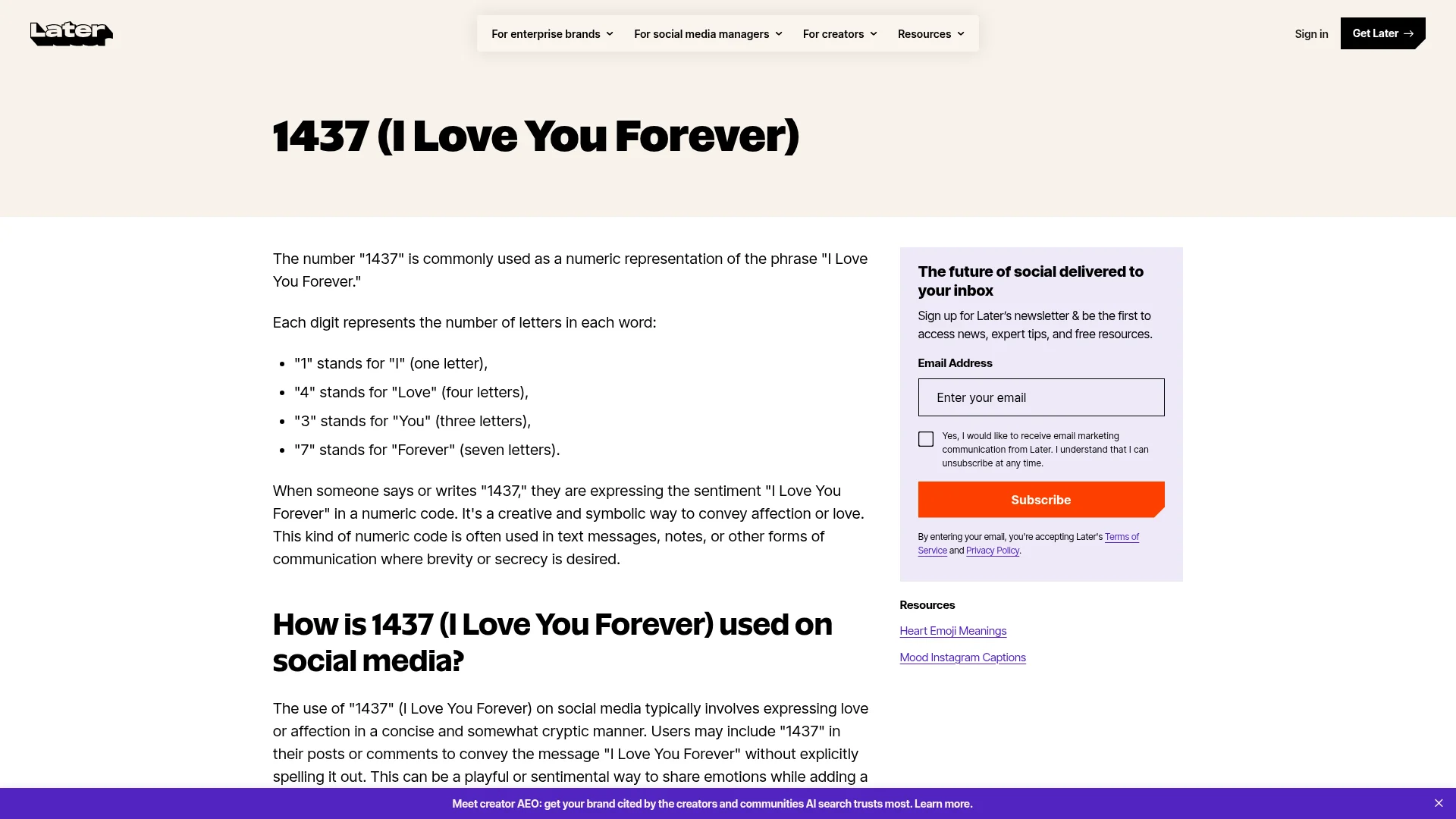
The single largest micro-topic anywhere in Later's library: 188 Glossary entries defining viral slang, internet acronyms ("1437"), meme phrases, and generational vocabulary under /social-media-glossary/. Most B2B SaaS libraries treat the Glossary as a small AEO surface for product or category terms. Later treats it as a 188-URL franchise covering the language Gen-Z audiences actually use. The play is clear: when a marketer or creator searches "what does 1437 mean," they land on Later. That builds top-of-funnel brand awareness with the audience least likely to encounter Later through a buying search.
Sample pages:
- What does 1437 mean? | Later Social Media Glossary
/social-media-glossary/1437/ - What is an Access Group? | Later Social Media Glossary
/social-media-glossary/access-group/ - What does "Accountant" mean online? | Later Glossary
/social-media-glossary/accountant/ - What is an Aesthetic? | Later Social Media Glossary
/social-media-glossary/aesthetic/
Strategy, Planning & Trends (~125 Pages)
Strategy frameworks, content calendars, posting cadences, generational marketing insights, accessibility coverage, holiday playbooks, and platform-launch reactions (BeReal, Threads). The mix matches how social media managers search before they search for a specific platform: a strategy question first, a tool question second. Pieces like "best social media schedulers in 2026" sit alongside narrative breakdowns like the Bad Bunny Super Bowl content strategy analysis, which lets the same micro-topic capture informational TOF queries and commercial-investigation queries with one editorial cadence. Cultural-moment and timestamped explainers (BeReal, AAPI Heritage Month, Threads launch) age into reference posts and compound long-tail traffic.
Sample pages:
- Bad Bunny's Super Bowl Performance: A Lesson in Content Clarity
/blog/bad-bunny-super-bowl-content-strategy/ - Social Media Accessibility: Top Alt Text for Social Media Tips
/blog/alt-text/ - How to Celebrate AAPI Heritage Month on Social Media | Later
/blog/asian-american-and-pacific-islander-heritage-month-on-social-media/ - Social Selling: The Definitive Guide (2022 Update)
/social-selling/
Analytics & Measurement (~51 Pages)
Engagement rate calculation, reach versus impressions, KPI frameworks, reporting and dashboards, industry benchmark reports, and Later Social's analytics product surface. The "5 signs you've outgrown basic social media analytics" framing is the bridge that ladders editorial readers toward paid analytics tooling. The 3-URL benchmark layer (Instagram Industry Benchmarks, Creator Mental Health Report, Competitive Benchmarking) is small but distinctive. Original benchmark data earns the kind of citation traffic Glossary entries can't, and extending the franchise into quarterly or annual editions would compound authority quickly.
Sample pages:
- Social Analytics Software for Smarter Social Insights | Later
/social-media-analytics/ - Alpha Access: Later Trend Score
/trend-score/ - 8 Ways to Build a Brand Awareness Campaign to Boost ROI in 2025
/blog/brand-awareness-campaign/ - Modern Hootsuite Competitors for Social Teams | Later
/blog/hootsuite-competitors/
Social Media Manager Craft & Community (~50 Pages)
Becoming a social media manager, agency-versus-in-house career paths, salary content, certifications, mental health, social listening, brand reputation monitoring, LaterCon, and webinar landing pages. This is audience-of-one content, written for the practitioner, not the buyer their company employs. It functions as long-tail audience-building: the social media manager who finds Later through a career article becomes the social media manager who recommends Later when their team evaluates tools. The 13-URL social listening sub-thread is the cluster's bridge into enterprise functionality. Small-business buyers don't search for "social listening," but mid-market and agency buyers do.
Sample pages:
- Tools for Social Media Managers to Schedule & Analyze | Later
/social-media-managers/ - Social Media Management for Small Businesses Made Easy | Later
/small-business-owners/ - Brand Reputation Management Software—Protect Your Brand | Later
/reputation-management-software/ - LaterCon - Social Media & Digital Marketing Conference
/latercon/
Strategy insight: This cluster does four jobs at once. It captures generic "social media strategy" search demand with the editorial layer, owns the slang-defining surface that most B2B SaaS libraries ignore, holds the analytics vocabulary that buyers use when defending budget to leadership, and surfaces the social media manager craft as audience-building content. The Slang & Pop Culture micro-topic alone (188 URLs) is larger than any single cluster at most peer companies. That investment is hard to copy because the entries are short, but the volume took years to compound: a defensive position built one term at a time.
2. Influencer & Creator Marketing
Pages: 344 · Share of library: 21.9%

The second-largest cluster and the structural inheritance from the 2022 Mavrck merger: brand-side influencer marketing, campaigns, EMV measurement, creator search, outreach, payments, brand case studies, vertical playbooks, affiliate programs, and the Later Influence product surface. This cluster is the single biggest reason Later's library can't be benchmarked against pure social media schedulers like Buffer or SocialBee on a like-for-like basis. Folding the 55 brand case studies and the affiliate-marketing content into this cluster reflects the buyer journey: a marketing leader evaluating Later Influence reads campaign playbooks, ROI frameworks, and proof points in the same browsing session.
Content-type mix: Blog / Editorial 44.8% · Case Studies / Customer Stories 15.7% · Guides & Resources 13.7% · Events/Webinars 7.8% · Glossary / Definitions 7.8% · Product & Feature Pages 7.3% · Free Tools 1.5% · Research/Reports 0.9%
Micro-topics within this cluster
Influencer Strategy & Campaigns (~159 Pages)
The cluster's dominant sub-theme: campaign design, briefs, contracts, gifting strategies, campaign timelines, payments and program operations, plus the "Made You Look" campaign showcase library. 159 URLs is more pages than most pure social media schedulers have in their entire library, and the depth reflects Mavrck's pre-merger position as an enterprise influencer platform. The vocabulary ("campaign strategy," "brief," "contract") matches what marketing leaders use when they brief agencies, making this sub-theme a competence-signal as much as an SEO surface. Buyers want to see the depth before they trust the platform.
Sample pages:
- Made You Look: Campaigns so good you break the algorithm.
/made-you-look/ - 10 influencer marketing tips from the minds behind the internet's biggest campaigns
/blog/10-expert-influencer-marketing-tips-from-internets-biggest-campaigns/ - 5 creators who stopped the scroll: What brands can learn
/blog/5-creators-who-stopped-the-scroll/ - How to Add a Link to Your Instagram Story in 2025
/blog/add-links-instagram-stories/
Creator Discovery & Vetting (~60 Pages)
Finding influencers, vetting creators, micro-influencer programs, brand ambassadors, and UGC creator sourcing, supported by named product pages like the 10M+ Creator Influencer Network and the Brand Ambassador Management surface. The volume is the strategic point: 60 URLs dedicated to finding and qualifying creators is depth pure scheduling tools can't match without an acquisition. The product pages also do something the editorial content alone can't: give specific named-feature URLs ("Influencer Network With 10M+ Creators") to compete on AEO surfaces where AI engines cite specific scale claims.
Sample pages:
- Brand Ambassador Management for Creator Programs | Later
/brand-ambassadors/ - Influencer Marketing and Social Media Management | Later
/influencer-creator-program/ - Influencer Network With 10M+ Creators | Later
/influencer-network/ - Micro Influencer Marketing Platform for Authentic Connections
/micro-influencers/
Brand Influencer Case Studies (~55 Pages)
Brand and agency case studies showing measurable outcomes with Later Influence and Later Social. Customers include 24 Hour Fitness, American Girl, American Greetings, Bibigo, Magnetic Creative, and others. Case study titles foreground the outcome (impressions, engagement, campaign reach) rather than the customer name first. Two outliers worth flagging: the "Later Runs on Later" self-referential pieces (Later's own marketing team using Later Influence and Later Social) are a credibility move that competitors who don't or can't eat their own cooking can't reproduce. And 50 brand-side studies versus only 2 agency-led ones is a meaningful imbalance for a platform that explicitly names agencies in its audience definition.
Sample pages:
- Influencer Marketing & Social Media Case Studies | Later
/case-studies/ - How 24 Hour Fitness scaled to 197K+ impressions and 51% peak engagement with Later
/case-studies/24-hour-fitness/ - American Girl: Influencer Marketing Case Study from Later
/case-studies/american-girl/ - How American Greetings Built a Powerful Influencer Campaign
/case-studies/american-greetings/
Influencer ROI, EMV & Affiliate (~37 Pages)
Earned media value, attribution, ROI measurement, analytics for brand-side influencer marketing, plus affiliate marketing strategies and the Mavely affiliate-network partnership. The "10 Creator Campaign Metrics Your CEO Actually Cares About" framing is the tell: this is content written to give an enablement-stage buyer the language they need to justify the budget to a finance team. EMV is also a Mavrck-native concept, and owning the EMV vocabulary is the kind of category-shaping move that pre-merger Mavrck invested in heavily. The affiliate layer (anchored by Mavely) turns creator content into trackable revenue and gives the cluster a commerce-side proof point distinct from the campaign-side one.
Sample pages:
- Affiliate Marketing: Grow Sales with Influencer Affiliates
/affiliate-marketing/ - 10 Creator Campaign Metrics Your CEO Actually Cares About
/blog/10-creator-campaign-metrics-your-ceo-actually-cares-about/ - 6 best influencer marketing tools built for real results in 2026
/blog/6-best-influencer-marketing-tools-built-for-real-results-in-2026/ - How Affiliate Links Upgrade Your Influencer Marketing Program
/blog/affiliate-links/
Influencer Verticals, Products & Research (~33 Pages)
Industry-specific playbooks across food and beverage, fashion and beauty, CPG, retail, ecommerce, and agencies, alongside Later Influence product pages and the three branded research reports (the 2025 State of Influencer Marketing Report, the Creator Compensation Report, and the underlying reports hub). The vertical pattern matches Later's existing notable customers (Anthropologie, Lululemon, El Pollo Loco span CPG and fashion) and lets the company point to verticalized landing pages in sales conversations. Three Research / Reports URLs sit inside this cluster, and they anchor the entire library's most defensible content asset: branded annual research that compounds across editions. Whether this research franchise scales beyond three URLs into a multi-edition library is the most consequential editorial decision Later can make in 2026.
Sample pages:
- Influencer Marketing Platform for Agencies | Later
/agencies-freelancers/ - Influencer Marketing for CPG Brands & Campaigns | Later
/cpg-influencers/ - Influencer Marketing for Ecommerce & DTC Brands | Later
/ecommerce-influencers/ - Fashion Influencer Marketing Platform & Tools | Later
/fashion-beauty-influencers/
Strategy insight: This cluster is structurally why Later doesn't need to win the social media scheduler comparison fight on its own terms. 344 pages on brand-side influencer marketing, with 55 outcome-led case studies and a 37-URL ROI and affiliate layer, is depth that takes years to manufacture. Mavrck's pre-merger investment is preserved as a moat. The thinness of the Research / Reports layer (3 URLs) inside an otherwise deep cluster is the actionable gap: every other dimension of influencer marketing is well-covered, but the State of Influencer Marketing series could plausibly carry the cluster's authority signal if extended into a multi-edition franchise.
3. Instagram Marketing & Growth
Pages: 197 · Share of library: 12.5%
Instagram is the original Later platform focus and remains the third-largest cluster: Instagram-specific tactics, features, algorithm coverage, growth playbooks, shoppable mechanics, and the dedicated Instagram Scheduler product pages. The cluster reflects Later's commercial origin story. Later started as an Instagram-first scheduling tool, and the Instagram authority is the legacy moat.
Content-type mix: Blog / Editorial 58.4% · Guides & Resources 27.9% · Glossary / Definitions 6.1% · Product & Feature Pages 4.6% · Free Tools 3.0%
Micro-topics within this cluster
Instagram Algorithm & Growth (~31 Pages)
Algorithm mechanics, ranking signals, follower growth, the Explore page, shadowbans, and Instagram SEO. The "How to Hack the Instagram Algorithm in 2025" pattern is consistent across the sub-theme: declarative, year-stamped, slightly playful titles. Those titles ladder onto two distinct search intents. Marketers searching for tactical advantage, and curious consumers searching for "why my Instagram isn't working." Capturing both with one editorial cadence is what makes the Instagram cluster's search efficiency so high.
Sample pages:
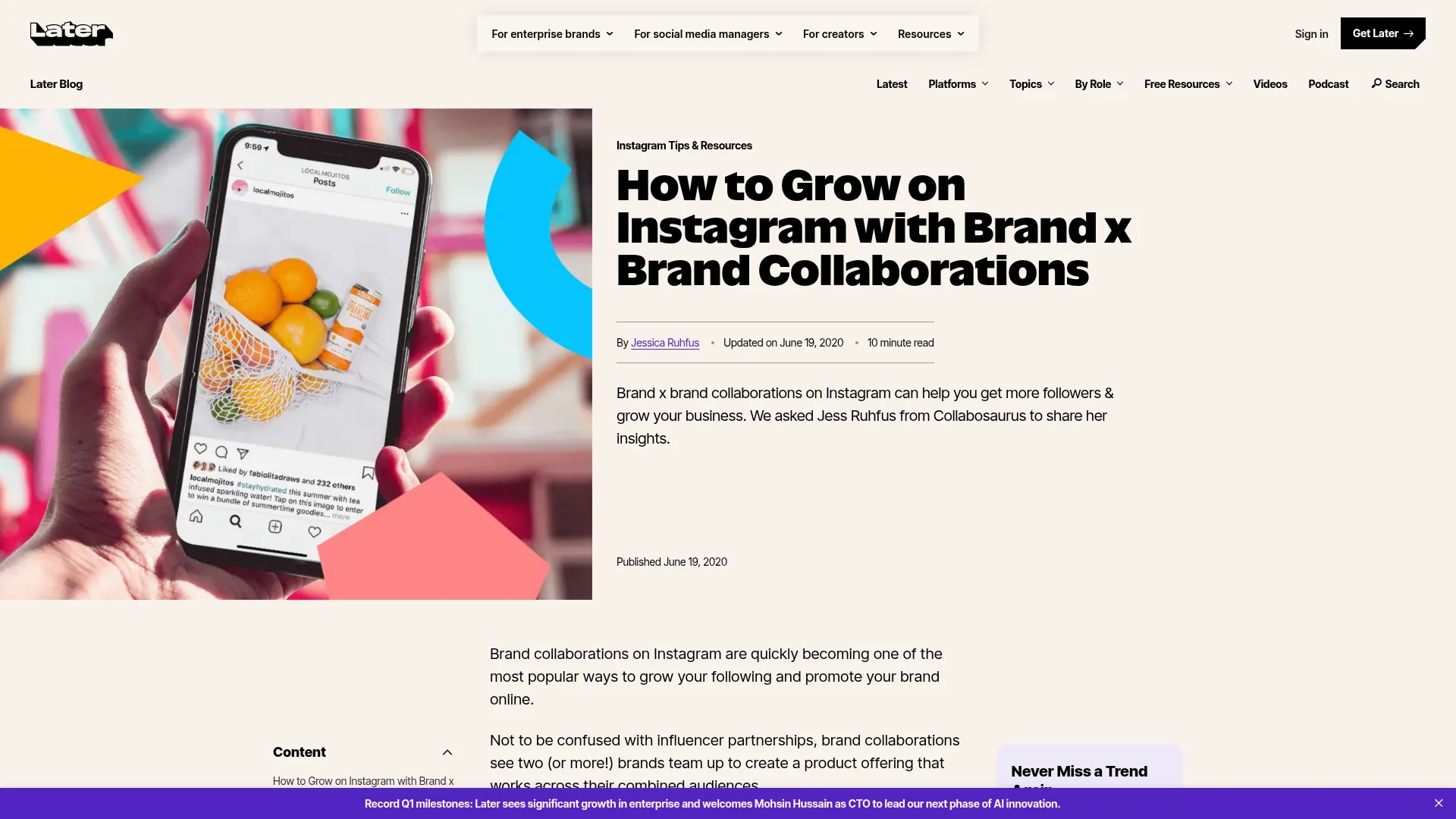
- How to Use Brand Collaborations on Instagram to Grow Your Business
/blog/brand-collaborations-on-instagram/ - How to Hack the Instagram Algorithm in 2025 (10 Proven Tips)
/blog/cheat-instagram-algorithm/ - How I Hacked the Instagram Algorithm Like a Teen
/blog/how-i-hacked-the-instagram-algorithm/ - How to run an Instagram account performance review that leads to growth | Later
/blog/instagram-account-performance-review/
Instagram Reels & Stories (~60 Pages)
Reels production, Stories features, templates, GIF integration, AR effects, and scheduling for short-form Instagram video. 60 URLs is one of the cluster's largest sub-themes, and the depth reflects how rapidly Instagram's product surface has shifted toward short-form video. The recurring "best apps for X" format is the pattern that ages best. Buyers update those queries every year, which means evergreen URLs with year-stamped titles continue earning traffic through annual republish cycles.
Sample pages:
- How to Add GIFs to Instagram Stories
/blog/add-gifs-instagram-stories/ - 18 of the Best Design Apps For Creating Gorgeous Instagram Stories
/blog/apps-for-instagram-stories/ - 13 Fun AR Effects for Instagram Stories
/blog/ar-effects-instagram/ - 9 Best Instagram Reels Editing Apps on the Market in 2025
/blog/best-app-for-editing-reels/
Instagram Features, Tactics & Commerce (~82 Pages)
Highlights, polls, DMs, broadcast channels, collab posts, profile setup, accessibility, analytics, plus Instagram Shop, product tags, monetization, and ad creation. The largest sub-theme in the cluster and the most diverse: 82 feature-by-feature posts cover the Instagram product surface in detail, with a focused commerce layer (Instagram Shop, product tags, monetization, ads) folded in alongside the feature how-tos. The strategic value is search-coverage breadth. Every Instagram feature query and every Instagram-shop query has a Later URL behind it, which builds aggregate authority on the platform's name even when individual posts don't drive headline traffic.
Sample pages:
- 5 Ways to Make Your Instagram Account More Accessible Right Now
/blog/accessible-instagram-account/ - Authenticity on Instagram: How to Grow Your Instagram Account
/blog/authenticity-on-instagram/ - How to Drive Sales with Automated Instagram DMs
/blog/automated-instagram-dms/ - How to Brand Yourself on Instagram
/blog/brand-yourself-on-instagram/
Instagram Scheduling, Publishing & Product (~24 Pages)
Scheduling Instagram posts, Reels, Stories, carousels, and first comments, plus the dedicated Instagram Scheduler product pages under /instagram-scheduler/ (planner, auto-post, hashtag suggestions, best-time-to-post, analytics features). Combining the editorial workflow content with the matching commercial product surface gives Instagram-first buyers a single sub-theme that covers the platform's how-to and the platform's tool. Nine dedicated product URLs is dense for a single-platform scheduler surface, and the URL structure (one path prefix, one feature per child page) is the cleanest in the library.
Sample pages:
- Instagram Scheduler by Later | Schedule Instagram posts in advance
/instagram-scheduler/ - Best Instagram Posts Types: Carousel, Image & Video Ranked
/blog/best-types-of-instagram-posts/ - 5 Steps to Creating a Killer Instagram Marketing Campaign
/blog/how-to-make-an-instagram-marketing-campaign/ - How to Post on Instagram: Everything You Need to Know to Share Content
/blog/how-to-post-on-instagram/
Strategy insight: Instagram remains Later's strongest single-platform authority surface, with 82 URLs on features and commerce alone and a clean 9-URL product directory inside the scheduling sub-theme. The cluster is also the template for how Later structures every other platform-specific surface (algorithm, features, scheduling, product pages), though no other platform gets this depth. Whether to scale the same template to TikTok, YouTube, and LinkedIn at full Instagram depth is the cluster-shape decision the rest of the library implicitly defers.
4. Later Product & Company
Pages: 184 · Share of library: 11.7%
The conversion-and-utility surface: pricing, alternatives and comparison pages, partner and referral programs, careers, legal pages, newsroom, sitemap navigation, and resource hub pagination. Also where the bulk of the Other content type lives. This is the commercial spine of the site combined with the navigation residue that doesn't belong to any topical cluster.
Content-type mix: Other 88.0% · Comparison Pages 9.8% · Product & Feature Pages 2.2%
Micro-topics within this cluster
Resource Hub & Pagination (~138 Pages)
Resource hub index pages, blog pagination, search hub pagination, and category landing pages. 138 URLs of pagination is the bulk of the cluster. These are navigation artifacts rather than discoverable content, but they sit in the sitemap and count toward the library's URL total. Excluding pagination, the library's true editorial footprint is closer to 1,434 URLs, which makes the per-URL efficiency number look even stronger.
Sample pages:
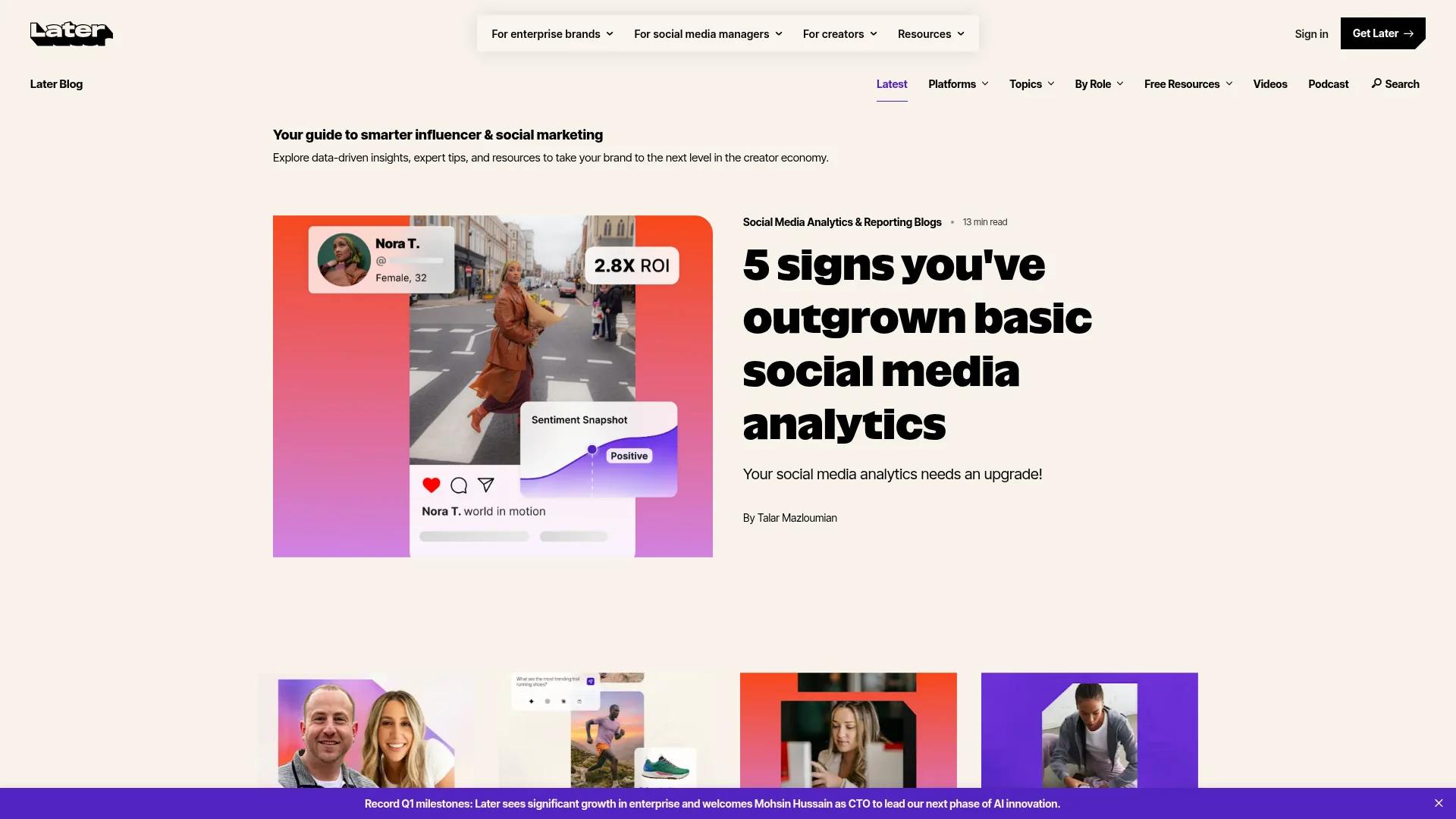
- Later Blog: Expert Social Media & Influencer Marketing Tips
/blog/ - Later's Marketing Resources: Free Courses, Guides & Templates
/resources/ - Social Media Glossary & Marketing Definitions - Later
/social-media-glossary/ - Later Blog | Page 1 of 65 | Social Media Marketing News & Tips
/blog/1/
Competitor Alternatives Pages (~18 Pages)
Later vs Buffer, Hootsuite, Sprout Social, Planoly, GRIN, Captiv8, CreatorIQ, Canva, Linktree, Loomly, Tailwind, and other competitor comparison pages. 18 URLs is the canonical alternatives surface; the naming pattern is consistent ("[Competitor] Alternative" rather than "Later vs [Competitor]"), which signals an acquisition-stage commercial intent. These pages target searchers already looking to switch off a competitor, not earlier-stage comparison shoppers. The set is the cluster's primary BOFU conversion surface.
Sample pages:
- Buffer Alternatives: Try Later for Social Scheduling
/buffer-alternative/ - Canva Alternatives: Try Later for Social Scheduling
/canva-alternative/ - Captiv8 Alternative With Better Support & Value | Later
/captiv8-alternative/ - CreatorIQ Alternative With Easier Setup & Payouts | Later
/creatoriq-alternative/
Legal & Utility Pages (~15 Pages)
Terms, privacy policy, agreements, sitemap, form tests, and other legal and navigation utility pages. Standard utility footprint with one anomaly: a /form-test/ URL that shouldn't be in the production sitemap.
Sample pages:
- Influencer Marketing and Social Media Management | Later
/agreements/ - Form Test
/form-test/ - Later | Privacy Policy and Cookie Policy (EU)
/privacy/ - Later Sitemap | Explore Our Site Directory
/sitemap/
Pricing, Programs & Company (~13 Pages)
Pricing pages, referral and affiliate programs, promotional landing pages, About, careers, newsroom, and media kit. The dedicated promotional landing pages (/growthbf/, /lovelater/) signal an active paid-search and email-promotion program that the editorial content alone doesn't expose. The company-page footprint sits alongside the pricing pages because buyers evaluating Later consult both in the same session.
Sample pages:
- Later: Influencer Marketing and Social Media Management
/ - Influencer Marketing and Social Media Management | Later
/about/ - Later Affiliate Program: Turn Your Referrals Into Rewards
/affiliate-program/ - Later Careers - Come Join the Later Team
/careers/
Strategy insight: The 18 Comparison Pages and 13 Pricing, Programs & Company pages together are the cluster's commercial spine: under 35 URLs doing the heavy lifting of converting search traffic into pricing-page visits. The 138-URL pagination layer is sitemap residue. It inflates the apparent URL count but contributes near-zero discoverability value. The actionable opportunity is the comparison layer: 18 alternatives pages is a defensive minimum, not a defensive moat, for a brand whose buyers actively search "Buffer vs Later," "Hootsuite alternatives," and "Sprout Social vs Later."
5. Content Creation Craft
Pages: 170 · Share of library: 10.8%
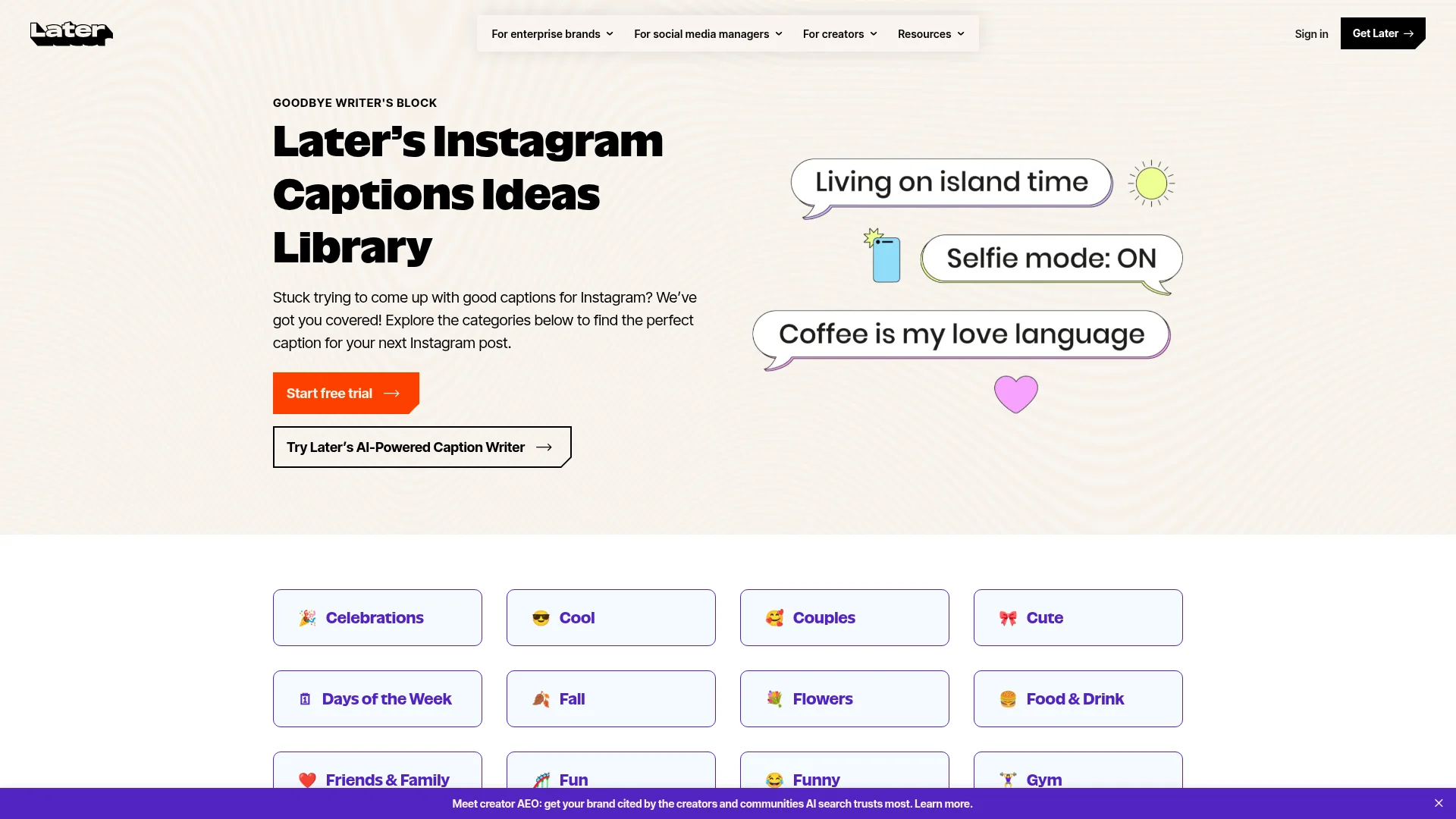
Hands-on production craft: captions, hashtags, emojis, video hooks, UGC, AI tools, and visual content best practices. The cluster sits beneath the platform-specific clusters and serves the practitioner who already knows their channel and is now figuring out how to make the actual asset.
Content-type mix: Blog / Editorial 61.8% · Guides & Resources 29.4% · Glossary / Definitions 5.3% · Free Tools 1.2% · Other 1.2% · Product & Feature Pages 1.2%
Micro-topics within this cluster
Instagram Caption Libraries (~105 Pages)
Themed Instagram caption collections (travel, mood, gym, throwback, monthly) and bio caption ideas under /instagram-captions-ideas/. The largest sub-theme in the cluster by a wide margin. 105 URLs of curated caption libraries is a search-coverage play targeting one of the highest-volume long-tail query patterns in social media ("instagram captions for [thing]"). Each caption library page targets a discrete query, and the pages compound over time as new seasonal themes are added: a hard surface for a competitor to replicate without months of content production.
Sample pages:
- Instagram Captions Ideas Library | Later
/instagram-captions-ideas/ - How to Add Captions to Instagram Stories in 2025
/blog/add-captions-to-instagram-stories/ - How to Create a Good Bio for Instagram: 13 Tips to Stand Out
/blog/how-to-make-a-good-impression-with-your-instagram-bio/ - How to Plan Instagram Content: 8 Tips for Captions, Stories, & More
/blog/how-to-plan-instagram-content/
Short-Form Video & Visual Production (~31 Pages)
Hooks, scripts, lighting, b-roll, editing tips, mobile video editing, UGC production playbooks, aesthetic feed planning, and visual-first content guidance. The sub-theme treats short-form video and visual production as a craft separate from any single platform. Useful because Reels, TikTok, and YouTube Shorts share underlying production techniques, and a craft-first piece can rank on all three platform names without dilution. Folding UGC and visual design into the same micro-topic reflects how creators and brand teams actually plan production: hooks, lighting, and editing decisions sit together regardless of which network the asset eventually lands on.
Sample pages:
- Social Media Content Creation Tool for UGC & More | Later
/content-creation-tools/ - Hire UGC Creators for Authentic Brand Content | Later
/ugc-creators/ - How to Create Engaging Social Media Ads - Later Blog
/blog/create-social-media-ads/ - How to Make Money Streaming Video Games with BasicallyIDoWrk
/blog/how-to-grow-as-a-video-game-streamer-with-marcel-cunningham/
AI Content & Caption Tools (~21 Pages)
AI-assisted content creation, caption generators, AEO and AI search visibility, and AI-driven creator workflows, anchored by the /caption-writer/ free tool. 21 URLs on AI content in 2026 is the right scale for a buyer-stage topic that's still finding its vocabulary. The mix of "what is AI content" explainers and the Caption Writer free tool covers both the informational and the utility intent, which is the structure that ranks for new-category terms.
Sample pages:
- Instagram Post Caption Writer & Generator | Later
/caption-writer/ - AI Content Creation: Our Guide for Content Creators & Marketers
/blog/ai-content-creation/ - The ROI of AI in Influencer Marketing: Why 77% of Brands Report Better Results
/blog/ai-in-influencer-marketing-for-brands/ - AI Tools for Marketing: The Essential Tools You Need
/blog/ai-tools-for-marketers/
Hashtags, Emojis & Reference Libraries (~13 Pages)
How hashtags work across platforms, hashtag research, niche hashtag sets, and emoji meaning libraries (travel, smileys, hearts, sports, hands, animals) under /emoji-meanings/. Reference-format content targeting "what does X mean" and "how do I use Y" search demand. Hashtag research used to be a much larger Later content surface in earlier years, and the small footprint reflects the platform's declining strategic importance to Instagram's algorithm. The emoji library, like the slang glossary, is consumer-facing definitional content that builds brand awareness with audiences who weren't searching for a social media tool.
Sample pages:
- Emoji Meanings Library
/emoji-meanings/ - How Many Hashtags Should You Use on Instagram? (2025 Data)
/blog/how-many-hashtags-on-instagram/ - Instagram first comment, schedule it with Auto Publish
/blog/instagram-first-comment/ - Instagram Reels guide: specs, algorithm, and growth
/blog/instagram-reels/
Strategy insight: The Caption Libraries sub-theme (105 URLs) is the cluster's anchor and one of the library's quietest content assets. Most analyses of Later focus on the editorial blog and miss that a third of Later's library is essentially seasonal caption SKUs. The AI Content & Caption Tools sub-theme is the cluster's forward-looking layer: 21 URLs is enough to surface the category without committing to it, and the Caption Writer free tool is the kind of bottom-funnel utility that converts AEO-driven traffic into product trials.
6. Platform-Specific Playbooks
Pages: 156 · Share of library: 9.9%
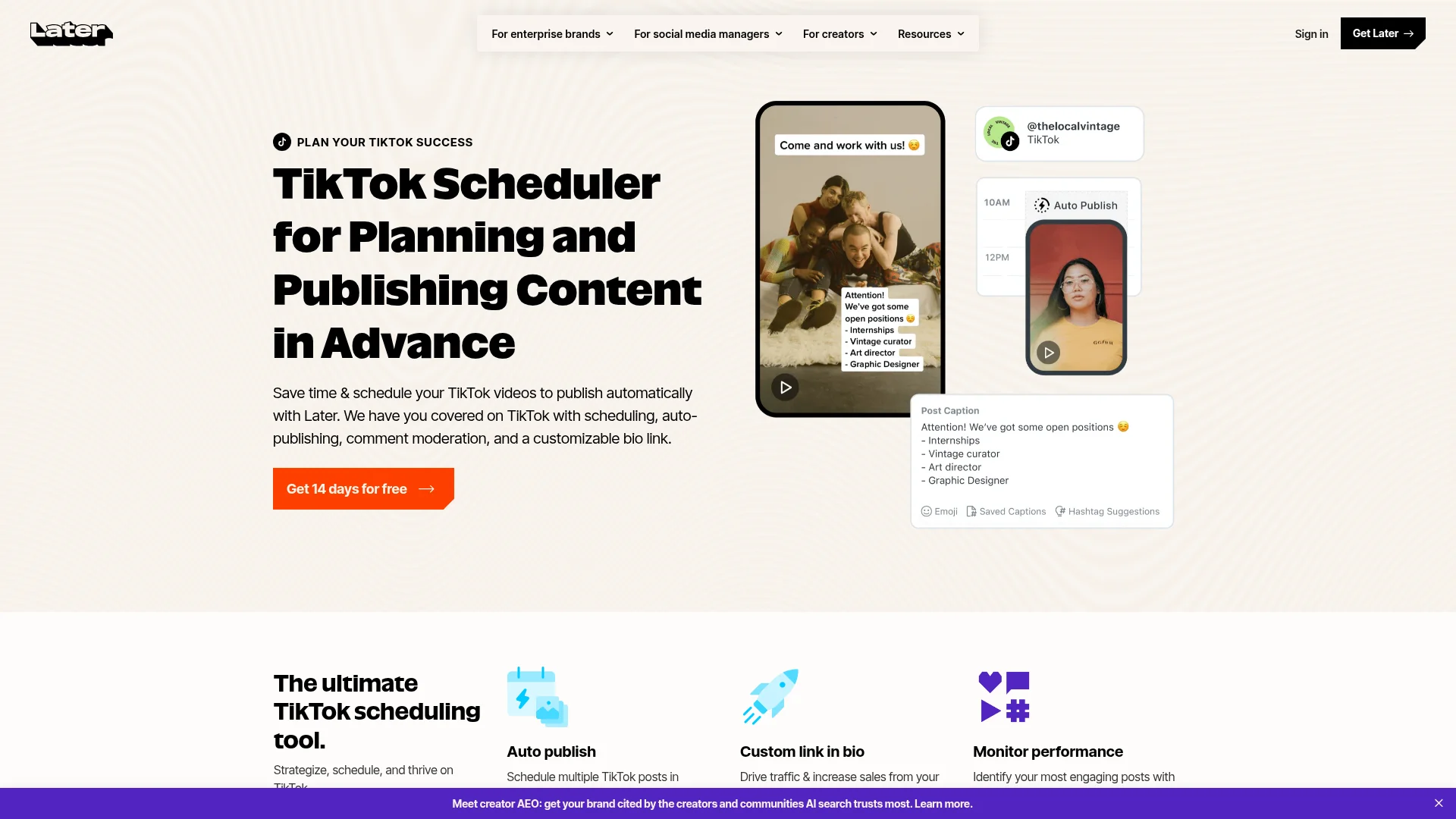
Dedicated coverage of TikTok, Pinterest, YouTube, LinkedIn, Facebook, Threads, X (Twitter), and Snapchat: strategy, features, scheduling, and the per-network Later Scheduler product pages. The cluster exists as a multi-platform roll-up rather than seven tiny per-platform clusters. Each platform is a micro-topic inside it, sized to its strategic weight rather than its sitemap presence. TikTok carries roughly half the cluster, reflecting its top-three Later focus status, while Facebook, Threads, X, and Snapchat sit together as table-stakes coverage.
Content-type mix: Blog / Editorial 67.3% · Guides & Resources 14.7% · Glossary / Definitions 12.8% · Product & Feature Pages 5.1%
Micro-topics within this cluster
TikTok Features & Scheduling (~50 Pages)
Duets, stitches, text-to-speech, sounds, captions, creator tools, filters, the platform's refresh feature, TikTok Shop, scheduling mechanics, and the dedicated /tiktok-scheduler/ product page. 50 URLs is the largest sub-theme in the cluster: feature coverage plus scheduling and the matching commercial product surface, all in one place. The volume here builds aggregate authority on the TikTok name without depending on any single piece ranking individually. TikTok Shop coverage is the clearest content gap inside the sub-theme. Search volume for TikTok Shop in 2026 justifies a 10-20-URL build-out that the current coverage doesn't yet match.
Sample pages:
- TikTok Scheduler: Plan and Auto Publish Posts | Later
/tiktok-scheduler/ - How to Add Text to Your TikTok Videos
/blog/add-text-to-tiktok-videos/ - Best time to post on social media in 2026 | Later
/blog/best-time-to-post-on-social-media/ - The Best Time to Post on TikTok in 2025 | Later
/blog/best-time-to-post-on-tiktok/
TikTok Strategy & Trends (~36 Pages)
TikTok trends, viral mechanics, growth strategies, batch content production, and brand examples. The recurring "Current TikTok Trends to Try in [Year]" pattern is the cluster's evergreen-republish workhorse. Annual refreshes capture the seasonal "what's trending on TikTok" search demand without requiring net-new editorial. CapCut and other adjacent tools also get covered here rather than in a dedicated tools sub-theme.
Sample pages:
- How to Batch Content for Social Media (Instagram, Tiktok, YouTube, & more)
/blog/batch-content-for-social-media/ - 28 Brands on TikTok to Inspire Your Feed | Later
/blog/brands-on-tiktok/ - How To Use CapCut Templates on TikTok in 2024 | Later
/blog/capcut-templates/ - Current TikTok Trends to Try in 2026 | Later
/blog/current-tiktok-trends/
YouTube & LinkedIn Marketing (~27 Pages)
YouTube and YouTube Shorts strategy, monetization, scheduling, plus LinkedIn content strategy, personal branding, B2B tactics, and the matching YouTube Scheduler and LinkedIn Scheduler product pages. Combining the two networks reflects the underlying buyer profiles. YouTube content leans into Shorts strategy and creator commerce, while LinkedIn content serves the social media manager audience (who use LinkedIn personally) more than enterprise B2B teams. Both are long-form-and-professional networks distinct from short-form video, which is the structural logic.
Sample pages:
- LinkedIn Post Scheduler | Post Smarter, Not Harder with Later
/linkedin-scheduler/ - YouTube Scheduler: Plan and Auto Publish Videos | Later
/youtube-scheduler/ - YouTube Influencer Marketing Platform for Brands | Later
/youtubers/ - Best Time to Post on LinkedIn in 2025 to Maximize Engagement
/blog/best-time-to-post-on-linkedin/
Facebook, Threads, X & Snapchat (~27 Pages)
Facebook page management, Meta Business Suite alternatives, Threads strategy, X (Twitter) alternatives, microblogging tactics, Snapchat strategy, and the matching Scheduler product pages. Table-stakes platform coverage: necessary for a social media management tool to surface, but not strategically central in 2026. Combining Threads and X into the same sub-theme is structurally honest. They're the same format with different audiences, and post-2024 X migration content has natural overlap with Threads launch content. Snapchat sits here too as residual platform coverage that demonstrates Later schedules the platform without pretending Snapchat is a strategic focus.
Sample pages:
- Facebook Scheduler: Plan and Publish Posts Automatically | Later
/facebook-scheduler/ - Schedule Snapchat Content Quickly and Easily | Later
/snapchat-scheduler/ - Schedule Threads With Later to Save Time and Grow | Later
/threads-scheduler/ - Best Time to Post on Facebook According to Real Data | Later
/blog/best-time-to-post-on-facebook/
Pinterest Marketing (~16 Pages)
Pinterest strategy, scheduling, idea pins, SEO, and the Pinterest Scheduler product page. Pinterest is the largest per-network slice outside TikTok, reflecting Later's historic Pinterest authority and the platform's continuing relevance for ecommerce brands, a buyer profile that overlaps with Later's named customer list.
Sample pages:
- Pinterest Scheduling Tool to Plan & Auto Post Pins | Later
/pinterest-scheduler/ - 12 Brands on Pinterest with Awesome Marketing Strategies - Later Blog
/blog/brands-on-pinterest/ - Why You Should Claim Your Instagram Account on Pinterest
/blog/claim-instagram-account-pinterest/ - How to Get More Followers on Pinterest
/blog/get-followers-on-pinterest/
Strategy insight: The roll-up structure (one cluster covering eight platforms) is the right architectural choice for a small library. Splitting into seven 10-URL clusters would fragment authority and produce thin per-platform surfaces. The per-network scheduler product pages (
/pinterest-scheduler/,/youtube-scheduler/, and so on) give Later one dedicated landing page per platform name, which is the minimum viable structure to compete for "[platform] scheduler" search demand without building Instagram-depth authority on each. TikTok absorbs half the cluster because TikTok absorbs half the strategic attention; that ratio is the right shape.
7. Creator Economy & Monetization
Pages: 107 · Share of library: 6.8%
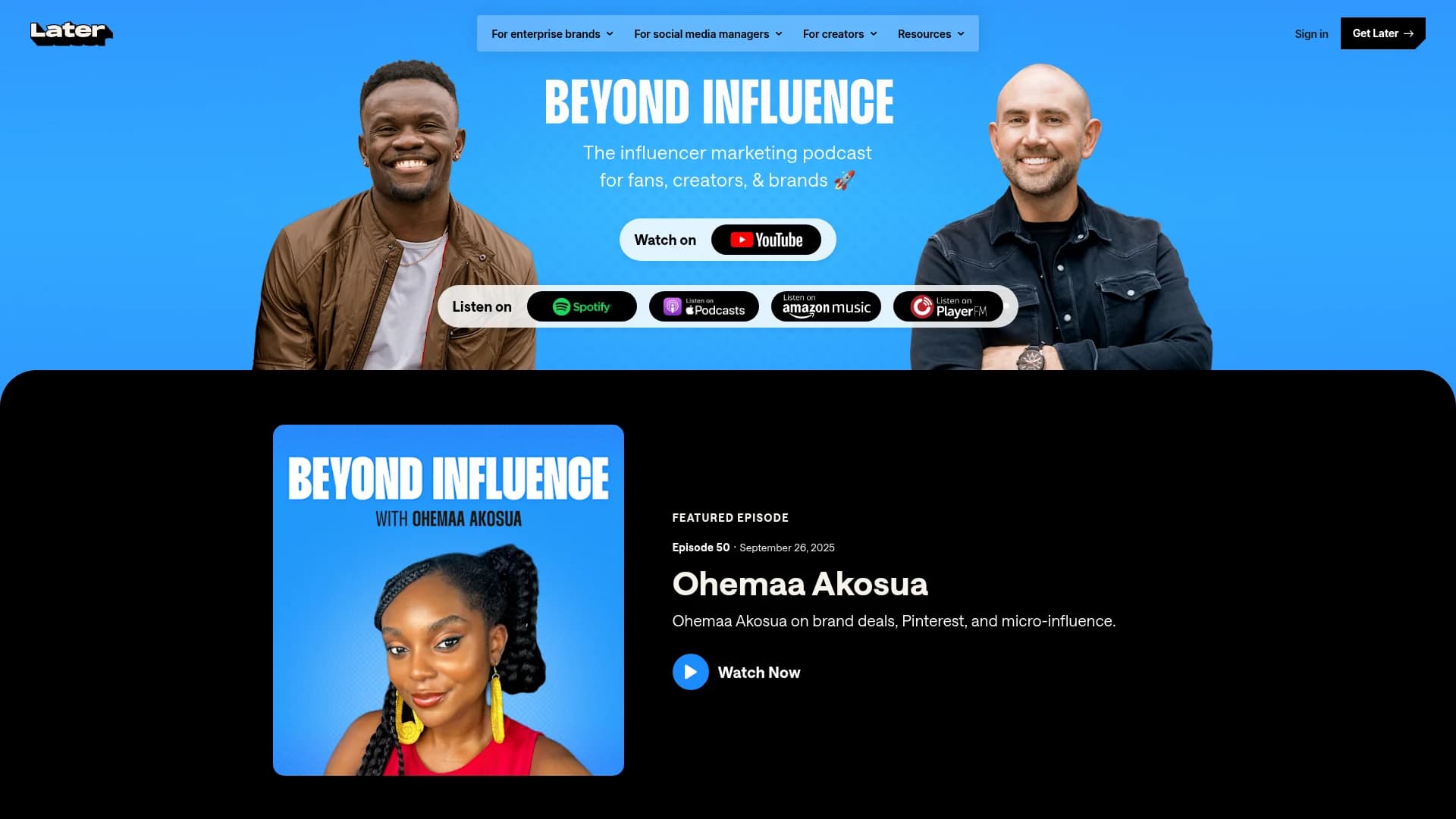
Creator-side content covering audience building, brand deals, rates, monetization paths, and the Beyond Influence podcast. This cluster serves the creator as a customer in their own right, distinct from the brand-side Influencer & Creator Marketing cluster. The Beyond Influence podcast (58 episodes) accounts for over half the cluster's URLs.
Content-type mix: Podcast / Audio Series 54.2% · Blog / Editorial 44.9% · Research/Reports 0.9%
Micro-topics within this cluster
Beyond Influence Podcast Episodes (~58 Pages)
Interview episodes of the Beyond Influence podcast, hosted by Kwame Appiah and Scott Sutton, featuring creators, brand operators, and influencer marketing leaders. 58 episodes is a multi-year compounding asset. The format is hard to replicate without years of consistent production, and named-guest episodes function as relationship infrastructure. Each guest becomes a known supporter once their conversation is published. The podcast lives in the Creator Economy cluster rather than the Influencer & Creator Marketing cluster, which positions it as creator-facing editorial rather than brand-facing thought leadership.
Sample pages:
- Beyond Influence Podcast with Kwame Appiah & Scott Sutton | Later
/beyond-influence-podcast/ - Beyond Influence Podcast Episodes | Page 1 of 7 | Full List & Streaming Options
/beyond-influence-podcast/episodes/ - Beyond Influence Podcast Episodes | Page 2 of 7 | Full List & Streaming Options
/beyond-influence-podcast/episodes/2/ - Beyond Influence Podcast Episodes | Page 3 of 7 | Full List & Streaming Options
/beyond-influence-podcast/episodes/3/
Creator Monetization & Rates (~23 Pages)
What creators should charge, brand deal negotiations, sponsored content pricing, and earnings benchmarks, anchored by the separately-published Creator Compensation Report. Money-focused creator content is one of the highest-intent search verticals in the creator economy (creators with revenue questions are creators evaluating tools), and 23 URLs is enough depth to surface the topic without diluting brand-side messaging.
Sample pages:
- Why 2026 is the Year of Diversified Monetization | Later
/blog/2026-creator-income-diversified-monetization/ - How 3 Asian Creators Are Celebrating AAPI Heritage Month on Social Media
/blog/aapi-heritage-month-creators/ - Affiliate Marketing Compensation Models for Brands & Creators
/blog/affiliate-marketing-on-the-rise-for-social-media-creators-compensation/ - How to Become an Instagram Influencer: Complete Guide | Later
/blog/become-an-instagram-influencer/
Audience Building & Personal Brand (~15 Pages)
Growing a creator audience, niching down, building a personal brand, full-time creator transitions. The angle is consistently aspirational ("how to become a content creator"), targeting the search intent of someone considering full-time creator work, not someone already employed by a brand. That positions the cluster upstream of Later's main commercial audience and explains why the podcast lives here rather than in the brand-facing Influencer & Creator Marketing cluster.
Sample pages:
- How to Become a Content Creator in 8 Simple Steps | Later
/blog/become-a-content-creator/ - Later's Beyond Influence Podcast
/blog/beyond-influence-podcast-launch/ - 5 Content Creator Tips for Aspiring Creators | Later
/blog/content-creator-tips/ - Understanding the Creator Economy in 2025
/blog/creator-economy/
Creator Collabs & Partnerships (~11 Pages)
Working with brands, partnership structures, collab post mechanics, and creator-brand relationship best practices. The cluster's bridge to the brand side. These pieces are written in a register both creators and brand marketers can read, which makes them the editorial connective tissue between the two halves of Later's combined business.
Sample pages:
- How to Spot Accounts That Buy Instagram Followers | Later
/blog/buy-instagram-followers/ - How brands can use creators as cultural translators
/blog/how-brands-can-use-creators-as-cultural-translators/ - How YouTube Creators Build Holiday Momentum That Lasts All Year
/blog/how-youtube-creators-build-holiday-momentum-that-lasts-all-year/ - What Is An Influencer Scorecard? (+ Free Template)
/blog/influencer-score/
Strategy insight: Beyond Influence at 58 episodes is the most under-documented compounding asset in Later's library. It gives the company a multi-year audio franchise in a category where almost no peer has invested at this scale. The cluster's positioning (creator-side, not brand-side) is also a deliberate audience choice: creators are the supply side of Later's influencer marketplace, and content that serves them is content that fills the supply side without paying acquisition costs.
Key Observations
What Stands Out About Later's Content Strategy
The library is the category's per-URL efficiency leader by a wide margin
Later generates ~2,269 monthly organic visits per page across 1,572 URLs, more than twice the next-most-efficient peer in the social media management category, and roughly five times the median. The 3.57M monthly visits come from a library smaller than Hootsuite's (3,826 URLs), Brandwatch's (7,072), or Buffer's (2,982). What this signals: every page in the library has to earn its place, and the franchise-led structure (Blog + Glossary as two pillars) is what makes that bar sustainable. The flip side is scaling. Adding URLs at this efficiency is harder than adding URLs at lower efficiency, and any expansion has to preserve the per-page traffic bar.
The Glossary is treated as a 281-URL franchise, not an AEO afterthought
281 Glossary / Definitions entries (17.9% of the library) is unusually deep for a social media management platform. Most B2B SaaS libraries sit in the 15-50 range for definitional content. Later's twist is the editorial choice to fill the Glossary with social media slang and pop-culture terms (188 of the 281 entries sit in the Multi-Platform Social Media Strategy cluster), not just product or marketing terminology. The play is consumer-adjacent AEO: when AI engines answer "what does 1437 mean," they cite Later, which builds brand recognition with audiences who weren't searching for social media tools.
The Mavrck merger left a 344-page influencer marketing surface no scheduler-only competitor can match
The Influencer & Creator Marketing cluster (21.9% of the library) is the structural inheritance from the 2022 Mavrck acquisition, now expanded to include the 55 brand case studies and the affiliate-marketing content. 344 URLs is more pages than most pure social media schedulers (Buffer, SocialBee, Loomly) have in their entire library. The strategic effect: when buyers compare Later to Hootsuite or Sprout Social, the influencer marketing depth is a category-bending differentiator. Later isn't competing on "better scheduler," it's competing on "scheduler plus a 344-page influencer marketing capability with 55 outcome-led case studies attached."
The research franchise exists but hasn't been scaled into a multi-edition series
Only 6 Research / Reports URLs sit in a 1,572-page library (0.4%), anchored by the 2025 State of Influencer Marketing Report, the Creator Compensation Report, and the Creator Mental Health Report. The franchise is real, but thin. Branded annual research is the single hardest content asset for a competitor to replicate, and three reports in 2024-2025 suggests Later has the production capability. The strategic question is whether to extend the State of Influencer Marketing series into a multi-edition library (2023, 2024, 2025, 2026) that compounds backlink equity across years.
13,221 ranking positions sit on page 2 of search, the largest single optimization opportunity
21.8% of Later's positions are in the top 10, but another 15.1% (13,221 positions) sit in the 11-20 slot, page 2 of Google. That's the highest-value optimization slice in the library because pages already on page 2 are within striking distance of page 1 with focused work (refreshed content, internal linking, AEO formatting). The current editorial cadence appears to be net-new publishing rather than systematic position-recovery work on existing URLs; closing even 10% of that gap would push roughly 1,300 additional positions into top-10 visibility.
Comparison-page investment is light for the category's traffic leader
19 Comparison Pages (1.2% of library) is conspicuously thin for a brand whose buyers actively search "Buffer vs Later," "Hootsuite alternatives," and "Sprout Social vs Later." Buffer, Hootsuite, and Sprout Social are the three peers most often compared against Later in commercial-intent searches, and 19 alternatives pages is a defensive minimum rather than a defensive moat. Adding canonical "Later vs [Competitor]" pages for the top 6-8 named competitors, alongside the existing alternatives pages, is a low-effort move that maps directly to BOFU search intent.
The /blog and /resources path prefixes do too many jobs at once
744 URLs live under /blog/ spanning all 7 topic clusters, and 287 URLs live under /resources/ spanning 6 clusters and several content types. The URL structure can't easily distinguish between editorial blog content, customer stories, comparison pages, and pagination, all of which share the same parent path. Splitting into dedicated paths (/blog/, /case-studies/, /compare/, /glossary/) would clarify section authority for Google and AI engines, and the structure already exists for the Glossary and case studies; the cleanup is mainly inside the /blog and /resources directories.
The top two clusters carry nearly half the library, with the remaining five doing balanced work
Multi-Platform Social Media Strategy (26.3%) and Influencer & Creator Marketing (21.9%) together account for 48.2% of every page Later publishes. The remaining five clusters split the other 52% in tight bands of 7-13% each, which is a balanced spread rather than a long-tail one. The shape tells you something about how Later allocates editorial attention: two flagship surfaces get deep, sustained investment, and every other surface gets enough coverage to compete without aspiring to flagship depth. Whether to add an eighth flagship cluster (research, comparison, or a deeper product-feature surface) or keep doubling down on the existing two is the next architectural decision.
More analyses in Social Media Management
Loomly
How Loomly uses 336 blog posts and a 62-term marketing glossary to drive 40K monthly visits in social media management. 482 pages, 4 clusters.
Planable
How Planable uses 386 blog posts and 33 free AI content tools to drive 191K monthly visits in social media management. 600 pages, 5 clusters.
Sendible
How Sendible uses 536 blog posts, 133 product pages, and 41 case studies to drive 126K monthly visits in social media management. 770 pages, 6 clusters.
SocialBee
How SocialBee uses 838 blog posts, a 215-term glossary, and 34 free tools to drive 143K monthly visits in social media management. 1,238 pages, 6 clusters.
Methodology: This analysis is based on Later's full public sitemap (1,572 URLs, sourced from robots.txt), enriched with each URL's title and meta description via lightweight HTTPS fetches. URLs were classified into a 12-bucket content type taxonomy and grouped into 7 topic clusters with 30 micro-topics using LLM-assisted classification. Company facts came from public web research across Crunchbase, LinkedIn, and Later's own About, blog, and newsroom pages. Traffic metrics (monthly organic visits, traffic value, ranking positions, position distribution) came from DataForSEO's domain rank overview, aggregated globally across 117 locale combinations. All counts reflect the Later sitemap as of 2026-05-26.