
Summary
Hootsuite drives 2,968,907 monthly organic visits by running a breadth-play content library: 3,826 indexable pages organized into 9 topic clusters, with no single format above 17% share. The two largest clusters (the 875-URL /whats-new/ changelog and the 585-URL Resource Library) together hold just 38.2% of the library. The 129 annual-research-report URLs anchor the strategy alongside 193 customer case studies and 579 corporate press releases. 22.3% of Hootsuite's 155,330 ranking positions sit in the top 10 across 117 locale combinations, comparable to Buffer's 23.4% and Sprout Social's 23.4% but earned across a much larger surface area.
Key facts:
- Library size: 3,826 indexable pages organized into 9 topic clusters; 16.4% Guides & Resources, 15.1% Product & Feature Pages, 5.3% Free Tools, and a 49.4% Other bucket driven by 875 product update notes plus 579 press releases
- Largest cluster: Product Update Notes ("What's New") (875 URLs, 22.9% of library)
- Flagship content asset: Annual Research & Reports inside the Research, Industry & Corporate Pages cluster. 129 URLs anchored by the Social Media Trends Report and the Social Media Career Report (with vertical cuts for healthcare, finserv, education, and government)
- Search performance: 2.97M monthly visits across 155,330 ranking positions; 22.3% in top 10 (~776 visits per page)
- Notable gap: Zero URLs classified as Blog / Editorial, Podcast / Audio Series, Documentation, or Glossary / Definitions in the main www sitemap. The editorial blog runs on a separate blog.hootsuite.com subdomain
Company Overview
Hootsuite at a Glance
| Company | Hootsuite (Hootsuite Inc.) |
| Founded | 2008 · Vancouver, British Columbia, Canada |
| Category | Social Media Management |
| What They Do | Hootsuite is a social media management platform that lets brands schedule and publish content across multiple networks, monitor mentions and conversations, engage from a unified inbox, and measure performance with analytics and social listening. After acquiring Talkwalker in 2024, it also offers AI-powered consumer intelligence and social listening at enterprise scale. Customers include Barceló Hotel Group, DaVita, Mapfre, Georgia State University, Ochsner Health, and Julius Baer. |
| Funding | $284M raised; last disclosed equity round Series B (Aug 2013, $165M, Insight Partners and OMERS Ventures) |
| Headcount | 1,000–1,500 (LinkedIn band) |
| Monthly Organic Visits | Traffic Value (PPC equiv.) | Ranking Positions |
|---|---|---|
| 2.97M | $7.29M | 155.3K |
Ranking positions reflect total positions across 117 indexed (location, language) combinations, not unique keywords. A keyword ranking in both US-en and UK-en counts twice.
Hootsuite's content operation is unusual for its breadth rather than its depth in any one format. The 3,826 indexable pages on hootsuite.com fan out across product marketing, free utility tools, customer proof, multi-year research, a heavy /whats-new/ changelog, a 579-URL press-release archive, and a six-locale translation footprint. There is no editorial blog in this sitemap. Hootsuite's well-known long-form blog content lives at blog.hootsuite.com on a separate subdomain. What remains on the www domain is a corporate-and-product surface plus a deep resource and free-tools library calibrated for SEO acquisition.
Content Architecture
What Does Hootsuite's Content Engine Look Like?
Hootsuite's main website hosts 3,826 indexable pages organized into 9 topic clusters. The architecture reveals a company that runs many content formats in parallel (product marketing, downloadable resources, free utility tools, customer proof, research, changelogs, and PR) rather than concentrating investment in a single flagship format.
Content Type Distribution
| Content Type | Count | Share | Notes |
|---|---|---|---|
| Other | 1,889 | 49.4% | Driven by 875 /whats-new/ changelog posts + 579 press releases + 328 legal pages |
| Guides & Resources | 629 | 16.4% | Templates, playbooks, checklists, cheat sheets, vertical guides |
| Product & Feature Pages | 578 | 15.1% | Platform features, industry pages, network landing pages, use-case pages |
| Free Tools | 201 | 5.3% | 201 standalone /social-media-tools/ utilities mirrored across 5 non-English locales |
| Events / Webinars / Sessions | 198 | 5.2% | Live and on-demand webinars, summits, Uplift events |
| Case Studies / Customer Stories | 193 | 5.0% | Named customer stories organized by industry |
| Research / Reports | 129 | 3.4% | Social Media Trends Report, Social Media Career Report, vertical cuts |
| Comparison Pages | 9 | 0.2% | Eight head-to-head comparison URLs |
| Blog / Editorial | 0 | 0.0% | Not in www sitemap. Editorial blog lives on blog.hootsuite.com |
| Podcast / Audio Series | 0 | 0.0% | No podcast asset on the main domain |
| Documentation | 0 | 0.0% | Not in www sitemap. Help center and developer docs sit on separate subdomains |
| Glossary / Definitions | 0 | 0.0% | No "what is X" definitional content surfaces in the main sitemap |
Key finding: Almost half of Hootsuite's www footprint sits in the "Other" bucket. 875 release-notes-style /whats-new/ posts and 579 corporate press releases together account for 38% of the entire library, larger than any traditional editorial format. This is a corporate-and-changelog-heavy architecture, with editorial blog content explicitly separated onto a different subdomain.
Content Strategy Archetype
Hootsuite operates a breadth-play, multi-format content engine. No single content type dominates. Guides & Resources leads at 16.4%, Product & Feature Pages sits a close second at 15.1%, and Free Tools comes third at 5.3%. The two largest topic clusters together hold only 38.2% of the library. This is fundamentally different from an editorial-led or documentation-led architecture: Hootsuite distributes investment across templates, free utility tools, customer proof, multi-year research, frequent product update posts, and a heavy press-release archive. The shape reflects a category-leader-scale operator with multiple parallel acquisition surfaces and a corporate footprint built for analyst coverage and enterprise procurement.
Locale & Translation Strategy
How Hootsuite Publishes Across Markets
Hootsuite publishes content across six locales: English (root) and five Latin-script European languages. The non-English libraries are translation mirrors of selected en-root content, not curated regional content.
| Locale | URLs | Share |
|---|---|---|
| en (root) | 1,815 | 47.4% |
| de | 465 | 12.2% |
| fr | 442 | 11.6% |
| es | 422 | 11.0% |
| it | 355 | 9.3% |
| pt | 327 | 8.6% |
Only 47.4% of Hootsuite's URLs are unique en-root content. The remaining 2,011 URLs are translations or regional variants, which roughly 2.11×s the apparent library size. The five non-English locales each carry a similar share (8–12%), suggesting Hootsuite translates a consistent core (product pages, top tools, key resources, customer stories, legal documents) rather than building locale-specific content. DataForSEO's 117 indexed (location, language) combinations reflect this footprint: keyword counts and ranking-position totals count the same article multiple times when it ranks across locales.
Strategy insight: The 2.11× locale multiplier matters when benchmarking. Against single-locale peers like Buffer (2,982 URLs, almost entirely English) or Later (1,572 URLs), Hootsuite's unique en-root content base of ~1,815 URLs is the right comparison point, not the headline 3,826. The locale strategy looks calibrated for European enterprise sales coverage rather than long-tail SEO in non-English markets. The translated free-tools pages may have a different role from translated product pages, but the consistent locale shares across cluster types suggest one centralized translation workflow rather than locale-specific editorial decisions.
Search Performance Quality
Where Hootsuite Ranks
The DataForSEO domain rank overview shows Hootsuite ranking in 155,330 positions across 117 locale combinations. The position distribution skews toward the long tail. Hootsuite ranks for many keywords, but only a minority sit on page 1.
| Position | Count | Share |
|---|---|---|
| #1 | 2,879 | 1.9% |
| #2–3 | 6,345 | 4.1% |
| #4–10 | 25,451 | 16.4% |
| #11–20 | 29,107 | 18.7% |
| #21–50 | 57,504 | 37.0% |
| #51–100 | 34,044 | 21.9% |
22.3% of Hootsuite's ranking positions are in the top 10, comparable to category peers Buffer at 23.4% and Sprout Social at 23.4%, and broadly in line with Later at 21.8% and Agorapulse at 21.8%. Hootsuite leads the category on absolute ranking positions (155,330) by a wide margin. Buffer trails at 101,102, Sprout Social at 84,293, and Later at 87,538. The shape of the distribution matters: 29,107 positions sit in the 11–20 band, the most actionable optimization sweet spot (content that's already on Google's second page and could be pushed to first with focused work). A further 57,504 positions sit in 21–50, a substantial reservoir of content within reach of page-2 visibility with targeted optimization.
Per-URL traffic efficiency is high at ~776 visits per page. For a 3,826-URL library that's strong. It signals that individual pages are working hard on average, rather than the library leaning on volume to manufacture aggregate traffic.
Content Deep Dive
What Is Hootsuite Actually Publishing, and How?
Hootsuite's content organizes around 9 primary topic clusters. Each cluster is described below with content-type composition, the micro-topics inside it, and concrete example URLs. Cluster and micro-topic groupings reflect a per-URL classification of the full sitemap; counts are exact, not approximate.
1. Product Update Notes ("What's New")
Pages: 875 (all locales) · Share of library: 22.9%
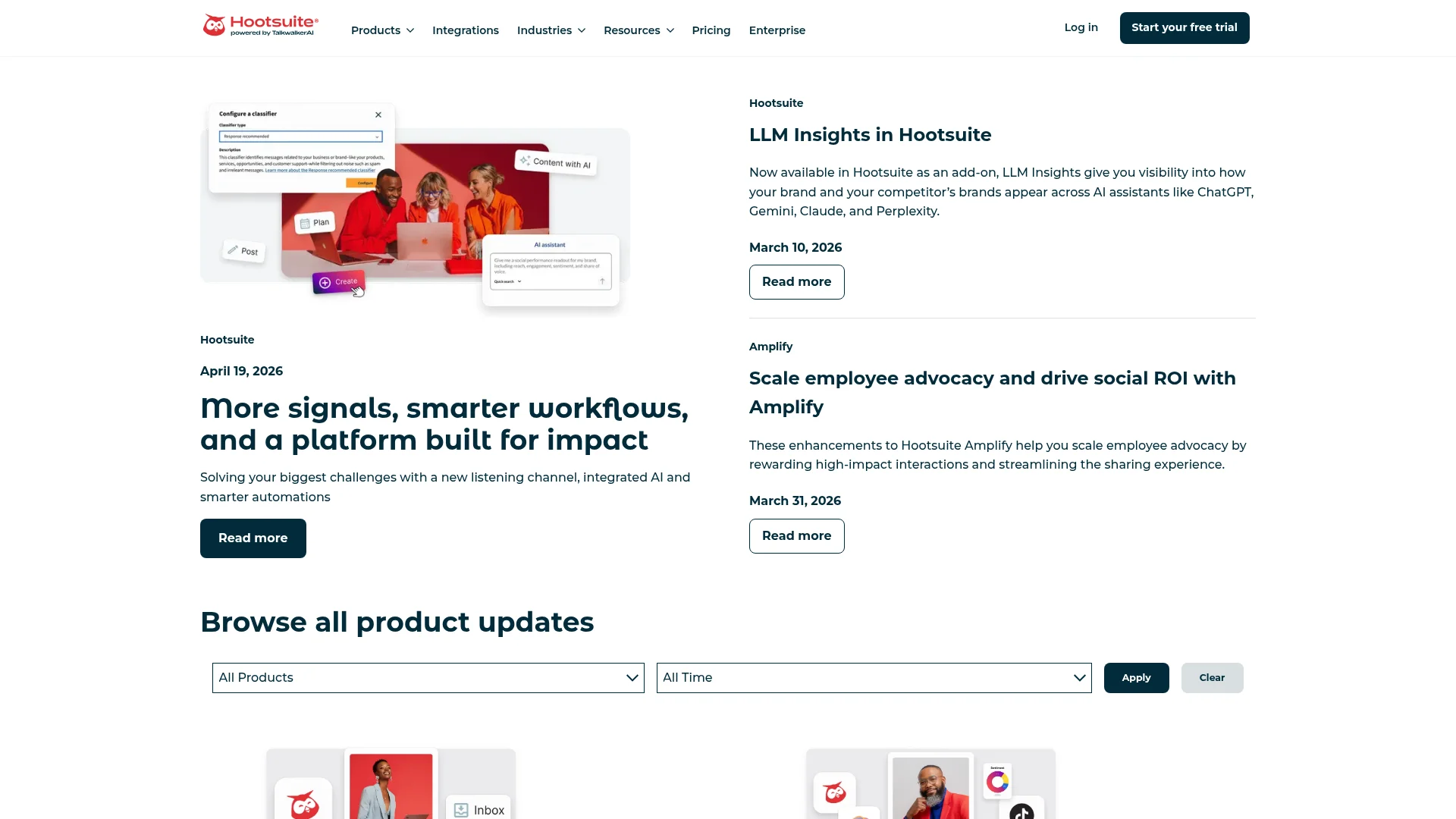
The largest URL group on the site. Release-notes-style /whats-new/* posts announcing platform updates, feature ships, integrations, and fixes. A high-frequency, short-form changelog series with mostly thin metadata, kept indexable on the public domain rather than hidden behind a help-center login.
Content-type mix: Other 100%
Micro-topics within this cluster
Platform, Integrations & Admin Updates (~223 Pages)
Cross-platform updates: quarter-end roundups, App Directory additions (HubSpot, Salesforce, Canva, Adobe, Trustpilot), SCIM, SSO, permissions changes, certification courses, bug fixes, and locale-specific changelog index pages. The largest sub-stream in the cluster, because it captures every shipped feature that doesn't sit cleanly inside the publishing, inbox, analytics, or AI feature areas, plus the localized /whats-new index pages that mirror the English changelog into German, French, Spanish, Italian, and Portuguese.
Sample pages:
- What's New? Hootsuite New Features and Fixes
/whats-new - What's New? Hootsuite New Features and Fixes (de)
/de/whats-new - What's New? Hootsuite New Features and Fixes (es)
/es/whats-new - What's New? Hootsuite New Features and Fixes (fr)
/fr/whats-new
Publishing, Inbox & Workflow Updates (~202 Pages)
Updates to scheduling, the planner, the calendar, approvals, the composer, the unified inbox, DMs, replies, the VAI chatbot, and customer-care workflow. Publishing and the inbox are Hootsuite's two original product pillars, and the volume here reads as defensive maintenance rather than category expansion. The workflow surface is mature, so the update stream is heavy on incremental fixes and quality-of-life improvements rather than new capabilities.
Sample pages:
- Access inbox on mobile
/whats-new/access-inbox-on-mobile - Add WhatsApp account to Inbox 2.0
/whats-new/add-a-whatsapp-account-to-inbox-20 - Add more inclusive emoji in compose and inbox
/whats-new/add-more-inclusive-emoji-in-compose-and-inbox - Add or remove networks from scheduled posts
/whats-new/add-or-remove-social-networks-from-your-scheduled-posts
AI, Listening & Amplify Updates (~171 Pages)
Updates to OwlyGPT, OwlyWriter, the Yeti agent, AI classifiers, the Talkwalker social-listening integration, sentiment and signals features, and the Amplify employee-advocacy product. 171 dedicated update posts inside an 875-post changelog means roughly 20% of every shipping update is tied to the post-2023 capability layer. The cluster doesn't argue for AI or listening as a category. It just ships them, and the cadence is the proof.
Sample pages:
- 9:16 videos as Instagram Reels in Amplify
/whats-new/916-videos-as-instagram-reels-in-amplify - Additional LinkedIn insights coverage in Listening
/whats-new/additional-linkedin-insights-coverage-in-hootsuite-listening - AI chatbot in Inbox 2.0
/whats-new/ai-chatbot-in-inbox-20 - AI Classifiers in Inbox
/whats-new/ai-classifiers-in-inbox
Network & Channel Updates (~162 Pages)
Update posts about specific social-network integrations and channel-level features: LinkedIn, TikTok, Instagram, X, YouTube, Threads, Reddit, Pinterest, Mastodon, WhatsApp, and Google Business Profile. The single largest network-specific sub-stream, reflecting how Hootsuite ships network-specific updates each time a connected platform changes its API or surfaces a new format. Each post sits at its own /whats-new/ URL, which makes every integration its own searchable, linkable artifact.
Sample pages:
- Edit scheduled Instagram posts
/whats-new/ability-to-edit-scheduled-posts-for-instagram-direct-publishing - Mobile updates: accelerate your strategy
/whats-new/accelerate-your-strategy-with-hootsuites-latest-mobile-updates - Accessibility improvements for mobile
/whats-new/accessibility-improvements-for-mobile - Instagram data missing in activity emails
/whats-new/account-activity-emails-missing-instagram-data
Analytics & Reporting Updates (~117 Pages)
Updates to analytics, reports, metrics, dashboards, KPIs, and year-in-review reports across the platform. The volume here is a tell about product investment: Hootsuite ships analytics updates as often as it ships network integrations, suggesting reporting capability is treated as a continuous build-out rather than a fixed module.
Sample pages:
- 2019 Year in Review Report
/whats-new/2019-year-in-review-report - 2020 Year in Review Reports
/whats-new/2020-year-in-review-reports - New integrated social selling dashboard
/whats-new/a-new-integrated-experience-with-the-social-selling-dashboard - Access report configuration from the top
/whats-new/access-report-configuration-options-from-the-top-of-your-reports
Strategy insight: A changelog that grows to 875 URLs is unusual in category content strategy. Most B2B SaaS platforms either bury release notes in-app or put them behind a help-center login. Hootsuite's choice to keep /whats-new/ indexable and public means every shipped feature becomes a searchable, linkable artifact. The 171-post AI, Listening & Amplify sub-stream alone doubles as evidence-of-investment for buyers researching Hootsuite's AI roadmap, useful at the procurement stage and easy for analysts to cite. The cost is sitemap weight: 22.9% of the library is short-form changelog with thin metadata, which contributes very little organic traffic per page despite the absolute volume.
2. Resource Library: Templates, Guides & Playbooks
Pages: 585 (all locales) · Share of library: 15.3%
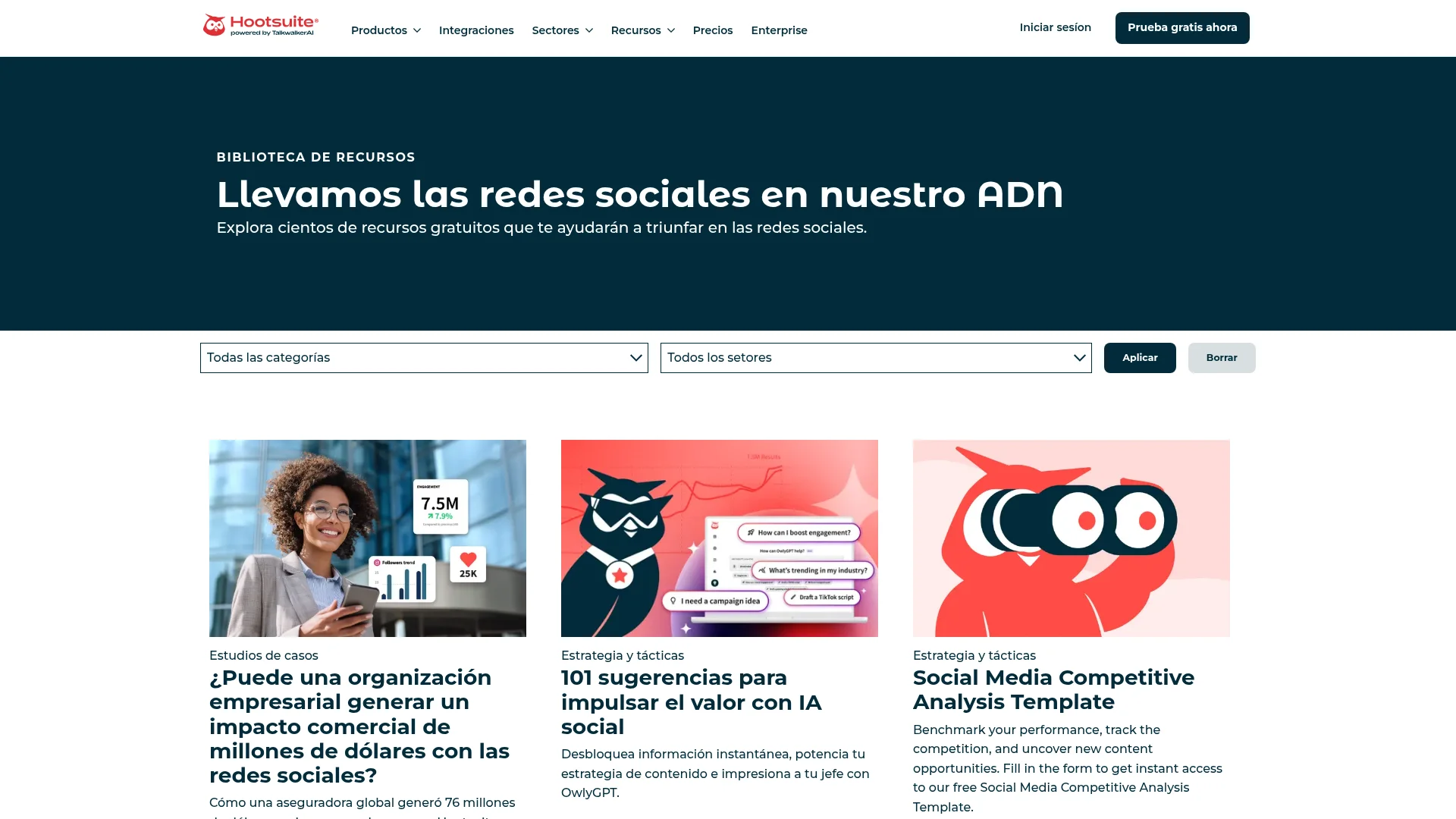
Downloadable templates, checklists, cheat sheets, calculators, and topical playbooks across the social media discipline. The gated and ungated content marketing asset library, housed under /resources/* and /resources/blog/* and distinct from the editorial blog content on the separate blog.hootsuite.com subdomain.
Content-type mix: Guides & Resources 100%
Micro-topics within this cluster
Vertical, SMB & Library Long-Tail (~158 Pages)
Vertical-themed strategy guides for financial services, healthcare, government, higher ed, and nonprofit; SMB-scoped resources; and legacy or locale-translated index pages that round out the library. The largest sub-bucket inside the resource library by URL count, driven by the fact that every vertical asset gets mirrored into five non-English locales and that the /recursos, /ressources, /ressourcen, /risorse, and /recursos index pages each carry their own canonical URL.
Sample pages:
- Recursos de redes sociales (es)
/es/recursos - Ressources sur les médias sociaux (fr)
/fr/ressources - Recursos de mídias sociais (pt)
/pt/recursos - Social media marketing for small business
/resources/10-tips-for-running-your-first-campaign
Topical Discipline Guides (ROI, Selling, Listening, Care, Influencer, Video, Paid, Compliance) (~151 Pages)
Guides organized by social media discipline: social ROI and measurement, social selling, social commerce, social listening, customer care, influencer marketing, employee advocacy with Amplify, video and visual content, paid social, and compliance. A coherent set of discipline-themed assets that map to defined practitioner job titles and the proof-language enterprise champions need to forward to a CFO. Social selling and ROI carry the heaviest concentrations inside this bucket.
Sample pages:
- Social media compliance in regulated industries
/resources/6-steps-to-social-media-compliance - 8 Elements of a Successful Government Social Media Strategy
/resources/8-elements-of-a-successful-government-social-media-strategy - 8 Tips for Building a Social Business
/resources/8-tips-for-social-business - A Social Selling Roadmap for Financial Services
/resources/a-social-selling-roadmap-for-financial-services
Strategy Playbooks, Checklists & Cheat Sheets (~145 Pages)
Long-form strategy guides, playbooks, toolkits, and workbooks paired with short checklist downloads, cheat sheets, and a handful of calculator-format resources. A two-layer asset stack where strategy guides carry the why and checklists or cheat sheets carry the doing. A buyer who lands on a checklist often clicks through to the parent guide, and vice versa, increasing time on site and conversion-stage signal.
Sample pages:
- Social Media Resources hub
/resources - Social Advertising Guide
/social-advertising-guide - Social Advertising Guide (de)
/de/social-advertising-guide - Social Advertising Guide (es)
/es/social-advertising-guide
Templates & Bundles (~131 Pages)
Free downloadable templates: content calendars, strategy templates, report templates, post templates, vertical bundles for healthcare, government, and education, and policy templates. Templates are SEO-attractive because they match exactly how practitioners search ("social media strategy template," "content calendar template") and conversion-friendly because the asset itself is the value. The gating is a clean exchange.
Sample pages:
- Nonprofit Social Media Strategy Template
/resources/nonprofit-social-media-strategy-template - Social Media Strategy Template
/resources/social-media-strategy-template - Social Selling Business Case Template
/resources/social-selling-business-case-template - Nonprofit Social Media Strategy Template (de)
/de/resources/nonprofit-social-media-strategy-template
Strategy insight: The Resource Library is structurally Hootsuite's editorial-marketing engine on the www domain, replacing the role a blog plays for most competitors (since the actual blog is on a subdomain). The vertical, SMB, and long-tail sub-bucket is the largest by URL count not because it's the strongest asset but because each vertical guide gets mirrored across five non-English locales, inflating raw page counts. The ~158-URL long-tail is the cleanup opportunity: localized index pages and legacy assets with thin metadata dilute the section's URL-prefix authority. Templates dominate the format mix at 131 URLs, the right shape for a category where practitioners search for tactical "how to do X" tools.
3. Press Releases & Newsroom
Pages: 579 (all locales) · Share of library: 15.1%
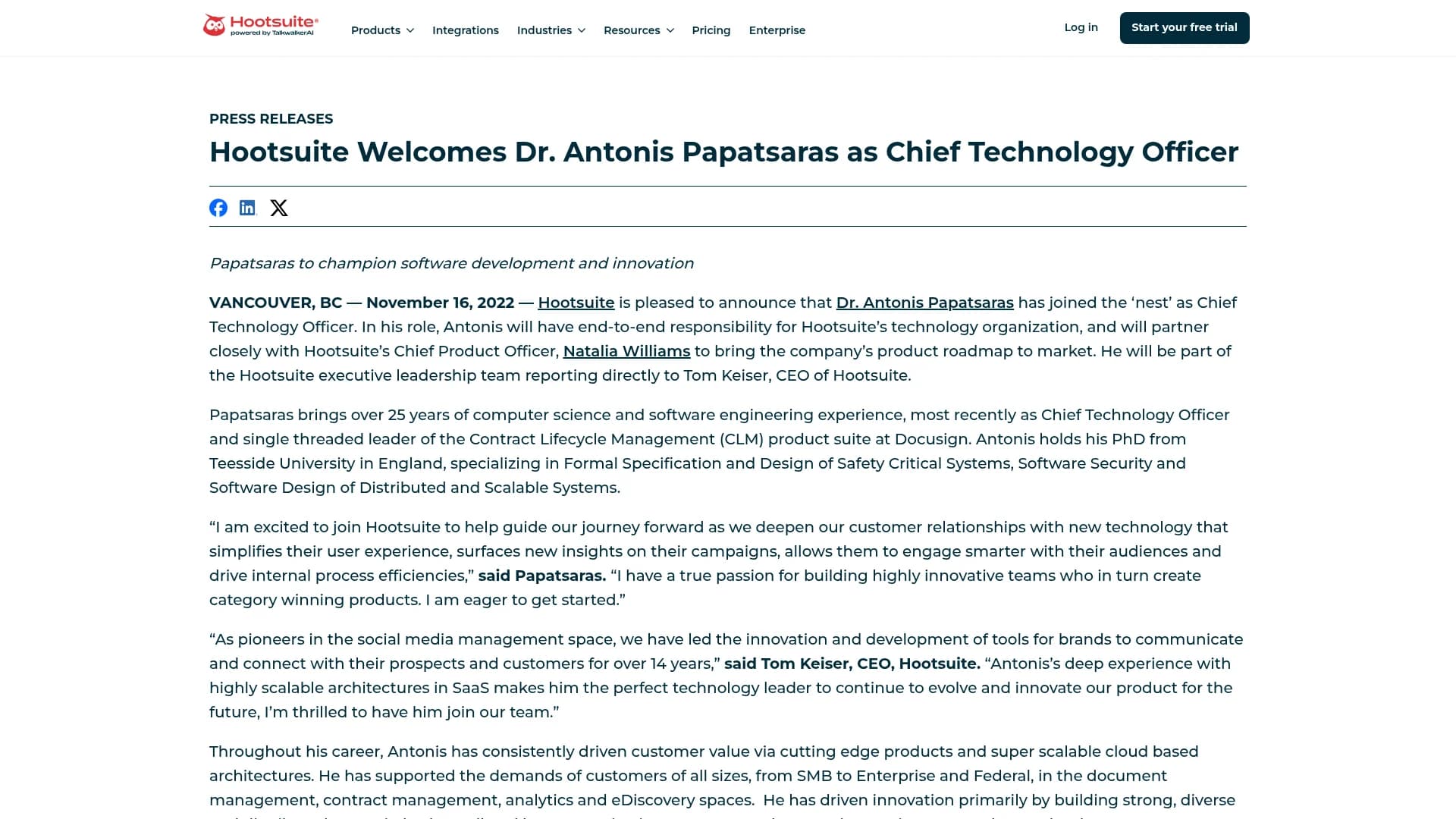
Official corporate news under /newsroom/press-releases/* covering product launches, partnerships, leadership announcements, awards, research releases, and acquisition coverage. Corporate-voiced PR distributed via the newsroom, written for analysts, trade press, and investors rather than practitioners.
Content-type mix: Other 100%
Micro-topics within this cluster
Press Releases & Newsroom: Other (~269 Pages)
Leadership and board appointments, business results, funding milestones, acquisition announcements (Talkwalker, Sparkcentral, Heyday, Brandwatch, Seesmic), research and report releases, social-impact and DEI updates, market-expansion news, and other corporate news items. The single largest sub-bucket inside the newsroom by URL count, reflecting the breadth of corporate, financial, ESG, and M&A communications Hootsuite publishes alongside its product news. Leadership announcements alone (CTO, CPO, regional heads) carry a substantial share.
Sample pages:
- Dr. Antonis Papatsaras Joins Hootsuite as CTO
/newsroom/press-release/hootsuite-welcomes-dr-antonis-papatsaras-as-chief-technology-officer - Natalia Williams Joins Hootsuite as Chief Product Officer
/newsroom/press-release/hootsuite-welcomes-natalia-williams-as-chief-product-officer - New Head of LATAM Region
/newsroom/press-release/hootsuite-welcomes-new-head-of-latam-region - Hootsuite Wins in Influencer Marketing Technology
/newsroom/press-release/hootsuite-wins-best-in-social-influencer-tech-social-marketing-management
Product Launches & Partnerships (~184 Pages)
Releases announcing new product launches, platform features, app rollouts, and partnerships or integrations with Bynder, Salesforce, Canva, Adobe, and other vendors. The two flagship PR types Hootsuite ships most often, written to drive analyst pickup and partner co-marketing. Partnership PR often runs in tandem with the App Directory updates in the changelog cluster, with the press release acting as the cited artifact and the changelog post as the technical note.
Sample pages:
- Hootsuite Announces TikTok Integration
/newsroom/press-release/hootsuite-announces-integration-with-tiktok-empowering-customers-to-be - Hootsuite Announces Collaboration with WHO
/newsroom/press-release/hootsuite-collaborates-with-the-world-health-organization - Hootsuite Joins AWS ISV Accelerate Program
/newsroom/press-release/hootsuite-joins-aws-isv-accelerate-program-and-launches-in-aws-marketplace - Hootsuite Reaches 3 Million Signups
/newsroom/press-releases/3-million-milestone-press-release
Awards & Industry Recognition (~126 Pages)
Press releases announcing analyst recognition, awards, and rankings on G2, Forbes, Constellation, Forrester, and other industry placements. A high-volume PR theme. Hootsuite issues regular award-recognition releases as part of its analyst-relations program, and each one becomes a citation artifact for procurement-stage research.
Sample pages:
- Hootsuite News and Press Releases
/newsroom - Hootsuite News and Press Releases (de)
/de/newsroom - Hootsuite News and Press Releases (es)
/es/newsroom - Hootsuite News and Press Releases (fr)
/fr/newsroom
Strategy insight: A 579-URL newsroom on the www domain is large for the category and reflects Hootsuite's enterprise-procurement posture. The Other sub-bucket carries 46.5% of the cluster, driven by the long tail of leadership, financial, and acquisition releases (Talkwalker, Sparkcentral, Heyday, Brandwatch). For analyst-relations programs, that depth is the point: every quarterly trade-press cycle can pull from a fresh release. The cost is that the newsroom contributes very little organic search traffic per page, similar to the changelog cluster, so the value sits in citation and authority signals rather than direct acquisition.
4. Product & Platform Features
Pages: 453 (all locales) · Share of library: 11.8%
Feature-marketing pages that describe what the Hootsuite platform does and how to buy it: /platform/, /plans/, /pages/, /lp/, /enterprise/, /solutions/, and assorted product landing pages. Anchors the product story for buyers and analysts.
Content-type mix: Product & Feature Pages 100%
Micro-topics within this cluster
Platform Overview, Pricing & Integrations (~241 Pages)
Top-level platform landing pages, the integrations directory, generic feature-marketing landing pages, and plan-comparison and pricing pages for Standard, Advanced, and Enterprise tiers across locales. The largest sub-bucket because every overview, pricing, and integrations page gets mirrored into five non-English locales, and Hootsuite maintains separate landing pages for enterprise and SMB tiers. These pages do double duty: they introduce the platform end-to-end and explain how to buy it.
Sample pages:
- Social Media Marketing and Management Tool
/ - Hootsuite (de)
/de - Hootsuite Enterprise Plan
/enterprise - Hootsuite (es)
/es
Listening, Intelligence & Add-on Modules (~90 Pages)
Pages on social listening, media monitoring, sentiment, trend research, consumer and audience insights, competitive analysis, reputation, crisis management, and the Amplify and Talkwalker product modules. The post-Talkwalker product layer plus the Amplify add-on, all marketed as intelligence and listening capabilities that sit above the core publishing product. This is the cluster's clearest commercial bet.
Sample pages:
- Free Trend Tracker and Trend Analysis Tool
/trend-analysis-tool - Trending Hashtags Today
/trending-hashtags - Free Trend Tracker (de)
/de/trend-analysis-tool - Trending Hashtags Today (de)
/de/trending-hashtags
AI, Advertising & Add-on Modules (~66 Pages)
Pages dedicated to Hootsuite's AI assistants (OwlyGPT, OwlyWriter), generative AI capabilities, paid social management, advertising tools, and Promote or Boost feature pages. Adjacent feature pillars that Hootsuite markets as distinct value layers within the broader platform. The OwlyGPT and Talkwalker landing pages anchor this bucket and are the most-cited URLs in Hootsuite's 2025-2026 analyst materials.
Sample pages:
- OwlyGPT AI Social Media Manager
/owlygpt - Hootsuite Talkwalker Acquisition, Features, and News
/talkwalker - OwlyGPT AI Social Media Manager (de)
/de/owlygpt - Hootsuite Talkwalker (de)
/de/talkwalker
Engagement, Publishing & Analytics Features (~56 Pages)
Pages on the unified inbox, engagement and customer care, content scheduling, calendar, approval workflows, link-in-bio, best-time-to-post, social analytics, and ROI reporting. The three operational pillars of the legacy Hootsuite product: engage incoming messages, publish outgoing content, and analyze what happened. The smallest of the four feature sub-buckets, which is the right tell about where product marketing investment currently sits.
Sample pages:
- Social Media Analytics Tools
/platform/analytics - Social Media Analytics Tools
/platform/analyze - Best Time to Post on Social Media Tool
/platform/best-time-to-post-on-social-media - Social Media Engagement Tools
/platform/engage
Strategy insight: The relative sizes inside this cluster reveal where Hootsuite's product marketing investment has shifted. Listening, Intelligence & Add-on Modules (90 URLs) plus AI, Advertising & Add-on Modules (66 URLs) together account for 156 URLs, roughly 2.8× the core Engagement, Publishing & Analytics surface (56 URLs). The post-Talkwalker product story (listening, AI, advocacy) is now larger by page count than the original Hootsuite product story (engage, publish, analyze), even though the latter is what most existing customers actually use. This is consistent with a category leader telling a new product story while servicing the old one.
5. Research, Industry & Corporate Pages
Pages: 414 (all locales) · Share of library: 10.8%
A combined cluster of high-intent landing surfaces and corporate pages: annual research reports, vertical industry pages, social-network landing pages, use-case framings, head-to-head comparisons, and About, leadership, and partner-program pages. Each sub-group is small on its own (40–130 URLs), but together they form a coherent set of buyer-facing landing pages and corporate identity surfaces.
Content-type mix: Research / Reports 31.2%, Product & Feature Pages 30.2%, Other 25.9%, Guides & Resources 10.6%, Comparison Pages 2.2%
Micro-topics within this cluster
Use-Case, Comparison & Corporate Pages (~151 Pages)
Cross-functional /use-cases/* pages for PR and communications, business intelligence, social marketing, product innovation, and customer experience; head-to-head /hootsuite-vs-* comparison pages against Sprout Social, Buffer, Later, Loomly, Sprinklr, Brandwatch, Metricool, and HubSpot; About and leadership pages, partner and affiliate programs, social impact, DEI, the TikTok creators series, and assorted corporate community pages. Three small but high-intent landing-page types that together describe Hootsuite as a brand and as a buyer choice. The comparison-page sub-set is the most strategically loaded: eight canonical comparison-shopping queries covered with one URL each, no locale variants, and no /alternatives surface.
Sample pages:
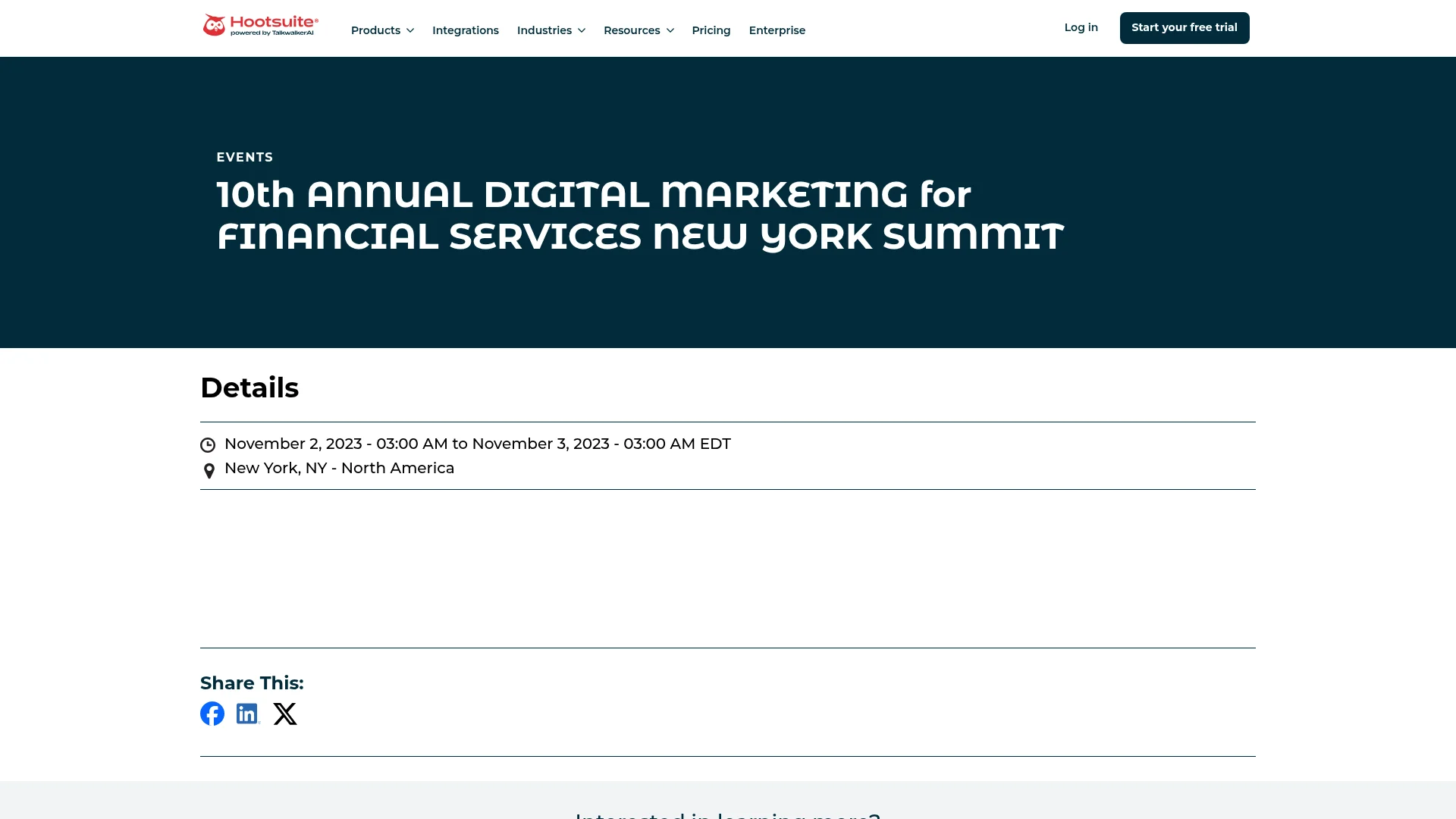
- 10th Annual Digital Marketing for Financial Services NYC Summit
/10th-annual-digital-marketing-for-financial-services-new-york-summit - 5th Annual Digital Marketing for Financial Services Midwest Summit
/5th-annual-digital-marketing-for-financial-services-midwest-summit - About Hootsuite
/about - Hootsuite affiliate program
/affiliate-program
Industry & Social Network Landing Pages (~134 Pages)
/industries/* vertical pages for healthcare, financial services, government and public sector, higher education, marketing agencies, and small and medium businesses; long-tail vertical pages for CPG, technology, hospitality, sports, legal, real estate, and professional services; and /platform/network-* landing pages for Instagram, TikTok, LinkedIn, Facebook, X, YouTube, Pinterest, Threads, and Bluesky. Vertical-buyer and social-network landing pages share the same architectural shape: a single high-intent page per audience that ranks for "[network or industry] marketing" or "[industry] social media" queries.
Sample pages:
- Schedule Bluesky Posts with Hootsuite
/bluesky - Analyze and Schedule Facebook Posts
/facebook - Hootsuite for Government, Healthcare, Finance, and More
/industries - Automate and Schedule Instagram Posts
/instagram
Annual Research & Reports (~129 Pages)
The Social Media Trends Report, the Social Media Career Report (with salary, burnout, team-structure, healthcare, finserv, education, and government cuts), the Consumer Report, Relationship and Brand Engagement reports, and vertical research themed for financial services, government, healthcare, and education. A distinct content asset class within the cluster: long-form proprietary research reports that anchor Hootsuite's thought-leadership and PR programs across multiple years. Branded multi-year research is the hardest content asset for a competitor to replicate quickly.
Sample pages:
- 2024 Relationship and Brand Engagement Report
/research/consumer-report - 2023 Social Media Career Report
/research/social-media-career-report - 2023 Education Social Media Career Report
/research/social-media-career-report-education - 2023 Finance Social Media Career Report
/research/social-media-career-report-financial-services
Strategy insight: Combining annual research, industry pages, network landing pages, use-case framings, and corporate identity into one cluster reveals what they share: each one is a single, high-intent landing surface that targets a defined audience query. The two-franchise research strategy (Trends + Career) is unusual and load-bearing. Most competitors run one annual report; Hootsuite runs two and slices each into vertical editions, multiplying the citation surface. Sitting next to research, the 134 industry-and-network landing pages give Hootsuite wide vertical coverage, and the 9 comparison pages give it just enough defensive coverage to surface in head-to-head searches without committing to a full /alternatives program.
6. Legal, Trust & Compliance
Pages: 328 (all locales) · Share of library: 8.6%
/legal/, /trust-center/, and /security/* pages: terms of service, privacy policies, data-processing addenda, compliance pages, accessibility statements, brand assets, and acquired-product legacy legal pages. Heavily duplicated across locales as required for enterprise SaaS selling into regulated markets.
Content-type mix: Other 100%
Micro-topics within this cluster
Terms of Service & Agreements (~128 Pages)
Master terms, API terms, ads terms, enterprise terms, beta terms, SLA, payment terms, partner agreements, and product-specific (Talkwalker, Sparkcentral, GPT) terms across locales. Terms-of-service variants are the largest legal sub-category and the most heavily locale-mirrored, because every acquired product preserves its own legal artifacts even after integration.
Sample pages:
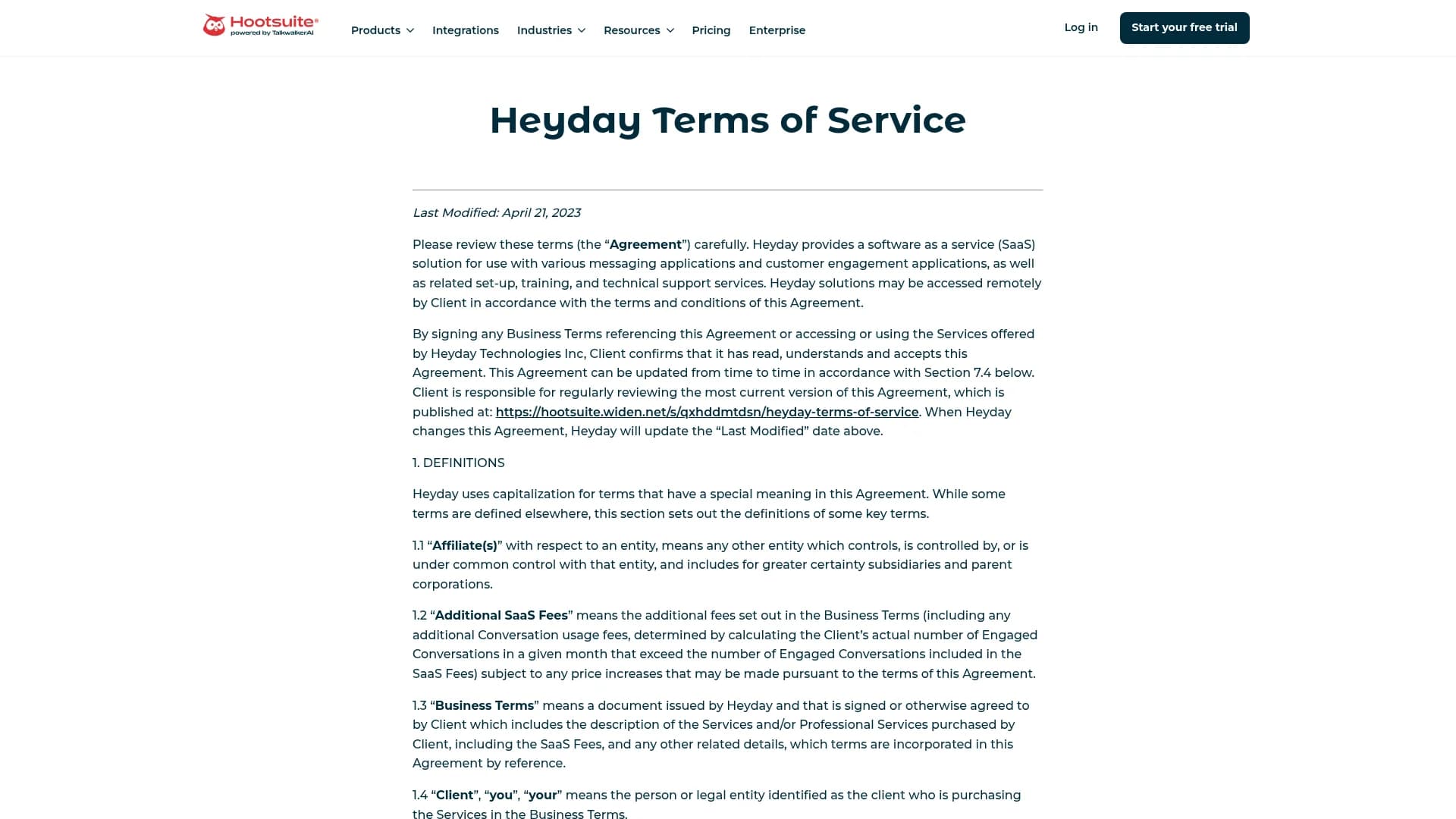
- Heyday Terms of Service
/heyday-terms - Advertising Terms & Conditions
/legal/ads-terms - AI Terms of Service
/legal/ai-terms - Hootsuite API Terms of Service
/legal/api-terms-of-service
Legal & Trust: Other (~109 Pages)
Acceptable-use, EULA, copyright, code of ethics, anti-corruption, modern slavery, whistleblowing, COVID protocols, brand assets, transparency reports, acquired-product legacy policies, and other compliance documents. The long tail of corporate compliance documents, locale-specific policy mirrors, and legacy policies from acquired products (Sparkcentral, Heyday).
Sample pages:
- Hootsuite Legal Center
/legal - Hootsuite Legal Center (de)
/de/legal - Hootsuite Legal Center (es)
/es/legal - Hootsuite Legal Center (fr)
/fr/legal
Privacy, Trust Center & Security (~91 Pages)
Main privacy policy, product-specific privacy policies, DPAs, sub-processor lists, GDPR pages, cookie policies, accessibility statements, and the buyer-facing Trust Center. Privacy, data processing, accessibility, and trust-center pages together form the buyer-facing trust surface needed in enterprise and EU procurement.
Sample pages:
- Hootsuite Accessibility
/accessibility - Platform Security and Data Protection
/security - Sparkcentral Privacy Policy
/sparkcentral-privacy-policy-archive-2022 - Hootsuite Trust Center
/trust-center
Strategy insight: A 328-URL legal-and-trust footprint is the structural cost of selling into European enterprise and regulated industries. Every privacy policy gets mirrored across six locales, every acquired product (Sparkcentral, Heyday, Talkwalker) keeps its legacy policies indexed, and the trust center maintains its own buyer-facing surface separate from the raw legal documents. This is necessary infrastructure rather than content strategy, but it contributes 8.6% of the library by URL count and almost nothing to organic acquisition.
7. Free Social Media Tools
Pages: 201 (all locales) · Share of library: 5.3%
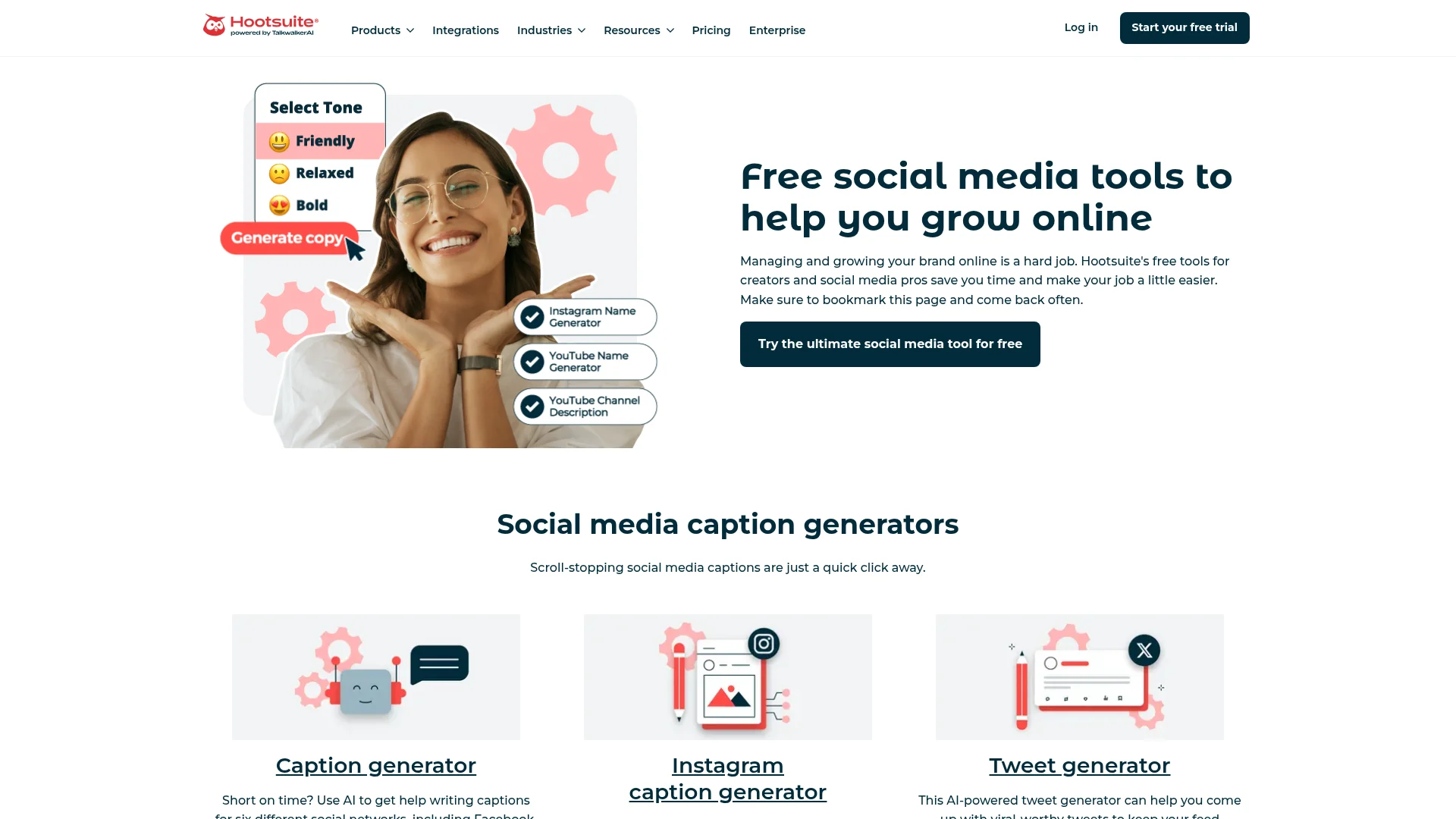
Free standalone utilities under /social-media-tools/*: calculators, generators, character counters, hashtag tools, and AI caption writers. Mirrored across five non-English locales as a high-volume SEO acquisition surface. A large, coherent SEO play with dozens of small free tools, each ranking for utility queries.
Content-type mix: Free Tools 100%
Micro-topics within this cluster
Caption & Content Generators (~80 Pages)
AI-powered generators for captions, tweets, LinkedIn posts, Facebook posts, video descriptions, and content ideas across all five non-English locales. The largest single sub-bucket of the free-tools library, capturing the AI-generator wave of free SEO tools that exploded in 2023-2024. Each generator targets a specific search like "Instagram caption generator" or "LinkedIn post generator" and converts curious users into free-tier signups.
Sample pages:
- Best Free Social Media Tools for Growth & Engagement
/social-media-tools - Best Free Social Media Tools (de)
/de/social-media-tools - Best Free Social Media Tools (es)
/es/social-media-tools - Best Free Social Media Tools (fr)
/fr/social-media-tools
Identity, Bio & Hashtag Tools (~66 Pages)
Bio writers, username generators, channel-name generators, business-name generators, and hashtag generators for Instagram, TikTok, and general social media use. Identity-related and hashtag-related generators that share a similar utility shape and ranking footprint, organized as a single sub-cluster because they target adjacent practitioner moments (setting up a profile, choosing a brand handle, picking hashtags for a post).
Sample pages:
- AI Business Name Generator
/social-media-tools/ai-business-name-generator - AI Instagram Bio Generator
/social-media-tools/ai-instagram-bio-generator - Free Social Media Bio Generator
/social-media-tools/bio-generator - Free Facebook Post Caption Generator
/social-media-tools/facebook-post-caption-generator
Calculators & Utility Tools (~55 Pages)
Engagement-rate, ROI, advocacy, and salary calculators alongside character counters, Boolean search, social SEO tools, post-preview tools, and emoji or sentiment utilities. A grab-bag of calculators and SEO-utility tools that target optimization and measurement workflows rather than generative output. The engagement-rate and ROI calculators tie directly into Hootsuite's measurement positioning.
Sample pages:
- Boolean Search Generator
/social-media-tools/boolean-generator - Free Emoji Translator Tool
/social-media-tools/emoji-translator - Free Employee Advocacy Calculator
/social-media-tools/employee-advocacy-calculator - Engagement Rate Calculator
/social-media-tools/engagement-rate-calculator
Strategy insight: A 201-URL free-tools cluster mirrored across five non-English locales is unusually wide for the category. Buffer and Later run free tools too, but at lower volume and with thinner localization. Hootsuite's choice to localize every tool produces a long-tail ranking surface that captures "[tool name] [language]" searches in markets where AI-tooling SEO is less crowded than in English. The trade-off is operational: 201 tools × 6 locales is a maintenance commitment, and tool freshness is the variable that determines whether they continue ranking as Google's quality bar rises.
8. Webinars & Events
Pages: 198 (all locales) · Share of library: 5.2%
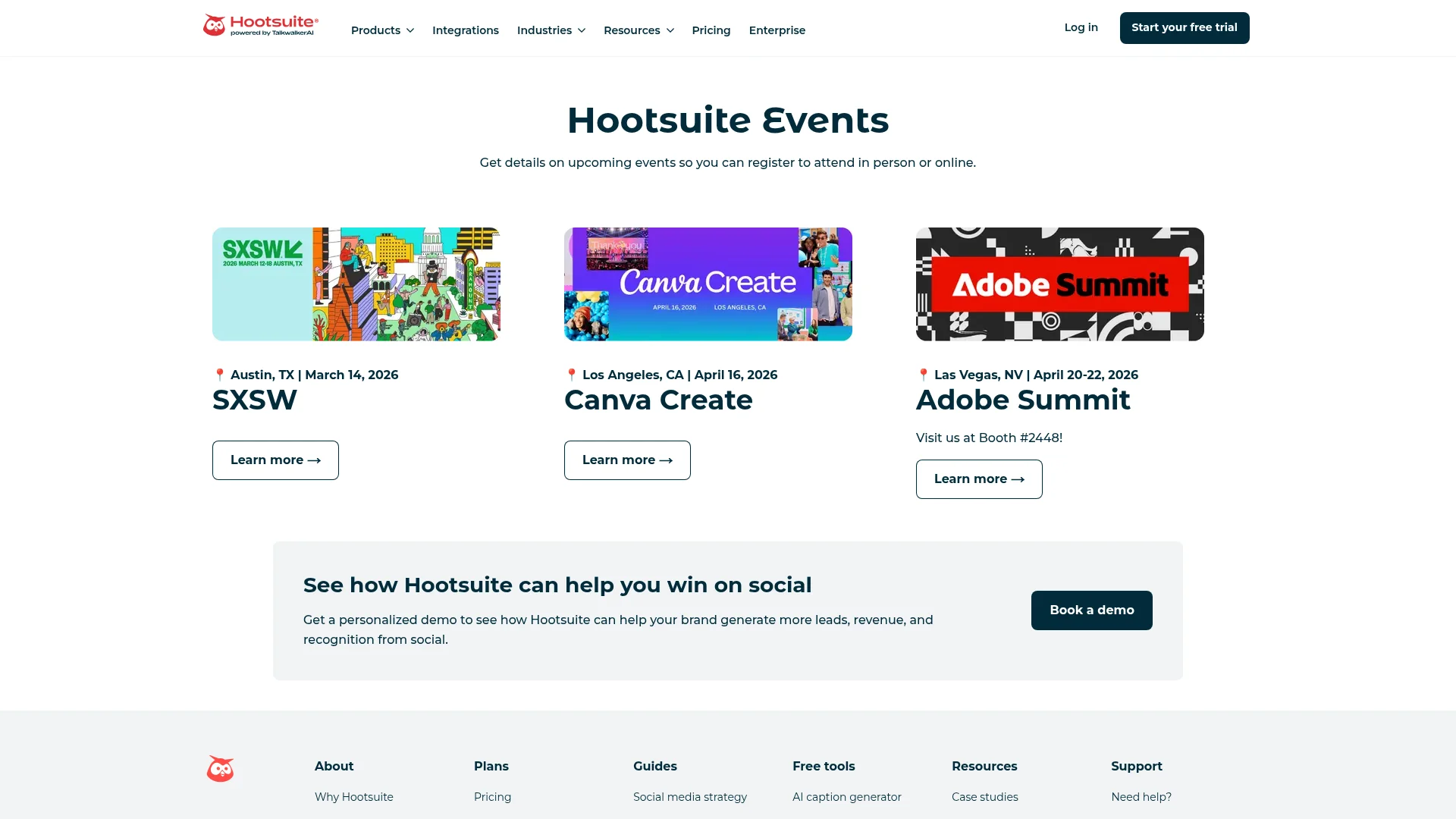
Live and on-demand webinar sessions, summits, and event pages under /webinars/* and /events/*. Hootsuite's live-content program, distinct from gated guides or evergreen blog posts. A coherent live-content asset class that runs in parallel with the evergreen resource library and supports both top-of-funnel education and vertical-account marketing.
Content-type mix: Events / Webinars / Sessions 100%
Micro-topics within this cluster
Vertical, Event & Long-Tail Webinar Sessions (~116 Pages)
The Uplift summit series for nonprofits, vertical webinar tracks for financial services, healthcare, education, government, and agencies, multi-day summit and conference event landing pages, and one-off sessions that do not fit a single theme. The larger of the two sub-buckets by URL count because Hootsuite has run vertical webinar tracks across many years, each carrying its own /webinars/ landing page and locale mirrors. The /webinars and /events index pages also live here.
Sample pages:
- Social Media Events
/events - Free Social Media Webinars and Trainings
/webinars - Social Media Events (de)
/de/events - Free Social Media Webinars and Trainings (de)
/de/webinars
Strategy, AI & Listening Webinars (~82 Pages)
Webinars on social media strategy, trends, content hacks, OwlyGPT and AI use cases, automation, social listening, Talkwalker, brand monitoring, sentiment, and trends analysis. The general best-practices webinar series targeting working social practitioners, plus the AI and listening tracks that anchor Hootsuite's current positioning. The 2026 Social Trends webinar feeds the Social Media Trends Report franchise and runs every year.
Sample pages:
- Social Media Trends 2026: CMO Strategy
/webinars/2026-social-trends - 3 Benefits of Curating Content
/webinars/3-benefits-of-curating-content - 3 Ways to Ramp Up Your Social Commerce Strategy
/webinars/3-ways-to-ramp-up-your-social-commerce-strategy - 7 Unexpected Benefits of Social Listening
/webinars/7-unexpected-benefits-of-social-listening
Strategy insight: Hootsuite runs webinars as a parallel live-content layer to the gated guides in the resource library. The vertical sub-bucket carries 58.6% of the cluster, reflecting that webinars are a vertical-account marketing tool more than a top-of-funnel acquisition surface. The 2026 Social Trends webinar tying back to the Social Media Trends Report shows how the live program reinforces the annual-research franchise rather than competing with it.
9. Customer Stories & Case Studies
Pages: 193 (all locales) · Share of library: 5.0%
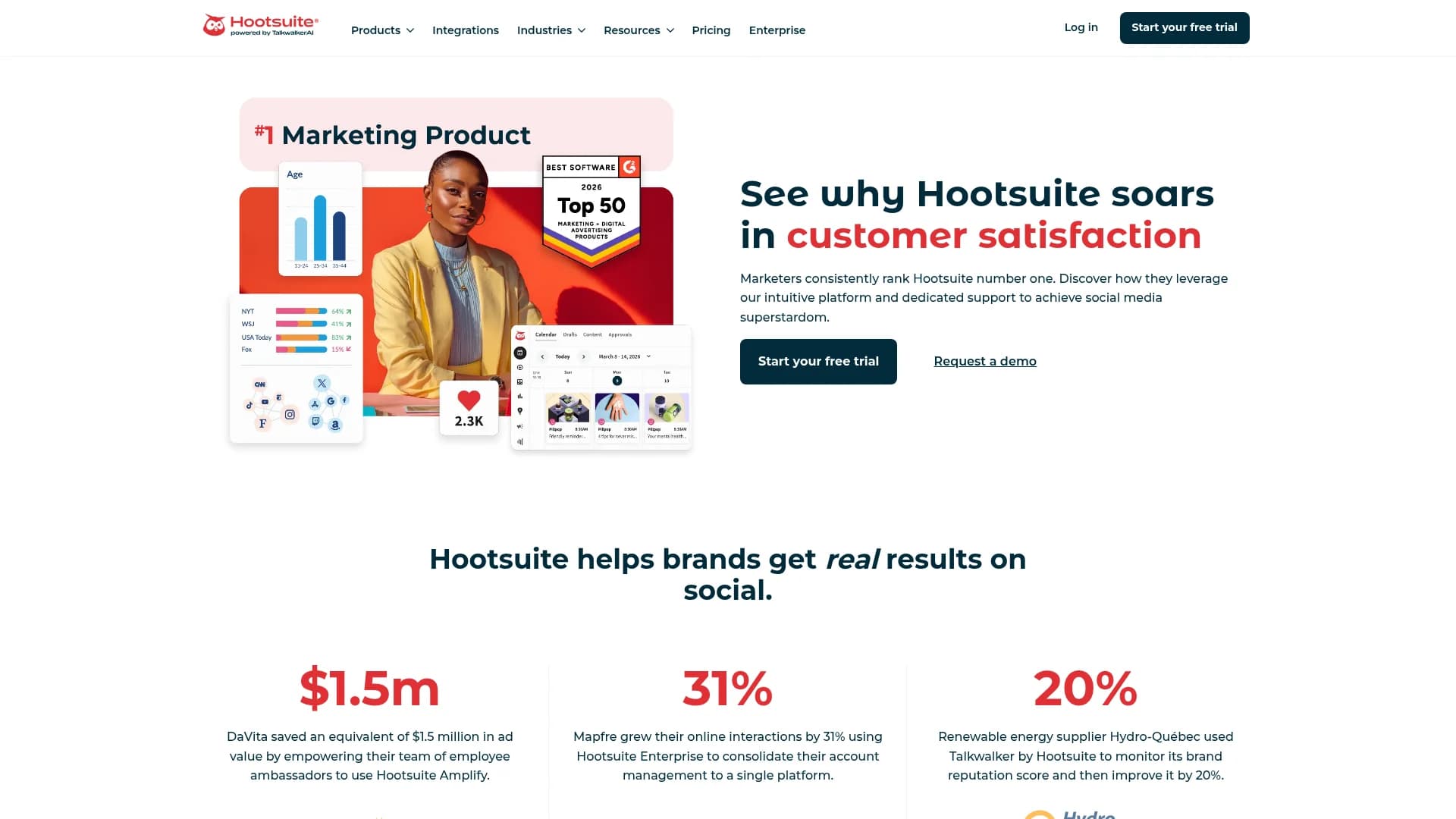
Customer-named success stories and case studies across /resources/[customer], /resources/case-study/, /resources/-case-study, /pages/case-study-*, /customers, and localized mirrors. A body of social-proof content separate from product or guide content, organized around the customer's industry and the product they use.
Content-type mix: Case Studies / Customer Stories 100%
Micro-topics within this cluster
Customer Stories & Case Studies: Other (~92 Pages)
Government and public-sector cases (RMWB, Carahsoft, City of Greater Bendigo); education and cultural institutions (British Museum, University of Sydney, St Andrews); retail and CPG (Clarins, Amway); sports and fitness; tech brands (Nokia, Stocksy); energy and utilities (ENGIE, Hydro-Québec, SPIE); nonprofits (UNESCO); real estate; and locale-translated /customers index pages. The wider portfolio of customer stories beyond the three flagship industry tracks, covering every vertical Hootsuite serves with one or two named brands. The locale-translated /customers index pages alone account for a substantial share.
Sample pages:
- Hootsuite Reviews, Testimonials, and Success Stories
/customers - Hootsuite Reviews, Testimonials, and Success Stories (de)
/de/customers - Social Media-Ressourcen (de)
/de/ressourcen - Hootsuite Reviews, Testimonials, and Success Stories (es)
/es/customers
Financial Services, Hospitality & Employee Advocacy Cases (~63 Pages)
Banks, insurance, and wealth-management customers (Julius Baer, MAPFRE, Armanino, Sykes, IAG); hotel groups, travel, and hospitality brands (Barceló, Meliá, U-Haul, Sodexo, APO, Stuckey's); and Amplify employee-advocacy customers (Antalis, Docaposte, SIX Group). Three closely-merchandised industry tracks that together carry Hootsuite's largest concentrations of named enterprise customer logos. Employee-advocacy customers are merchandised separately as Amplify customer proof.
Sample pages:
- Employee Advocacy Case Study (Amplify)
/resources/amplify-case-study - Armanino and Hootsuite (Financial Services)
/resources/armanino - Docaposte Builds B2B Growth Through Employee Advocacy
/resources/docapost-puts-employee-advocacy-at-the-heart-of-its-b2b-development-strategy - Antalis and Amplify (B2B Employee Advocacy)
/resources/how-antalis-leads-its-industry-on-social-with-employee-ambassadors
Healthcare Customer Stories (~38 Pages)
Case studies featuring healthcare and medical organizations including DaVita, Ochsner, RACGP, Watermark, and Innovetive Petcare. Healthcare is the most-represented single vertical in the case-study library, with multiple named brands and a clear regulatory-content fit. Hospitality and travel customers are folded into the broader finserv-hospitality-advocacy bucket above because they share an enterprise-buyer narrative.
Sample pages:
- Meliá Hotels Scales Global Social Strategy
/pages/case-study-melia-hotels - Auckland Philharmonia Case Study
/resources/apo-case-study - Corewell Health Case Study
/resources/corewell-health-case-study - Croda Healthcare Case Study
/resources/croda
Strategy insight: Customer Stories & Case Studies is a deep customer-proof library at 193 URLs. It functions as a compounding evidence asset: every new named-customer story adds to the moat, and new entrants without comparable customer relationships cannot match this footprint in a short timeframe. Healthcare leads as a single named vertical (38 URLs); the combined finserv-hospitality-advocacy bucket leads by count (63 URLs) because those three tracks share an enterprise-buyer narrative and a tight content cadence. The 92-URL Other sub-bucket includes the locale-translated /customers index pages, which inflate the count without adding distinct customer logos.
Key Observations
What Stands Out About Hootsuite's Content Strategy
The library is a breadth-play, not a single-asset bet
No two clusters in Hootsuite's library together exceed 40% of total pages. The top two (the 875-URL /whats-new/ changelog and the 585-URL Resource Library) combine for just 38.2%. Top three formats (Guides & Resources 16.4%, Product & Feature Pages 15.1%, Free Tools 5.3%) each sit well below dominance. This is the architectural shape of a category leader running many parallel acquisition surfaces (product pages, free tools, customer stories, research, webinars, PR, changelog) rather than concentrating investment in one flagship format. The trade-off is clear: breadth is resilient against any single format's traffic decline, but it dilutes the cumulative authority any single surface can build.
Locale duplication roughly 2.1×s the apparent library size
Only 47.4% of URLs (1,815) are unique en-root content. The remaining 2,011 URLs are translations or regional variants across German, French, Spanish, Italian, and Portuguese. Each non-English locale carries 8–12% of the library, suggesting one centralized translation workflow rather than locale-specific editorial decisions. For benchmarking, Hootsuite's comparable surface area against single-locale peers like Buffer (2,982 URLs) or Later (1,572 URLs) is closer to ~1,815 unique en-root pages, comparable to Buffer at the unit level, smaller than its headline 3,826 suggests.
Per-URL traffic efficiency is high at ~776 visits per page
2.97M monthly organic visits across 3,826 pages works out to ~776 visits per URL, efficient for a library of this size. The signal is that individual pages are working hard on average, rather than the library leaning on volume to manufacture aggregate traffic. Sustaining this at scale requires preserving the per-page bar as the library grows, which is a different operational discipline from "publish more." The /whats-new/ changelog (875 URLs of thin metadata) is the obvious headwind on this metric. Pulling those out, the surviving 2,951 URLs work materially harder.
Only 22.3% of ranking positions sit in the top 10, but 29,107 sit in 11-20
Hootsuite's top-10 share (22.3%) is in line with category peers Buffer (23.4%) and Sprout Social (23.4%), but the 29,107 positions in the 11-20 band represent the most actionable optimization sweet spot: content already on Google's second page that focused work could push into top-10 visibility. A further 57,504 positions sit in 21-50, a substantial second reservoir. For a leader with this position count, the lift from systematic 11-20 optimization could be larger than any new-content investment.
Comparison-page investment is light for a leader of this scale
9 canonical comparison pages, across a 3,826-URL library and a 155,330-ranking-position footprint, is modest defensive coverage. Direct competitors (Buffer, Sprout Social, Later, Sprinklr) get one URL each; indirect competitors (HubSpot, Metricool, Loomly, Brandwatch) the same. There are no locale variants, no /alternatives surface, and no defensive footprint against the long tail of "Hootsuite alternative" searches that challenger displacement campaigns target. Either commit and expand (mirror across locales, build /alternatives, add long-tail variants) or accept the gap and reinvest the effort elsewhere. The in-between is the weakest position.
The /whats-new/ changelog is structurally the largest content asset (875 URLs)
At 22.9% of the library, the changelog is larger than any traditional editorial format on the www domain. Keeping it indexable and public, rather than hiding it in-app or behind a help-center login, means every shipped feature becomes a searchable, linkable artifact. The 171-post AI, Listening & Amplify sub-stream alone doubles as evidence-of-investment for buyers researching Hootsuite's AI roadmap, useful at the procurement stage. The cost is sitemap weight and per-URL traffic dilution; the benefit is procurement-stage citation surface and a continuous "actively-shipping" signal to industry watchers.
The two-franchise research strategy (Trends + Career) is a compounding asset, but the editorial blog isn't on this domain
The Social Media Trends Report and the Social Media Career Report together anchor a 129-URL annual-research sub-bucket inside the combined Research, Industry & Corporate Pages cluster. Branded multi-year research is the hardest content asset for a competitor to replicate quickly. The www sitemap contains zero URLs classified as Blog / Editorial, Podcast / Audio Series, or Glossary / Definitions. The editorial blog lives on blog.hootsuite.com, a separate subdomain. That split is unusual at this scale: it means hootsuite.com's authority is built largely on research, templates, free tools, customer proof, and PR, with the long-form editorial cadence that typically anchors a content engine living on a different domain entirely.
The /resources URL prefix carries three different content types
267 URLs at /resources span Guides & Resources (200), Case Studies / Customer Stories (52), and Research / Reports (15). Three content types sharing a single URL prefix dilutes section-level authority for any of them. A buyer landing on /resources/croda (a healthcare case study) is in a different mode than a buyer landing on /resources/social-media-strategy-template (a gated template), but search engines see them as siblings. Splitting customer stories and research into dedicated paths (/customers/* and /research/* respectively) would tighten architectural clarity, but at the cost of redirecting hundreds of existing URLs with established backlinks.
More analyses in Social Media Management
Later
How Later uses 674 blog posts, a 281-term glossary, and a 58-episode podcast to drive 3.6M monthly visits in social media management. 1,572 pages, 7 clusters.
Loomly
How Loomly uses 336 blog posts and a 62-term marketing glossary to drive 40K monthly visits in social media management. 482 pages, 4 clusters.
Planable
How Planable uses 386 blog posts and 33 free AI content tools to drive 191K monthly visits in social media management. 600 pages, 5 clusters.
Sendible
How Sendible uses 536 blog posts, 133 product pages, and 41 case studies to drive 126K monthly visits in social media management. 770 pages, 6 clusters.
Methodology: This analysis is based on Hootsuite's full public sitemap (3,826 URLs, sourced from robots.txt), enriched with each URL's title and meta description via lightweight HTTPS fetches. URLs were classified into a 12-bucket content type taxonomy and grouped into 9 topic clusters with 30 micro-topics using LLM-assisted classification. Company facts came from public web research across Crunchbase, LinkedIn, and Hootsuite's own About and newsroom pages. Traffic metrics (monthly organic visits, traffic value, ranking positions, position distribution) came from DataForSEO's domain rank overview, aggregated globally across 117 locale combinations. All counts reflect the Hootsuite sitemap as of 2026-05-26.