
Summary
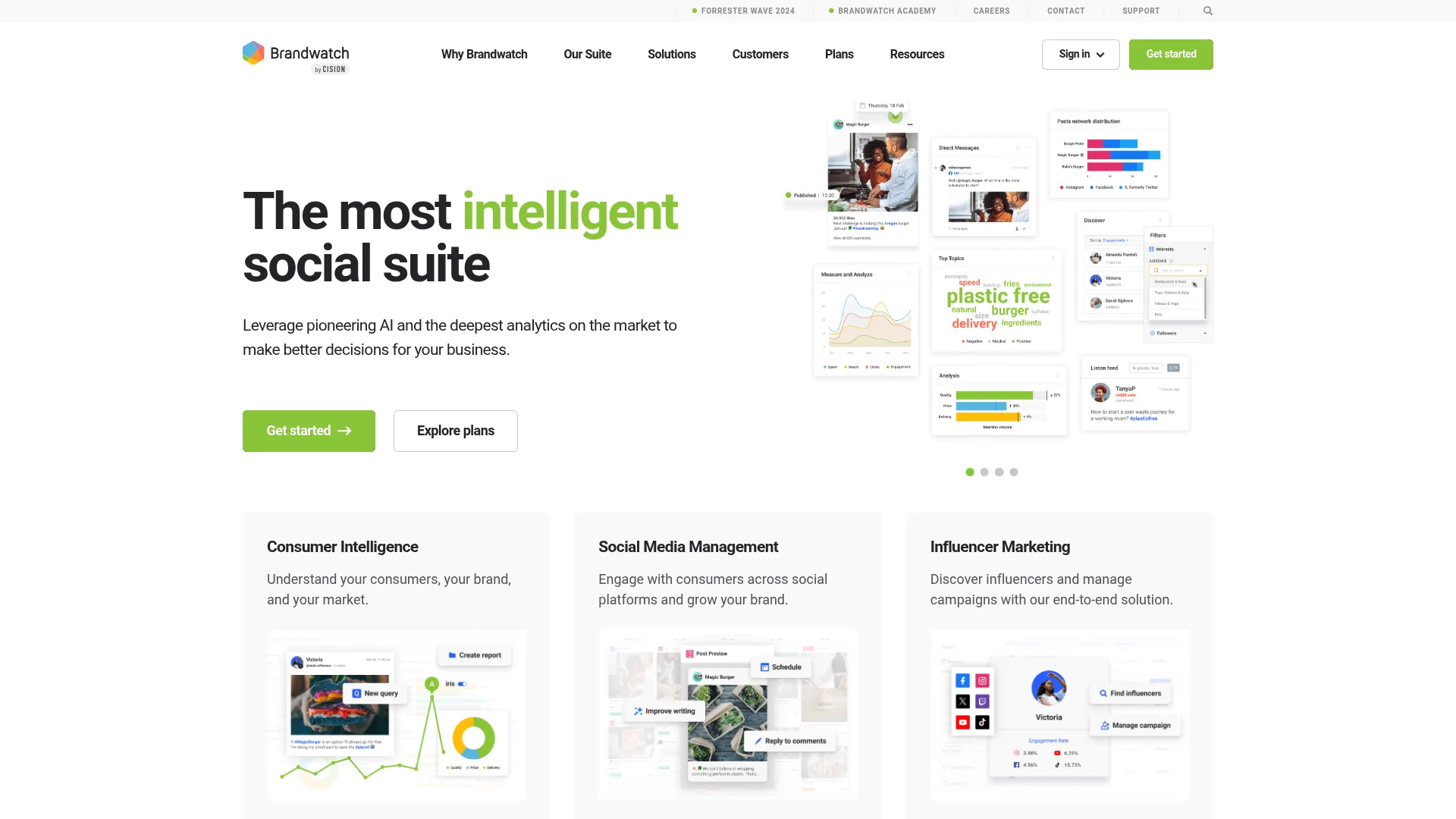
Brandwatch drives 534,161 monthly organic visits by running the largest content library in the social media management cohort: 7,072 indexable pages, organized into 7 topic clusters and 29 micro-topics, with editorial spread across four locales. The architecture combines three product lines (Listen / Consumer Intelligence, the Suite social media management platform, and Influence) into one Product Surfaces & Tactical Playbooks cluster, alongside a 1,288-URL Research, Guides & Webinar Programs franchise that anchors the library as a multi-year compounding asset. 15.2% of Brandwatch's 39,132 ranking positions sit in the top 10 across 117 indexed (location, language) combinations, below the category leader, with the bulk of positions concentrated in the 11-20 and 21-50 ranges where focused optimization could move pages onto page one. The library reflects an enterprise consumer-intelligence posture, not an SMB-publishing tool: a different content shape from the rest of the category.
Key facts:
- Library size: 7,072 indexable pages organized into 7 topic clusters; 54.4% Blog / Editorial
- Largest cluster: Editorial Blog (German) (1,588 URLs, 22.5% of library)
- Flagship content asset: Research, Guides & Webinar Programs, 1,288 URLs spanning the annual Digital Marketing Trends series, Change Makers, Brandwatch Index, Pulse live-events, marketer guides, thought-leadership webinars, and 730 localized editions
- Search performance: 534K monthly visits across 39,132 ranking positions; 15.2% in top 10 (~76 visits per page)
- Notable gap: Zero comparison pages and zero free tools across a 7,072-URL library, two surfaces a market-leader-sized footprint would normally defend
Company Overview
Brandwatch at a Glance
| Company | Brandwatch (Brandwatch, a Cision Company) |
| Founded | 2007 · Brighton, East Sussex, UK |
| Category | Social Media Management / Social Listening & Consumer Intelligence |
| What They Do | Brandwatch is a social media suite offering consumer intelligence, social listening, and social media management tools. It serves enterprise marketing, PR, insights, and social media teams at Fortune 1000-class brands and global agency networks (Unilever, Walmart, Dell, American Airlines, PepsiCo, Nestle) by monitoring conversations across more than 100 million online sources. |
| Funding | $67M raised pre-acquisition; acquired by Cision in June 2021 for $450M |
| Headcount | 1,000–5,000 (LinkedIn band) |
| Monthly Organic Visits | Traffic Value (PPC equiv.) | Ranking Positions |
|---|---|---|
| 534K | $937K | 39.1K |
Ranking positions reflect total positions across 117 indexed (location, language) combinations, not unique keywords. A keyword ranking in both en-US and de-DE counts twice.
Brandwatch's content operation is dense and editorially-led across four locales: 7,072 indexable pages, 54.4% Blog / Editorial. Unlike pure-play social media management peers, Brandwatch carries content for three distinct product lines (the Listen / Consumer Intelligence suite from the original Brandwatch, the Suite social management surface inherited from the Falcon.io merger, and Influence from the Paladin acquisition) plus a dedicated long-form research, guides, and webinars franchise. The German blog at 1,588 URLs is larger than the English editorial blog at 519, a locale split most category peers do not maintain.
Content Architecture
What Does Brandwatch's Content Engine Look Like?
Brandwatch's main website hosts 7,072 indexable pages organized into 7 topic clusters. The architecture reads as a long-running, multi-locale editorial publication built on top of an enterprise consumer-intelligence positioning, not the tool-led content shape of pure-play SMM competitors.
Content Type Distribution
| Content Type | Count | Share | Notes |
|---|---|---|---|
| Blog / Editorial | 3,844 | 54.4% | Bulk of the library; split across four locales, German largest at 1,588 |
| Other | 1,191 | 16.8% | Press releases, author archives, locale roots, taxonomy, utility pages |
| Events / Webinars / Sessions | 476 | 6.7% | Includes recurring Social Pulse series and 184 localized webinars |
| Research / Reports | 453 | 6.4% | Annual Digital Marketing Trends series across /reports/, /changemakers/, /pulse/, /brandwatch-index/, /originals/ |
| Product & Feature Pages | 409 | 5.8% | Listen, Iris AI, Suite, Engage, Publish, Measure, Influence, integrations |
| Guides & Resources | 359 | 5.1% | Long-form playbooks; 249 are localized editions |
| Case Studies / Customer Stories | 229 | 3.2% | Named-customer stories; 143 localized |
| Glossary / Definitions | 111 | 1.6% | Dedicated /social-media-glossary/ archive (definitional SEO surface) |
| Podcast / Audio Series | 0 | 0.0% | Not present in the main sitemap |
| Comparison Pages | 0 | 0.0% | No canonical /vs/ or /alternatives/ URLs |
| Free Tools | 0 | 0.0% | No calculators, templates, or interactive utility surfaces |
| Documentation | 0 | 0.0% | Not present in the main sitemap |
Key finding: Blog / Editorial accounts for 54.4% of every page Brandwatch publishes. Four content categories register zero: Podcast, Comparison Pages, Free Tools, and Documentation. The absences are structural, not accidental. Brandwatch's content engine is built for marketers and consumer-insights teams reading editorial, not for builders reading docs or buyers comparing tools.
Content Strategy Archetype
Brandwatch operates an editorial-led, multi-locale enterprise-intelligence model. The primary content asset is a 3,844-URL blog spread across four locales, supported by a 1,288-URL Research, Guides & Webinar Programs cluster, a 590-URL product and tactical-playbooks cluster, and a 1,865-URL Glossary, Case Studies, Press & Company Surfaces cluster anchored by a 111-URL definitional glossary. This archetype is atypical for the social media management category; most peers are SMB-publishing-tool led with a single-locale blog. Brandwatch's footprint is closer to a global media-monitoring platform, reflecting its lineage as a social listening enterprise (Brandwatch + Crimson Hexagon) folded into Cision's PR and intelligence portfolio.
Locale & Translation Strategy
How Brandwatch Publishes Across Markets
Brandwatch publishes content across four locales. Non-English content accounts for 65.5% of the library, an inversion of the typical single-locale-with-translations pattern.
| Locale | URLs | Share |
|---|---|---|
| root (en) | 2,440 | 34.5% |
| de | 2,317 | 32.8% |
| es | 1,320 | 18.7% |
| fr | 995 | 14.1% |
The German blog alone (1,588 URLs in the Editorial Blog (German) cluster) is larger than the English editorial blog (519 URLs in Editorial Blog (English)). Spanish editorial sits at 714 URLs; French at 508. Reports, guides, and webinars are heavily localized: 730 of 1,288 long-form authority URLs are non-English editions. Case studies follow the same pattern (143 of 229 case studies localized; 132 of 262 press releases localized).
DataForSEO's 117 indexed (location, language) combinations confirm the breadth, but the headline keyword count (39.1K) reflects total ranking positions across those combinations, not unique keywords. A single page ranking in 10 locales is counted ten times.
Strategy insight: The DACH investment is the most distinctive locale choice in the category. Most social media management competitors run an English-dominant library with European translations as an afterthought; Brandwatch's German blog runs ahead of English on volume, reflecting Brandwatch's pre-Cision DACH commercial footprint and the company's Brighton-UK + Berlin-DE engineering history. For benchmarking against single-locale peers, the practical comparison base is closer to the 2,440 root-locale URLs than to the headline 7,072.
Search Performance Quality
Where Brandwatch Ranks
The DataForSEO domain rank overview shows Brandwatch ranking in 39,132 positions across 117 locales. The distribution is bottom-heavy. Most ranking positions sit beyond the first page of results.
| Position | Count | Share |
|---|---|---|
| #1 | 281 | 0.7% |
| #2–3 | 729 | 1.9% |
| #4–10 | 4,936 | 12.6% |
| #11–20 | 9,163 | 23.4% |
| #21–50 | 15,931 | 40.7% |
| #51–100 | 8,092 | 20.7% |
15.2% of Brandwatch's ranking positions are in the top 10, meaningfully below category leader Buffer at 23.5% and a notch behind Sprout Social (23.4%), Hootsuite (22.3%), and Later (21.8%). The largest single bucket is positions 11-20 at 9,163 ranking positions, the most actionable optimization slot, where content already on Google's second page could be pushed onto page one with focused work. Another 15,931 positions sit in 21-50, where structural improvements (depth, freshness, internal linking, schema) typically move pages.
Per-URL efficiency is 76 visits per page. That's low against pure-play SMM peers (Buffer 824, Later 2,269, Sprout Social 1,015, Hootsuite 776) but consistent with two structural realities: locale duplication mechanically dilutes per-page traffic (only ~35% of URLs are unique en-US root content), and Brandwatch's enterprise audience searches on lower-volume, higher-intent terms than the SMB queries that drive SMM-tool traffic.
Content Deep Dive
What Is Brandwatch Actually Publishing, and How?
Brandwatch's content organizes around 7 primary topic clusters spanning four locales, three product lines, and a separate long-form research-and-events franchise. Each cluster is described below with content-type composition, the micro-topics inside it, and concrete example URLs. Counts are exact, derived from per-URL classification of the full sitemap.
1. Editorial Blog (English)
Pages: 519 · Share of library: 7.3%
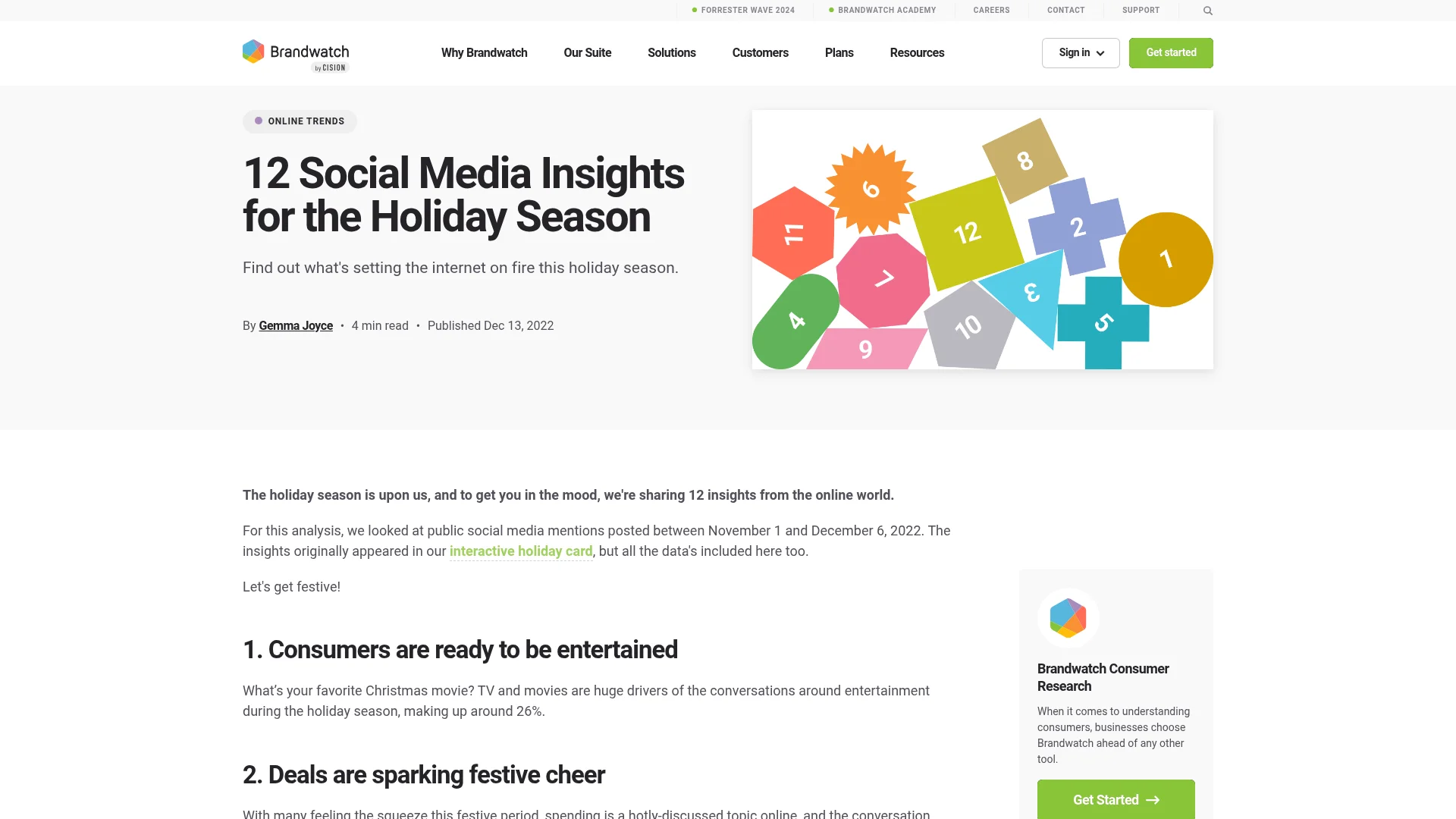
The main English-language Brandwatch blog outside the product- and platform-specific tactical content: thought leadership, industry commentary, cultural analysis, brand storytelling, AI editorial, and corporate news. Houses Brandwatch's broader marketing, brand, and culture coverage that isn't squarely product- or platform-specific, plus the long-running year-in-review series and funding-announcement editorial.
Content-type mix: Blog / Editorial 100%
Micro-topics within this cluster
Cultural Trends & Virality (~195 Pages) The largest sub-theme in the English blog: memes, viral moments, holidays, brand campaigns, and pop-culture phenomena analyzed through social data. This is Brandwatch's signature editorial mode and has been since the early 2010s. Take a cultural moment, run the social-listening data, publish the chart with commentary. The format is hard to replicate because it requires both editorial chops and proprietary listening data, which is precisely why competitors who don't operate listening tools cannot do this cluster well.
Sample pages:
- 12 Social Media Insights for the 2022 Holiday Season
/blog/12-social-media-insights-for-the-holiday-season/ - 4 Reasons Why 3D Films Have Failed
/blog/4-reasons-why-3d-films-have-failed/ - Accidentally Going Viral: Do Brands Make the Most of It?
/blog/accidentally-going-viral-how-do-brands-deal-with-it/ - Mastering Advertising Research: Improve Your Campaign Strategies Today
/blog/advertising-research/
Marketing, Brand & AI Editorial (~276 Pages) The cluster's strategic spine: broader marketing strategy, annual trend coverage, brand-building editorial, AI-in-marketing commentary, industry vertical deep dives, employee-advocacy frameworks, and B2B marketing tactics. Pieces designed to be read by CMOs and senior marketers rather than tactical practitioners. The framing language ("marketing intelligence," "actionable insights," "content marketing strategy") matches the vocabulary used in agency pitch decks and analyst conversations. The recurring sport, gaming, and fashion coverage in the industry-vertical slice is unusual for a B2B SaaS library, reflecting Brandwatch's Fortune 1000 customer mix.
Sample pages:
- 10 Design Tips For Creating Research Reports People Want to Read
/blog/10-design-tips-creating-research-reports/ - 13 Behind-the-Scenes Post Ideas You Should Steal Immediately
/blog/13-behind-the-scenes-post-ideas-you-should-steal-immediately/ - 29 Free Writing Tools and Resources to Improve Your Content
/blog/29-writing-tools-and-resources/ - 3 Free Tools for Creating Infographics Quickly
/blog/3-free-tools-for-creating-infographics-quickly/
Brandwatch Product News (~48 Pages) Brandwatch company news, product updates, year-in-review posts, funding announcements, FAQ explainers, and internal communications. Owned by the comms team and distinct from third-party editorial. The 2012-2019 year-in-review series is a long-running format that doubles as a corporate-history archive, useful for backlink durability since older posts continue to attract references in analyst write-ups.
Sample pages:
- 10 Brandwatch updates to help your company thrive in 2023
/blog/10-major-brandwatch-product-updates/ - Brandwatch 2012 Review
/blog/2012-in-review/ - 2018: Brandwatch's Year in Review
/blog/2018-brandwatch-year-in-review/ - Brandwatch in 2019: A Year in Review
/blog/a-year-in-review-2019/
Strategy insight: The Cultural Trends & Virality sub-theme is Brandwatch's clearest editorial signature. 195 pages of data-led cultural commentary is a content surface few competitors can match because it depends on owning social-listening infrastructure to generate the underlying numbers. That sub-theme alone explains why Brandwatch ranks against organic media (not just SMM tools) on cultural-moment keywords. The Marketing, Brand & AI Editorial bucket at 276 URLs is the broadest sub-theme and shows how Brandwatch frames its argument: less about platform mechanics, more about strategic perspective for senior marketers. AI-in-marketing pieces sit inside that broader bucket, a placement that suggests Brandwatch has not yet built a dedicated AI editorial cadence the way AEO and AI-search vocabulary would reward.
2. Editorial Blog (German)
Pages: 1,588 · Share of library: 22.5%
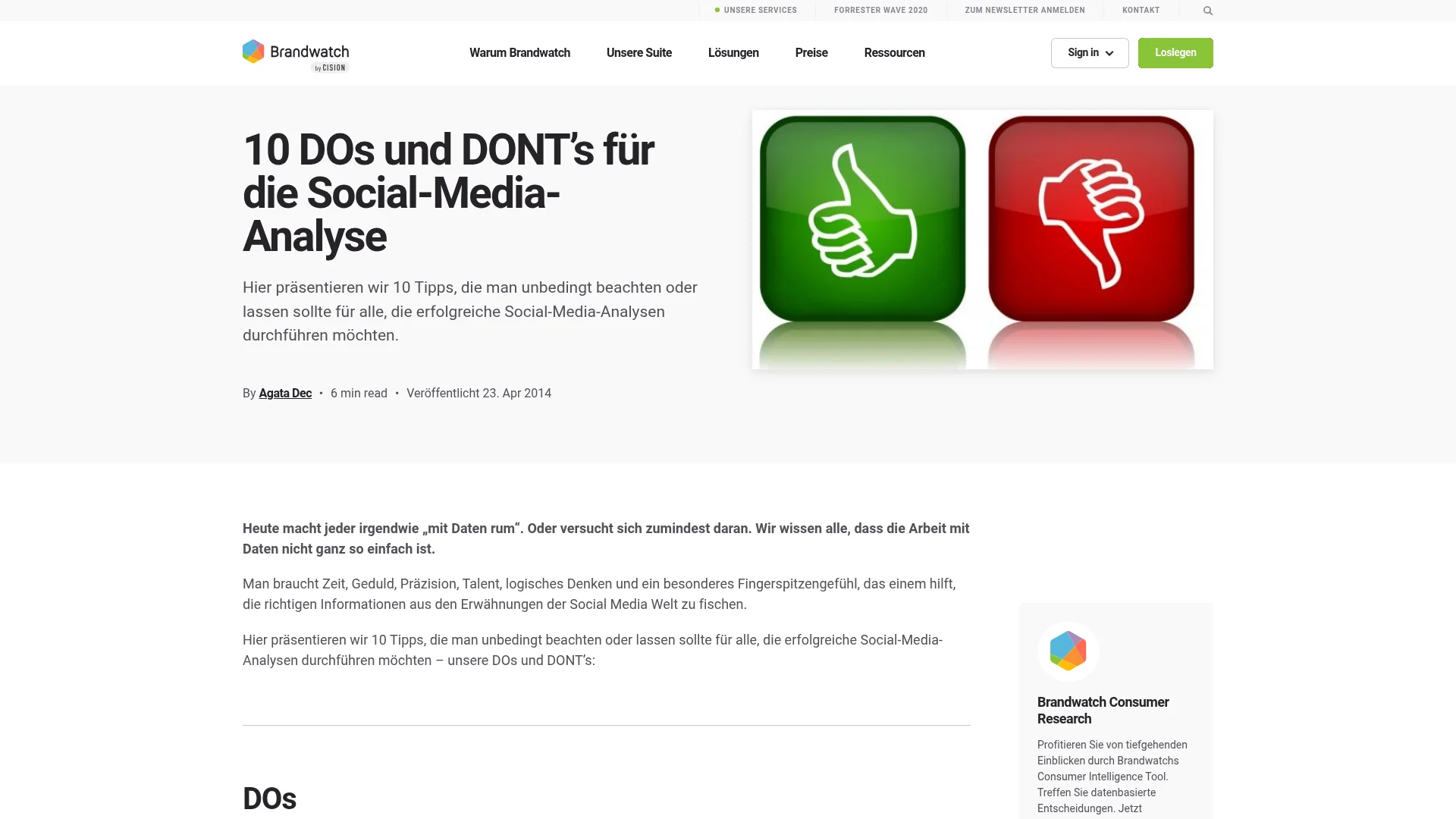
The largest single cluster in the Brandwatch library, the /de/blog/ archive, running larger than the English editorial blog by a factor of three. Covers German-language marketing strategy, social listening, DACH cultural research, platform tactics, brand stories, and Brandwatch product communications for the DACH audience.
Content-type mix: Blog / Editorial 100%
Micro-topics within this cluster
DE: Marketing & Strategy (~420 Pages) Broader marketing strategy, trend coverage, and industry commentary in German. Mirrors the English Marketing, Brand & AI Editorial sub-theme for the DACH audience but at a substantially larger scale: 420 pages versus 276 in English, an inversion of the typical translation-as-afterthought pattern. The depth reflects Brandwatch's pre-Cision DACH commercial concentration. Germany and the broader DACH region were among the company's strongest enterprise markets, and the editorial investment matched.
Sample pages:
- 10 DOs und DONT's für die Social-Media-Analyse
/de/blog/10-dos-donts-fuer-die-social-media-analyse/ - Warum Ihre Social Media Reports nutzlos sind
/de/blog/10-gruende-warum-ihre-social-media-reports-nutzlos-sind/ - Leitfaden: 10 grundlegende Markforschungsmethoden
/de/blog/10-grundlegende-markforschungsmethoden/ - 10 praktische Anwendungsfälle für Social Data
/de/blog/10-praktische-anwendungsfaelle-fuer-social-data/
DE: Cultural Trends & Research (~378 Pages) DACH-specific cultural moments, German consumer research, and locale-specific trend analysis. The second-largest German sub-theme, and a useful illustration of how the editorial argument adapts by locale. Where the English Cultural Trends sub-theme leans American (Super Bowl, Oscars, Black Friday), the German version covers Halloween, Christmas markets, and DACH-specific consumer moments alongside the global events. Same template, locally-rooted content.
Sample pages:
- 10 Dinge, die wir dieses Jahr im Marketing gelernt haben
/de/blog/10-dinge-die-wir-dieses-jahr-im-marketing-gelernt-haben/ - So implementieren Sie Soziale Daten im Unternehmen
/de/blog/10-schritte-um-social-media-daten-in-ihrem-unternehmen-zu-implementieren/ - 10 Social Media Insights rund um Halloween
/de/blog/10-social-media-insights-rund-um-halloween/ - 10 Tipps für mehr Engagement auf Google+
/de/blog/10-tipps-fuer-mehr-engagement-auf-google/
DE: Social Listening & Monitoring (~219 Pages) German content on social listening, monitoring, and consumer intelligence. The core Brandwatch capability translated for the DACH market, and the third-largest sub-theme inside the German blog, signaling that listening is more central to the DACH editorial argument than it is to the English one, where listening editorial mostly lives in the Product Surfaces & Tactical Playbooks cluster.
Sample pages:
- 10 Belege für den Wert von Social Media Monitoring
/de/blog/10-wege-den-wert-von-social-media-monitoring-zu-belegen/ - 15 Zeitspar-Hacks für die Social Data-Analyse mit Brandwatch
/de/blog/15-nuetzliche-zeitspar-hacks-fuer-die-social-data-analyse-mit-brandwatch/ - 5 Möglichkeiten wie Social Listening die Wettbewerbsanalyse bereichern kann
/de/blog/5-moeglichkeiten-wie-social-listening-die-wettbewerbsanalyse-bereichern-kann/ - 5 Tipps für bessere Marketing Intelligence aus Sozialen Daten
/de/blog/5-tipps-fuer-bessere-marketing-intelligence-aus-sozialen-daten/
DE: Platform & Tactics (~205 Pages) German-language platform-specific tactics across Instagram, Facebook, TikTok, LinkedIn, Twitter, and Pinterest. Mirrors the English platform tactics editorial for DACH practitioners. The volume distribution by platform follows the English pattern (Instagram and X-era Twitter heaviest), suggesting the localization process took source articles and translated them rather than generating DACH-native platform content.
Sample pages:
- 10 Gründe, warum du Twitter-Follower verlierst
/de/blog/10-grunde-warum-du-bei-twitter-follower-verlierst/ - 10 Top Influencer auf Twitter zum Thema Roboter
/de/blog/10-top-influencer-auf-twitter-zum-thema-roboter/ - 12 Top Pinterest Analytics und Marketing Tools
/de/blog/12-top-pinterest-analytics-und-marketing-tools/ - 18 Tipps für eine erfolgreiche Twitter Marketingstrategie
/de/blog/18-tipps-fuer-eine-erfolgreiche-twitter-marketingstrategie/
DE: Brand, Industry & Product News (~366 Pages) Brand-building, DACH industry vertical analysis, Brandwatch product updates, locale-native event coverage (Twittwoch Ruhrgebiet, NYK Chicago), customer-feedback frameworks, and other German editorial sitting alongside the strategy, listening, and platform-tactics sub-themes. Reads as editorial commentary with a DACH lens: pieces on customer feedback culture, social media for employees, German-market vertical analysis, and Query Builder product explainers.
Sample pages:
- 10 nützliche Social Bookmarking Seiten
/de/blog/10-nuetzliche-social-bookmarking-seiten/ - 10 bedeutende Brandwatch-Updates für den Erfolg Ihres Unternehmens im Jahr 2023
/de/blog/10-updates-2023/ - 17. Twittwoch Ruhrgebiet
/de/blog/17-twittwoch-ruhrgebiet-buzz-und-ein-kamingesprach/ - 3 einfache Möglichkeiten für besseres Kundenfeedback
/de/blog/3-einfache-moeglichkeiten-fuer-besseres-kundenfeedback/
Strategy insight: The German blog being larger than the English blog is the single most distinctive locale signal in the social media management category. Most peers maintain English-dominant libraries with selective European translation; Brandwatch's DACH editorial argument runs at three times the English volume. The strategic question is whether this reflects historical investment that should now be rationalized (translation costs add up against an enterprise audience that mostly reads English in DACH commercial contexts), or whether the DE content is genuinely earning DACH-search-engine traffic that English-only competitors are leaving on the table. The DataForSEO position data does not split cleanly enough by locale to answer that directly.
3. Editorial Blog (Spanish)
Pages: 714 · Share of library: 10.1%
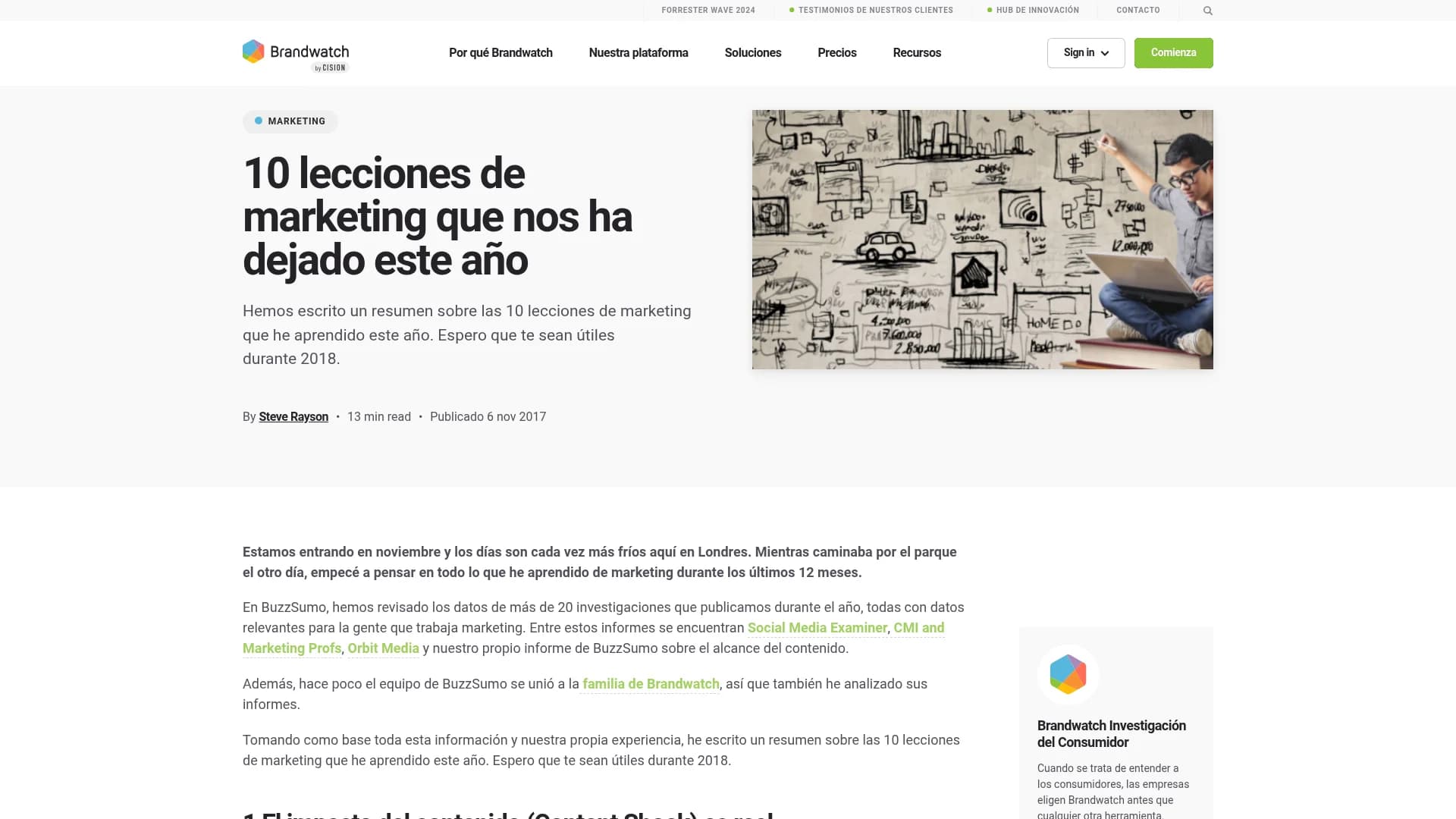
The /es/blog/ archive: second-largest locale library, serving a distinct Spanish-speaking audience across Spain and Latin America. Spans marketing strategy, platform tactics, brand commentary, locale-specific consumer research, and product communications in Spanish.
Content-type mix: Blog / Editorial 100%
Micro-topics within this cluster
ES: Marketing & Strategy (~196 Pages) Broader marketing strategy, trends, and industry commentary in Spanish. The largest named sub-theme in the Spanish cluster, mirroring the strategy emphasis in both the English and German clusters. The volume (196 pages) sits between English Marketing, Brand & AI Editorial (276) and the German equivalent (420), consistent with Spanish being a mid-tier locale priority in Brandwatch's localization strategy.
Sample pages:
- 10 lecciones de marketing que nos ha dejado este año
/es/blog/10-lecciones-de-marketing/ - 10 maneras de aprovechar la monitorización de las redes sociales II
/es/blog/10-maneras-de-aprovechar-al-maximo-la-monitorizacion-de-las-redes-sociales-ii/ - 10 maneras de aprovechar al máximo la monitorización de las redes sociales
/es/blog/10-maneras-de-aprovechar-al-maximo-la-monitorizacion-de-las-redes-sociales/ - 2020: Tendencias del consumidor en los restaurantes
/es/blog/2020-tendencias-consumidor-restaurantes/
ES: Platform & Tactics (~89 Pages) Spanish-language platform-specific tactics: Instagram, LinkedIn, YouTube. Localized stats roundups (LinkedIn statistics, YouTube statistics) form the bulk of this sub-theme, which is a translation-friendly format because the underlying numbers travel directly across languages even if the surrounding commentary is locally written.
Sample pages:
- Cómo conseguir más alcance orgánico en Instagram: 11 consejos clave
/es/blog/11-ways-boost-instagram-organic-reach/ - 98 estadísticas de las redes sociales para 2017
/es/blog/116-estadisticas-de-las-redes-sociales/ - 37 estadísticas de Instagram que debes saber
/es/blog/37-estadisticas-de-instagram/ - 4 herramientas de Youtube que tienes que conocer
/es/blog/4-herramientas-youtube/
ES: Brand & Industry (~87 Pages) Brand strategy and industry analysis in Spanish. Brand-safety content for influencer campaigns, PR-monitoring rationale, and reputation-management editorial: the conversational layer between Brandwatch's listening capabilities and the comms / PR audience that converts on those capabilities.
Sample pages:
- Cómo garantizar la seguridad de la marca para las campañas de influencers
/es/blog/5-estrategias-influencers-seguridad-marca/ - 5 razones por las que la monitorización de las redes sociales es esencial para las RR.PP.
/es/blog/5-razones-monitorizacion-rrpp/ - 5 vías de obtener opiniones positivas con Brandwatch
/es/blog/5-vias-opiniones-positivas/ - Lecciones que aprendimos analizando 250 millones de imágenes
/es/blog/6-lecciones-de-marketing-que-aprendimos-tras-el-analisis-de-250-millones-de-imagenes/
ES: Listening, Culture & Product (~342 Pages) Spanish content combining social listening editorial, locale-specific cultural research, Brandwatch product updates and event coverage, and the long-tail Spanish editorial that spans the listening and product-news arcs. Includes Vizia release notes, Brandwatch Qriously feature explainers, Black Friday and emoji-trend analyses, and Latin America-specific consumer-research pieces. The combined volume reflects how Spanish-language buyers of Listen and Consumer Research move between the listening narrative and the broader cultural and product editorial.
Sample pages:
- 10 aplicaciones de la inteligencia de redes sociales
/es/blog/10-aplicaciones-inteligencia-de-redes-sociales/ - 20 mejores campañas de marketing de 2019, según los datos
/es/blog/20-mejores-campanas-marketing/ - 2016, el resumen en redes sociales - Análisis Brandwatch
/es/blog/2016-el-resumen/ - 21 herramientas para mejorar tus relaciones públicas
/es/blog/21-herramientas-y-fuentes-para-mejorar-tus-relaciones-publicas/
Strategy insight: The Spanish blog is structurally a smaller mirror of the German one, with one quirk: the listening, culture, and product editorial sit in a single combined sub-theme rather than as separate sub-clusters. That consolidation reflects the smaller per-thread volume in Spanish; the threads exist but at half the depth of the German equivalents. The most actionable observation is the relative under-investment in Spanish cultural commentary against the German depth. Spanish-speaking consumer markets across Spain, Mexico, Colombia, and Argentina are large and culturally rich enough that data-led cultural commentary in Spanish would plausibly earn outsized engagement against the relatively thin competitive editorial in that locale.
4. Editorial Blog (French)
Pages: 508 · Share of library: 7.2%
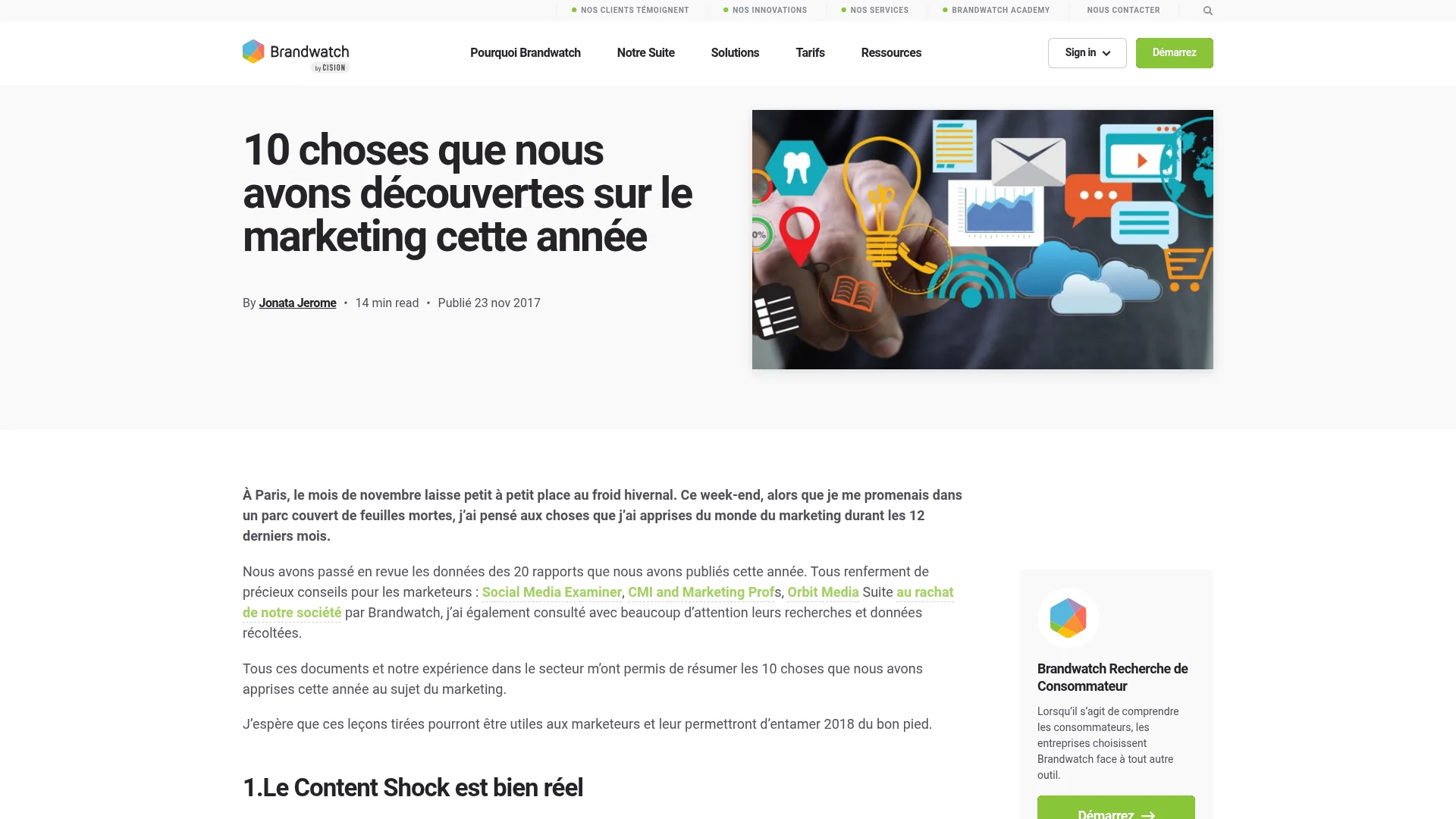
The /fr/blog/ archive: third-largest locale library, serving a francophone audience across France, Belgium, Switzerland, and French-speaking Canada and Africa. The smallest of the four editorial-blog clusters but still substantial against most peers' total French footprints.
Content-type mix: Blog / Editorial 100%
Micro-topics within this cluster
FR: Social Listening & Monitoring (~208 Pages) The largest French sub-theme. French content on social listening, monitoring, and consumer intelligence. Notably, this is the only locale blog where listening is the dominant sub-theme rather than marketing strategy or cultural trends. The pattern suggests Brandwatch's francophone commercial motion leans heavily on the listening and monitoring narrative, closer to the original Brandwatch positioning than to the post-merger SMM-suite framing.
Sample pages:
- 10 choses que nous avons découvertes sur le marketing cette année
/fr/blog/10-choses-avons-decouvertes-marketing-cette-annee/ - 10 façons de prouver la valeur ajoutée de la veille des médias sociaux
/fr/blog/10-facons-de-prouver-la-valeur-ajoutee-de-la-veille-des-medias-sociaux/ - 11 conseils incontournables pour votre marketing digital
/fr/blog/11-conseils-marketing-digital-incontournables/ - L'année 2017 de Brandwatch en quelques chiffres
/fr/blog/2017-brandwatchs-recap/
FR: Marketing & Strategy (~92 Pages) Broader marketing strategy, trends, and industry commentary in French. Mirrors the strategy sub-theme across other locales: annual trends pieces, CMO-targeted editorial, free social-media-tool roundups. The 92-page volume is the second-largest sub-theme inside the French cluster.
Sample pages:
- 2020: Les tendances consommateurs pour le secteur du divertissement
/fr/blog/2020-tendances-divertissement/ - Les top résolutions pour 2024 sur les réseaux sociaux
/fr/blog/2024-nouvelles-resolutions/ - 3 lacunes marketing que les CMO doivent adresser en 2019
/fr/blog/3-lacunes-cmo-2019/ - 30 outils social media gratuits pour tous vos besoins marketing
/fr/blog/30-outils-social-media-gratuits-pour-tous-vos-besoins-marketing/
FR: Platform Tactics, Brand & Product (~208 Pages) French-language platform-specific tactics (Instagram organic reach, LinkedIn statistics, top CMOs on Twitter), fashion-vertical commentary (a recurring French specialty given the luxury-brand customer base), locale-rooted cultural moments, Brandwatch product updates (Qriously, Vizia 2, Audiences feature explainers), and confinement-era pieces. The combined volume reflects how French editorial threads sit at a smaller scale than DACH and are grouped together for taxonomy clarity. The "top 30 CMOs in France on Twitter" format is a locally-rooted twist on the English platform-tactics formula that makes the content harder to translate-and-paste but more genuinely useful to a French audience.
Sample pages:
- 10 choses qui manquent le plus aux français pendant le confinement
/fr/blog/10-choses-confinement/ - 10 conseils pour réussir son stand en salon professionnel
/fr/blog/10-conseils-pour-reussir-son-stand-en-salon-professionnel/ - Les meilleurs outils d'analyse des réseaux sociaux
/fr/blog/10-meilleurs-outils-analyse-reseaux-sociaux/ - Choisir sa plateforme de marketing d'influence
/fr/blog/11-criteres-plateforme-marketing-influence/
Strategy insight: The French blog has the most distinctive sub-theme distribution of the locale clusters. Social Listening & Monitoring is the largest sub-theme rather than Marketing Strategy or Cultural Trends. That ordering suggests Brandwatch's francophone commercial motion leans on the older listening and monitoring narrative more heavily than its DACH or US motions do. The 208-URL combined Platform Tactics, Brand & Product sub-theme is a useful structural marker: the smaller French volume per-thread means the platform-tactics, brand, culture, and product-news editorial sit together rather than as separate buckets. A question worth running against the underlying customer-distribution data is whether the lighter French editorial investment matches the commercial weight of francophone markets.
5. Product Surfaces & Tactical Playbooks
Pages: 590 · Share of library: 8.3%
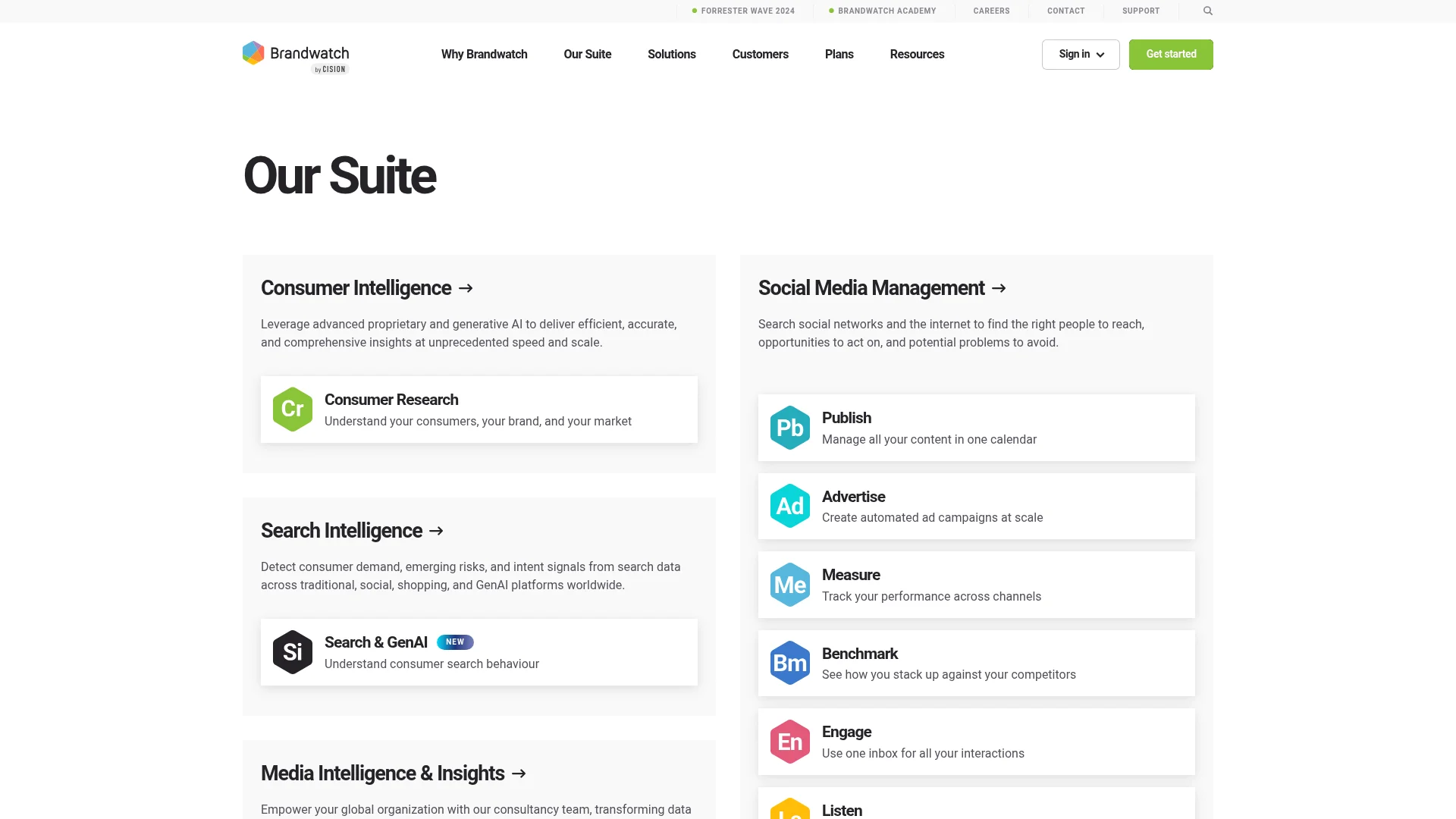
The combined English-language product and platform-tactics surface: product pages for Brandwatch's three product lines (Listen / Iris AI / Consumer Research, the post-Falcon.io Suite, and Influence), the social listening fundamentals editorial that sets up those products, and the platform-by-platform tactical playbooks that marketers search for at the tactical level (Instagram, TikTok, X, Meta, LinkedIn, YouTube, Pinterest, and emerging networks). This cluster covers what most pure-play SMM peers would consider their core content footprint, but at Brandwatch it sits alongside the larger locale-editorial blogs and the long-form research and webinars franchise.
Content-type mix: Blog / Editorial 87.3% · Product & Feature Pages 12.7%
Micro-topics within this cluster
Platform & Product Pages (~75 Pages) The direct product surfaces for every Brandwatch product line: Listen, Iris AI, Consumer Research, APIs, the Suite landing page, Engage, Publish, Measure, Benchmark, Advertise, Influence, and the Shopify Influence integration. The naming convention reveals the company's M&A heritage: the original Brandwatch products carry noun names (Listen, Consumer Research), the Falcon products carry verb names (Engage, Publish, Measure), and Influence is the Paladin rebrand. The split signals two product heritages that have been merged commercially but not renamed.
Sample pages:
- Brandwatch | Understand and engage with your customers at the speed of social
/suite/ - Brandwatch | Unsere Lösungen im Überblick
/de/suite/ - Suite Brandwatch | Réseaux Sociaux & Consumer Intelligence
/fr/suite/ - Advertise | Automated Social Media Ad Campaigns
/products/advertise/
Social Listening & Consumer Research Editorial (~118 Pages) Editorial and explainer content covering what social listening is, how to do it, how to evaluate monitoring tools, survey methodology, audience segmentation, and brand-monitoring tactics for English-speaking buyers. Heavy on top-of-funnel "how to" and category-defining articles, the conversation-shaping layer that funnels readers into the Listen and Consumer Research products. The sub-theme leans on Brandwatch's original positioning as the company that helped define enterprise social listening, and the older posts (2014-2018 vintage) still rank because the conceptual vocabulary they established remains the search vocabulary buyers use.
Sample pages:
- Social Data: 10 Practical Applications
/blog/10-practical-applications-social-data/ - New Year, New Goals: Here are 2024's Hottest Resolutions
/blog/2024-new-years-resolutions/ - 5 Audience Insights We Discovered in Minutes Using Ready to Use Social Panels
/blog/5-audience-insights-ready-to-use-social-panels/ - 5 Cool Things You Can Do With Brandwatch Consumer Research
/blog/5-cool-things-brandwatch-consumer-research/
Platform Tactics: Instagram, TikTok & X (~133 Pages) The two largest platform-tactical surfaces in the English blog, paired together because short-form, visually-driven networks share an audience inside SMM teams. Instagram growth, hashtags, Reels, analytics, fonts, and best-time-to-post content; TikTok marketing tactics, trends, and Brandwatch's Official TikTok Partner editorial; and the pre-2022 Twitter back catalog plus current X coverage. Older "10 most influential Twitter campaigns" posts continue to rank because the underlying audience search intent stayed steady even as the platform's branding shifted.
Sample pages:
- 10 Most Influential Twitter Marketing Campaigns of All Time
/blog/10-most-influential-twitter-campaigns/ - 4 Things We've Learnt from the Commonwealth Games
/blog/4-things-weve-learnt-commonwealth-opening-ceremony/ - 5 Social Media News Stories You Need to Read This Week
/blog/5-social-media-news-stories-you-need-to-read-this-week/ - 5 Ways LinkedIn Can Help You Boost your Business
/blog/5-ways-linkedin-can-help-you-boost-your-business/
Platform Tactics: Meta, LinkedIn, YouTube & Others (~108 Pages) Facebook, LinkedIn, Threads, YouTube, Pinterest, Reddit, Snapchat, WhatsApp, and other professional-network and long-tail platform tactics. The breadth here is the signal. Most SMM peers concentrate on the top three or four networks; Brandwatch publishes across the long tail because its enterprise audience covers brand teams that touch every channel a Fortune 1000 company runs. YouTube Shorts vs long-form, Pinterest analytics, LinkedIn profile optimization, and social-bookmarking content all sit here.
Sample pages:
- 8 Popular Social Bookmarking Sites for 2026
/blog/10-popular-social-bookmarking-websites/ - 6 Ways to Maximize Your Brand's LinkedIn Profile
/blog/6-ways-maximize-linkedin-profile/ - Top 11 Best Facebook Management Tools for 2025
/blog/best-facebook-management-tool/ - Best Time to Post on LinkedIn in 2026 by Day
/blog/best-time-to-post-on-linkedin/
Social Analytics, Engagement & Influence Editorial (~156 Pages) Analytics frameworks, KPIs, measurement guidance, community management, customer-care playbooks, crisis communications, and influencer-marketing tactics (discovery, vetting, campaign management, FTC disclosure). A cross-platform sub-theme distinct from network-specific tactics: the strategic operational layer that supports the Suite and Influence products. Includes named-product editorial like the "4 Ways Vizia Has Transformed Internal Reporting" post that doubles as SEO and product-marketing copy. The community-management editorial is written for a different reader than the social-media-manager generalist who consumes the platform tactics content.
Sample pages:
- 11 Smart Higher Education Social Media Marketing Strategies
/blog/11-successful-higher-education-social-media-marketing-strategies/ - 4 Ways Vizia Has Transformed Internal Reporting at Brandwatch
/blog/4-ways-vizia-transformed-reporting/ - 5 Ways To Use Charting by Minute for Community Management
/blog/5-ways-use-charting-minute-community-management/ - Mastering A B Testing Social Media: Essential Strategies for Success
/blog/a-b-testing-social-media/
Strategy insight: This cluster is where Brandwatch competes directly with pure-play SMM tools on traditional SEO terms, and the relative weight (590 URLs, 8.3% of library) shows the company is not trying to win that lane the way Buffer or Hootsuite do. The platform tactics surfaces carry the SEO floor, while the editorial focus stays on the consumer-intelligence and research narratives in other clusters. The Influence product line in particular is under-built: even with influencer editorial folded into Social Analytics, Engagement & Influence, the per-product investment lags Listen and the Suite. There is a product surface, a Shopify integration, and an acquired-tool brand history, but the long-tail editorial that would convert influencer-marketing search intent into Influence-product trials is thinner than the other two product lines.
6. Research, Guides & Webinar Programs
Pages: 1,288 · Share of library: 18.2%
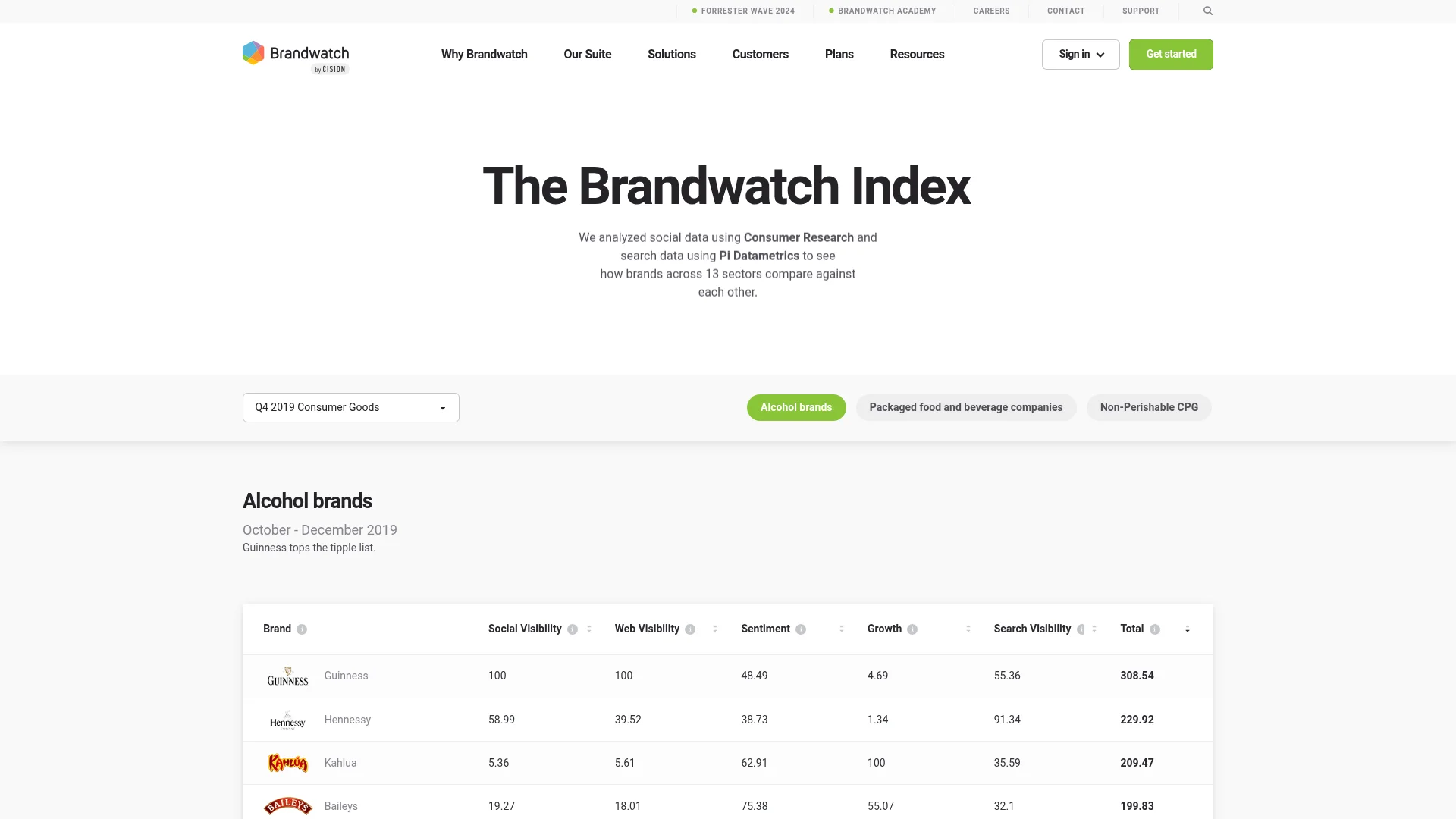
Brandwatch's longer-form authority content: the annual Digital Marketing Trends reports, the Change Makers brand showcase, the Brandwatch Index, Brandwatch Originals, Pulse live-event analysis, marketer guides and downloadable playbooks, thought-leadership webinars, recurring Pulse APAC monthly series, and the localized editions of all of the above. The three editorial surfaces (Research/Reports, Guides & Resources, Webinars & Events) are combined into one cluster because Brandwatch uses them collectively as its gated long-form authority layer.
Content-type mix: Events / Webinars / Sessions 37.0% · Research / Reports 35.2% · Guides & Resources 27.9%
Micro-topics within this cluster
Annual Trend Reports & Cultural Research (~156 Pages) The English-language research output: the Digital Marketing Trends series (2022-2026 editions), older State-of-Social releases, industry-vertical research reports (fashion, sport, retail, telecom, finance, CPG, healthcare, automotive), the Change Makers brand showcase, the Brandwatch Index, Brandwatch Originals, and Pulse live-event analysis. Each series cadence matters: the annual Digital Marketing Trends edition is the structural backbone, and buyers, agencies, and analysts return year over year to compare findings. The Change Makers profiles sit at /changemakers/[name]/ as a deliberate franchise hierarchy, and Originals is positioned as streaming-content events rather than static reports.
Sample pages:
- The Brandwatch Index
/brandwatch-index/ - Brandwatch | Covid-19 Resource Center
/cv19-resources/ - Brandwatch Originals: Building Cultural Relevance
/originals/ - Reports
/reports/
Marketer Guides & Playbooks (~110 Pages) English-language /guides/ entries: the Advanced Social Media Marketer's Playbook, the Agency Guide series, consumer-intelligence playbooks (CPG, credit cards, content strategy, CSR), platform-specific marketing guides (Instagram, LinkedIn), and the annual Complete Marketer's Guide releases (2018, 2019, Marketer of 2020). Reads as content designed for sales enablement as much as for SEO. These are the playbooks Brandwatch's enterprise sales team can hand to prospects in specific industries.
Sample pages:
- Guides
/guides/ - Guides (DE hub)
/de/guides/ - Guides (FR hub)
/fr/guides/ - 10 Steps to Effective Competitor Intelligence
/guides/10-steps-to-effective-competitor-intelligence/
Thought Leadership & Product Webinars (~292 Pages) The English-language webinar programme: strategic sessions on AI, consumer behavior, brand building, and industry trends; Innovation Spotlight quarterly product roadmap sessions for existing customers; Trajaan search-intelligence customer-education events; the recurring Social Pulse APAC monthly series; and hub pages for the events programme. The Pulse APAC cadence in particular is the kind of named-series content that audience-building programs compound around, similar to how research-report franchises compound. 246 thought-leadership webinars is a substantial top-of-funnel surface that could plausibly feed more aggressively into the editorial blog and research clusters through transcript-to-article workflows, a content multiplier most B2B SaaS teams underuse.
Sample pages:
- Events
/events/ - Webinars
/webinars/ - Events (DE hub)
/de/events/ - Webinars (DE hub)
/de/webinars/
Localized Reports, Guides & Webinars (~730 Pages) German, Spanish, French, and Italian editions of the flagship reports, guides, and webinars, plus locally-originated content like the German Agenturreport series and the German Agentur-Guide playbooks. 730 of the cluster's 1,288 URLs are localized editions, the highest localization ratio of any cluster in the Brandwatch library, signaling that the long-form authority surfaces are the most consistently translated content Brandwatch operates. Worth noting that several localized assets are not pure translations: the Agenturreport and Agentur-Guide series appear to be locally originated rather than translated from English.
Sample pages:
- 10 Schritte für eine effektive Wettbewerbsanalyse
/de/guides/10-schritte-fur-eine-effektive-wettbewerbsanalyse/ - 7 Fehler im Marketing und wie Sie diese vermeiden können
/de/guides/7-fehler-im-marketing-und-wie-sie-diese-vermeiden-koennen/ - Der Agentur-Guide für Social Media Analytics
/de/guides/agentur-guide-fuer-social-media-analytics/ - Leitfaden für Agenturen in 2020
/de/guides/agenturen-in-2020/
Strategy insight: This combined Research, Guides & Webinar Programs cluster is Brandwatch's clearest compounding asset. 1,288 URLs across multiple recurring series, 730 of them localized, reflects a multi-year commitment to translating flagship long-form content. The architectural choice to keep research under dedicated URL hierarchies (/reports/, /changemakers/, /pulse/, /brandwatch-index/, /originals/) rather than folding it into the blog signals that the franchise is positioned as a product surface in its own right, distinct from editorial and intended to function as backlink-magnet content for analysts, journalists, and marketing-community references. The Marketer Guides & Playbooks sub-theme at 110 URLs is the smallest English component, and the thin Platform Marketing Playbooks slice inside it (about five guides) is the most actionable expansion opportunity: a company that publishes 241+ pages of platform tactics could build five more channel-specific gated playbooks to capture download-conversion intent the blog cannot.
7. Glossary, Case Studies, Press & Company Surfaces
Pages: 1,865 · Share of library: 26.4%
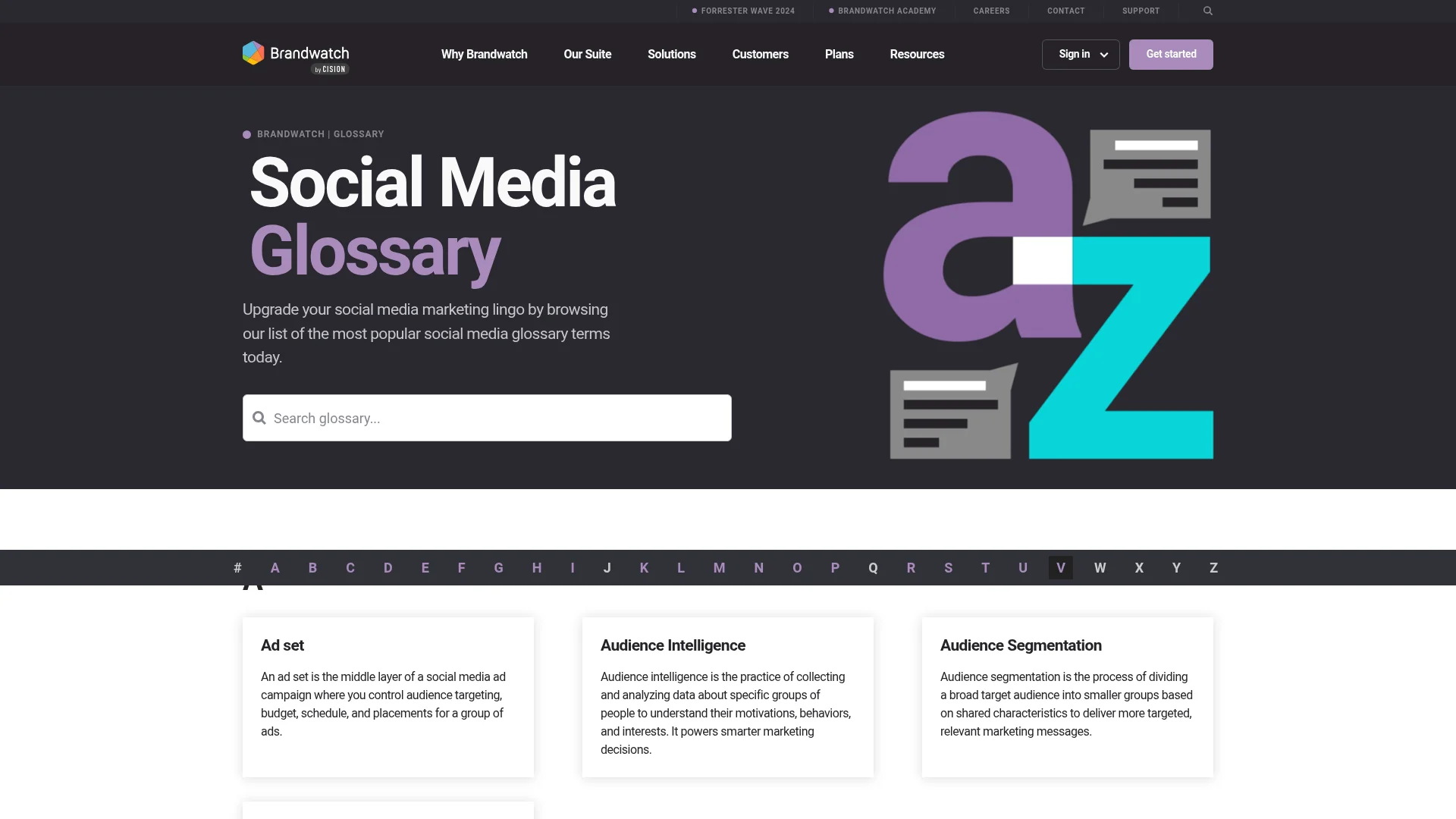
The largest cluster by URL count, a pooled grouping of Brandwatch's non-editorial surfaces: the 111-URL Social Media Glossary archive, 229 named customer case studies, 262 press releases and newsroom URLs, industries/roles/integrations/partnerships/demo/company corporate pages, and the 856-URL WordPress author archives plus other locale-root and utility pages. Per playbook, navigational, definitional, and corporate-information surfaces are pooled into a single cluster rather than fragmented across small thematic groups.
Content-type mix: Other 63.9% · Product & Feature Pages 17.9% · Case Studies / Customer Stories 12.3% · Glossary / Definitions 6.0%
Micro-topics within this cluster
Social Media Glossary (~111 Pages) The dedicated /social-media-glossary/ archive: 111 short definitional "what is X" entries covering metrics and analytics (brand awareness, brand equity, audience targeting), strategy and tactics (brand advocacy, brand reputation, audience segmentation, brand safety), listening and intelligence concepts (audience intelligence, brand monitoring, Boolean search), influencer and creator vocabulary (brand ambassador, content creator, creator economy, creator marketplace), and platform features (ad sets, boosted posts, cross-posting, customer journey). A coherent SEO-led glossary asset organized under a single URL hierarchy, distinct from the editorial blog and from product pages.
Sample pages:
- Social Media Glossary & Marketing Terms
/social-media-glossary/ - What is an ad set? | Brandwatch Social Media Glossary
/social-media-glossary/ad-set/ - What is Audience Intelligence? | Brandwatch Social Media Glossary
/social-media-glossary/audience-intelligence/ - What is audience segmentation? | Brandwatch Social Media Glossary
/social-media-glossary/audience-segmentation/
Customer Case Studies (~229 Pages) Named customer success stories across English and locale variants: how brands use Brandwatch for listening, SMM, influence, and consumer intelligence. Includes the "Art of the Possible" agency story citing 158% client growth, American Airlines' command center, the Cision-uses-Brandwatch meta-case, Glossier's TikTok work, FaZe Clan, OnePlus, and the Automated Creative + Durex/KFC partnerships. 143 of 229 cases (62%) are localized: the localization ratio is consistent with the rest of Brandwatch's locale strategy and is the conversion-stage proof library for Listen and Consumer Research buyers, which is consistent with those being Brandwatch's highest-priced enterprise SKUs. Several localized cases feature US-headquartered customers, which signals localization is for the reader audience, not because the customer is regionally specific.
Sample pages:
- Case Studies
/case-studies/ - 7 Brands That Leveled Up Their Social Media Game With Brandwatch
/case-studies/7-brands-that-leveled-up-their-social-media-game/ - American Airlines
/case-studies/american-airlines/ - AOL
/case-studies/aol-ford/
Press Releases & Newsroom (~262 Pages) The /press/ archive: press releases, M&A announcements (BuzzSumo, Paladin, Qriously, PeerIndex, the Cision acquisition itself), product launches (Case Management for social customer care, the Twitter Ads integration, generative-AI reputation management, the Kinetiq TV-analytics partnership), leadership news (the Pasewark CRO appointment, the Cali Tran CEO succession), analyst recognition (IDC MarketScape, Forrester, Constellation ShortList), industry awards, and localized newsroom content. 132 of 262 press URLs (50%) are localized. The archive doubles as a historical record of Brandwatch's M&A and product-evolution story, and analyst write-ups and journalist references continue to link to these pages years after publication.
Sample pages:
- Press Hub
/press/ - Press Hub (DE)
/de/press/ - Press Hub (FR)
/fr/press/ - Press Releases
/press/press-releases/
Industries, Roles, Integrations & Company Pages (~318 Pages) Industry vertical pages (CPG, retail, healthcare, finance), role-based solution pages (PR, agencies, analysts, social media managers), third-party integrations (HubSpot, Salesforce, Shopify, Slack, Bynder), supported data networks (TikTok, Reddit, LinkedIn, Threads, Bluesky), strategic partnerships (Reddit, TikTok, LinkedIn, X, LexisNexis, BuzzSumo, Bynder, Converseon), demo and pricing surfaces, the Brandwatch Academy and customer-support pages, and the company about/careers/legal pages. Use-case-targeted product surfaces organized by industry and role: the conversion-stage equivalent of the industry deep dives in the editorial blog. Each data network gets its own URL, which signals ecosystem depth to buyers comparing platforms and creates a long-tail of platform-name search ranking surfaces.
Sample pages:
- Promotional Offer
/academy-offer/ - Transform your skills with Brandwatch Academy
/brandwatch-academy-business/ - What is Brandwatch Academy?
/brandwatch-academy/ - Contact Us
/contact/
Author Archives & Utility Pages (~945 Pages) WordPress blog author archive pages at /blog/author/[name]/ (the largest single bucket inside the cluster), locale root URLs, the English root, campaign landing pages under /p/, /brandwatch-tiktok/, /paladin/, /influence-shopify/, the Suite cross-product platform pages, Search Intelligence and Enterprise platform pages, and other navigational and taxonomy URLs. 945 URLs account for 13% of the entire Brandwatch sitemap, the kind of indexable-noise volume that inflates the URL count without contributing editorial signal.
Sample pages:
- Brandwatch (root)
/ - Brandwatch is a TikTok Official Partner
/brandwatch-tiktok/ - Brandwatch (DE root)
/de/ - Brandwatch (ES root)
/es/
Strategy insight: This cluster is Brandwatch's customer-proof and corporate-credibility footprint, and the 111-URL glossary inside it is one of the strongest definitional surfaces in the social media management category. Most peers either skip glossary content entirely or scatter it across blog posts without a dedicated hierarchy. For AEO and AI-citation contexts, structured "what is X" content is one of the highest-value surfaces a content team can build, and Brandwatch has the foundation in place. The 229 named-customer cases is another substantial compounding asset because new entrants cannot manufacture comparable customer relationships in a short timeframe. The most actionable structural observation is the 945-URL Author Archives & Utility Pages bucket: 13% of the indexable footprint is auto-generated WordPress noise that could be noindex'd to concentrate crawl budget on substantive editorial.
Key Observations
What Stands Out About Brandwatch's Content Strategy
The library is editorial-led at enterprise scale, not SMM-tool scale
54.4% of every page Brandwatch publishes is Blog / Editorial: 3,844 pages across four locales. This is a fundamentally different architecture from the publishing-tool-led peers in the social media management category. Buffer, Hootsuite, Later, and Sprout Social all anchor their libraries on scheduling-tool content and tactical platform tactics. Brandwatch anchors on cultural-trends commentary, consumer-research methodology, and locale-specific editorial: content shaped for enterprise marketing and insights teams, not for SMB social-media managers searching "best scheduling tools." Reads as a long-running editorial publication for buyers and practitioners, not a reference manual for builders.
Locale duplication roughly 2.9×s the apparent library size
Only 34.5% of URLs (2,440) are unique en-US root content. The remaining 65.5% are translations, regional variants, or locale-native originals: German at 32.8% of the library, Spanish at 18.7%, French at 14.1%. The German blog alone (1,588 URLs) is larger than the English editorial blog (519). For benchmarking against single-locale peers, the practical comparison base is closer to 2,440 URLs than to the headline 7,072. This locale inflation also mechanically dilutes per-URL traffic metrics. The 76 visits/page efficiency floor against SMM peers is partly an artifact of counting four locale variants as four pages.
The Glossary, Case Studies, Press & Company cluster is a deep customer-proof library
1,865 URLs across the customer-evidence and corporate-credibility surfaces: 111 glossary entries, 229 named case studies, 262 press releases, 318 industry/role/integration pages, and 945 author and utility URLs. Every new named-customer story adds to the moat because new entrants cannot manufacture comparable customer relationships in a short timeframe. The 132 localized press releases and 143 localized case studies are a substantial investment most B2B SaaS peers do not match. The 111-URL glossary in particular is one of the strongest definitional surfaces in the category, an SEO-led asset competitors at this scale often skip or fragment.
Per-URL efficiency is meaningfully below SMM peers, but mostly for structural reasons
76 visits per page across 7,072 URLs reads as low against Buffer (824), Later (2,269), Sprout Social (1,015), and Hootsuite (776): pure-play SMM peers whose visits/URL run an order of magnitude higher. The gap is real but explainable. Locale duplication mechanically dilutes per-page traffic (only 2,440 unique en-US URLs), and Brandwatch's enterprise consumer-intelligence audience searches on lower-volume, higher-intent terms than the SMB queries that drive SMM-tool traffic. Reading the 76 figure as weak performance misses the structural context; reading it as a signal that the library has substantial optimization headroom in the 11-20 and 21-50 ranking buckets reads it more honestly.
The 11-20 ranking bucket is the single largest optimization opportunity
9,163 ranking positions sit in positions 11-20: the largest single bucket in the distribution and the most actionable optimization slot. Another 15,931 positions sit in 21-50. Together that is 25,094 ranking positions on page two or three of search results, against 5,946 positions currently in the top 10. The math says that even a modest improvement in positions 11-20, pushing a third of them onto page one, would mean a 50%+ lift in top-10 footprint. For a library where the editorial mass already exists, this is a content-optimization play more than a content-production play.
Comparison pages and free tools are zero, which is unusual for a market-leader footprint
Zero canonical /vs/ or /alternatives/ pages and zero free-tool URLs across 7,072 pages. Competitor comparison content typically defends brand-search positions against challengers running displacement campaigns; their absence cedes that surface entirely to competitors. Free tools and calculators are similarly missing: a high-intent lead-magnet surface that other SMM peers (Buffer's hashtag generator, Later's link-in-bio tools) use as both SEO content and onboarding ramps. Both gaps are structural, not accidental. They reflect an enterprise-sales motion that does not optimize for self-service evaluation, but they also cap the conversion-stage footprint at a level a market-leader-sized library could plausibly expand.
The top two clusters account for 49% of the library, with balanced flagship investment beyond them
Glossary, Case Studies, Press & Company Surfaces (26.4%) and Editorial Blog (German) (22.5%) together hold 48.8% of the library, a balanced concentration that reflects an architecture investing meaningfully in both flagship surfaces and breadth. The remaining five clusters split the other 51%: Research, Guides & Webinar Programs at 18.2%, Editorial Blog (Spanish) at 10.1%, Product Surfaces & Tactical Playbooks at 8.3%, Editorial Blog (English) at 7.3%, Editorial Blog (French) at 7.2%. The structural takeaway is that no single editorial surface dominates the way a single SMM blog dominates a Buffer or Hootsuite library. Brandwatch's depth is in the locale split and in the long-form authority franchise more than in any one English editorial archive.
12% of the library is sitemap noise, author archives, and unverified pages
Most of the author-archive pages are WordPress taxonomy noise: they list posts by author and add little discoverability value. Removing them from the sitemap (or noindex'ing them) would tighten the apparent library size, concentrate crawl budget on substantive editorial, and meaningfully change how the library is perceived in cross-company benchmarking. This is the kind of cleanup a content-ops team could close in a single quarter for material gain in both perceived library-quality and per-URL traffic efficiency.
More analyses in Social Media Management
Buffer
How Buffer uses 2,029 blog posts and the Open Buffer transparency library to drive 2.5M monthly visits in social media management. 2,982 pages, 7 clusters.
Hootsuite
How Hootsuite uses 629 guides and a 129-URL research franchise to drive 2.97M monthly visits in social media management. 3,826 pages, 9 clusters.
Later
How Later uses 674 blog posts, a 281-term glossary, and a 58-episode podcast to drive 3.6M monthly visits in social media management. 1,572 pages, 7 clusters.
Loomly
How Loomly uses 336 blog posts and a 62-term marketing glossary to drive 40K monthly visits in social media management. 482 pages, 4 clusters.
Methodology: This analysis is based on Brandwatch's full public sitemap (7,072 URLs, sourced from robots-txt), enriched with each URL's title and meta description via lightweight HTTPS fetches. URLs were classified into a 12-bucket content type taxonomy and grouped into 7 topic clusters with 29 micro-topics using LLM-assisted classification. Company facts came from public web research across Crunchbase, LinkedIn, and the company's own About and blog pages. Traffic metrics (monthly organic visits, traffic value, ranking positions, position distribution) came from DataForSEO's domain rank overview, aggregated globally across 117 locale combinations. All counts reflect the Brandwatch sitemap as of 2026-05-26.