You have a page that ranks. You search the term, and Google's AI Overview quotes someone else, then stacks four follow-up questions underneath that you could have answered better than anyone. That stings, and it is fixable.
Here is the good news: the People Also Ask box and the AI Overview above it are fed by the same thing, so one piece of structural work wins both. That overlap is the whole opportunity in AI Overviews People Also Ask work. This guide walks you through eight steps: map the question tree in your niche, write each answer so an engine can lift it whole, and check whether any of it landed.
You do not need a bigger content team for this. You need a question list and a repeatable shape for answering it.
Why every People Also Ask question is a hidden sub-query
Google does not answer your buyer's question by searching for their question. It breaks the query apart first.
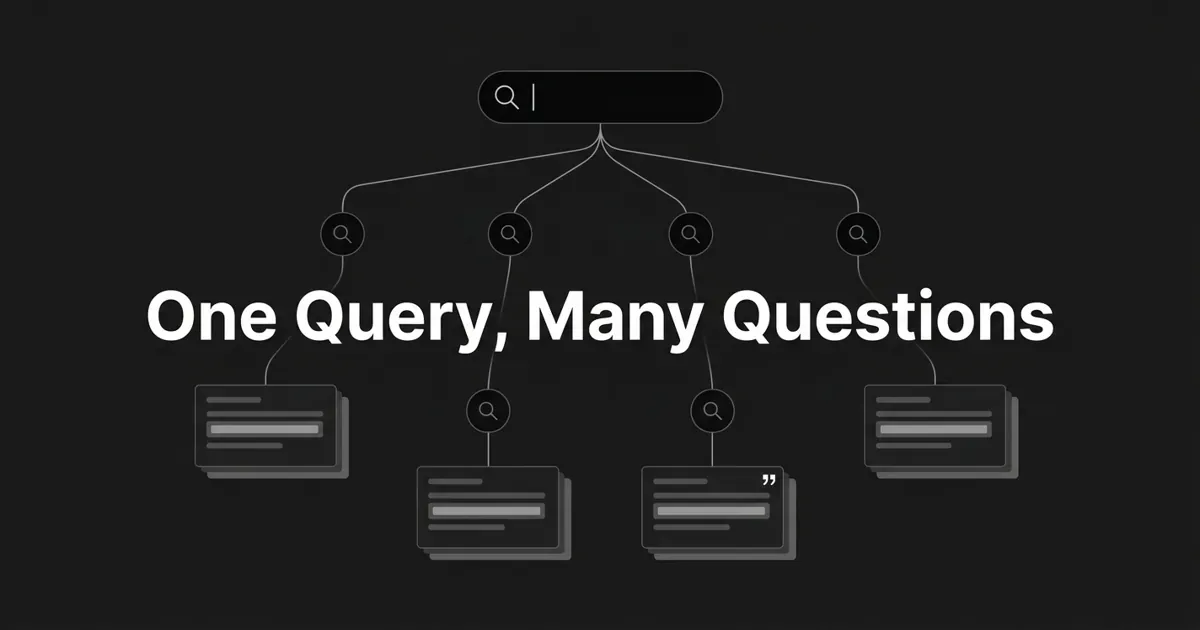
That technique is called query fan-out, and Google confirmed it publicly at I/O in 2025. The search system decomposes one prompt into several sub-queries, retrieves passages for each in parallel, then fans the results back in as one synthesized answer. Most queries fan out two to four hops. Head terms go deeper.
Now look at a People Also Ask box. Four to eight questions, each one semantically a step past the original search. Those are not a coincidence. They are the same expansion, made visible.
That is the load-bearing idea for everything below. Each PAA question is a sub-query Google already runs internally, whether you see it or not. When PAA is rich on a query, AI Overviews tend to recycle those exact questions into their follow-up chain rather than inventing new ones. Since early 2026, pressing "Show more" on a follow-up hands the reader straight into AI Mode.
So the job is not "rank for the topic." Page-level authority does not substitute for section-level answerability. To get cited in AI Overviews PAA chains you answer each sub-query in its own clearly headed section, or you can be the best resource on the internet for the parent topic and still lose every slot underneath it.
One more thing before you start. AI Overview citations used to come almost entirely from the top ten organic results. That has loosened: recent large-scale analysis puts it closer to a third, down from roughly three-quarters a year earlier, with a real share now pulled from pages ranking well below page one. Strong rankings are still a floor, not a gate. A well-structured section can win a citation your rankings would not have.
Step 1: Map the PAA tree for your niche
Every People Also Ask AI Overviews win starts with the questions, not the content. Pick five to ten seed queries, the head terms your buyers actually search, and open each one in an incognito window set to your target locale.
Log every PAA question that appears, then expand them. Clicking one generates a second tier, and that tier generates a third. Three to five expansions usually exhausts a niche, and the questions that only surface at depth three are the ones nobody has written for yet.
Build a spreadsheet as you go. One row per question, with columns for the seed, the question, the URL currently answering it, rough search volume, and an intent label: definitional, how-to, comparison, or informational. That last column decides the format later.
Tools help if the manual version feels slow. AlsoAsked maps PAA trees visually and has a free tier. AnswerThePublic scrapes broad question lists cheaply. Semrush and Ahrefs both filter questions inside their keyword databases.
Staring at a blank sheet? DeepSmith's Discover Prompts generates a starter set from your product, persona, and buyer-stage context, so you have a seed pool in minutes. You still layer real PAA harvesting on top, because live SERP phrasing is what you are trying to match.
How you know it is done. You have somewhere between 30 and 200 questions for the niche, in Google's exact wording, with intent labels attached.
Where people slip. They mine from a tool and never check the live SERP. PAA phrasing shifts over time, and Google quietly rewrites questions. Pull from the real result page before you draft, every time.
Step 2: Cluster the questions into answer groups
Two hundred questions is not two hundred pages. Your next move is grouping questions that share one answer.
Work through the list and pull together anything one well-written section would satisfy. A section can carry three to eight related questions when the H2 reflects the dominant one and the near-variants sit under it as H3s or short Q&A pairs.
Then check coherence. A page stuffed with twenty loosely related questions reads as thin to an engine judging topical fit. Better to split into a parent page plus a few focused children, cross-linked, than to build one sprawling catch-all.
Validate before you commit a cluster to the calendar. Search the seed in incognito and confirm the live SERP shows a rich PAA box. An empty or shallow box means Google is not fanning that query out much, so there is less to win. Spend the effort where the tree is dense.
How you know it is done. Your question list has collapsed into clusters, each one mapped to a specific page or a specific section on an existing page.
Where people slip. They cluster by keyword similarity instead of by answer. Two questions that look alike but need different answers belong in different sections, or the passage hedges both and satisfies neither.
Step 3: Write the answer first, in 40 to 80 words
This is the step that decides whether you get cited in AI Overviews PAA blocks, and it is mostly a discipline problem.
Every PAA-targeted section opens with a compact answer block, roughly 40 to 80 words, and the first sentence is the direct answer. No warm-up. No "many marketers wonder whether." The engine's extraction window starts at the top of the section, and a lead-in burns it.
The shape looks like this:
- H2 that mirrors the PAA question. Word for word, which is the next step.
- The answer block. First sentence answers the question in plain language. The next two or three sentences qualify it and add the specific detail that makes it useful.
- Supporting detail below. Bullets, a short table, an example, a number.
- A link to the parent or child page in the cluster.
Keep the extractable unit tight. The passages engines lift tend to run in the low hundreds of words, and longer blocks dilute the match. Let the section run 200 to 500 words, and make sure the first 100 to 200 stand alone.
Structure pulls weight too. Most AI Overview citations contain a list, a table, or a definition-style snippet, and pages using lists get cited noticeably more often. Keep lists under seven items and tables modest. Numbered lists suit procedural questions, bullets suit unordered detail, and a bolded term followed by one clean sentence suits "what is" questions.
Pro tip. Write the answer block before you write anything else in the section. If you cannot answer the question in 60 words, you do not understand it well enough yet, and the research gap will show up in the draft.
How you know it is done. You can delete every sentence in the section except the opening block, hand that block to someone with no context, and they still get a complete, correct answer.
Where people slip. They restate the question as the first sentence. "Whether PAA questions affect AI Overview citations is a common concern" answers nothing and wastes the window. Lead with the claim.
Step 4: Mirror the exact PAA wording in your headings
Heading text is a retrieval signal, so match it to what Google already shows.
Copy the PAA question verbatim into the H2. If PAA says "How do you get into AI Overviews," your heading says that, not "Steps for AI Overview inclusion." The paraphrase is where the match weakens, and it is the single easiest thing to get right.
Use question-form headings for every PAA-targeted section, then carry the same phrasing into the first sentence of the answer and the meta description. Heading, answer, and metadata pointing at one string is a strong, cheap signal.
This is also where your follow-up question AI Overviews coverage gets built. The second and third-tier questions you harvested in Step 1 become H3s inside the relevant section, each with its own short answer block. That is what puts you in the follow-up chain rather than just the opening summary.
DeepSmith handles this layer natively. Heading structure, keyword coverage, and metadata are part of the writing pipeline rather than a review pass afterward, so articles come out with citation-ready formatting: crisp answers near the top of each section, clear question headings, structured lists where they fit.
How you know it is done. Every H2 and H3 on the page maps to a real question from your harvested list, in the phrasing Google used.
Where people slip. They rewrite PAA questions into brand voice. "Unlocking your AI answer potential" is not a query anyone types, and it matches nothing.
Step 5: Move every answer into the top third of the page
Placement matters more than most teams expect. Analysis of cited pages consistently finds most extracted passages come from the top portion of the document, not from wherever the answer happens to sit.
Practical rule: the answer to your page's primary PAA question belongs within the first 300 words. Everything after that is supporting depth for the reader, and secondary extraction surface for the engine.
Three things quietly push answers down the page. A long table of contents. A hero section that scene-sets before it answers. An FAQ block parked at the very bottom holding the answers the engine most wanted. Audit for all three.
Then check the rendered HTML. Answers hidden inside accordions, tabs, or click-to-expand elements may not be available at retrieval time. If a passage matters for citation, it lives in visible markup, whatever the design does on top.
Common mistake. Building a beautiful 200-word introduction that sets context before answering anything. It reads well to a human scrolling and empty to a system deciding which 130 words to quote. Put one framing sentence in front of the answer if you need it, then answer.
How you know it is done. Someone can load the page, read only what is above the fold, and have the primary question answered.
Where people slip. They optimize the page's hero and forget every section has a top too. Each PAA-targeted section needs its answer at its own top.
Step 6: Add the schema that earns citations, and skip the rest
Schema is an understanding layer in your PAA AEO stack, not a magic switch, and the wrong markup actively wastes your time.
Use FAQPage schema only where a genuine, visible question-and-answer layout exists. Google narrowed FAQ rich results sharply in 2023, and marking up fifteen PAA questions at the bottom of an unrelated page produces nothing. Where the FAQ is real and visible, generative-engine optimization research finds structured Q&A earns notably higher citation probability than the same content left unmarked.
Match the rest of your markup to the question type:
- HowTo for procedural PAA questions, with steps in order, each with text.
- Article plus Person plus Organization on every long-form page, with author credentials, publisher logo, and accurate published and modified dates.
- DefinedTerm for "what is" questions.
- ItemList for "best" and "top" patterns.
- Speakable, optionally, on the answer block itself for voice-driven results.
Two hygiene rules cover most failures. Schema must match what a visitor actually sees, and it should sit near the content it describes, not buried in the footer. Validate with Google's Rich Results Test and the Schema Markup Validator before you ship.
How you know it is done. Every claim in your structured data has a visible counterpart on the page, and both validators pass clean.
Where people slip. They treat schema as the strategy. Markup helps a machine parse an answer that already exists. It cannot create one.
Step 7: Put a real author and real evidence behind the page
The overwhelming majority of pages cited in AI Overviews carry strong experience and expertise signals. That is a filter, not a tiebreaker: thin pages rarely clear it however well structured.
Four things to get in place:
- A named author with a visible bio and specific credentials. Not "the marketing team." Something a reader can verify, ideally showing hands-on work with the topic.
- First-party evidence in the content. Original screenshots, your own data table, a diagram you made, a dated test. The cheapest way to become the source instead of a summary of other sources.
- Site-level trust pages. About, Contact, an editorial policy, accessible privacy and terms.
- Inline citations to primary sources wherever you use a number or a claim you did not generate.
Consistency compounds. One author covering one topic area across many articles builds topical authority in a way a rotating cast of bylines does not. If your niche touches health, money, legal, or safety, the bar rises again.
One original image or short video per PAA page helps too. Pages combining text, visuals, and structured data get cited at meaningfully higher rates than text-only pages.
How you know it is done. A skeptical reader can tell within ten seconds who wrote the page, what they know, and where the numbers came from.
Where people slip. They add an author box with a stock photo and no credentials. An empty byline signals as little as no byline.
Step 8: Track what gets cited, then fix what slips
You cannot iterate on what you do not measure, and follow-up question AI Overviews placements move on their own schedule.
Set a weekly rhythm. For each target query, capture the SERP in incognito at your target locale and log four things: whether an AI Overview fired, whether you were cited, which URLs were, and the exact passage quoted. Do the same for the PAA box. When Google rewrites a question, that is your signal to rewrite the heading.
Watch this separately from rankings. A page can appear in AI Overviews before it reaches the top ten organically, and drop out while still holding position three. Check AIO presence monthly on its own schedule rather than inferring it from rank movement.
Manual capture works at small scale and stops working fast. Dedicated trackers cover the gap: SE Ranking and Semrush offer AI Overview tracking, Profound serves enterprise teams, Otterly and Rankscale monitor brand mentions across engines, and ZipTie focuses on citation forensics.
DeepSmith comes at the same problem from the production side. The AEO module tracks mention rate, citation rate, and share of voice across ChatGPT, Perplexity, Gemini, Claude, and Google AI Mode, with per-prompt and per-page breakdowns plus a competitor leaderboard, so you see which pages earn citations and which prompts drive them. Coverage rises by plan: Pro at $99 a month tracks ChatGPT, Grow at $199 adds Perplexity, Scale at $399 adds Gemini, Enterprise all five. Keeping tracking and writing in one place turns a gap you find on Monday into a queued article instead of a note in a doc.
How you know it is done. You have a dated AI Overviews People Also Ask log per target query showing AIO status, PAA status, cited URLs, and the quoted passage, going back at least four weeks.
Where people slip. They measure clicks and conclude the work failed. AI Overviews demonstrably reduce clicks on the pages beneath them. Track mention, citation, and share of voice instead, because that is what this channel actually produces.
What to do next
Do not try to rebuild your whole library. Take one page that already ranks decently, run Steps 1 through 5 against it, and republish. One page, one week. You will learn more from a single rewrite you can measure than from a strategy doc nobody executes.
Then set the cadence that keeps your People Also Ask AI Overviews coverage current. A quarterly refresh of your extractable passages, a monthly presence check, and a weekly glance at whether PAA phrasing has moved. That is your PAA AEO checklist, and it is small enough to actually keep.
If the bottleneck is production rather than knowing what to do, name it. Mapping the tree is a morning's work. Writing sixty properly structured sections is not. DeepSmith is built for that gap: it tracks where you show up in AI answers, finds the questions you are losing, and produces publish-ready articles grounded in your own brand context, with heading structure, internal links, and metadata already built in. You can start a 7-day free trial and see real data and real drafts before you pay.
Take it one cluster at a time. Momentum matters more than a perfect map.