You opened AthenaHQ's plans page, saw $295 a month, and paused. That pause is fair. You are being asked to buy a credit system before you know how many answers you need.
Take a breath. Most teams shopping for AthenaHQ alternatives are asking the same two questions, and both are answerable.
Can this tool tell me where AI answers leave my brand out? And once it tells me, who writes the pages that fix it?
How we picked these AthenaHQ alternatives
Every roundup should show its work.
We only looked at dedicated AEO, GEO, and AI-search visibility platforms. Generic SEO suites that bolted a widget onto an existing product are out of scope. AthenaHQ is the baseline, not an entry.
We ranked on six things, in this order:
- Depth of AI-answer monitoring. Prompt-level visibility, mentions, citations, sentiment, source pages, share of voice.
- The distance from measurement to action. Does it hand you finished content, or a chart?
- Fit for a marketing team. Brand context, collaboration, reporting, integrations.
- Price transparency and a real entry point. A published number beats "book a demo."
- Engine coverage that matches your buyers. Engine counts are not comparable across vendors, so read the list, not the number.
- Enterprise controls where they matter. Multi-brand, API, SSO, security, support.
One caveat before you read a single score. AI answers shift by engine, model, prompt wording, location, language, and date. Google says AI Overviews and AI Mode may use different models, so responses and links vary, and meeting the requirements does not guarantee crawling, indexing, or serving. Treat any visibility score as trend evidence, not a permanent ranking.
What AthenaHQ does, and where buyers start looking elsewhere
AthenaHQ positions itself as a command center for AEO and GEO. Its material describes cross-platform visibility tracking, automated content-optimization recommendations, citation-source analysis, link-building guidance, an executive dashboard, ROI and competitive reporting, real-time monitoring, sentiment, PR monitoring, content-gap analysis, and a copilot called Ask Athena.
Here is AthenaHQ pricing as published:
| Plan | Price | What you get |
|---|---|---|
| Essential | Free | 300 credits plus $25 free credit, unlimited members, prompt and response analysis, sources, competitor insights, content recommendations |
| Starter | $295/month (17% off annual) | 3,600 credits, one credit per AI response, 10 models, integrations, CSV export, on-page and off-page actions, unlimited topics and competitors |
| Enterprise | Custom | Custom credits and websites, knowledge base and claim review, Athena Citation Engine, SSO, audit log, multi-region support, white-glove setup |
All plans include ChatGPT, Perplexity, Gemini, Google AI Overviews, and Copilot. Paid plans add Google AI Mode, Claude, Grok, DeepSeek, and Meta AI.

So why do people go looking for Athena HQ competitors? Usually one of three reasons. The $295 Starter is above budget. The credit model makes a monthly bill hard to predict. Or the tool shows them where they are losing and they still have nobody to write the twenty pages that would fix it.
Quick comparison: the 9 best AthenaHQ alternatives
| # | Platform | Best for | Starting price | Main tradeoff |
|---|---|---|---|---|
| 1 | DeepSmith | Visibility tied straight to content production | $99/mo ($80 annual) | Ten-engine coverage sits on Enterprise |
| 2 | Peec AI | Prompt analytics and BI reporting | $95/mo Starter | Analytics, not production |
| 3 | Profound | Enterprise AI-search operations and agents | $99/mo Starter, yearly | Multi-engine use moves you up fast |
| 4 | Otterly.AI | Lowest-cost monitoring plus GEO audits | $29/mo Lite | Extra engines are paid add-ons |
| 5 | Scrunch | AI visibility plus agent experience | $250/mo Core | Expensive entry, tightly capped |
| 6 | Goodie | Closed-loop AEO with revenue attribution | $399/mo Explorer | Pro and Enterprise pricing is custom |
| 7 | Rankscale | Engine breadth and technical page audits | $20/mo Essentials | Essentials includes zero AI answers |
| 8 | LLMrefs | Keyword-led AI visibility, simple price | $79/mo advertised | Keyword updates weekly, not daily |
| 9 | Knowatoa | Focused, affordable question monitoring | $59/mo Starter | Content execution is on you |
1. DeepSmith: best for teams that need AEO and production in one system
Best for: marketing leads who want AI-search measurement to produce a defensible content backlog, then turn that backlog into on-brand articles, published and repurposed, without hiring writers.
Here is what most tools on this list will not tell you. Measurement is the cheap half of the problem. You can buy a dashboard for $29 a month. What you cannot buy for $29 a month is the twenty articles that dashboard says you are missing.
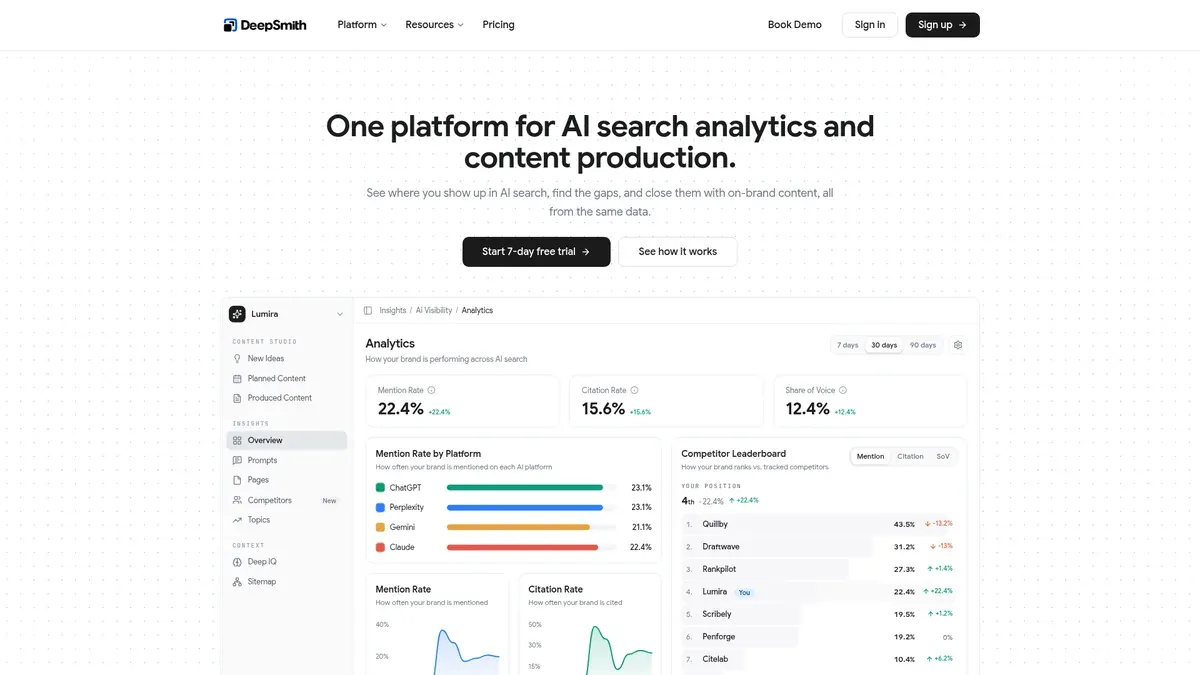
DeepSmith closes that loop in one workspace. AI Visibility shows where your brand is mentioned, cited, absent, or displaced. Content Map turns your site and your competitors' sites into one shared topic and funnel-stage map, so coverage is a measurement instead of a hunch. Opportunity Agents return ideas with the evidence attached, Content Studio turns those ideas into finished articles, and Deep IQ keeps every draft grounded in your real product, persona, and voice.
Pricing
| Plan | Monthly | Annual | Articles/mo | Tracked prompts | Seats | Engines |
|---|---|---|---|---|---|---|
| Pro | $99 | $80 | 20 | 50 | 5 | ChatGPT |
| Grow | $199 | $160 | 40 | 100 | 7 | ChatGPT, Perplexity |
| Scale | $399 | $299 | 90 | 200 | 10 | ChatGPT, Perplexity, Gemini |
| Enterprise | Custom | Custom | Custom | Custom | Custom | All ten engines |
Pro is $99 a month, a third of AthenaHQ's Starter, and it includes 20 finished articles. A 7-day free trial gives you real data and real drafts before you pay. No long-term contracts, no cancellation fees. The ten engines are ChatGPT, Gemini, Perplexity, Claude, Google AI Overviews, Google AI Mode, Grok, Meta AI, Microsoft Copilot, and DeepSeek.
Key features
- AI Visibility: scheduled prompt tracking with mention rate, citation rate, share of voice, sentiment, and visibility trend, plus a per-platform breakdown, a competitor leaderboard, full answer history, page-level citation attribution, and the competitor pages winning your prompts. Discover Prompts builds the starter question set from your own product and persona context.
- Content Map: crawls your site and unlimited competitor sites, classifies every page onto a granular topic and a funnel stage, and flags coverage gaps and untapped topics. Sitemaps re-check every 24 hours.
- Opportunity Agents: named agents that read your own data and return ideas with the justifying data point attached. Get cited for a tracked prompt, turn mentions into citations, take a competitor's citations, fix how AI describes you.
- Content Studio and Autowrite: New Ideas to Planned Content to Produced Content, with the Writer producing researched, linked articles with a cover image and publish-ready metadata. Schedule one and Autowrite writes it on its date, hands-off, so your calendar keeps moving during your busiest week.
- Deep IQ: company, products, personas, brand voice, visual guidelines, and content types stored once as structured context every draft runs against. This is what stops voice drift and invented product claims.
- Publishing and repurposing: publish straight to WordPress, Webflow, Strapi, Sanity, Contentful, or your own webhooks, and every article arrives with channel versions for LinkedIn, X, newsletters, and more.
- Multi-Workspace: run multiple brands or clients from one account, each isolated with its own context.

The honest tradeoff
Pro, Grow, and Scale do not expose all ten engines. Pro covers ChatGPT, Grow adds Perplexity, Scale adds Gemini, and the full ten sit on Enterprise.
That is a tier decision, and for most teams it is the right one. Ask where your buyers actually are. If the honest answer is ChatGPT, or ChatGPT plus Perplexity, you are paying $99 or $199 for the engines that matter to you plus a production engine nobody else on this list includes. If you need all ten with custom limits, budget for Enterprise, which adds 1:1 onboarding and a dedicated account manager.
DeepSmith ranks first because the path from "we are invisible for this prompt" to "the page that fixes it is published" happens in one place.

2. Peec AI: best for structured AI-search analytics and reporting

Best for: SEO and content managers, marketing teams, and agencies that want organized prompt analytics, competitor benchmarking, and clean BI reporting.
Peec describes itself as AI search analytics for marketing teams. You organize and tag prompts, track across countries, add brands, choose models, and see how you rank against the market. It surfaces the sources shaping answers in your space, naming examples like G2, LinkedIn, and Reddit, then points recommendations at them.
Pricing: Starter $95/month for 50 prompts, 1 project, and 3 models with daily tracking. Pro $245/month for 150 prompts and 2 projects. Advanced $495/month for 350 prompts and 5 projects. All three cover 3 countries per project. Agency plans are priced in credits, from Essential at 10,000 credits and 111 prompts up to a custom tier.
Key features: visibility, position, sentiment, mentions, impressions, and monthly trends. Competitor rankings, source analysis, and AI-suggested prompts with search-volume indications. CSV export, a Looker Studio connector, a REST API, and a live MCP server.
Honest limitation: Peec is an analytics and reporting layer first. Its public material describes recommendations, not an article-production, scheduling, publishing, and distribution pipeline. The brand pricing shown publicly is annual, so read those numbers as advertised monthly-equivalent rates.
3. Profound: best for enterprise AI-search operations and agents

Best for: growing companies and enterprises that want visibility, prompt-demand data, agent analytics, and a large integration ecosystem in one platform.
Profound is broad. Prompt Volumes surfaces what people actually ask AI. Answer Engine Insights shows how AI represents your brand, with reports for AI Visibility, Source Citations, Brand Sentiment, and Content AEO. Agent Analytics measures AI-bot visits and how ChatGPT, Gemini, Claude, Perplexity, and others interpret your site.
Pricing: Starter $99/month billed yearly for ChatGPT only, 50 prompts, 1,500 responses a month, and 1 seat. Growth $399/month billed yearly for three answer engines, 100 prompts, 9,000 responses, and 3 seats. Enterprise is custom, with up to nine engines, multiple companies, SSO/SAML, SOC2, and a 24-hour SLA.
Key features: AEO reports covering visibility, citations, sentiment, and content AEO. Prompt-volume research. Autonomous agents and agent analytics. An AEO FAQ workflow that scrapes a page, identifies core and user queries, and generates FAQs. CMS integrations including Contentful, Sanity, Webflow, WordPress, and Adobe Experience Manager, CDN connections including Cloudflare, Fastly and Vercel, and analytics ties into Google Analytics, Search Console, and Looker.
Honest limitation: the breadth is real, and so is the way cost climbs with engines, prompts, responses, seats, and agent usage. Starter is a single-engine ChatGPT tier, not a multi-engine program, and the capabilities most people picture are custom-priced. Not every listed integration is on every plan.
4. Otterly.AI: best low-cost entry for monitoring and GEO audits

Best for: a small team that wants an accessible price, daily monitoring, and GEO audits without a procurement cycle.
Otterly connects prompt research, monitoring, and optimization. It tracks brand mentions, average position, share of AI voice, citations, sentiment, and referenced links, identifies the pages and third-party sources worth pursuing, and adds crawlability checks, content audits, and briefs.
Pricing: Lite $29/month ($25 annual) for 15 prompts, 1 workspace, and 1,000 GEO URL audits. Standard $189/month ($160 annual) for 100 prompts, unlimited workspaces, 5,000 audits, and 2,000 API and MCP requests. Premium $489/month ($422 annual) for 400 prompts and 10,000 audits. Enterprise is custom, starting at $1,000/month. All plans cover ChatGPT, Google AI Overviews, Perplexity, and Microsoft Copilot across 65+ countries.
Key features: a public API on Standard and above, and an MCP server that connects with Claude, ChatGPT, Cursor, and any MCP client, exposing brand reports, raw responses, citations, audits, and recommendations. API workflows feed Looker, Slack, Google Sheets, and webhooks.
Honest limitation: that $29 entry is genuinely 15 prompts, one workspace, four core engines, and no API or MCP allowance. Google AI Mode, Gemini, and Claude are paid add-ons, and an extra 100 prompts runs $99/month higher up. Otterly documents briefs and audits, not end-to-end production and publishing.
5. Scrunch: best for AI visibility plus agent experience

Best for: teams that care as much about how AI agents crawl and interpret their site as about how AI answers describe their brand.
Scrunch runs an Observe, Understand, Deliver workflow. AI Monitoring & Citations tracks prompts, authoritative citations, brand performance, and changes over time. AI Search Trends estimates prompt volumes and surfaces demand shifts, and the Agent Experience Platform extends that into agent behavior, agent traffic, and product observability.
Pricing: Core $250/month for 125 unique prompts, 5 site audits a month, 1 brand workspace, 5 users, and 4 LLMs (ChatGPT, Perplexity, Google AI Overviews, Copilot), plus 1 country, 3 personas, 2 languages, and 5 competitors. Enterprise is custom and covers 9 LLMs. A 7-day free trial is offered.
Key features: funnel stages, citations and sources, prompt management, a reporting dashboard, a 25-page site map, AI-agent traffic, sentiment, recommendations, and basic content generation on Core. Enterprise adds full site audits, multi-domain tracking, AXP, Looker Studio, query and advanced APIs, custom MCP, SSO, and a dedicated account team.
Honest limitation: Core is the most expensive entry tier here and it is deliberately narrow. Four LLMs, one country, 125 prompts, five users, one workspace. The coverage, API, AXP, and support that make Scrunch compelling live on Enterprise.
6. Goodie: best for closed-loop AEO and revenue attribution

Best for: brands that want prompt research, monitoring, optimization actions, revenue attribution, and AI-commerce visibility together.
Goodie's loop is Research, Monitor, Action, Measure. Research identifies the prompts your customers ask and the volume behind them. Monitoring covers mentions, sentiment, competitive share, and citations. Action gives you a prioritized playbook, and Measure connects visibility back to business outcomes.
Pricing: Explorer $399/month for 100 prompts, 3,000 AI responses a month, 10 optimization actions, three core models (ChatGPT, AI Overviews, Perplexity), Google Analytics revenue attribution, MCP, and 3 seats, with a 7-day trial. Pro and Enterprise are demo-gated. Pro adds Gemini, Copilot, and Amazon Rufus, 250 prompts, and SKU-level AI-commerce visibility, and Enterprise reaches up to 11 models and 500-plus prompts.
Key features: a Content Studio that generates AI-optimized content while holding brand voice. An Agentic Commerce Suite tracking product appearance in ChatGPT, Amazon Rufus, Perplexity, and other shopping surfaces. An Agent Experience Suite showing how AI crawlers see your site, plus API, export, MCP, and Google Analytics connections.
Honest limitation: $399 is the floor, and it buys three core models, 100 prompts, and 10 actions a month. Pro and Enterprise pricing is not published. The commerce and revenue features only pay off if you have the catalog and analytics maturity to use them, and Goodie publishes no conventional CMS integration catalog.
7. Rankscale: best for broad engine coverage and technical audits

Best for: buyers who want many engines, historical visibility data, and deep technical page audits.
Rankscale calls itself an integrated AI SEO suite for brand monitoring and generative-engine optimization. It tracks brands, products, and ads across 17-plus engines and gives you a visibility score, rankings, sentiment, mentions, citations, share of voice, competitor gaps, and prompt research. Its page audits assess AI-bot crawlability, hierarchy, and technical SEO signals across more than 94 checkpoints.
Pricing: Essentials from $20/month with unlimited search terms and all regions, but zero credits, zero AI answers, and zero page audits. Pro $99/month for 1,200 credits, up to 4,800 AI answers, 10 brand dashboards, and 50 audits, with a 7-day trial. Growth $385/month for 5,500 credits and 22,000 answers. Enterprise $780/month for 12,000 credits and 48,000 answers. Annual billing saves 15%, each engine query typically costs 0.25 credits, and workspaces have no per-seat charge.
Key features: coverage of ChatGPT, Perplexity, Claude, Gemini, Google AI Overviews, Google AI Mode, DeepSeek, Grok, Copilot, Mistral, and more. Competitor analysis across visibility, citations, sentiment, and gaps, plus citation analysis linking source URLs to ranking gaps. REST API and a native Looker Studio connector on Pro and above, with white-label options on Growth.
Honest limitation: read that Essentials tier carefully. At $20 it includes zero credits and zero AI answers, so it is a shell for search terms, not a monitoring plan. Your real starting point is Pro at $99. Because pricing is credit-based, work out prompts times engines times refresh frequency before comparing it with a prompt-priced tool. Rankscale documents no native article-production workflow.
8. LLMrefs: best for keyword-led AI visibility at a simple price
Best for: SEOs, agencies, and growth teams who want to import an existing keyword list and see how it performs in AI search.
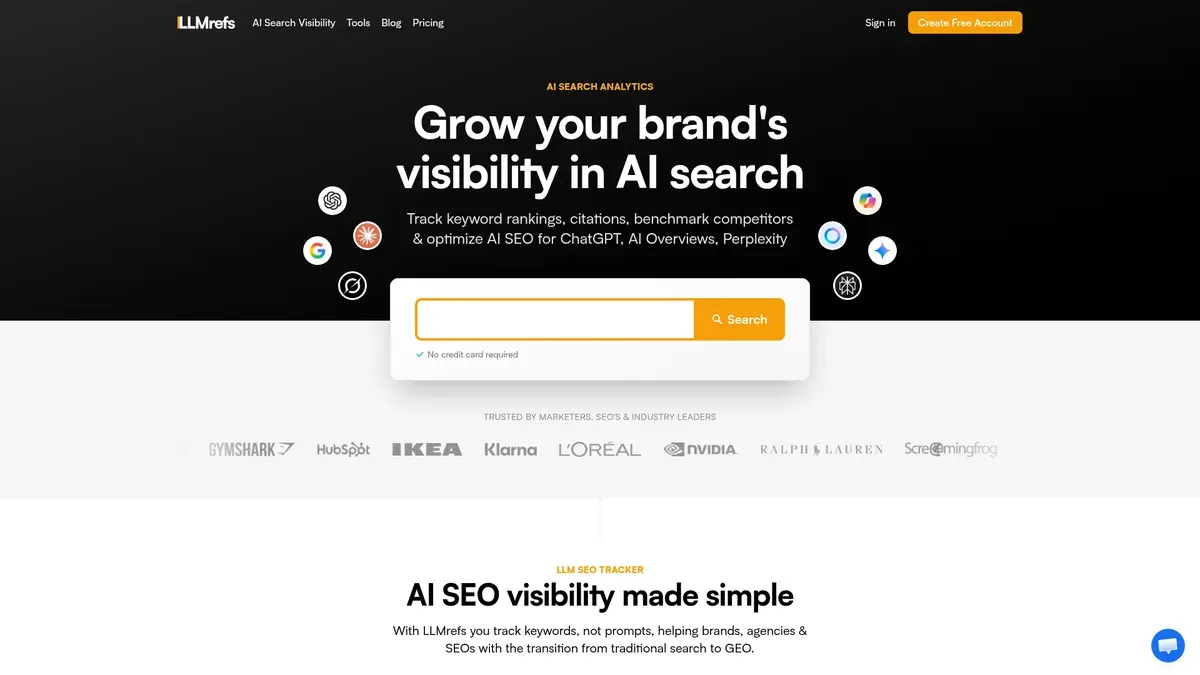
LLMrefs starts from keywords rather than hand-written prompts. It generates fan-out prompts from real AI conversations, estimates monthly AI prompt volume, ranks brands by share of voice and position, and exposes the source URLs generative engines cite. If your team already thinks in keyword lists, onboarding is short.
Pricing: one All-in-One plan advertised at $79/month, covering 500 prompts for brand mentions, sources, and fan-out queries, with unlimited domains, projects, and team members. A 7-day trial, no credit card required.
Key features: SEO keyword list import, auto-generated fan-out prompts, rankings, visibility, citations, position, and share of voice. Source URL filtering for outreach. Weekly reports, prompt-volume estimates, CSV export, and API access. Engines listed include ChatGPT, Google AI Overviews, Google AI Mode, Gemini, Perplexity, Claude, Grok, Microsoft Copilot, Meta AI, and DeepSeek, with geo-targeting across 20-plus countries and 10-plus languages.
Honest limitation: a keyword model is not the same as a deliberately designed buyer-prompt program, and each keyword updates at least weekly rather than daily. The product material emphasizes measurement and AI SEO utilities, not brand-grounded article production. Its public pages also give conflicting country counts, so take the conservative figures.
9. Knowatoa: best for focused, affordable question monitoring
Best for: a small team getting its bearings in AI search, tracking a focused set of questions, and handling content changes in-house.
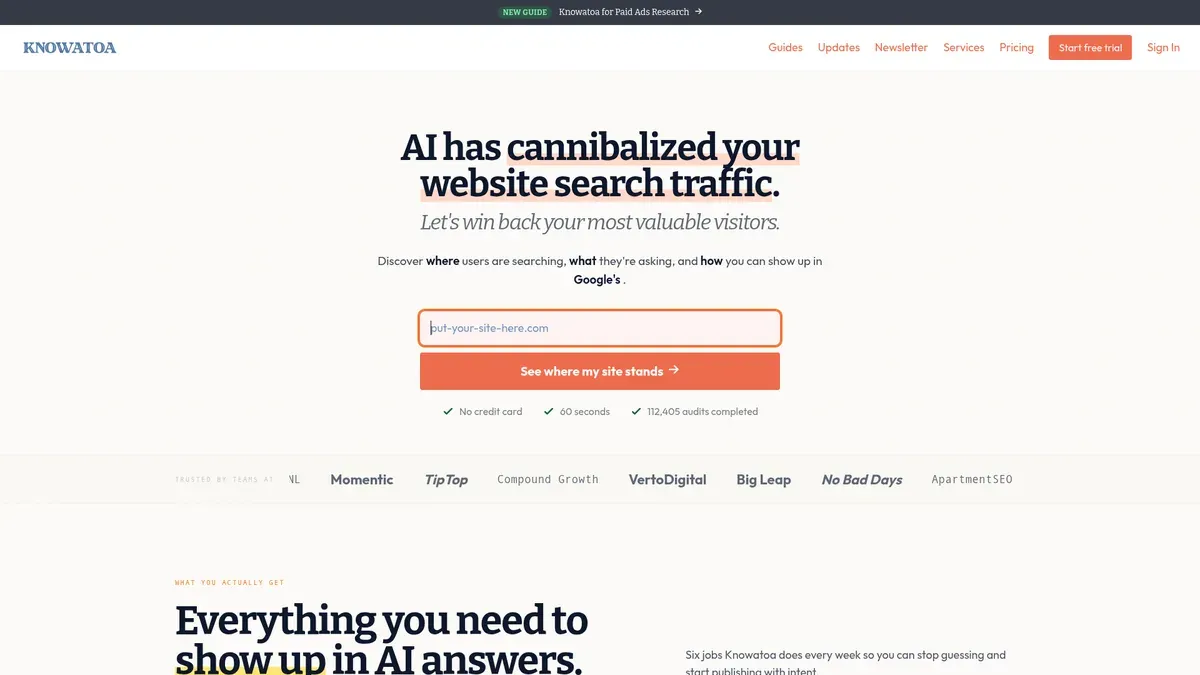
Knowatoa keeps the scope tight on purpose. It shows whether your brand appears in answers to specific questions, which competitors are cited instead, which URLs shape those answers, and what to fix per platform. Weekly digests tell you what changed, and sentiment alerts flag a shift in tone.
Pricing: Starter $59/month covering ChatGPT, Google AI Overviews, and Google AI Mode for a focused question set, with a free trial. Growth $199/month covering all seven listed services. Enterprise is custom. The public pricing page does not state numeric question limits, so ask before you buy. Unlimited sites can be tracked, and all sites share the same question limit.
Key features: weekly visibility, citation, and sentiment changes. Competitor gaps and trusted-source analysis. AI-generated content briefs tied to identified gaps. API access for programmatic visibility data, plus MCP, Looker Studio, and NinjaCat in the reporting stack, with availability varying by plan.
Honest limitation: Starter covers three AI services and is built for a focused question set, not broad coverage, and the official page does not disclose question, user, or prompt limits. Knowatoa is a good low-cost monitoring and briefing layer. If you want a production calendar, automatic article generation, CMS publishing, and repurposing, you will be pairing it with something else.
How to choose: match the tool to your actual bottleneck
Nine options is a lot. Let's make it a five-minute decision.
If you cannot see where you are losing. Almost any tool here solves this, so compare the unit being measured, not the price tag. DeepSmith counts tracked prompts, Peec counts prompts by model and project, Rankscale counts fractional credits per engine query, and Knowatoa counts questions shared across sites.
If you can see the gap but cannot act on it. This is where DeepSmith earns first place. Opportunity Agents attach evidence to each idea, and Content Studio turns those ideas into scheduled, brand-grounded articles that publish to your CMS. Goodie is a real alternative when revenue attribution matters more than volume, and Profound is one at enterprise scale.
If your budget is small. Knowatoa Starter at $59, LLMrefs at $79, DeepSmith Pro at $99, Profound Starter at $99 billed yearly, or Rankscale Pro at $99. Otterly Lite is cheaper at $29, and it is 15 prompts. Skip Rankscale Essentials here, because zero AI answers is not a monitoring plan.
If you need the widest engine coverage. AthenaHQ Starter, Profound Enterprise, Goodie Enterprise, Scrunch Enterprise, Rankscale, or LLMrefs. Confirm the exact engine list on the exact plan first, because some vendors count Google surfaces separately, some bundle model families, and some just say "all major engines."
If you run an agency or multiple brands. Peec agency plans, Rankscale Growth, LLMrefs, Knowatoa Growth, Profound Enterprise, or DeepSmith Multi-Workspace. Ask one question of each: are seats, prompts, and credits pooled across clients, or allocated per client?
If you should honestly pick a competitor. Peec when BI reporting is the priority. Profound when enterprise agents and integrations decide it. Otterly when you want the cheapest way to start. Scrunch when agent experience is central. Goodie when revenue attribution is the reason. Rankscale when technical audits matter most. LLMrefs when your workflow is keyword-led. Knowatoa when you want a small, cheap question tracker and your writers are already booked.
Choose DeepSmith when the writing is the bottleneck, because measurement alone will not move your citation rate. Something has to publish the page.
Try it before you commit
You do not need a bigger content team this quarter. You need one system that tells you what to write and then writes it.
Start a 7-day DeepSmith free trial and see real visibility data and real drafts for your own brand before you pay. No long-term contract, no cancellation fee.