An AEO content workflow has two halves that most teams buy separately. The first half measures how often AI engines name and cite the brand across the prompts buyers actually ask. The second half turns those gaps into published articles. The DeepSmith vs AthenaHQ vs Frase decision is really a decision about whether those halves should live in one system or in two, because each of the three tools sits in a different place on that line. AthenaHQ is the measurement specialist, with the deepest analytics of the three and nine models tracked from its entry tier. Frase is the optimization-first production platform, built around SEO content workflows with AI citation tracking added alongside. DeepSmith runs both halves on one dataset: the prompts where the brand is invisible feed the briefs and the finished articles that close them.
The comparison at a glance
| Capability | DeepSmith | AthenaHQ | Frase |
|---|---|---|---|
| Primary stance | AEO-first track-and-write in one loop | GEO analytics with an action layer | SEO-first optimization with AI visibility attached |
| Engines at entry tier | ChatGPT (Pro, $99/mo) | 9 models including ChatGPT, Perplexity, AI Overviews, AI Mode, Gemini, Claude, Copilot, Grok (Starter) | ChatGPT and Google AI (Starter, $39/mo annual) |
| Engines at top published tier | ChatGPT, Perplexity, Gemini on Scale; all ten engines on Enterprise | All engines, multi-region, multi-language | All five on Scale |
| Core analytics | Mention rate, citation rate, share of voice, sentiment, visibility trend, page-level attribution, competitor leaderboard | Mention and citation rates, share of voice, sentiment, sources cited, prompt volume estimates, citation pattern analysis | Mentions, citations, share of voice across tracked engines |
| Content production | Writer plus Autowrite, producing publish-ready articles with links, cover image, and metadata | Action Center recommendations; Content Optimization Agent on Starter; Deep Research on Enterprise | Research, outline, draft, and image generation in the editor with GEO scoring alongside SEO scoring |
| Brand context layer | Deep IQ: company, products, persona, voice, visual, content types | Brand voice and guidelines on Starter; persona targeting on Enterprise | Brand voice settings per project |
| Internal linking | Automatic at generation, drawn from an enriched sitemap | Manual recommendations | Manual or suggested |
| Entry price | $99/mo, or $80/mo annual | $295/mo, or roughly $245/mo annual | $39/mo annual, $49/mo monthly |
| Top published tier | Scale, $399/mo or $299/mo annual | Custom Enterprise | Scale, $239/mo annual or $299/mo monthly |
| Free entry | 7-day trial | Free plan with $25 credit | 7-day trial, no card required |
The two halves of an AEO content workflow
Measurement and production fail in different ways when they are separated, which is what makes this a stack decision rather than a feature contest. A measurement tool reports that the brand appears in a thin share of answers for a tracked prompt set while a named competitor appears in most of them. That finding is only useful if something downstream converts it into pages. A production tool ships articles on a cadence, but without visibility data it optimizes against ranking signals rather than against the specific prompts where the brand is losing.
Both halves matter more than they did two years ago. Roughly two-thirds of searches now end without a click, and research on AI Overviews indicates that click-through on the top organic result falls by more than half when an AI answer is present. The compensating finding is that brands cited inside those answers pick up meaningfully more organic and paid clicks than brands that are absent. Citation, not position alone, is what the content is being bought for.
The practical question for a content team is therefore where the handoff sits. In a two-tool setup, the handoff is a human: someone exports the prompt gaps from the analytics tool, writes briefs from them, and loads those briefs into the production tool. That step is cheap when the program tracks twenty prompts and publishes four articles a month. It becomes the bottleneck at a hundred prompts and forty articles, which is the volume at which most teams start looking for an AI visibility and content tool that removes the handoff rather than a better version of each half.
AthenaHQ: measurement depth without native production

AthenaHQ is a Generative Engine Optimization platform built to measure brand presence inside AI answers and recommend what to do about it. It was founded by two former Google Search and DeepMind engineers, is Y Combinator-backed with a $2.7M seed round, and is headquartered in San Francisco. Its center of gravity is analytics.
Its strengths are real and specific:
- Engine breadth at the entry paid tier. Starter tracks nine models, including ChatGPT, Perplexity, Google AI Overviews, AI Mode, Gemini, Claude, Copilot, and Grok. No other tool in this comparison covers that many engines at its first paid plan.
- Prompt Volume Intelligence. Unlimited prompts with an estimated monthly AI search volume per platform, which is the closest thing in this trio to keyword volume data for AI answers. It indicates which prompts are worth targeting rather than only how the brand performs on the ones already chosen.
- Analytical range. Sentiment, sources cited, citation pattern analysis, brand-voice scoring, and unlimited competitor tracking, with an Action Center that returns concrete on-page and off-page recommendations such as schema fixes and citation-building targets.
- Enterprise plumbing. SSO, audit logs, multi-region and multi-language tracking, and BI connections through Tableau, Power BI, and Looker, alongside Shopify, Webflow, GA4, and Search Console.
The limits bound those strengths rather than cancel them. Athena does not produce articles natively. The Content Optimization Agent on Starter writes optimized content and Enterprise adds Deep Research, but the Action Center recommends changes rather than drafting, linking, illustrating, and publishing a finished piece. Whatever the analytics surface must still be built somewhere else, so the true cost of the AthenaHQ path is the Starter price plus whatever production already costs.
That Starter price is $295 per month, roughly $245 on annual billing, the highest entry point of the three by a wide margin. Consumption is metered in credits, where one credit equals one analyzed AI response, and the 3,600 monthly credits on Starter work out to somewhere near 1,166 queries across three engines. Broad engine coverage and credit budgeting pull against each other: every additional engine multiplies the responses consumed by the same prompt set, so the nine-model figure is a ceiling that a real prompt schedule rarely reaches at once.
Frase: optimization-first production with visibility attached

Frase is an SEO content optimization platform that has repositioned around AI search, adding GEO scoring and AI Visibility tracking to a product whose foundation is SERP-based briefs, on-page optimization, and AI-assisted drafting. It positions itself as a content operating system for AI search, and it is the production archetype in this comparison.
Its case is strong on production economics and on the editor itself:
- Lowest entry price of the three. Starter is $39 per month on annual billing, $49 monthly, with a seven-day trial that does not require a card.
- Best article-per-dollar ratio. Ten articles a month on Starter, forty on Professional, and one hundred on Scale at $239 per month annually.
- SEO and GEO scoring in one editor. A draft is scored against ranking competitors and against AI citation patterns at the same time, which is a genuinely useful signal for a writer working on the page.
- Content Guard. Continuous monitoring that flags ranking decay or AI citation loss on published pages in real time, drafts the fix, and can auto-publish it as an opt-in behavior.
- Agency shape. Up to ten sites on Scale, multilingual output, and publishing into WordPress, Webflow, Sanity, Wix, or FraseCMS.
The counterweight is where the visibility half sits. AI Visibility in Frase is a module inside Optimize, not the product's center, and its analytics depth is shallower than AthenaHQ's. Engine coverage also climbs slowly: Starter tracks ChatGPT and Google AI only, Perplexity requires Professional, and Claude and Gemini require Scale. A team buying primarily for AEO measurement will find the layer thin, and the $39 headline covers one seat and one site, so the plan that matches a real content team is Professional at $103 per month annually or Scale at $239.
The deeper point is what the product optimizes toward. Frase scores content against ranking competitors first and AI citation patterns second, which suits a team whose organic search program is the main event. When AI citation is the main event, an optimization score computed from SERP competitors is a proxy for the outcome rather than a measurement of it.
DeepSmith: tracking and production on one dataset
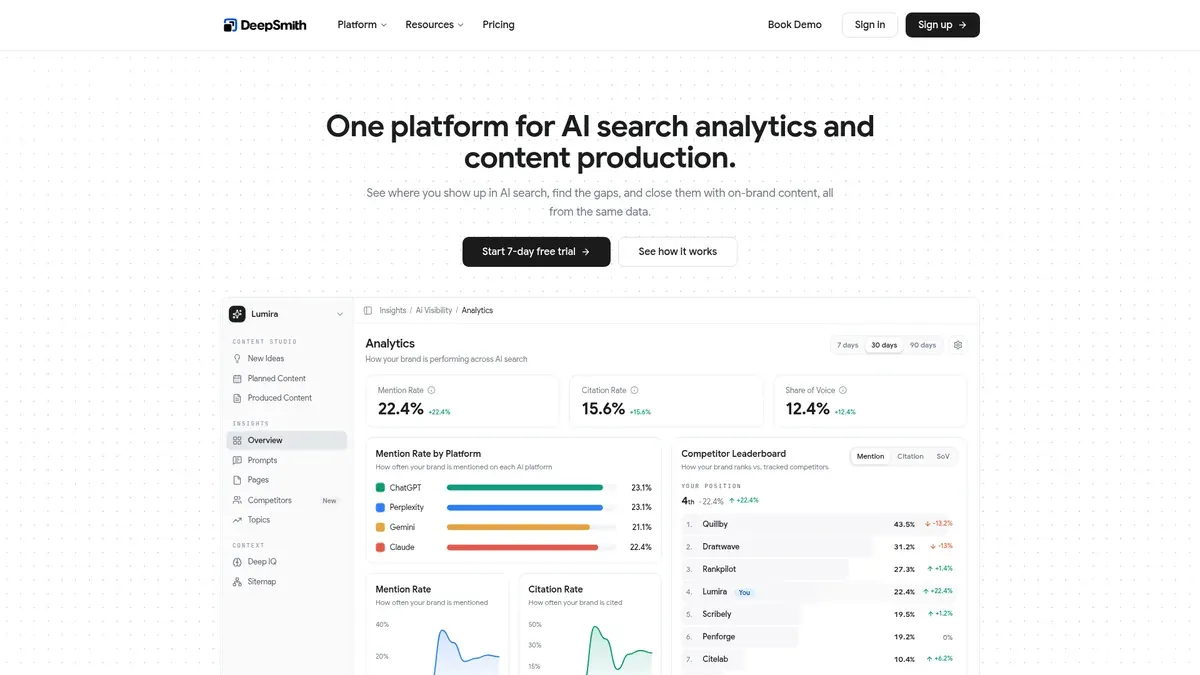
DeepSmith is an AI search analytics and content production platform in one. The AEO module tracks mention rate, citation rate, share of voice, sentiment, and visibility trend across ten engines: ChatGPT, Gemini, Perplexity, Claude, Google AI Overviews, Google AI Mode, Grok, Meta AI, Microsoft Copilot, and DeepSeek. Underneath that sit per-prompt mention and citation rates, full answer history, page-level citation attribution, and a competitor leaderboard showing which competitor pages win the tracked prompts on which platform. Content Studio then turns those findings into articles: New Ideas is the single backlog, fed by Opportunity Agents that read the brand's own visibility and Content Map data and return ideas with the justifying data point attached, the Writer produces a finished article with research, internal and external links, a cover image, and publish-ready metadata, and Autowrite runs the same pipeline on a schedule with no one in the app.
Three things separate this from a bundle of two products under one login.
First, the same dataset drives both halves. A prompt where the brand is absent is not a report to export; it is an idea in the queue, and the Pages view reports back which published URLs earned citations and which prompts drove them.

Second, Deep IQ carries structured brand context into every generated piece: company positioning with claims to make and avoid, product profiles, buyer personas, brand voice, visual guidelines, and reusable content types. Voice and product accuracy are enforced by stored context rather than re-briefed per article.
Third, the output unit is a finished article. Internal links are inserted automatically at generation from an enriched sitemap, and metadata, schema-ready structure, and the cover image arrive with the draft. Produced Content publishes straight to WordPress, Webflow, Strapi, Sanity, Contentful, or a custom webhook, and every finished article arrives with social posts already written, with the Apps Library extending that to LinkedIn, X, Medium, Substack, newsletter and nurture email, and other channels.

Engine coverage rises with the tier rather than arriving all at once. Pro at $99 per month tracks ChatGPT, Grow adds Perplexity, Scale adds Gemini, and Enterprise covers all ten. ChatGPT carries the largest user base of the engines in question, so a single-engine starting point is a narrower net rather than a blind one, and the tiers that widen it also raise the article and prompt ceilings in step.
AthenaHQ vs Frase: what the two-tool pairing actually costs
The most common alternative to one AI visibility and content tool is the obvious pairing: AthenaHQ for measurement, Frase for production. The combination is coherent, and for some teams it is the right answer. It is worth pricing honestly.
On annual billing, AthenaHQ Starter runs about $245 per month and Frase Professional runs $103, so the pair lands near $348 per month before either tool is stretched. On monthly billing the same pair is closer to $424. For comparison, DeepSmith Grow is $160 per month annually and Scale is $299. The AthenaHQ vs Frase pairing is not the cheap option; it is the option that buys the deepest analytics and the highest article ceiling, at the cost of a seam in the middle.
That seam has three specific costs. The prompt gaps live in one system and the content calendar lives in another, so someone reconciles them by hand every cycle. Brand context is configured twice, once as Athena's brand guidelines and once as Frase's per-project voice settings, and the two drift. Attribution runs backwards: Frase scores a page against SERP competitors while Athena reports whether the page earned citations, and connecting the two is manual analysis rather than a built-in view.
For teams with an analyst who owns the measurement layer and a separate production team, that seam is manageable and the depth is worth it. For a lean content team where the same two or three people do both jobs, the seam is where the AEO content workflow stalls.
Frase vs DeepSmith: optimization scoring versus publish-ready output
Comparing the two production tools directly clarifies what each article costs to finish. The Frase vs DeepSmith question is not which one writes faster; it is what arrives at the end of the run.
Frase produces a draft inside an editor, scored against ranking competitors and AI citation patterns, with research and image generation available in the same workflow. The writer stays in the loop, watching the score move. That is the correct shape for a team that wants control over every optimization decision and has the editorial hours to spend on it.
DeepSmith produces a finished article: researched, internally and externally linked, with a cover image and publish-ready metadata, ready for review and publishing rather than for a further optimization pass. Autowrite extends that to unattended production on a schedule. The trade is directional rather than absolute. Frase gives more granular in-editor control and a lower headline price; DeepSmith removes the steps that sit between a scored draft and a published page, including the internal linking that commonly consumes thirty to sixty minutes per article when done by hand.
Engine coverage differs by catalogue and by tier. DeepSmith covers ten engines against Frase's five, but the full ten sit on Enterprise, and at the published top tier Frase Scale tracks all five for $239 per month annually against three on DeepSmith Scale at $299. What the extra hundred dollars buys is the other half of the workflow: DeepSmith Scale ships ninety publish-ready articles, two hundred tracked prompts, and ten seats against Frase Scale's one hundred editor drafts, five seats, and ten sites, so the comparison rewards whichever unit the team is actually short of.
Engine coverage and price, compared honestly
No tool in this trio wins every axis, and the honest summary is short.
- Widest engine coverage at the entry tier: AthenaHQ. Nine models on Starter is the broadest net any of these three opens at a first paid plan, and the entry price of $295 per month with credit-metered consumption is what pays for it.
- Lowest entry price: Frase. Thirty-nine dollars a month annually is genuinely the cheapest way in, and it buys one seat, one site, ten articles, and two tracked engines.
- Most capability per line item: DeepSmith. Pro at $99 per month includes fifty tracked prompts, twenty publish-ready articles, and five seats, so the measurement and the production budget are the same budget.
- Deepest analytics: AthenaHQ. Prompt volume estimates and citation pattern analysis go beyond what either of the other two reports, and none of it drafts an article.
- Best post-publish maintenance loop: Frase. Content Guard watches published pages for ranking and citation decay and drafts the fix, which is a maintenance capability rather than a gap-finding one.
Free entry differs as well. AthenaHQ offers a free plan with a $25 credit, Frase offers a seven-day trial with no card required, and DeepSmith offers a seven-day trial described as real data and real drafts before payment, with no long-term contracts and no cancellation fees.
Which of the three should a content team choose
Choose AthenaHQ when measurement is the deliverable and production already exists elsewhere. A team with in-house writers or an agency retainer, an analyst who owns the visibility dashboard, and enterprise requirements around SSO, audit logs, multi-region tracking, and BI reporting will get more from Athena's depth than from any production feature. The budget question is whether $295 per month for analytics alone fits alongside what production already costs.
Choose Frase when the primary workflow is SEO content production and AI citation is a secondary signal being watched rather than the target being optimized for. Agencies running many client sites, teams that want in-editor control over every optimization decision, multilingual programs, and cost-per-seat-sensitive operations are all well served, provided the analytics layer only needs to be adequate rather than deep.
Choose DeepSmith when the two halves need to be the same system. That applies when the prompts where the brand is invisible should become the articles that close them without a manual handoff, when the output needs to be publish-ready rather than a draft to finish, when brand voice and product claims must hold at higher volume through stored context, and when a multi-brand or agency operation needs isolated workspaces with their own context, content, and billing. It is the strongest fit precisely where the AthenaHQ vs Frase pairing is weakest: in the seam between measuring and making.
Teams that want to test the combined loop against their own prompts and their own site can start a DeepSmith free trial and see both halves running on real data before committing to a plan.