The question of brand authority vs topical authority arrives at most content teams in a specific way: a marketing lead searches their own category in ChatGPT or Perplexity, sees a competitor named instead, and has to decide where the next two quarters of effort should go. One path invests in recognition, making the company legible to the wider web as a known entity. The other invests in depth, making the company's site the most complete resource on the subjects its buyers ask about. Both are defensible, and the two are frequently discussed as though they were interchangeable.
They are not. The available evidence suggests the two authorities operate on different gates in the retrieval process, respond to different interventions, and move on different timelines. Understanding what drives AI citations requires separating them cleanly, because the correct first investment depends almost entirely on which gate a given brand is currently failing.
This piece is a comparison and a prioritization frame. It defines each authority, examines the evidence on how each influences citation behavior, and offers a recommendation by starting position. It does not cover the implementation steps for either lever.
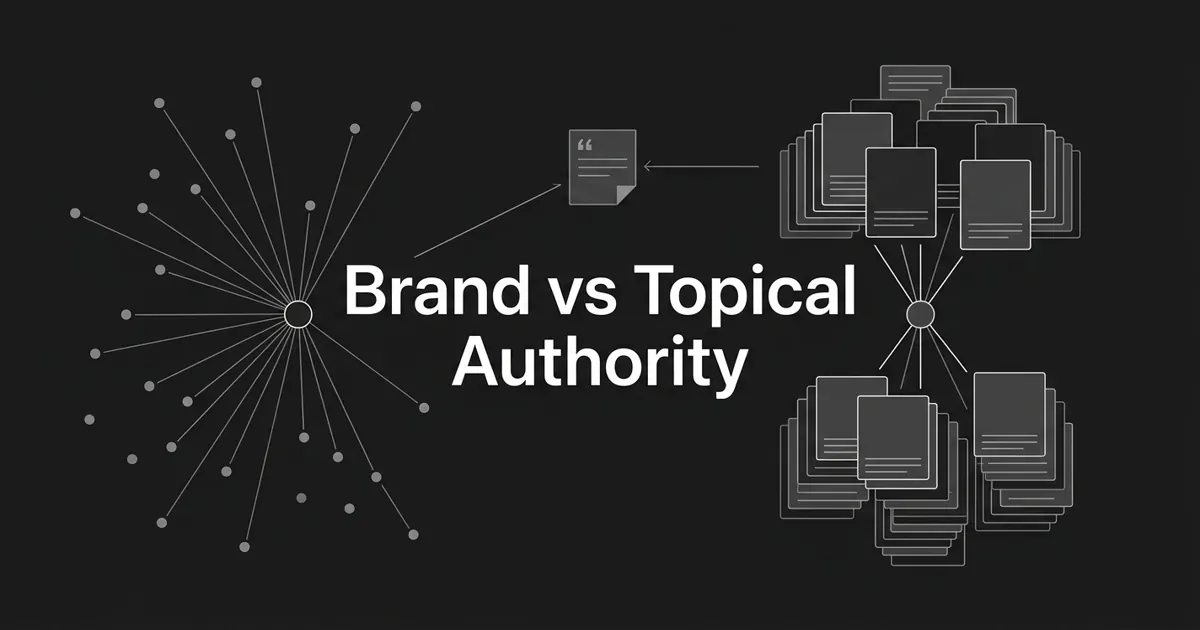
Brand Authority vs Topical Authority at a Glance
| Dimension | Brand authority | Topical authority |
|---|---|---|
| Primary asset | Recognition as an entity across the web | Depth of coverage on a subject on the site |
| Where it lives | Off-site: news, reviews, directories, community threads, Wikipedia, podcasts | On-site: the content cluster itself |
| Build mechanism | PR, reviews, partnerships, inclusion in "best of" lists, entity markup, brand mentions | Topic-cluster content, internal linking, comprehensive coverage, schema, freshness |
| Primary AI effect | Determines whether the brand is mentioned or considered | Determines whether the brand is cited as the source |
| Time to impact | Months to quarters, compounding | Weeks to months, per piece |
| Measurement | Mention share, entity presence, share of voice, sentiment | Coverage completeness, internal-link density, citation rate per prompt |
| Biggest failure mode | Thin brand presence, inconsistent entity data, low third-party coverage | Shallow content, broken internal linking, missing semantic entities |
| Best leverage for | Unknown brands, undifferentiated markets, comparison queries | Established brands contesting the "best answer" position |
| Durability | More defensible; entity status persists | More fragile; a competitor can out-publish and displace |
| When neglected | The brand is ignored by AI even where good content exists | AI cites competitors on the topic instead |
Brand Authority: Recognition at the Entity Level
Brand authority describes how recognizable, trusted, and entity-definable a company is across the wider web, including within the training corpora that AI models draw on. The operative question is whether the rest of the internet, and the systems trained on it, know who the company is and what it does.
The signals that contribute are largely off-site and entity-level: branded search volume, branded web mentions from third-party sites naming the company even without a link, backlinks and referring domains, press coverage and reviews in authoritative outlets, Wikipedia and Wikidata presence, consistent structured data carrying the same name and description across the web, sentiment and recommendation patterns in reviews and roundups, and knowledge panel presence in Google.
The defining constraint follows from that list. Brand authority is something the rest of the web confers; a company cannot publish its way to it alone. This is the characteristic that most often surprises teams who have spent years treating content volume as the primary growth lever, and it is the reason brand authority AEO work tends to route through public relations, analyst relations, and community presence rather than through the editorial calendar.
Topical Authority: Depth Within a Subject
Topical authority describes how comprehensively and credibly a domain covers a specific subject area. The operative question is whether the site owns the answer space for a topic, in the sense that a reader seeking the deepest available answer would find it there.
The contributing signals are largely on-site and content-level: coverage breadth across subtopics, depth per page, an internal-link architecture that groups related material into coherent clusters, topical relevance of inbound links from other sites writing on the same subject, freshness and update cadence, semantic completeness across entities and definitions and comparisons, and structured data marking up the topic.
Unlike brand authority, topical authority is directly buildable. A team that publishes comprehensively and connects the material internally can move it without waiting for a third party to act. That controllability is precisely why the topical authority AI search conversation tends to dominate content-team planning, and why teams sometimes over-index on it: it is the lever they can pull unilaterally, which is not the same as the lever that is currently binding.
What Drives AI Citations: The Available Evidence
Several independent studies now bear on the question, and they converge on a picture that is more nuanced than either camp usually presents.
The largest published analysis, an Ahrefs study of 75,000 brands released in December 2025, examined which factors correlate with being mentioned inside ChatGPT, AI Mode, and AI Overviews. Branded web mentions, meaning third-party sites naming the brand, correlated at approximately 0.664, the strongest single signal in the study. Backlinks correlated at approximately 0.218, materially weaker. The composite brand authority measure sat near 0.41. Read conservatively, that pattern suggests that being named by third parties is roughly three times more strongly associated with AI visibility than raw backlink counts, which places the dominant signal firmly on brand-authority terrain.
A separate BrightEdge analysis compared how often ChatGPT names brands against how often it links to them. ChatGPT mentioned brands roughly 3.2 times more often than it cited them, and approximately half of all prompts triggered at least one brand mention. Commercial-intent queries of the "best X for Y" and "X vs Y" form produced considerably higher mention and citation rates than purely informational queries. The asymmetry between mention and citation is the single most useful finding for this comparison: a brand can be highly visible without being cited, and the two outcomes respond to different work.
A meta-analysis across six independent citation studies found that between 82 and 95 percent of AI citations trace back to earned third-party sources such as press, reviews, roundups, comparison articles, and community threads, rather than to brands' own properties. That figure, if it holds, places brand-authority work upstream of most citation activity.
Evidence on the topical side is narrower but consistent. A study relating site-wide coverage depth to AI Overview citation likelihood reported a correlation near 0.41, and found that pages ranking sixth or worse with strong topical coverage were cited more often than top-ten pages with shallow coverage. The reasonable reading is that once a page has entered the retrieval candidate pool, topical depth acts as the tiebreaker. Topical authority appears necessary but not sufficient, operating downstream of entity recognition rather than as a substitute for it.
Two further findings complicate any strategy that treats AI citation as a byproduct of conventional ranking. Aggregate analyses indicate that roughly 80 percent of ChatGPT's most-cited pages do not rank in Google's top 100 for the same queries, and the share of AI Overview citations drawn from the Google top ten has fallen from approximately 76 percent to approximately 38 percent within twelve months. AI retrieval and classical ranking evidently use overlapping but distinct signals.
The peer-reviewed work points at a third variable entirely. The GEO paper from Princeton and IIT Delhi, presented at KDD 2024, found that modest structural changes to content, including citing sources, incorporating statistics, and adopting quotation-friendly phrasing, produced up to roughly 115 percent lift in impression share on a Perplexity-style engine. The gains came from formatting rather than from new content. Authority of either kind, absent citation-ready structure, leaves citations unclaimed.
The Authority Signal Stack AI Answers Rely On
The research converges on roughly seven layers of authority signals AI answers draw on when selecting sources. The two authorities sit at different layers, which is the mechanical reason neither substitutes for the other.
- Retrieval candidates. What the engine surfaces from its index or a live web search. Topical authority governs whether a page enters this set at all.
- Brand entity presence. Whether the brand is recognized as an entity, evidenced through Wikipedia, Wikidata, knowledge panels, and repeated third-party reference. Brand authority governs this layer exclusively.
- Mention signal. Third-party sites naming the brand, with or without a link. The strongest correlate in the Ahrefs analysis.
- Link signal. Backlinks, referring domains, and anchor text, materially weaker in AI citation than in classical search.
- Content quality and structure. Clear answers near the top, headings, lists, schema, and source citations.
- Topical depth and cluster coverage. Whether the site owns the topic or holds a single page on it.
- Trust signals. About pages, author bylines, editorial standards, and primary-source citation.
The practical reading is straightforward. No amount of topical depth passes layer two, and no amount of entity recognition passes layers one, five, and six. These are the authority signals AI answers combine, and they stack rather than compete. Teams that audit their position against all seven layers, rather than against the one or two they already influence, tend to locate the binding constraint faster.
Best for Unknown Brands: Brand Authority
Brand authority is the binding constraint under several identifiable conditions.
The clearest is a brand that is new or unrecognized in a category. Generative engines do not recommend entities they do not know, and topical publishing rarely moves visibility until the brand exists in the corpus at all. The first task is insertion: press placements, inclusion in comparison lists, community presence, podcast appearances, a clean Wikipedia and Wikidata footprint, and consistent entity markup.
The second is a category dominated by a few household names. AI summaries tend to reproduce the existing hierarchy unless a challenger has deliberately placed itself into the third-party content the engines read. The third is a product that sells through comparison and commercial-intent queries, where the answer is a list of named brands and mention share, not citation share, is the operative metric.
The fourth is high-consideration or high-stakes purchasing, including enterprise software, legal, financial, and healthcare categories, where buyers research across many sources and the breadth of a brand's presence across analyst coverage, review sites, and community threads shapes which names the summary produces. In each of these cases, brand authority AEO programs are constrained by the pace of third-party coverage rather than by editorial capacity, which is why their timelines run in quarters. The fifth is repositioning. A model already holds a description of an established entity, and topical content on the company's own site does comparatively little to revise it; only third-party coverage reliably does.
Best for Known but Uncited Brands: Topical Authority
Topical authority binds under a different and equally identifiable set of conditions.
The most common is a recognized brand losing citations to better-resourced publishers. The recognition gate is already passed, and the leak is answer ownership: citations flow to whoever holds the most thorough treatment of the subtopic. The remedy is publishing or rewriting the definitive page on the specific subtopics where citations are being lost.
Categories that reward research-heavy depth follow the same logic, since tutorials, technical explanations, definition pages, and comparisons are precisely the formats generative engines cite most readily. Regulated or fast-moving categories add a freshness dimension, where specificity and update cadence keep a page citation-worthy as the underlying facts change. Practitioner audiences behave similarly, tending to surface the most thorough technical resource rather than the most recognized name.
The final case is compounding. For a brand that has already established entity presence, each additional comprehensive piece widens the gap, and a single well-built pillar page can shift citation share measurably within weeks rather than quarters.
Where Both Authorities Are Required
Several situations resist a single-lever answer.
Mid-funnel commercial queries are the clearest. A prompt such as "best CRM for SaaS startups" requires recognition, so that the brand is named at all, and answer ownership, so that the brand is cited as the source. Brand authority alone produces a named but uncited company. Topical authority alone produces a cited but anonymous one, which yields traffic without brand presence.
Reputation-sensitive verticals behave the same way, since engines are measurably more conservative in healthcare, legal, and financial contexts and appear to favor established entities that also carry deep coverage. Long B2B sales cycles compound the effect across many touches: a buyer may consult several AI summaries before clicking, and the two authorities determine, respectively, how many name the brand and how many cite it.
The flywheel framing is the most useful one. Brand authority raises the mention rate, and topical authority raises the citation rate on each mention. The two multiply rather than add.
Caveats the Evidence Does Not Settle
Several qualifications deserve to travel with these numbers.
Most of the studies report correlations rather than controlled experiments, and the causal direction remains unestablished. Brands that attract press coverage also tend to publish more and attract more search traffic, and those confounders almost certainly inflate some coefficients. A correlation near 0.664 indicates a strong association, not proof of a mechanism.
Engine-specific variance is substantial. ChatGPT leans more on entity recognition acquired from its training corpus, Perplexity leans more on live retrieval, and Gemini blends the two. Brand authority therefore matters more on the first, topical freshness more on the second, and both on the third. Any single strategy applied uniformly across engines will be misaligned somewhere.
The mention and citation distinction, which this comparison rests on, is itself imperfectly measured. One Semrush audit found that roughly 62 percent of citations were "ghost citations," in which a URL was cited but the brand was never named in the answer text. The same content can drive one outcome without the other.
The binary also blurs at the extremes. A brand with unusual topical depth eventually becomes an authority brand by association, and a brand with unusual recognition is treated as authoritative in adjacent subjects it has barely covered. The two are better understood as a stack than as a choice.
Measurement remains immature. Most tracking tools evaluate citation against a synthetic prompt set, and prompt sets, collection cadences, and brand-name definitions differ between vendors. Cross-tool figures for the same brand can vary by 30 to 50 percent, so any individual number is best treated as directional rather than exact.
Which Should You Choose
The recommendation follows from the starting position rather than from any general ranking of the two levers.
A new or unrecognized brand should start with brand authority. Engines do not cite or recommend entities they do not know, and topical content will underperform its quality until the entity exists in the corpus. The measurable objective is mention share, and the realistic horizon is three to six months before it shifts.
An established brand losing citations should start with topical authority. The recognition gate is passed and the leak is answer ownership. The work is diagnostic first: identify which competitor pages are winning those citations, and publish the more thorough treatment. Citation share on a given topic can move within four to eight weeks of publishing a clearly superior page.
A well-established brand in a fast-moving category should run both in parallel, weighted toward topical authority. Brand authority defends against displacement by AI-native entrants; topical authority defends against deeper publishers. A first-year split near 30 percent brand-authority work and 70 percent topical-authority work is a reasonable starting allocation, subject to reassessment once mention and citation rates are separately visible.
A brand in a category where AI assistants already dominate discovery, including B2B SaaS, developer tools, and AI infrastructure, should also run both with topical authority weighted higher, since the mention-versus-citation asymmetry has the largest consequences where AI answers carry a disproportionate share of buyer research.
The prerequisite in every case is diagnosis, because the two failure modes are indistinguishable from the outside. Being absent from an AI answer and being cited without being named look identical in a traffic report and call for opposite responses. This is the specific problem DeepSmith addresses: it tracks mention rate, citation rate, and share of voice per prompt across ChatGPT, Gemini, Perplexity, Claude, and Google AI Mode, with engine coverage rising by plan tier, so that a team can see which gate is actually failing. Where the constraint is topical, it surfaces which competitor pages are winning the prompts in question and feeds those gaps into a production queue that produces publish-ready articles from the same brand context. Where the constraint is brand authority, the platform provides the diagnosis and tracks the lift, though the underlying work, the placements, the reviews, the community presence, is done outside any tool.
DeepSmith offers a 7-day free trial with real data and real drafts before payment, with no long-term contract. Start a free trial.