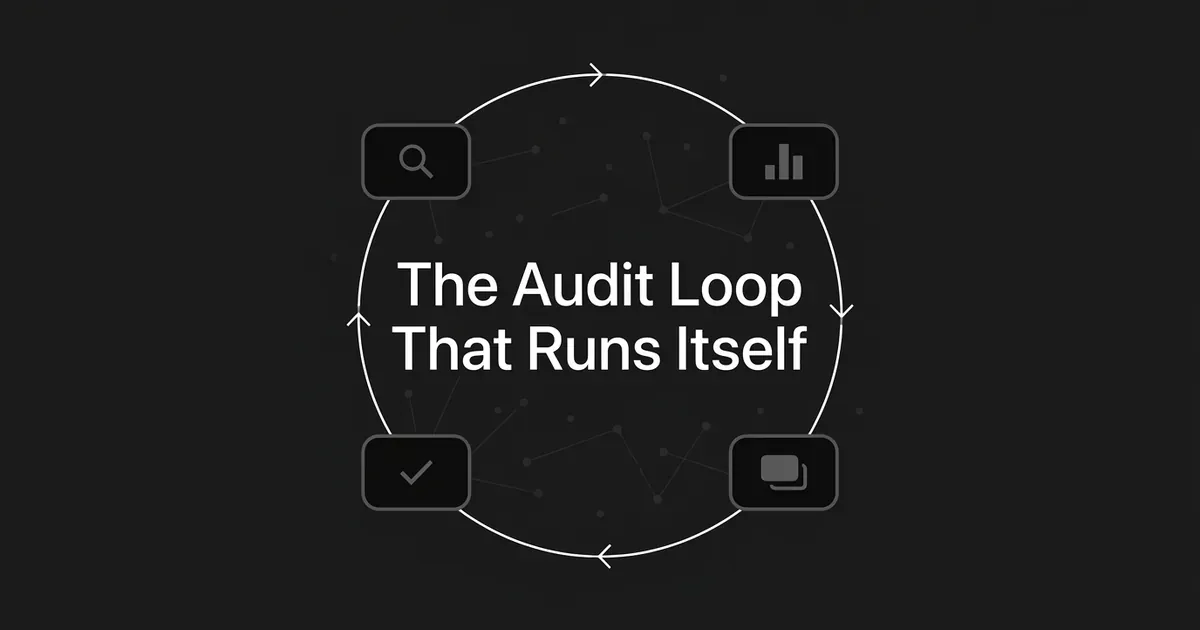
You checked ChatGPT once, saw a competitor named instead of you, and told yourself you would look again next month. Next month never came. That gap is what agentic AEO is for: an audit that keeps happening without you, plus a path from what it finds to what you actually change. This guide walks you through that loop, step by step, for a single brand.
You need three things to start: a list of prompts your buyers really ask, a way to run them on a schedule, and somewhere for the fixes to land. If you only have the first one today, that's normal. Start there.
Step 1: Build the prompt set your buyers actually ask
Your loop is only as honest as its questions. Write 30 to 100 prompts that a real buyer would type, and tag each one with a buyer stage (Awareness, Consideration, Decision) and an intent class (informational, commercial, navigational). Pick 3 to 5 direct competitors while you are in there.
Mix the types. Include transactional prompts about price and comparison. Include experiential ones about what a tool is like to use, or what people recommend. Engines pull different kinds of sources for each, so a set that leans one way hides half your picture.
How you know it's done. Every prompt has an answer to three questions: who asks this, at what stage, and what kind of source would you expect an engine to reach for. Your competitor list is reviewed at least quarterly.
Where people go wrong. Chasing giant category prompts like "best CRM," which engines answer with aggregator lists you will never own. Skipping the comparison prompts where a rival gets named out loud. Copying the same wording to every engine, which hides how differently each one behaves. Writing the set once and never touching it again as your positioning moves.
This is the step where a tool saves you a week of staring at a blank doc. DeepSmith's Discover Prompts builds a starter set from your product, persona, and buyer-stage context, and you edit, delete, or hand-write on top of it. Adding your competitors turns on Competitor Citations tracking, and their sitemaps get checked daily, so new pages show up as they ship.
Step 2: Check that the engines can reach the pages you want cited
Here's a quiet failure that wastes months. You write the perfect answer page, and the engine cannot read it. Before you optimize anything, audit access.
Google is the simple one. There is no special AI crawler to allow and no machine-readable AI file you have to publish. To be eligible as a supporting link in AI Overviews or AI Mode, a page has to be indexed and eligible to show in Google Search with a snippet. Same technical requirements, same best practices.
OpenAI splits its crawlers by job, and this is where teams trip. OAI-SearchBot is the one that surfaces sites in ChatGPT search. GPTBot crawls content that may be used for model training. ChatGPT-User visits a page when a person asks ChatGPT about it, and it does not decide whether you appear in search. Block GPTBot if you want out of training. That does not remove you from ChatGPT search, and it never did.
How you know it's done. You have a small matrix: each engine down one side, each page class across the top, and a yes or no for indexed, allowed by robots, and meta-tagged. Test at least one real page per engine.
Where people go wrong. Blocking GPTBot and expecting ChatGPT to stop citing you. Leaving a stray noindex on a commercial page. Disallowing a whole /blog/ or /docs/ path that should be citable. Letting a CDN or firewall quietly block crawler traffic.
Give this step patience. After a robots or snippet change, a Google recrawl can take anywhere from several days to several months, depending on how often that page gets refreshed. Robots changes for OAI-SearchBot propagate faster, in roughly a day. Your loop has to plan around that lag, not pretend it isn't there.
Step 3: Set up continuous AEO monitoring on a schedule
Now the loop starts moving. Run every tracked prompt across every tracked engine on a fixed cadence: weekly at minimum, daily for the decision-stage prompts you care most about. Save the full answer text, not just a yes or no.
One run tells you almost nothing. A repeated-measurement preprint from researchers at the University of St. Gallen ran 30 platform-topic tests across three engines and found no fixed number of runs that produces a stable citation ranking. The number of answers needed before the order settled and the differences cleared the margin ranged from 33 to 94. A few tests never settled at all, even after 125 questions. It's a preprint, so treat those numbers as the shape of the problem rather than a lookup table. The lesson still holds: repeat, then report a range.
Pro tip. One run is noise. Build the loop on repeat runs and trends, never on a single day's screenshot.
How you know it's done. You have one store holding the literal answer text, the parsed mentions and citations, the engine, the prompt, and a timestamp, going back 30 to 90 days. The cadence is written down somewhere a person can find it.
Where people go wrong. Snapshotting once a month and calling the newest answer the truth. Reading "no mention today" as "no visibility." Counting a navigation link as a citation. Tracking prompts nobody asks and celebrating a clean win on them.
This is the first place software genuinely beats a spreadsheet, and it's where you actually automate AI visibility audit work instead of remembering to do it. DeepSmith's AI Visibility runs your prompt set on the cadence you set, captures every full answer, and tracks mention rate and citation rate as two separate numbers, each with period-over-period change.
Step 4: Turn raw answers into rows your agent can read
An agent cannot act on paragraphs. It acts on rows. So convert every captured answer into a structured record before anything else happens.
One row per prompt and engine pair, carrying: was the brand mentioned, was one of your pages cited, which URL, was the description accurate or stale, what was the sentiment, and which domains were the sources. Tag each source as yours, a competitor's, or a third surface. Normalize the URLs so the same page collapses across runs: strip tracking parameters, lowercase the host, settle the trailing slash.
How you know it's done. Every row has the same fields, filled in. URL normalization is deterministic, so one page never shows up as three.
Where people go wrong. Treating a link carrying utm_source=chatgpt.com as a different page from the canonical URL. Mixing the sidebar link list in with citations inside the answer body. Filing G2, Capterra, or Reddit as either yours or a competitor's when they are really a third surface with their own PR job. Skipping this step because the answers "read fine," which is the point at which you stop being able to automate AI visibility audit reporting at all.
Step 5: Diagnose each gap and give it a name
You cannot fix "we're not showing up." You can fix a named gap. Sort every row into one of six buckets:
- Not mentioned at all.
- Mentioned, but no link to your page.
- Cited, but on a thin or outdated page.
- Cited on the right page, but described wrongly.
- Cited on the right page, with a competitor cited alongside and your share low.
- Cited on the right page, but the sentiment is negative.
Now pair each bucket with its likely cause. Not mentioned usually means you have no page shaped like the answer. Mentioned but not cited usually means the engine knows your name and found nothing citable to hand over. Cited on the wrong page usually means your homepage or product index is the most authoritative thing you have on that topic. A wrong description usually traces back to stale positioning copy, or to a third-party source the engine trusts more than you do. Negative sentiment is a messaging problem before it's a content problem.
That second bucket deserves a name of its own. Call it a ghost citation: the engine names you and links someone else. It's frustrating, and it's also the best signal in the whole dataset. The trust is already there. You just haven't given the model a page to point at.
Where people go wrong. Treating every absence as a content gap when it's really an entity gap, where the engine has no stable sense of who you are for that topic. Treating a wrong-page citation as a redirect problem when the cited page is genuinely the only relevant thing you have. Firing a fix off one noisy run.
DeepSmith does the tedious half here. The Pages view names which of your pages get pulled into answers and what share of your total citations each one owns, with the prompts driving them. Opportunity Agents read the same data and hand back ideas with the data point that justified each one attached, including agents built to get cited for a tracked prompt, turn mentions into citations, and fix how AI describes you.

Step 6: Pick the smallest fix that closes the gap
Every gap class maps to a menu of actions. Match them, then pick the cheapest one that could plausibly work.
- Not mentioned: write or expand a page built for that exact question.
- Mentioned but not cited: add a clear, liftable answer block near the top of the page most likely to be retrieved.
- Cited on the wrong page: write the dedicated answer page so the engine has a better option.
- Description wrong: edit your own positioning copy, and go after the third-party source the engine is actually reading.
- Share of voice slipping: build out the neighboring topics so citations accumulate across the cluster.
- Negative sentiment: correct it where the engine sourced it, not on your own blog.
Lead times differ a lot, and that matters more than it sounds. An inline edit takes minutes. A new citable block takes tens of minutes. A dedicated page takes hours. A PR correction takes days or weeks. A whole cluster takes weeks.
Common mistake. Defaulting to "write an article" for every gap when a fifteen-minute paragraph edit would close it today. Pick the smallest action that moves the number.
Where you put the answer matters as much as writing it. A CXL analysis of 100 AI Overview citations found about 55% came from the top 30% of the page, about 24% from the middle, and about 21% from below the 60% mark. FAQ blocks were the exception that still pulled citations from further down. So lead with the answer in your first 150 to 200 words, then let structured FAQ sections carry the rest.
And ranking is not the gate you might assume. Ahrefs looked at 863,000 keyword SERPs and four million AI Overview URLs and found roughly 38% of cited pages also sat in the SERP top 10, about 31% ranked between positions 11 and 100, and about 31% did not rank in the top 100 at all. Being invisible in classic search does not lock you out.
Pro tip. Group by intent, not by exact wording. One strong answer page can lift several prompts in the same cluster.
Step 7: Trigger the fix and log what you shipped
A diagnosis that stays in a dashboard is a diagnosis that never happened. Each chosen action becomes a tracked item carrying the gap it came from, the page that will change, who approves it, and how you will verify it later.
Route by risk. Low-risk work like a paragraph edit, an internal link, or a schema addition can go hands-off. Medium and high-risk work goes through a person. Whatever you dispatch, send it with your brand context attached: positioning, product facts, persona detail, voice. Context is what stops the output sounding like everybody else's.
This is the honest answer to how AI agents fix citations. They don't reach into an engine and change it. They shorten the distance between spotting a gap and shipping the page that answers it.
How you know it's done. Every item has a status you can read at a glance: planned, scheduled, written, or published. Every published item has a URL and a timestamp.
Where people go wrong. Logging actions in a sheet nobody opens. Approving a batch in bulk because clicking got tiring. Sending items to production with no brand context. Overwriting a page that was quietly working.
In DeepSmith this is Content Studio, and the path is short. Ideas land in New Ideas, get a date in Planned Content, and go to the Writer, which turns one idea into a finished article with internal and external links, schema, a cover image, and publish-ready metadata. Autowrite removes the last manual step: an article configured at planning time writes itself on its scheduled date and lands in Produced Content with nobody in the app. From there you publish straight to WordPress, Webflow, Strapi, Sanity, or Contentful, or to your own webhooks. That is how the loop keeps running through a week when you have no time, which is what running AI search visibility at scale really asks of a small team.
One boundary to respect. Your plan sets a hard ceiling on articles per month, 20 on Pro, 40 on Grow, 90 on Scale. The loop should queue past that, not blow through it. Engine coverage has a ceiling too: Pro starts at ChatGPT, Grow adds Perplexity, Scale adds Gemini, and Enterprise covers all ten. Don't promise yourself monitoring on an engine your plan doesn't track.
Step 8: Re-audit and check the change against the noise
The loop closes here. After the fix is live and indexed, and after you've allowed for that recrawl window, run the exact same prompt set on the exact same engines and compare.
Look at six things: mention rate, citation rate, whether the right page is now being cited, whether the description improved, sentiment, and share of voice. Then repeat the run enough times to clear the noise before you believe any of it.
Where people go wrong. Re-running once and declaring victory. Treating a citation as traffic, which it isn't. Missing that an engine changed underneath you. Ahrefs and CXL both note the Gemini 3 rollout in January 2026 reshaping AI Overview behavior, and a delta measured across a change like that tells you about the model, not your page.
Pro tip. Re-baseline after any known engine update. A win measured against an old baseline is a guess wearing a suit.
Set a regression watch too. Citations drift. A page that wins this month can quietly stop winning, and nobody notices until a quarterly review. Trend lines catch that. Snapshots don't. DeepSmith's Visibility Trend is built for exactly this: watch the direction, not the absolute number, so engine-side churn doesn't send you chasing ghosts.
Two things you should never promise, to yourself or to your boss. Google says indexing and serving are never guaranteed, even when you've done everything right. And tracker dashboards, including Bing's own AI Performance report, are sampled and aggregated rather than complete logs. Your loop moves rates and verifies movement. It does not buy citations.

What to do next
Start smaller than you think. Pick ten decision-stage prompts, run them weekly for a month, and diagnose only the ghost citations. That single bucket usually hands you the fastest wins, because the trust is already there.
Once that rhythm holds, widen the prompt set, add an engine, and move from fixing single prompts to covering whole intent clusters. That's the point where continuous AEO monitoring stops being a project and starts being how your content team works.
If you want the tracking and the fixing in one place instead of stitched across four tabs, start a free DeepSmith trial and see your real prompt data before you pay. Plans start at $99 a month, or $80 billed annually, with a 7-day free trial and no long-term contract.