Most AI visibility programs begin the same way. Someone opens a new tab, writes twenty questions a buyer might ask an AI engine, types each one into ChatGPT, and records whether the brand appeared. That artifact, an AI visibility tracking spreadsheet, is a legitimate first instrument. It costs nothing, it produces real observations, and it forces a team to decide which questions actually matter before any budget is committed.
The aeo tool vs manual spreadsheet decision is therefore not a question of whether the sheet works. It is a question of the point at which the sheet stops producing numbers a team can defend. That point is reasonably well defined, and it arrives earlier than most teams expect: somewhere around thirty tracked prompts, or the first time a second engine enters the picture, or the first time a CMO asks what share of category citations the brand actually holds.
Who each option suits
The decision resolves cleanly for most teams once the variables are named.
- A manual spreadsheet suits exploratory programs: fewer than roughly thirty prompts, one or two browser-accessible engines, weekly cadence, and an internal audience that treats the numbers as directional rather than reportable.
- A free one-shot grader suits teams that need a baseline this week and have not yet decided whether AI visibility warrants recurring budget.
- A tracking-only platform suits teams with a defined prompt portfolio, multiple engines, and a separate content function already producing the pages that would close the gaps.
- A combined tracking and production platform suits teams where the same people who read the visibility report are also responsible for shipping the content that changes it.
DIY spreadsheet vs AEO tools at a glance
| Option | Entry price | Engines at entry | Prompts at entry | Refresh | Production loop |
|---|---|---|---|---|---|
| DIY spreadsheet | $0 plus analyst time | Whatever is typed by hand | Whatever is typed by hand | Manual | None |
| HubSpot AEO Grader | Free, one-time | 3 (snapshot) | One-shot | None | None |
| HubSpot AEO | $50/mo ($45 annual) | 3 (ChatGPT, Gemini, Perplexity) | 25 | Daily | Prioritized recommendations |
| Otterly AI | $29/mo (Lite) | 4 core, others as paid add-ons | 15 | Daily | Recommendations |
| Semrush AI Visibility Toolkit | $99/mo (Starter) | AI Overviews plus 4 LLMs | 10 base | Daily | Recommendations |
| Profound | $99/mo annual (Starter) | 1 (ChatGPT) | 50 | Daily | Agents module |
| Peec AI | EUR 80/mo (Starter) | 3 of 6 models | 50 per day | Daily | Recommendations |
| Scrunch AI | $300/mo | ChatGPT, Perplexity, Google AIO, Copilot | Not published | Not published | Recommendations |
| Goodie AI | Custom, no public rate card | Major answer engines | Not published | Not published | Content production module |
| DeepSmith | $99/mo ($80 annual, Pro) | 1 at Pro, rising to 10 at Enterprise | 50 | Scheduled | 20 publish-ready articles per month |
Two clarifications the market makes easy to confuse. The HubSpot AEO Grader and the paid HubSpot AEO subscription are separate products, and only the paid one refreshes. Peec AI publishes in euros, so any dollar comparison depends on the conversion rate at the time of purchase.
What a realistic prompt-tracking spreadsheet involves
A working manual system is more structured than a list of questions. The columns that a functioning AI visibility tracking spreadsheet converges on are consistent: date refreshed, engine, exact prompt text, brand mentioned yes or no, brand cited as a linked source yes or no, the cited URLs, position in the answer, sentiment, competitors present, and a notes field. The prompt text must stay identical week over week, because any rewording invalidates the comparison.
Cadence sets the workload. Industry guidance places the floor at weekly refresh per engine, with daily refresh across multiple models preferred for genuinely trendable signal, and sets a minimum of fifteen to twenty prompts per topic before the data supports a trend line at all. A thirty-prompt set across three engines on a weekly cycle costs roughly an hour and a half per refresh: logging in, typing each prompt into each engine, reading the answer, pasting it into the row, and tagging the columns. A fifty to one hundred prompt set across four engines runs closer to half a day per refresh.
The economics look attractive at that scale, and honestly so. A team can track ChatGPT mentions spreadsheet-style for a full quarter, learn which questions its buyers actually ask, and spend nothing but the analyst's time. Free AI visibility tracking of this kind also produces something a tool cannot hand over: direct familiarity with how the engines phrase answers in the category, which shapes better prompts later.
Where DIY AEO tracking breaks
The failure modes are structural rather than a matter of discipline. They arrive in a predictable order.
Sample size of one. Each prompt-and-engine cell in the sheet is a single draw from a high-variance distribution. Measured within-model variance on identical prompts sits in the ten to thirty-four percent range across runs. A weekly snapshot records one number per cell, which means a movement of twenty percent between two cycles is indistinguishable from noise. Tools reduce this by querying repeatedly on a schedule; a manual system cannot without multiplying the analyst hours by the number of repeat runs.
Citation parsing is a parsing job, not a tagging job. Engines return sources in different shapes. ChatGPT places clickable links inline inside sentences. Perplexity returns numbered footnotes with source URLs. Gemini presents a sources panel. Claude cites inline. Google AI Mode mixes formats. Extracting which URL was cited, attributing it to a domain, and aggregating across engines into one source list is mechanical work that a spreadsheet cell cannot perform. The practical result is that most manual systems degrade into mention tracking, and the citation column quietly stops being filled.
Mention and citation collapse into one column. These measure two distinct behaviors. A mention is a recommendation signal: the engine names the brand in the answer text. A citation is an authority signal: the engine links to the brand's domain as a source. A brand can win one and lose the other, and tracking them as a single yes-or-no destroys the distinction that would tell a team which problem it has.
Share-of-voice math stops being defensible. AI share of voice is brand citations divided by total category citations, times one hundred. Computing it manually requires enumerating every cited URL in every answer, attributing each to a brand, and summing across the set. That is feasible at three competitors and fifty prompts. Beyond that, the arithmetic itself becomes the bottleneck, and the number loses the audit trail that makes it defensible in a leadership review.
Nothing raises an alarm. A sheet answers only the questions the analyst remembers to ask. If a prompt that had reliably produced a top-three citation drops out for two consecutive weeks, no alert fires. Detection waits for the next manual review pass, which puts a one to two week lag between the loss and the response.
Engine coverage silently narrows. ChatGPT and Perplexity are straightforward in a browser. Gemini, Claude, and Google AI Mode each require separate accounts, separate surfaces, and in some cases paid tiers. Most manual programs under-cover on the first day and never close the gap, which biases the whole dataset toward the two easiest engines.
Reporting and production stay disconnected. A sheet reports. It does not write. The gap analysis it produces has to be re-read, re-prioritized, and translated into briefs by a human every cycle, which is precisely the work that gets deferred when the quarter gets busy.
The AEO tool landscape, by entry point
Pricing in this category spans two orders of magnitude, and the spread reflects genuinely different products rather than different margins on the same one.
HubSpot AEO and the free AEO Grader
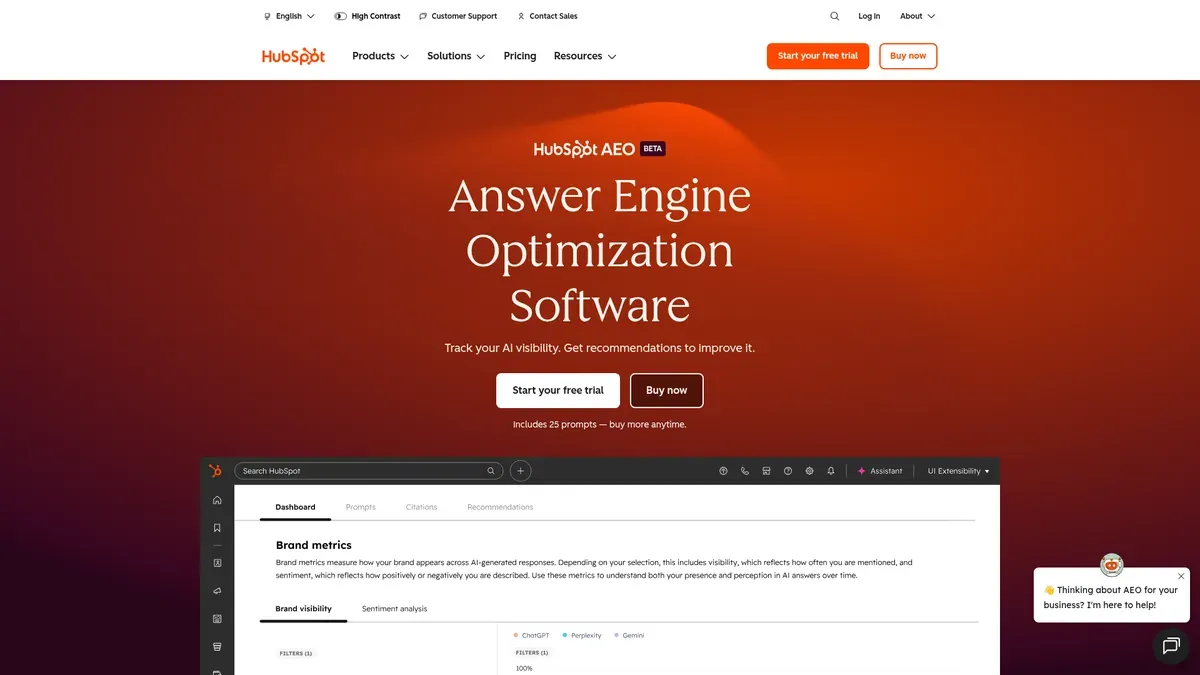
The AEO Grader is a free, one-time snapshot of brand visibility across three answer engines. It is the cleanest way to establish a baseline without committing budget, and it is worth running before any tool evaluation. Its limits follow from being one-shot: no refresh, no trend, no alerting, no citation parsing across engines. The paid HubSpot AEO subscription runs $50 per month, or $45 billed annually, and tracks ChatGPT, Gemini, and Perplexity with a visibility score, prompt tracking, citation analysis, and prioritized recommendations. That is the lowest paid entry point with three engines included, which is a real advantage. The prompt allowance is 25, which sits at or below the fifteen to twenty per topic floor once a second topic enters the portfolio, and the output stops at recommendations. It is included with Marketing Hub Professional and Enterprise and Content Hub Professional and Enterprise, which makes it the obvious choice for teams already working inside HubSpot and a less obvious one for teams that are not.
Semrush AI Visibility Toolkit

Semrush sells AI visibility as an add-on to its existing SEO toolkits, at $99 per month for Starter and $399 per month for Growth, which includes 100 tracked prompts. Coverage spans AI Overviews plus ChatGPT, SearchGPT, Perplexity, and Gemini, and a 14-day free trial is offered. For a team already paying for Semrush, layering AEO onto existing keyword and backlink data is the least disruptive path available. The qualification is that the Starter tier carries 10 base prompts, well under the trendable-signal floor, and the $99 sits on top of an existing subscription rather than replacing one, so the true entry cost is higher than the headline figure for anyone not already on the platform.
Otterly AI

Otterly's Lite tier is the cheapest recurring option in the set at $29 per month, and it covers ChatGPT, Google AI Overviews, Perplexity, and Microsoft Copilot by default with unlimited team members and daily refresh. On engine breadth per dollar at entry, nothing else competes. The constraint is prompt volume: 15 prompts at Lite, which the fifteen to twenty per topic guidance consumes entirely on a single topic. Claude, Google AI Mode, and Gemini are paid add-ons rather than included coverage. Standard runs $189 per month for 100 prompts and adds API access, MCP access, and Agent Analytics; Premium runs $489 per month for 400 prompts. Additional prompts are sold in blocks of 100 at $99 each, which is worth modeling before committing to a tier.
Profound

Profound's Starter tier is $99 per month on annual billing with 50 tracked prompts, and it covers ChatGPT only. Growth is $399 per month annually with three answer engines and 100 prompts. Enterprise is custom priced and tracks up to nine answer engines with multiple companies, a tailored prompt plan, dedicated Slack support, SSO and SAML, and SOC 2 compliance. The differentiator is methodological: a retrieval-based approach to monitoring how engines assemble answers, backed by a corpus of more than 1.5 billion real user conversations used for prompt research. That corpus is a genuine asset for discovering which prompts to track. The trade is that the engine breadth most teams want sits at the $399 tier, and the nine-engine coverage sits behind custom enterprise pricing.
Peec AI

Peec prices in euros: EUR 80 per month for Starter with 50 brand-tracked prompts per day, EUR 205 for Pro with 150 prompts per day and two projects, and EUR 420 for Advanced with 350 prompts per day, five projects, and additional countries. Enterprise is custom with unlimited models. Engines available at launch include ChatGPT, AI Mode, AI Overviews, Microsoft Copilot, Perplexity, and Gemini, with integrations for Looker, API, and MCP. Prompt volume per euro is the strongest in the set, particularly at Advanced. The bounding detail is that the self-serve tiers track three of the six models, so a team wanting full engine coverage moves to enterprise, and the multi-project structure matters mainly to agencies rather than single-brand teams.
Scrunch AI and Goodie AI

Scrunch AI sells self-serve tiers at $300 and $500 per month plus custom enterprise, covering brand mention monitoring across AI search, competitor benchmarking, actionable recommendations, AI crawler analytics, and content delivery direct to AI agents, across ChatGPT, Perplexity, Google AIO, and Copilot. The crawler analytics angle is distinctive and useful for technically mature teams. The entry price is roughly triple the $99 band, and prompt allowances are not published, which makes like-for-like modeling difficult before a sales call. Goodie AI is enterprise-only with no public rate card, spanning prompt research, visibility monitoring, optimization actions, and content production. The breadth is real; the accessibility to a mid-market team on a quarterly budget cycle is not, because every evaluation begins with a quote.
DeepSmith: measurement and production on one data layer

DeepSmith is an AI search analytics and content production platform in one. It tracks mention rate, citation rate, share of voice, sentiment, and visibility trend across ten engines: ChatGPT, Gemini, Perplexity, Claude, Google AI Overviews, Google AI Mode, Grok, Meta AI, Microsoft Copilot, and DeepSeek, with per-prompt history, page-level citation attribution, and a competitor leaderboard. It then produces publish-ready articles from the same stored context, which is the part a spreadsheet structurally cannot do and most tracking tools deliberately leave to a separate workflow. Opportunity Agents work off the same data one step earlier: they read your visibility and Content Map coverage and return content ideas that each carry the specific data point justifying them.

Pricing is $99 per month for Pro, $199 for Grow, and $399 for Scale, or $80, $160, and $299 per month billed annually, plus custom Enterprise. Pro includes 50 tracked prompts, 20 articles per month, and 5 seats; Grow includes 100 prompts, 40 articles, and 7 seats; Scale includes 200 prompts, 90 articles, and 10 seats. A 7-day free trial runs on real data and real drafts, and there are no long-term contracts or cancellation fees.

One limit deserves stating plainly: engine coverage rises by tier rather than arriving all at once. Pro tracks ChatGPT, Grow adds Perplexity, Scale adds Gemini, and Enterprise covers all ten. ChatGPT is the dominant surface for buyer-research queries in most B2B categories, so entry-tier coverage is a scope decision rather than a blind spot.
The comparison that matters is at equal price. At $399, Profound Growth provides three engines and 100 tracked prompts, and Peec Advanced at EUR 420 provides 350 prompts per day across three of six models. DeepSmith Scale at the same $399 provides 200 tracked prompts across three engines plus 90 publish-ready articles per month and 10 seats. A team buying tracking alone will find more prompts per dollar elsewhere. A team that would otherwise pay separately for tracking and for production is comparing one line item against two.
The cost math behind the AEO tool vs manual spreadsheet decision
The stakes have grown enough to make the spend question real. AI Overviews now cut clicks to the top-ranking page by roughly a third. Users who see an AI summary click through to a traditional result in fewer than one in ten cases, which moves a meaningful share of discovery into answers that standard analytics does not report on.
The honest calculation is therefore not automation for its own sake. It is analyst hours against subscription price, with a confidence premium on top.
DIY AEO tracking costs nothing on the invoice and roughly six hours of analyst time per month for a thirty-prompt, three-engine, weekly program, at an hour and a half per cycle. At a fully loaded mid-market marketing salary, that time is worth more than the $29 to $99 entry tiers in this market. The arithmetic tips further once the portfolio reaches fifty to two hundred prompts across two or more engines, where a paid tool typically repays the displaced hours inside a single quarter.
The stronger argument is the one that does not appear on the invoice. A manual number carries no audit trail, no repeat sampling, and no consistent citation attribution, which means it cannot be defended under questioning. A tool buys a number that survives the follow-up question. For programs that report into leadership, that is usually the deciding factor rather than the hours.
Which option fits which situation
- Stay manual when the program tracks under roughly thirty prompts on one or two engines, refreshes weekly, and reports internally as directional insight. A team whose entire program is to track ChatGPT mentions spreadsheet-style once a week sits squarely in this bracket. Budget an hour and a half per cycle, accept that movements under about thirty percent are inside the noise floor, and revisit the decision when a second topic or a second engine is added.
- Start with a free grader when a baseline is needed before any budget conversation. Free AI visibility tracking of the one-shot kind is genuinely useful for establishing where the brand currently stands, and genuinely useless for anything that requires a trend.
- Buy a tracking-only tool when the prompt portfolio has passed fifty, two or more engines matter, share-of-voice math has to hold up in a review, and a separate content team already owns production. HubSpot AEO fits teams already inside HubSpot; Semrush fits teams already paying for Semrush; Otterly fits engine breadth on a small budget; Peec fits high prompt volume; Profound fits prompt discovery depth; Scrunch fits technically mature teams that want crawler analytics.
- Buy a combined platform when the same team reads the report and ships the response. That is where DeepSmith is built to sit: the tracked prompts, the citation gaps, and the articles that close them run off one context layer rather than three tools and a handoff.
- Go enterprise for multi-brand, multi-region, or board-reporting cadence. At that scale the manual option is not a cost decision; it simply cannot keep up.
Start with real data before committing
The most reliable way to resolve this decision is to run both for a cycle. Keep the sheet, run a tool against the same prompt set, and compare the outputs on the questions leadership will actually ask. Start a 7-day DeepSmith trial to see real tracking data and real drafts against the brand's own prompts before any commitment.