You have been fixing your own website. Schema, headings, internal links, the whole checklist. And AI still hands the answer to somebody else.
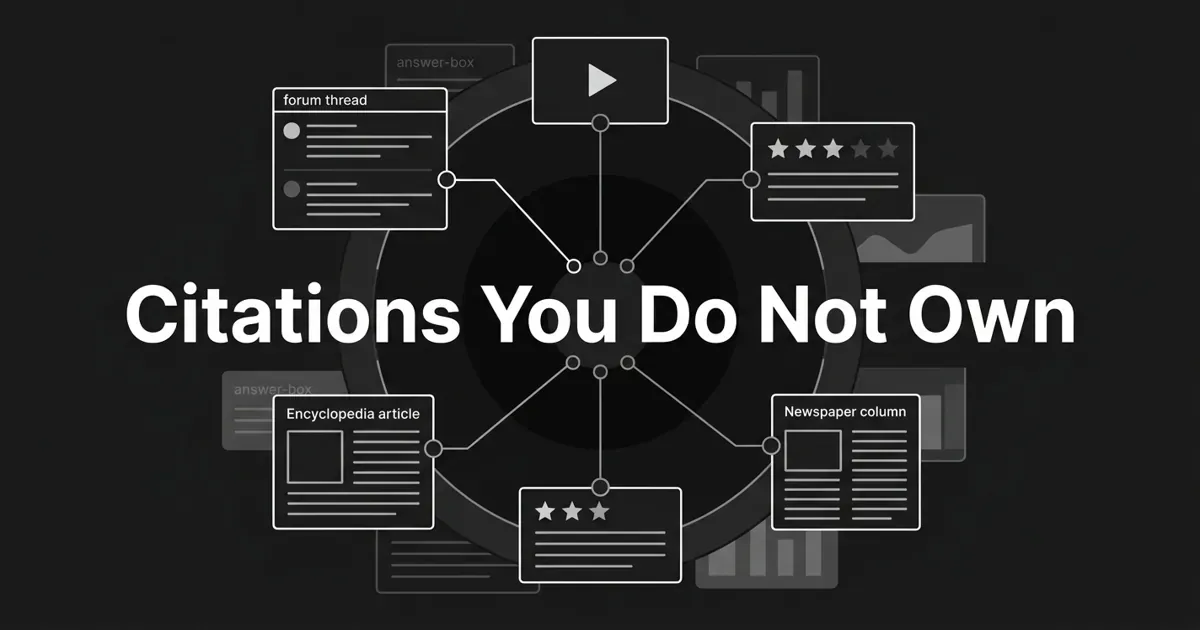
Here is the part nobody warned you about. A study of more than 25 million links across 17 industries found that roughly 84% of AI citations point at third-party sources. Owned brand content picks up about 14%. Six separate studies published over the last year landed in the same band: somewhere between 82% and 95% of what AI cites is earned, not owned.
So third-party AI citations are not a side quest. They are the main board.
That is not a failure on your part. It is a map problem. You have been optimizing the one asset that answer engines are least likely to quote, and nobody handed you the other map.
The stakes moved fast, which is why this caught so many teams mid-stride. Around half of buyers now start product research inside an AI chatbot rather than a search box, and Forrester put AI usage in B2B buying at 94% in 2026. When a model builds the shortlist and you are not in the sources it read, you are not losing a ranking. You are missing the consideration set entirely, before anyone has clicked anything.
Let's fix that. This playbook covers why AI engines prefer sources you do not own, which off-domain channels they trust most, how the mix shifts by engine, and a prioritized plan you can start on this week. Off-domain AI visibility is a program, not a hack, and it is very buildable once you can see the shape of it.
One promise before we start: you do not need to work all eight channels. You need to pick the right two.
Why AI answers cite sources you do not own
Answer engines cite outside sources because they are hedging against being wrong.
When a model builds an answer, it is not looking for the best-written page. It is looking for evidence it can trust enough to repeat. A claim that appears once, on the website of the company that benefits from it, is a weak piece of evidence. The same claim confirmed across several independent publishers is a strong one.
Published models of the citation pipeline describe roughly the same sequence. The engine parses intent, checks what it already knows, fans the prompt out into several searches, pulls URLs and snippets, links the entities it finds to known identifiers, weights the evidence, then writes the answer.
That weighting step is where you win or lose. Five things push a source up the stack:
- Cross-document confirmation. Consistent claims across independent publishers outrank any single source. Five pickups of one fact beat one very good blog post.
- Structured data with persistent identifiers. Pages carrying clean markup and stable IDs get read more reliably, wherever they live.
- Editorial independence. Coverage the brand did not write reads as confirmation. Your own page reads as a claim.
- Recency. Freshness is part of retrieval. Analysis of journalism citations found that most of them come from articles published in the past year.
- Original data. Academic work on generative engine optimization found that adding real statistics to content lifted AI visibility meaningfully. Owning a number and letting others quote it is one of the most durable moves you have.
There is one more pressure you should know about, because it changes how ambitious to be. Citation slots are scarce. Analysis of ChatGPT answers found it averages around four unique citations per turn when it cites at all, and roughly two thirds of cited answers carry between one and four sources.
Four slots. That is the whole shelf.
So this is not a game of being present somewhere on the internet. It is a game of being one of a handful of sources the engine considers safe enough to name. Corroboration is how you get onto a shelf that short.
Notice what is missing from the weighting list? Backlink volume as the deciding factor.
Ahrefs measured the correlation between AI visibility and brand web mentions at 0.664, against 0.218 for backlinks. Mentions of your name, linked or not, track AI visibility about three times more closely than links do. That is the whole reason earned mentions AEO is a different discipline from link building, even though the outreach looks similar from the outside.
Your next action: open ChatGPT and Perplexity, ask five questions your buyers actually ask, and write down every domain that gets cited. Not your rankings. The domains. That list is your real competitive set.
The channels AI trusts most, ranked
If you want to get brand mentioned in AI answers, these are the places worth your time, roughly in order of citation share.
Reddit. The single strongest community source. In one 680 million citation dataset, Reddit held about 47% of Perplexity's top-10 cited sources and around 21% of Google AI Overviews' top slots. When an engine needs social proof, this is where it looks.
YouTube. The most cited domain in Google's AI Overviews, sitting around 23% to 29% of citations depending on the study, and dominant in categories like gaming, ecommerce, health, and SEO. Video transcripts are accidentally perfect AEO format: a clear answer near the top, spoken structure, a stable URL.
Wikipedia. ChatGPT's foundational source. It carries roughly 48% of ChatGPT's top-10 citation slots and around 18% of AI Overview citations. If your category has definitional queries, this one is load-bearing.
Review platforms. G2, Capterra, Gartner Peer Insights, and TrustRadius punch far above their traffic. Three of the top five domains cited in AI Overviews are review platforms. Volume matters here, and so does depth: multi-paragraph reviews give an engine several times more extractable content than a star rating with one line under it.
Press and editorial journalism. Close to half of AI citations come from journalistic sources, and for industry-trend questions that share climbs higher. This is the highest-value channel per placement and the slowest to build.
LinkedIn. Around 13% of Google AI Overviews' top-10 citations, and stronger in B2B and enterprise categories. Named-author posts carry more weight than company-page posts.
Quora and niche forums. Roughly 14% of Google AI Overviews' top-10 citations. In technical categories, the specialist forum often beats the general one.
Publisher and syndication networks. Running one article across a network of independent publications produced a median citation lift above 200% in one 2026 analysis, and the distributed version held its citation authority roughly twice as long as the brand-only version.
A few other places show up in the data, Facebook among them, but they cluster in specific categories like sports and finance rather than carrying most queries. Chasing them early is rarely worth the effort.
If you want a default starting pair for B2B software, take reviews and earned editorial. Reviews are the fastest to move because you already have the customers, and editorial is the highest value per placement. If your category is visual, hands-on, or heavily compared, swap reviews for YouTube. Neither choice is wrong as long as you commit for a quarter.
Feeling the urge to do all eight? Resist it. Two channels worked properly will beat eight channels touched once, and the compounding only starts once something is running consistently.
Your next action: cross-reference the domain list you built in the last section against this ranking. Whichever two channels show up in both places, those are yours.
How the source mix shifts from engine to engine
Off-site AI search optimization is not one strategy. Each engine has a different appetite, and the overlap is smaller than most teams assume. One analysis found only about 11% of sites get cited by both ChatGPT and Perplexity.
ChatGPT leans encyclopedic. Wikipedia dominates its top citation slots, over 80% of its citations go to .com domains, and it favors authoritative editorial coverage with clean structured data. It also cites sources in most responses while naming a brand in only about a fifth of answers, which means the domain it links is often not the brand it mentions.
Google AI Overviews and AI Mode lean social and visual. Reddit, YouTube, Quora, and LinkedIn crowd the top 10. And here is the number that should reset your assumptions: 88% of Google AI Mode citations do not appear in the organic top 10. Your ranking report is a poor proxy for your citation odds.
Perplexity leans community. Reddit is far and away its top source, with YouTube well represented. Its citation behavior looks closest to traditional search, with inline links.
Gemini leans editorial. It carries more news and editorial weight than Perplexity and is less aggressive on Reddit.
Claude is the quietest of the group in public citation datasets, so treat conclusions about it as provisional.
The practical version: do not build a Reddit program if your buyers live in ChatGPT, and do not put everything into press if your category gets answered with video. Match the channel to the engine your buyers actually open.
Your next action: ask your last ten closed-won contacts which AI tool they used while researching. Ten answers is enough to pick a lane.
What surprises most teams about off-domain citations
Four findings tend to change how people plan. None of them are obvious from the SEO playbook.
Domain authority does not predict AI citations. Across an analysis of more than 22,000 domains, only about 7% appeared in both Google AI Overview and LLM citation lists. Authority scores are built on backlink quantity, and that is not what the evidence-weighting step rewards. A small, specific, well-structured source can outrank a big generic one.
Review platforms lost their traffic and kept their influence. Review sites shed roughly 90% of their organic traffic while simultaneously becoming three of the top five cited domains in AI Overviews. If you judged those platforms by referral traffic alone, you would have cut them right before they mattered most.
Press releases alone do not earn citations. Wire volume has grown around five times since mid-2025, and press releases still account for under 1% of total AI citations. What earns the citation is the editorial pickup, the reporter who writes their own piece. Pitch the journalist, not the wire.
Mentions and citations are not the same thing. ChatGPT mentions brands roughly three times more often than it cites them. A mention shapes the buyer's perception inside the answer. A citation sends the click. You need both, and you need to measure them separately, or you will misread your own progress.
Taken together, these four say the same thing in different accents. The signals that made a page rank are not the signals that make it citable, so a strategy inherited from SEO will keep under-investing in third-party AI citations while everyone wonders why the dashboard is flat.
Your next action: pick one belief on this list you were operating against, and say it out loud to your team this week. Getting everyone onto the same map is worth more than any single placement.
Your prioritized off-domain citation plan in eight moves
Here is the order. It is sequenced by citation share, cost to earn, and how well each fits a B2B buying journey. Start at the top, and do not skip to the fun one.
1. Publish original data, then pitch it. This is the engine for everything else. One proprietary number, survey, or benchmark gives journalists a reason to write and gives every other channel something to quote. Distribution across independent publishers is what produced those large citation lifts, and content with fresh statistics measurably outperforms commentary. Start with a question only your data can answer, then pitch reporters on the finding rather than on your company. The wire is not the story. The number is.
2. Build your entity presence on Wikipedia and Wikidata. ChatGPT's most-cited source is not a place you can buy your way into. Do not edit your own page and do not hire someone to do it for you. Build the independent coverage that makes an editor's job easy, and let the citation chain do the work. Wikidata is the quieter half of this move and often the more practical one, because a clean entity record with stable identifiers helps engines resolve who you are even before anyone writes an article about you.
3. Earn a real Reddit presence. Perplexity's top source and Google's number two. This is a long game measured in months, run by two or three employees who genuinely know the subreddit and answer questions without pitching. Bought accounts get discounted in retrieval and are not worth the reputational risk.
4. Build a YouTube library. Video is cited far more than any other format, and the transcript is what gets quoted. Answer one buyer question per video, put the answer in the first thirty seconds, and keep the titles literal. You do not need production value. You need a clear spoken answer that reads well as text, because text is what the engine actually sees.
5. Grow your review footprint, starting with G2. More reviews correlate with more citations, and depth beats brevity. Ask happy customers for a paragraph about a specific problem you solved, not a star rating. Those conversational reviews carry several times more extractable content, which means more surface for a model to quote. This is also the move with the shortest path to results, because the people who would write them are already in your CRM.
6. Syndicate through publisher networks. Once an article is working, getting it onto trusted independent publications multiplies its citation share and stretches its shelf life. This is the cheapest way to turn one asset into many third-party AI citations.
7. Run LinkedIn thought leadership through named humans. In B2B categories this is a genuine citation source, and individual authors outperform brand pages. A steady cadence from two or three executives beats a burst from the company account.
8. Show up in Quora and the forums your category actually uses. Stack Exchange for developer tools, Spiceworks for IT, the specific Slack or Discord where your buyers argue. Niche forums often own the long-tail questions AI gets asked.
One rule cuts across all eight: earn it honestly. Astroturfed Reddit threads, conflict-of-interest Wikipedia edits, and paid reviews all get discounted or removed, and the cleanup costs more than the shortcut saved. An off-site AI search optimization program built on real coverage compounds. One built on manufactured signal decays.
Your next action: pick move one and move three, block two hours this week, and leave the other six alone until those are running.
How to measure your off-domain footprint
You cannot run this program blind, and most teams do.
Every channel above is fire-and-forget without measurement. You will not know whether the Reddit thread, the G2 push, or the press pickup moved anything. And when budget season arrives, "we did some PR" is a much weaker sentence than "our citation rate on our twelve buying prompts went from 8% to 22%."
Three things any measurement setup needs:
- Prompt-level attribution. Not a brand-wide score. You need to know which specific buyer questions cite you and which cite someone else.
- Source visibility. Which domains feed the answers in your category, so you can see whether your off-domain work is showing up in the evidence pool.
- Competitive context. Which pages your competitors are winning citations on, so you can reverse-engineer their footprint instead of guessing at it.
This is exactly the lens DeepSmith's AI Visibility module takes. You define the prompts your buyers ask, and it reports mention rate, citation rate, and share of voice across ChatGPT, Gemini, Perplexity, Claude, and Google AI Mode, with a per-platform breakdown, the sources AI cites most, and a competitor leaderboard showing who wins your prompts and on which exact pages. Because tracking and production sit in the same platform, the gap you find on Tuesday can become the asset you publish on Thursday.
One diagnostic is worth watching above the rest: the ratio between how often you are mentioned and how often you are cited. If the engines name you but link somebody else, your reputation is landing and your evidence is not, which usually points at a structure or corroboration gap. If neither number moves, you are not in the evidence pool at all, and that is an off-domain problem before it is anything else. Two numbers, two very different fixes.
A quick scope note, because this playbook deliberately stays outside your website. Off-domain work does not replace clean pages, clear answers, or proper markup on your own domain. It sits on top of them. The point is that owned content alone caps out at a small slice of the citations available, so the leverage is outside.
On timing, be patient with yourself. Distribution effects tend to surface over a couple of months, and Reddit and Wikipedia presence compound slowly because both depend on community validation rather than a single publish date. Set a 90-day checkpoint, not a 14-day one.
Your next action: write down twelve prompts your buyers ask, run them today, and record who gets cited. That baseline is the most valuable hour in this whole playbook.
Start with one channel this week
Here is the throughline. Most of what AI cites is not yours, and it never will be. Your job is not to own the answer. It is to be present in the evidence the answer is built from.
That reframe is freeing once it lands. You are not fighting for a top spot. You are building corroboration, and corroboration is something a small team can absolutely produce.
So take a breath and make it small. Baseline twelve prompts. Note the domains AI already trusts in your category. Pick the two channels where those two lists overlap. Give it a quarter.
You have probably already done more of this than you think. That customer who wrote you a glowing paragraph, the conference talk on YouTube, the founder post that got shared around: those are earned mentions AEO assets sitting unclaimed. Go find them and build from there.
When you want the tracking and the production in one place, start a free DeepSmith trial and see your real citation picture before you pay for anything.