Someone in leadership just asked what your AI search strategy is. You froze, because there isn't one. No tracking, no prompt list, no content built for AI answers. If that is you, take a breath. You are not behind in the way you think you are.
Here is the good news. Only 16% of brands systematically track their AI search performance today. So learning how to build an AEO strategy from scratch does not put you at the back of the line. It puts you ahead of the 84% who have not started. The window is open, and you have time to walk through it.
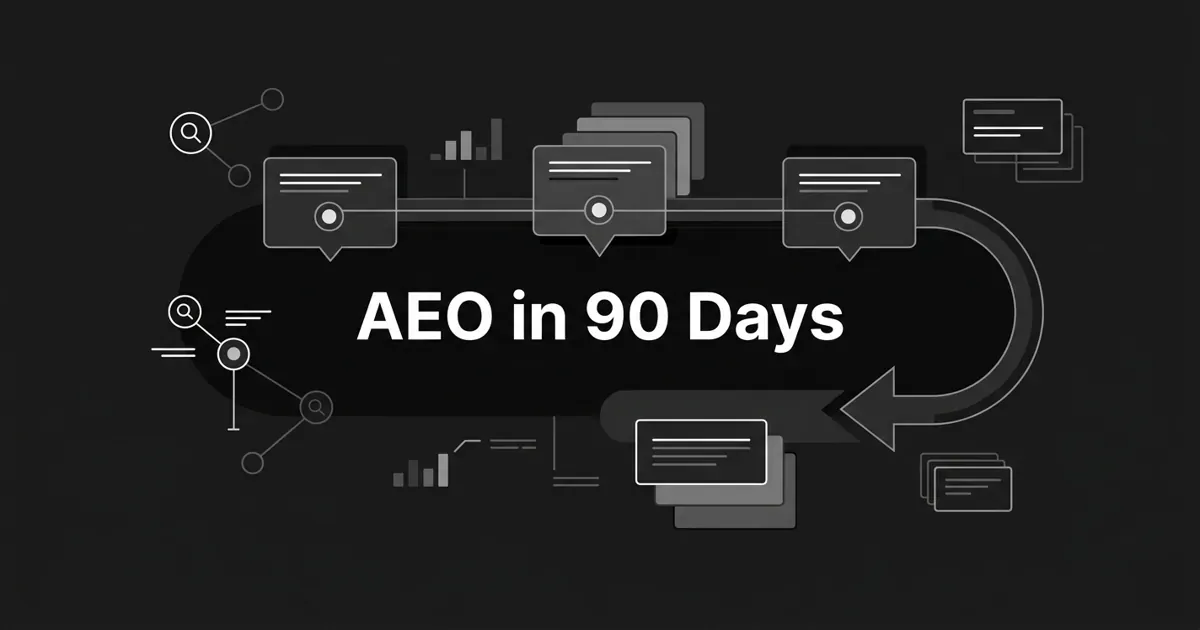
This guide gives you an AEO strategy from scratch as a phased plan you can actually run: a first 90 days AEO framework split into three 30-day chapters. First you measure where you stand. Then you produce the content that closes your gaps. Then you check what moved and build the rhythm that keeps it going. That is the whole shape. Let's walk it together.
The one loop your whole plan runs on
Before the steps, hold onto one idea. Every good answer engine optimization plan runs on a single loop, repeated over and over: track, then write.
You track where AI engines mention you, cite you, and leave you out. You pick the highest-value gap. You write the piece that fills it. You re-test to see if it worked. Then you re-rank and go again. Track, decide, produce, measure, refresh.
Answer Engine Optimization is the practice of structuring content so AI tools like ChatGPT, Perplexity, Gemini, and Google AI Overviews can understand, trust, and cite it as a direct answer. The win is not a ranking on a results page. The win is being the source the AI quotes. That shift changes what you measure, and it changes what you write. Keep the loop in mind and every step below will click into place.
Your first 90 days AEO plan is just that loop, run three times, getting sharper each pass.
Phase 1, Days 1 to 30: See where you actually stand
Getting started with AEO does not mean producing anything in the first month. It is about getting an honest picture. You cannot close a gap you have not measured, so let's measure first.
Step 1: Decide what winning looks like
Before you touch a single prompt, name your scoreboard. In AI search you track three numbers, not rankings.
- Mention rate: how often an engine names your brand.
- Citation rate: how often an engine links to one of your pages as a source.
- Share of voice: your slice of the citations in your category, measured against the competitors you care about.
Set these as your north star now, and take a snapshot before you change anything. That snapshot is your Day 1 baseline, and everything you do later gets measured against it.
Here are the benchmarks to anchor "good." Under 15% share of voice means a real gap, so you focus on fundamentals. Between 25 and 40% is competitive. Above 40% makes you a category leader. Anything above 60% is rare, because AI engines deliberately spread their citations around.
How to tell it is done: you can write down, in one sentence, what number you are trying to move and why it matters to the business.
Where people go wrong: measuring AEO like SEO. If you are still watching rankings and clicks, you are watching the wrong screen. The AEO scoreboard is mention, citation, and share of voice.
Step 2: Build your starter prompt list
Your prompts are the questions your buyers actually type into AI tools. This list is the spine of everything that follows, so build it with care, not from your own head.
Aim for 50 to 100 prompts. Pull them from three places, not one:
- Your Google Search Console. Look at long-tail queries and rewrite each one as a real question a buyer would ask.
- ChatGPT and Perplexity themselves. Seed one prompt, then harvest the follow-up questions each engine suggests, and repeat.
- Reddit and community threads. Question-style posts with real engagement are buyer questions in the wild. Rewrite them as prompts.
Sort every prompt into a category (informational, comparison, task-based, evaluative, or ideation) and tag it as branded or unbranded. Aim for mostly unbranded, roughly 70 to 80% of the list. That is where buyers start, long before they know your name.
How to tell it is done: you have a spreadsheet of 50 to 100 prompts, each tagged by category, branded or unbranded, and buyer stage.
Where people go wrong: tracking only branded prompts. You own 100% of nothing if the only questions you watch are the ones with your name in them. Start where your buyers actually start.
Step 3: Audit your presence and set your baseline
Now you find out the truth. For each prompt on your list, run it in ChatGPT, Perplexity, and Gemini, and write down what you see. Are you mentioned? Is your URL cited? Which competitors show up instead of you? Is the description of your brand even accurate?
Run the test clean. Use a logged-out browser in incognito mode, and check with web search both on and off. Logged-in tools personalize the answer and quietly ruin your data.
While you are at it, run a quick entity audit. Check how your brand is described on G2, Capterra, LinkedIn, Crunchbase, and Wikipedia. Inconsistent taglines and outdated details out there confuse the engines here.
Then turn your notes into numbers. Compute your mention rate, citation rate, and share of voice per engine, and date it Day 1. This is the moment a manual approach starts to strain, and it is where a tracking tool earns its keep. A platform like DeepSmith runs your prompt set on a schedule across ChatGPT, Perplexity, Gemini, Claude, and Google AI Mode, then reports mention rate, citation rate, and share of voice with a competitor leaderboard, so you are reading a dashboard instead of rebuilding a spreadsheet every week.
How to tell it is done: you have a baseline snapshot with the four numbers per engine, plus a one-page summary of what is accurate and what is not.
Where people go wrong: running the test once and calling it truth. A single prompt result is noise. Track a rolling average across a set of prompts, and remember that AI engines cite only three to eight sources per query. That handful of slots is the entire battlefield.
Step 4: Pick the 5 to 15 prompts to close first
You cannot fix everything in month one, and trying to is how good plans stall. So choose. From your gap list, pick the 5 to 15 prompts that sit at the intersection of high gap, real commercial value, and quick to close.
For each chosen prompt, decide the play:
- Update an existing page, if you already have one that nearly fits. This is the fastest path to a citation.
- Write a new article, if nothing you own answers the question.
- Go off-site, if the answer really belongs on a third-party review site or community thread.
Map each prompt to its target: the prompt, its category, the URL that should win it, a priority score, and an owner. That map is your production plan for Phase 2. If you want to move faster here, tools that watch competitor pages and your own sitemap can show you which questions rivals are already winning and where you have coverage to build on.
How to tell it is done: you have a prompt-to-content map with an owner on every row.
Where people go wrong: chasing prompts you cannot credibly win. If you sell a CRM, "best laptops" is not your fight. Pick questions where your product and your expertise give you a real shot.
Phase 2, Days 31 to 60: Produce the content that closes the gaps
Month two is where you build. Not just articles, but the repeatable system that produces them. Set the machine up once, and every future piece gets easier.
Step 5: Produce citation-ready content at each gap
This is the heart of the whole plan, so slow down and get the structure right. Writing for AI citation is not writing more, it is writing so a machine can lift a clean answer out of your page.
For each priority prompt, build one piece around these rules:
- Lead every section with a direct answer of 40 to 60 words, then add the proof, then the detail.
- Shape your headings as the questions your buyers ask, not clever labels.
- Keep paragraphs to two to four sentences. Use lists for steps and options, and tables for anything head-to-head.
- Add an FAQ block, with each question phrased the way a buyer would actually type it.
- Match schema markup to what is visible on the page, and never mark up content a reader cannot see.
- Include one original data point or a comparison table per commercial piece.
That last rule is worth more than three paragraphs of writing advice. Tables get cited roughly 2.5 times more often than plain prose, and original statistics correlate with 30 to 40% higher citation rates. Structure and evidence are your levers.
Before you write anything, load your brand context once: your positioning, your voice, your persona, your content types. This is the step where a production engine earns its place. DeepSmith runs on stored brand context through its Deep IQ layer, so every draft comes out on-brand and citation-structured by default, with internal links and a cover image built in rather than bolted on after. That is what keeps generic, me-too content out of your pipeline, the kind any competitor could have written and no engine bothers to cite.
How to tell it is done: the article is published, the schema validates, internal links resolve, and the page shows up correctly classified in your sitemap.
Where people go wrong: burying the answer under a warm-up paragraph. The engine wants the answer first. Give it the answer first, and save the throat-clearing for never.
Step 6: Repurpose every article the day it ships
Distribution is the step that quietly falls off every content plan. You publish, you mean to post it around, and then the next deadline swallows the week. Let's not let that happen this time.
Make distribution part of publishing, not a separate project. On the day a piece goes live, turn it into the channel-native versions your audience actually reads: a LinkedIn post, an X thread, a newsletter section, and at least one more. Each one adapted in tone and length, not a copy-paste of the article body.
This is a place where the right tool removes the friction entirely. Some platforms, DeepSmith among them, generate those channel formats from the finished article in the same brand voice, so distribution becomes one more click instead of one more afternoon.
How to tell it is done: every published article has one scheduled post per channel, queued within a few days of publishing.
Where people go wrong: treating distribution as "later." Later never comes. Build it into the publish step and it becomes a habit instead of a hope.
Phase 3, Days 61 to 90: Measure, learn, and build the rhythm
Month three is where your plan becomes a system. You get your first real numbers, you learn what worked, and you set the cadence that carries you past Day 90.
Step 7: Re-test on Day 70 and read the results
Around Day 70, run your original Day 1 prompt set again, across the same engines. Now you can compare. For each priority prompt, look at the change: are you mentioned now, is your URL cited, did any competitor's share slip?
Then do the most important part. Map the citations back to specific pages. You will likely find that two or three articles are earning most of the new citations while others have not moved yet. That is normal, and it is exactly the signal you need. It tells you what to make more of.
This is where your tracking tool pays you back. DeepSmith attributes citations to individual pages and shows which prompts each one is winning, so you can separate the drivers from the pieces that need another pass.
How to tell it is done: you have a side-by-side view of Day 1 versus Day 70, per engine, plus page-level attribution showing which articles earned citations.
Where people go wrong: expecting everything to win, and giving up when it does not. AEO moves on a 90 to 180 day timeline, not a 30-day one. Day 70 is your first read, not your verdict. Typically a fraction of new articles drive most of the early citations, so read the pattern and keep going.
Step 8: Refresh the prompt set and ship the next batch
Around Day 80, you close the loop and open the next one. Look at your Day 70 winners and add a few adjacent prompts to chase. Retire the under-performers that are not commercially important. Re-rank what is left, and schedule your next batch of pieces against the refreshed list.
Then set your ongoing cadence, because this is what turns 90 days of effort into a lasting engine:
- Weekly, 30 minutes: a quick dashboard health check to catch any sharp drops.
- Monthly, a couple of hours: refresh the prompt list, add winners, retire losers, re-rank.
- Quarterly: review competitor moves, refresh your third-party profiles, and re-test the full set.
How to tell it is done: you have an updated prompt set, a refreshed priority list, and the next batch scheduled with a repeating calendar reminder for your weekly check.
Where people go wrong: tracking the same frozen prompt list forever. AI search shifts week to week. A living list is what keeps your plan pointed at what buyers ask now, not what they asked in month one.
What to do next
You do not need a perfect answer engine optimization plan to start. You need the first loop. Spend your next 90 days building the muscle: measure, produce, and measure again. Then spend the next twelve months compounding the citation history you started here. That is how a standing start becomes a lead nobody catches.
If you would rather run this loop in one place instead of stitching together a spreadsheet, a tracker, and five writing tools, that is exactly what DeepSmith is built for: one platform for AI search analytics and content production, tracking where you show up and producing the on-brand content to close the gaps. You can start a free trial and set up your baseline before you pay.
Getting started with AEO was never about having all the answers on Day 1. It was about running the loop once, then again. You can do this.