Someone on your team said "we should be doing LLM seeding," and now you're wondering two things. What is it, actually? And is it the kind of thing you'd be comfortable explaining to a customer?
Good instincts. Both questions matter.
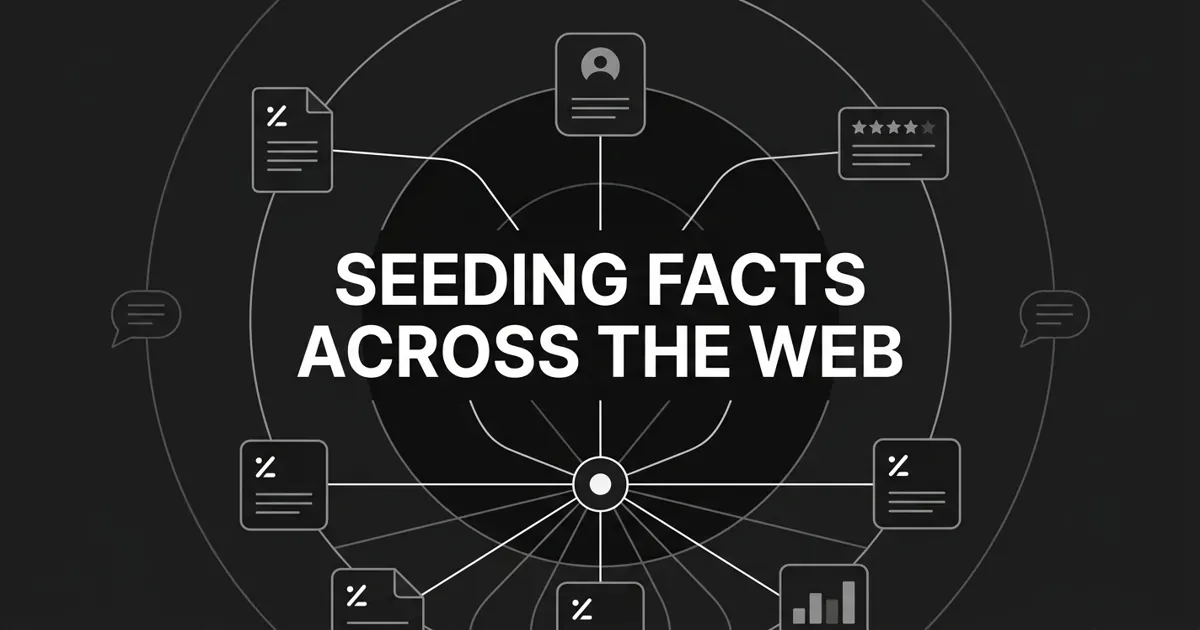
Here's the short version. LLM seeding is the deliberate work of putting consistent, accurate, sourceable information about your company across the web, so that AI models keep running into the same facts from enough credible places to repeat them confidently. That's it. No hidden text, no tricks, no clever prompt in a footer.
The confusing part is that a lot of advice out there blurs the honest version with the manipulative one. You can influence what AI says about brand and product questions. The method just has to be one you'd put your name on.
So this piece draws the line clearly. You'll get a definition you can hand to your CEO, a picture of how AI engines actually pick up brand information, the mechanics that work, the tactics that quietly damage you, and a way to tell whether any of it is landing.
Take a breath. This is more learnable than it sounds.
What Is LLM Seeding, Exactly?
LLM seeding is distributing consistent brand facts across the web so language models learn them and repeat them in generated answers.
Read that again and notice what it does not say. It says nothing about ranking. It says nothing about a submit button. You are not uploading anything to OpenAI or Google. You are changing what the open web says about you, on the assumption that models and their retrieval systems read the open web.
That assumption is correct, and it's the whole mechanism.
The word "seeding" also gets used two other ways in AI, and neither one is this. A random number seed is the starting value that initializes a model's randomness. A reproducibility seed is a control value that makes outputs deterministic. Both live in engineering docs. Neither has anything to do with your brand. If you search the term and land in a Stable Diffusion help article, you're in the wrong room.
So what is LLM seeding in practice? It's entity work. You're trying to shape what an AI system understands your company to be, not which page of yours sits at position three.
One thing to be honest about: there is no industry consensus definition of the term. Different vendors use it differently. Pick one meaning, hold it, and make sure your team is using the same one. That alone will save you a few circular meetings.
Your next step: write your own one-sentence definition and put it at the top of whatever doc your team is working from.
Where Seeding Sits Next to AEO, GEO, and LLMO
Three acronyms, one hierarchy, and it's simpler than the alphabet soup suggests.
AEO is what you want. Answer Engine Optimization is the outcome-level category: showing up inside AI-generated answers, whether that's Google AI Overviews, AI Mode, Perplexity, ChatGPT in browse mode, Gemini, or Claude with tools.
GEO is how you write. Generative Engine Optimization came out of a 2024 controlled study by researchers at Princeton and Georgia Tech, who tested specific content changes (adding citations, statistics, quotations, authoritative sourcing) and measured visibility gains in generative answers. Some setups moved the needle by tens of percent under experimental conditions. GEO is what you do inside one piece of content to make it easy to quote.
LLMO is a near-synonym for GEO, more common in European marketing writing.
LLM seeding is the upstream layer. It's what puts the right facts onto the right surfaces in the first place, so the GEO-shaped content you write has something accurate to point back to.
One sentence to remember all of it: AEO is what you want, GEO is how you write, seeding is what you put into the world.
Why does the distinction matter? Because teams skip straight to GEO tactics, rewrite twelve blog posts with better formatting, and get confused when AI answers still describe them wrong. The formatting was never the problem. The underlying facts scattered across the web were.
Your next step: decide which of the three you're actually short on. Most teams have some GEO instinct and almost no seeding discipline.
How AI Engines Actually Pick Up Brand Information
There are exactly two doors, and every plan to get brand into LLM knowledge runs through one of them.
The training door. Frontier models learn from periodic snapshots of the web: news, encyclopedias, indexed pages, books, curated corpora. If something is published widely enough, often enough, across credible enough domains, it eventually lands in a snapshot. Models internalize patterns more than they memorize copies. This door is broad but slow. Refresh cycles run on the order of months, the schedules aren't public, and there is no submit-URL path. Nobody can inject your brand into a training corpus. You can only raise the odds of inclusion.
The retrieval door. ChatGPT in search and browse modes, Perplexity, Gemini with grounding, Claude with tools, and Google AI Mode all pull from the live web at query time. A retrieval pipeline typically gathers somewhere between five and ten candidate pages, ranks them on relevance, recency, and entity clarity, then surfaces three or four as citations. This door moves in weeks, not quarters.
Most real answers blend both. Stable, established topics lean on what the model already knows. Current, niche, or commercial questions lean on retrieval. You don't get to choose which door opens. The question class chooses.
Here's the part that should shape your priorities: citations concentrate. A small set of authoritative surfaces accounts for a disproportionate share of what gets cited, and they show up again and again across vendor studies:
- News and trade publications
- Reference sources like Wikipedia, Wikidata, and official documentation
- Your own site, especially product, pricing, and about pages
- Review platforms
- Q&A and community sites with editorial weight
- Analyst and report-style content
- Structured social profiles
The pattern is consistent. The exact percentages are not, so treat any single vendor number as a hint rather than a target.
One more useful reality check: overlap between engines is low. One widely shared analysis found only about a tenth of cited domains were cited by both ChatGPT and Perplexity. Being visible in one engine tells you very little about the others.
Your next step: list the surfaces above and mark which ones currently carry accurate, current information about you. That list is your seeding backlog.
The Line Between Legitimate Seeding and Gaming the Models
Here's the litmus test, and it's genuinely simple.
If a tactic would embarrass you when a customer discovered it, it's manipulation. If a journalist could describe it approvingly in a business article, it's seeding.
That's the whole test. You can run it in about four seconds on any tactic a vendor pitches you.
Legitimate seeding treats the web as upstream of the model. It accepts that retrieval systems and training pipelines will read what's published, and it works to make that information correct, consistent, attributable, and easy to surface. Nothing is hidden from human readers. Nothing fakes authority it hasn't earned.
Manipulation treats AI engines as a target to be tricked. It tries to force a preferred answer through techniques the platforms already detect and discount: cloaking, hidden content, prompt injection, fake reviews, coordinated inauthentic posting, schema spam.
When you seed information for AI models the honest way, you're not talking to a model. You're talking to the web, and the model is downstream. That framing keeps you out of trouble almost automatically.
If your radar is already twitching at some of the tactics you've read about, trust it. It's calibrated correctly.
Your next step: run the litmus test on the last three AI-visibility tactics anyone recommended to you. Drop any that fail.
What Legitimate Seeding Looks Like in Practice
Six mechanics do most of the work when you seed information for AI models. None of them require a growth hack.
Brand consistency is the baseline. Company name, legal entity, address, product names, leadership names, founding date, and product claims should be identical everywhere they appear: your site, third-party listings, press materials, reference sources, review platforms. When surfaces disagree, models learn uncertainty. Uncertainty shows up as answers that hedge, misspell your product, or quietly leave you out.
Structured data is the accelerant. Organization schema with founders, headquarters, and founding date. Links out to your canonical profiles. Product schema with real pricing and offers. FAQ schema with tight question-and-answer pairs. This has been good search practice for years, and the same legibility now helps AI retrieval.
Authoritative third-party presence still matters. Independent, editorially controlled coverage in publications retrieval systems visibly weight. Worth knowing: press release wires are largely invisible to AI search unless the content is formatted for it, according to PR Newswire's own guidance. PR matters here because generative answers lean on news and analyst content, not because engines are a new audience for wire distribution.
Depth on your own property. Pages that explain plainly what you do, who you serve, and what makes you different. Straightforward "what is X" and "how X works" pages often become the cited source for category-defining questions. This is the cheapest lever you own.
Entity anchoring. Same name, same description, same category across every reference database, directory, and official profile you appear in. No single platform carries the weight. Consistency across all of them does.
Attributable claims. Anything quantitative you want repeated ("founded in 2014," "used by 12,000 teams") needs a primary source a model can verify. Unattributed claims increasingly get stripped during synthesis.
Two mental models tie these together.
The source-of-truth model: your own property is canonical, and every other surface should point back to it and agree with it. Drift is noise, and models smooth over noise by favoring whatever is most consistent.
The entity integrity model: treat your brand the way an encyclopedia treats a notable subject. Thirty consistent sources produce confident, fluent answers. Thirty slightly disagreeing sources produce hedged, generic ones.
Neither is proprietary. Practitioners converge on them because they reflect what retrieval systems reward.
Your next step: build one canonical fact sheet this week. Name, founding date, headquarters, product names, pricing, leadership, one-line description. Everything else gets audited against it later.
The Tactics That Backfire, and Why the Damage Spreads
Every one of these is detectable, increasingly detected automatically, and punished system-wide rather than just in the AI channel.
Cloaking and hidden text. Showing crawlers one page and humans another. Google prohibits it explicitly in its spam policies, and enforcement doesn't stay confined to one surface.
Prompt injection in public content. Burying instructions in your pages that try to steer how an AI summarizes them. It's fragile, the labs actively mitigate it, and getting caught costs you trust signals everywhere at once.
Fake reviews. Sockpuppet accounts on review platforms. This violates platform terms and endorsement rules, and those same ratings feed the AI summaries buyers read.
Structured data spam. Marking up entities that are irrelevant or misleading. The signals that trigger a manual action in search also drop you out of retrieval rankings.
Coordinated inauthentic amplification. Manufactured threads, paid comment brigades, sockpuppet communities. Genuine community discussion carries real weight in AI answers. The manufactured version damages you across every channel it touches.
Mass AI content farms. Hundreds of thin pages published purely to be cited. Helpful-content signals have pushed hard against this in both classical search and retrieval weighting.
Citation laundering. Getting mentioned in a synthetic "study" on a domain built to look credible. Downstream verification keeps improving, and the shelf life of these tactics keeps shrinking.
Why does this matter more for you than for a household name? Because the risk is asymmetric. A large brand caught cloaking might absorb it. A small brand caught cloaking is likely finished in that channel. Staying legitimate isn't only the ethical call. For most teams it's the practical one.
And the penalty is never contained. A cloaking detection or a fake-review takedown downgrades you in classical search, in AI retrieval, and in downstream trust signals at the same moment. The AI channel cannot be gamed in isolation, because it isn't a separate system. It's reading the same web.
Your next step: ask whoever runs your site whether anything on it is served differently to bots than to people. Ask plainly. It's a five-minute conversation that occasionally surfaces something inherited.
How You'd Know Seeding Is Working
You measure three things, by prompt, across the engines your buyers actually use.
Mention rate. How often an answer names you at all, linked or not.
Citation rate. How often your pages get linked as the source behind an answer.
Share of voice. How much of the answer space you hold relative to named competitors.
Screenshots are not measurement. One person typing a question into ChatGPT on a Tuesday tells you nothing repeatable, because answers vary by session, by phrasing, and by engine. What you need is a fixed set of prompts, checked on a schedule, with history.
Start with the questions your buyers genuinely ask. Category questions ("best tool for X"), comparison questions ("X vs Y"), and problem questions ("how do I fix Z"). Twenty to fifty prompts is plenty to begin. You can always expand once you see which ones move.
This is the part most teams skip, and it's why seeding programs stall. Without a baseline, you can't tell whether last quarter's work did anything, so the work quietly loses its budget.
Tracking is the measurement half of this, and it's what DeepSmith's AI visibility module is built for: you define the prompts, it checks them on a schedule across ChatGPT, Gemini, Perplexity, Claude, and Google AI Mode, and reports mention rate, citation rate, share of voice, and trend, plus which of your pages are earning citations and which sources are winning them instead. As Aditya G, Marketing Director at Bindbee, put it: "We are able to track prompts for which we rank in AI answers, generating meetings."
Set expectations honestly while you're at it. Retrieval-path effects can show up within weeks as crawlers reindex and rankings shift. Training-path effects are cumulative and tied to the next model snapshot, which runs on a cadence nobody outside the labs can see. Don't promise leadership a date.
Your next step: write down ten prompts your buyers would actually type, and record what each engine says today. That's your baseline, and it takes under an hour.
Start With One Surface
You don't need a seeding program. You need one accurate fact sheet and one surface fixed this week.
That's genuinely how this compounds. The work isn't glamorous: same description everywhere, real sources behind your numbers, clear pages explaining what you do, honest coverage you earned. Do that consistently and you influence what AI says about brand and product questions in the only durable way available. Try to shortcut it and you inherit a problem that spreads well past the AI channel.
Most teams are closer than they think. You almost certainly have the facts. What you're missing is the consistency, and consistency is fixable.
If you want the measurement half handled while you do the seeding work, you can start a free DeepSmith trial and see what the engines currently say about you before you change a thing.