
Summary
Loomly drives 40,432 monthly organic visits from the smallest content library in the social media management cohort: 482 indexable pages, single English locale, four topic clusters. The library is editorial-led (69.7% Blog / Editorial) and structurally distinctive in two ways. A 60-URL stream of release posts publishes directly into the main blog feed alongside editorial tactics, and a 62-URL Marketing Glossary is built from per-term definitional pages embedded in the same /blog path. Per-URL traffic efficiency runs high at ~84 visits per page, but top-10 ranking share sits at 12.66%, meaningfully lower than category leader Buffer (23.45%).
Key facts:
- Library size: 482 indexable pages organized into 4 topic clusters; 69.7% Blog / Editorial
- Largest cluster: Brand, Marketing Editorial & Glossary (142 URLs, 29.5% of library)
- Flagship content asset: Marketing Glossary, 62 per-term definition pages spanning platforms, advertising, engagement metrics, brand strategy, and marketing roles
- Search performance: 40K monthly visits across 7,925 ranking positions; 12.66% in top 10 (~84 visits per page, high per-URL efficiency)
- Notable gap: Zero Research / Reports URLs and only 4 Comparison Pages. No first-party research franchise, and a thin BOFU competitor-comparison surface.
Company Overview
Loomly at a Glance
| Company | Loomly, Inc. |
| Founded | 2015 · Los Angeles, CA |
| Category | Social Media Management |
| What They Do | Loomly is a social media management platform that helps marketing teams, agencies, brands, and creators craft and schedule posts, manage approvals, track analytics, and run a unified social inbox across major social channels. The primary audience is small-to-midsize marketing teams and agencies that need an intuitive content calendar with collaboration and approval workflows. Named customers include Porsche, BMW, L'Oréal, LVMH, Kering, and Puma. |
| Funding | $2.6M raised across multiple rounds; last priced round a $915K Seed (Jun 2019, Kima Ventures, Urania Ventures, Makers Camp). Acquired by ASG / Traject in Aug 2021; acquired by Bending Spoons in Jan 2025 and now part of the Bending Spoons portfolio. |
| Headcount | 11-25 (LinkedIn band) |
| Monthly Organic Visits | Traffic Value (PPC equiv.) | Ranking Positions |
|---|---|---|
| 40.4K | $177.8K | 7.9K |
Ranking positions reflect total positions across 111 indexed (location, language) combinations, not unique keywords.
Loomly's content operation is the smallest in the social media management cohort: 482 indexable pages in a single English locale, against peers running anywhere from 600 (Planable) to 7,000+ (Brandwatch) URLs. The library is editorially led (69.7% Blog / Editorial) and built around two structurally unusual choices. A continuous stream of product-launch posts publishes directly into the main blog feed instead of a separate changelog, and a 62-URL Marketing Glossary sits embedded inside the same blog footprint. The lean team behind the operation (11-25 employees) shapes the architecture. Every page has to work harder, and the cluster shape favors breadth over concentrated flagship assets.
Content Architecture
What Does Loomly's Content Engine Look Like?
Loomly's main website hosts 482 indexable pages organized into 4 topic clusters. The architecture is editorially led with a tightly grouped definitional layer and an above-average share of product-update content. It reads as a long-running editorial publication for social media practitioners, with the product story interleaved through the main blog.
Content Type Distribution
| Content Type | Count | Share | Notes |
|---|---|---|---|
| Blog / Editorial | 336 | 69.7% | Dominant type; covers platform tactics, strategy, brand, careers, product updates |
| Glossary / Definitions | 62 | 12.9% | Per-term "What is X" pages; high share for a 482-page library |
| Product & Feature Pages | 32 | 6.6% | Features, integrations, audience verticals, AI capabilities |
| Guides & Resources | 16 | 3.3% | Downloadable templates, guides, tutorial index |
| Case Studies / Customer Stories | 12 | 2.5% | Loomly Success Stories; small, consistent series |
| Other | 9 | 1.9% | About, careers, contact, legal, DPA, security |
| Podcast / Audio Series | 6 | 1.2% | Season 1 brand-themed interview series; never extended |
| Comparison Pages | 4 | 0.8% | One canonical comparison each: Buffer, Hootsuite, Sprout Social, Later |
| Free Tools | 3 | 0.6% | URL shortener, best-time-to-post, link-in-bio |
| Events / Webinars / Sessions | 2 | 0.4% | Webinars hub plus one replay |
| Documentation | 0 | 0.0% | Not present in www sitemap |
| Research / Reports | 0 | 0.0% | No first-party research franchise |
Key finding: Blog / Editorial accounts for nearly 70% of every page Loomly publishes. The more distinctive number is 12.9% Glossary / Definitions, an unusually high definitional share. Combined with zero Research / Reports and only 4 Comparison Pages, the architecture is a publication-plus-glossary play, with the conversion-stage and authority-asset layers left thin.
Content Strategy Archetype
Loomly operates an editorial-led, breadth-play publication model. The dominant asset is a long-running blog covering platform-by-platform tactics, social media strategy and operations, brand-building, and product launches, supplemented by a 62-URL Marketing Glossary and a small Loomly Success Stories series. The four clusters land between 111 and 142 URLs each; investment is spread across the publication rather than concentrated in two or three flagships. For a company with 11-25 employees serving the social media management category, the architecture reads as a deliberate breadth bet: cover every platform and every adjacent marketing discipline, rather than dominate a narrower territory.
Search Performance Quality
Where Loomly Ranks
The DataForSEO domain rank overview shows Loomly ranking in 7,925 positions across 111 indexed (location, language) combinations. The position distribution is bottom-heavy. Most rankings sit on page 2 or later, with the optimization sweet spot of positions 11-20 carrying nearly 20% of the total.
| Position | Count | Share |
|---|---|---|
| #1 | 68 | 0.9% |
| #2–3 | 92 | 1.2% |
| #4–10 | 843 | 10.6% |
| #11–20 | 1,572 | 19.8% |
| #21–50 | 3,430 | 43.3% |
| #51–100 | 1,920 | 24.2% |
12.66% of Loomly's ranking positions are in the top 10, meaningfully lower than category leader Buffer at 23.45% and below the cohort average across larger peers like Sprout Social (23.36%), Agorapulse (21.77%), and Later (21.79%). The most actionable layer is positions 11-20 (1,572 positions, 19.8%): content already on page 2 of Google that could be pushed onto page 1 with focused on-page work. Per-URL traffic efficiency runs in the opposite direction. At ~84 visits per page, Loomly's library works harder per URL than Agorapulse (43) or Brandwatch (76). The story isn't that Loomly's content underperforms. The smaller library has fewer ranking surfaces overall, and the top-of-page wins are distributed across a narrow set of high-performing pages.
Content Deep Dive
What Is Loomly Actually Publishing, and How?
Loomly's content organizes around four primary topic clusters. Each cluster is described below with content-type composition, the micro-topics inside it, and concrete example URLs. Counts are exact per-URL classifications of the full 482-page sitemap.
1. Channel Coverage
Pages: 112 · Share of library: 23.2%
Editorial guides, platform-specific tactics, scheduling launches, and integration pages organized around the individual social channels Loomly publishes to. The cluster combines the long-running editorial blog on platform-by-platform tactics with the per-channel launch posts and integration landing pages that signal product coverage of the same networks. It is the operational backbone of the blog: every major social channel a Loomly customer publishes to has both editorial and product content under this cluster.
Content-type mix: Blog / Editorial 92% · Product & Feature Pages 8%
Micro-topics within this cluster
Instagram & Visual Platforms (~28 Pages)
The largest single-channel sub-theme covers Instagram (the dominant share), Pinterest, and emerging visual or niche platforms. Instagram coverage spans Reels, Stories, algorithm explainers, bio guides, carousels, profile cards, ads, aesthetics, and collab posts. The mix of definitive-guide pillars and tactical micro-posts ("how to hide likes on Instagram in 4 clicks") covers both head-term and long-tail search intent, and the Pinterest and emerging-platform pieces round out the visual-first surface.
Sample pages:
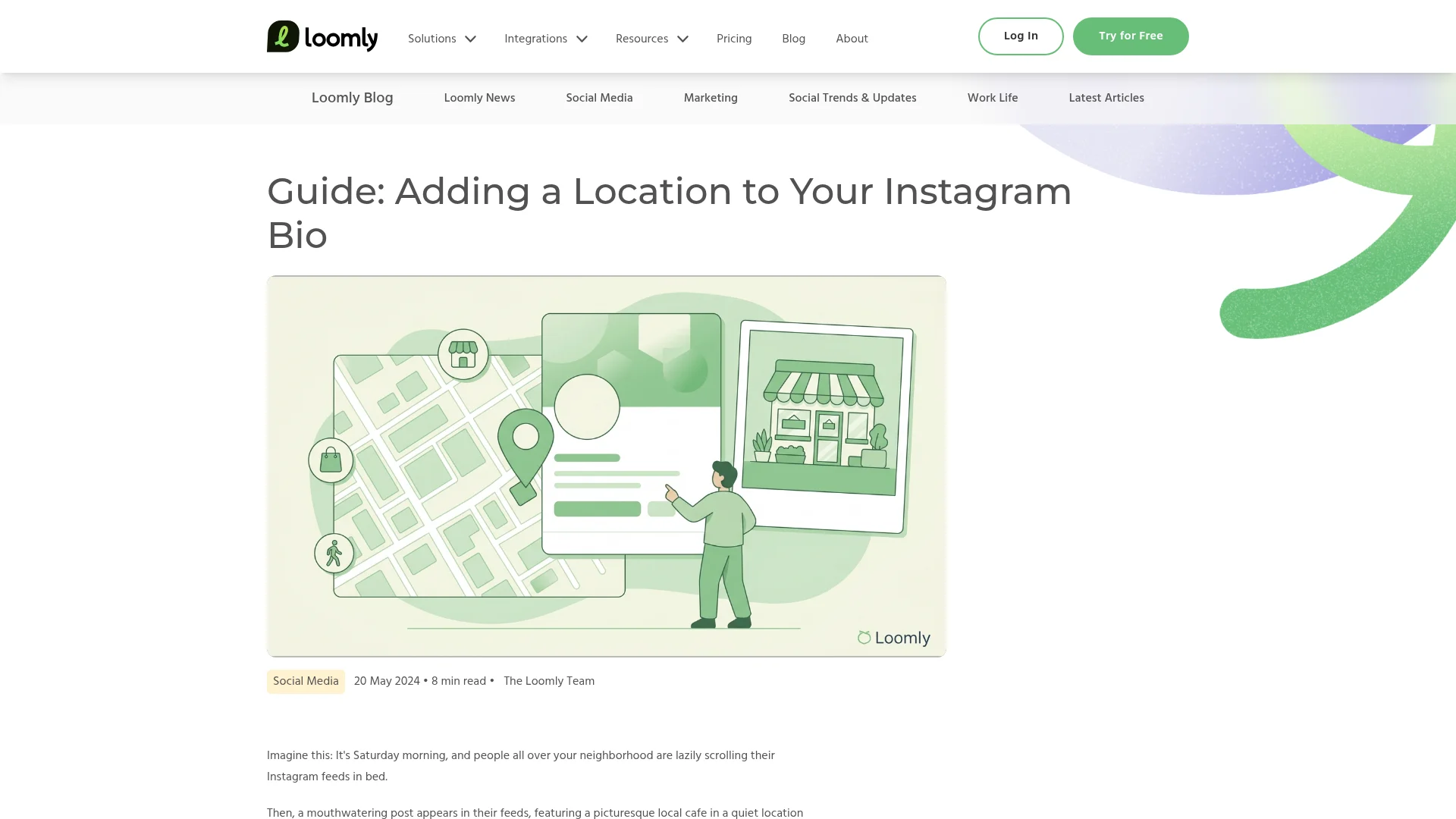
- Guide: Adding a Location to Your Instagram Bio
/blog/add-location-to-instagram-bio - 6 of the Best Instagram Reels Editing Apps
/blog/best-instagram-reels-editing-apps - Best time to post on Pinterest
/blog/best-time-to-post-on-pinterest - 12 DOs & DON'Ts to Build Your Brand on Instagram
/blog/build-your-brand-on-instagram
TikTok & YouTube (~19 Pages)
Video-platform tactics covering algorithm guides, video-length recommendations, ads, shadowban diagnostics, live streaming, thumbnails, watch time, Shorts, and "is TikTok right for my brand" framings. The mix includes both go-or-no-go content for buyers still evaluating whether to publish on a video platform and execution tactics for teams that already have. That spread is appropriate for Loomly's SMB and agency audience, where video adoption is uneven across customers.
Sample pages:
- Engage and Build Lasting Relationships with Your Audience on TikTok
/blog/engage-and-build-lasting-relationships-with-your-audience-on-tiktok - Mastering the TikTok Algorithm: Gain More Followers
/blog/how-to-get-followers-on-tiktok - How to Go Live on TikTok
/blog/how-to-go-live-on-tiktok - Is TikTok Right for Your Brand? 4 Questions to Ask Before Getting Started
/blog/is-tiktok-right-for-my-brand
LinkedIn Tactics (~12 Pages)
LinkedIn-specific content covers analytics, ads, carousels, organic post best practices, video, and the Top Voice badge. Coverage spans both organic and paid tactics, with carousel posts and carousel ads each getting their own dedicated piece. That's a sign LinkedIn's format expansion is being tracked closely rather than batched into a single platform overview, and it matches the platform's distinct B2B audience.
Sample pages:
- Beginner's Guide: How to Run LinkedIn Ads
/blog/linkedin-ads - How to Find and Track Your LinkedIn Analytics
/blog/linkedin-analytics - LinkedIn Carousel Posts Are Engagement Magnets (Here's How to Use Them)
/blog/linkedin-carousel - LinkedIn Carousel Ads: Specs, Use Cases, and Best Practices
/blog/linkedin-carousel-ads
Facebook & Twitter / X (~16 Pages)
Optimization-focused editorial for two mature broadcast platforms. Facebook coverage spans ads, Reels, Live, Stories, audience targeting, comment management, and profile publishing. Twitter / X coverage runs lighter, with five pages across marketing, advertising, threads, polls, trends, hashtags, and the blue badge. The shape signals a deliberate pullback as X's platform changes and shifting marketer adoption made evergreen Twitter content harder to maintain.
Sample pages:
- Can You Follow a Hashtag on Twitter?
/blog/can-you-follow-a-hashtag-on-twitter - Can You Delete Comments From Facebook Ads?
/blog/delete-comments-facebook-ads - How to Create Facebook Ads in 2024
/blog/facebook-ads - Facebook Ads Inspiration: 5 Creative Hacks To Boost Your Campaigns
/blog/facebook-ads-inspiration
Channel Scheduling & Integration Launches (~37 Pages)
The largest sub-theme in the cluster: per-channel product launch posts and integration landing pages announcing direct publishing, scheduling, and platform integrations for each social network. Every platform-format combination (Instagram Reels/Stories/Carousels, Facebook Reels/Stories, TikTok direct publishing, Threads, LinkedIn polls/PDFs, YouTube Shorts, Twitter polls) gets its own post, and per-channel /integrations/* landing pages provide the matching marketing surface. The pattern is essentially product-release notes structured as SEO content, and it gives every "[platform] scheduler" search a Loomly-branded page to surface.
Sample pages:
- Integrations | Loomly
/integrations - Introducing Alt Text for Social Media Images
/blog/alt-text-social-media-images - Boost Facebook Posts Visibility by Scheduling a First Comment
/blog/boost-facebook-posts-visibility-by-scheduling-a-first-comment - Boost Instagram Posts with Loomly
/blog/boost-instagram-posts-with-loomly
Strategy insight: Coverage is broad but uneven. Instagram, TikTok, and YouTube together hold 47 of the 75 editorial tactics URLs, while Pinterest and emerging platforms get under a handful each. The Channel Scheduling & Integration Launches micro at 37 URLs is the structural quirk: by treating every product release as a per-channel SEO page, Loomly turns the launch cadence into a topic cluster strategy for channel-specific scheduling searches. The trade-off is editorial coherence in the main blog feed, but for a lean team it's the right call.
2. Strategy, Operations & Careers
Pages: 111 · Share of library: 23.0%
Cross-platform operational and strategic content: strategy guides, content calendars, workflows, KPIs, ROI, audits, posting schedules, content ideation, community management, social media role definitions, hiring guides, agency operations, and team collaboration. It applies to social media programs as a whole and the people who run them, distinct from the channel-specific work in the previous cluster.
Content-type mix: Blog / Editorial 100%
Micro-topics within this cluster
Strategy & Planning (~32 Pages)
Foundational strategy content: how to create a social media strategy, set goals, build a posting schedule, define a content distribution strategy. The largest micro-topic in the cluster, with pieces like "best times to post on social media" and "26 best marketing tools for small business" that target high-volume head terms. These are the cluster's TOF anchors: pages that capture early-stage planning intent before a buyer is evaluating any specific tool.
Sample pages:
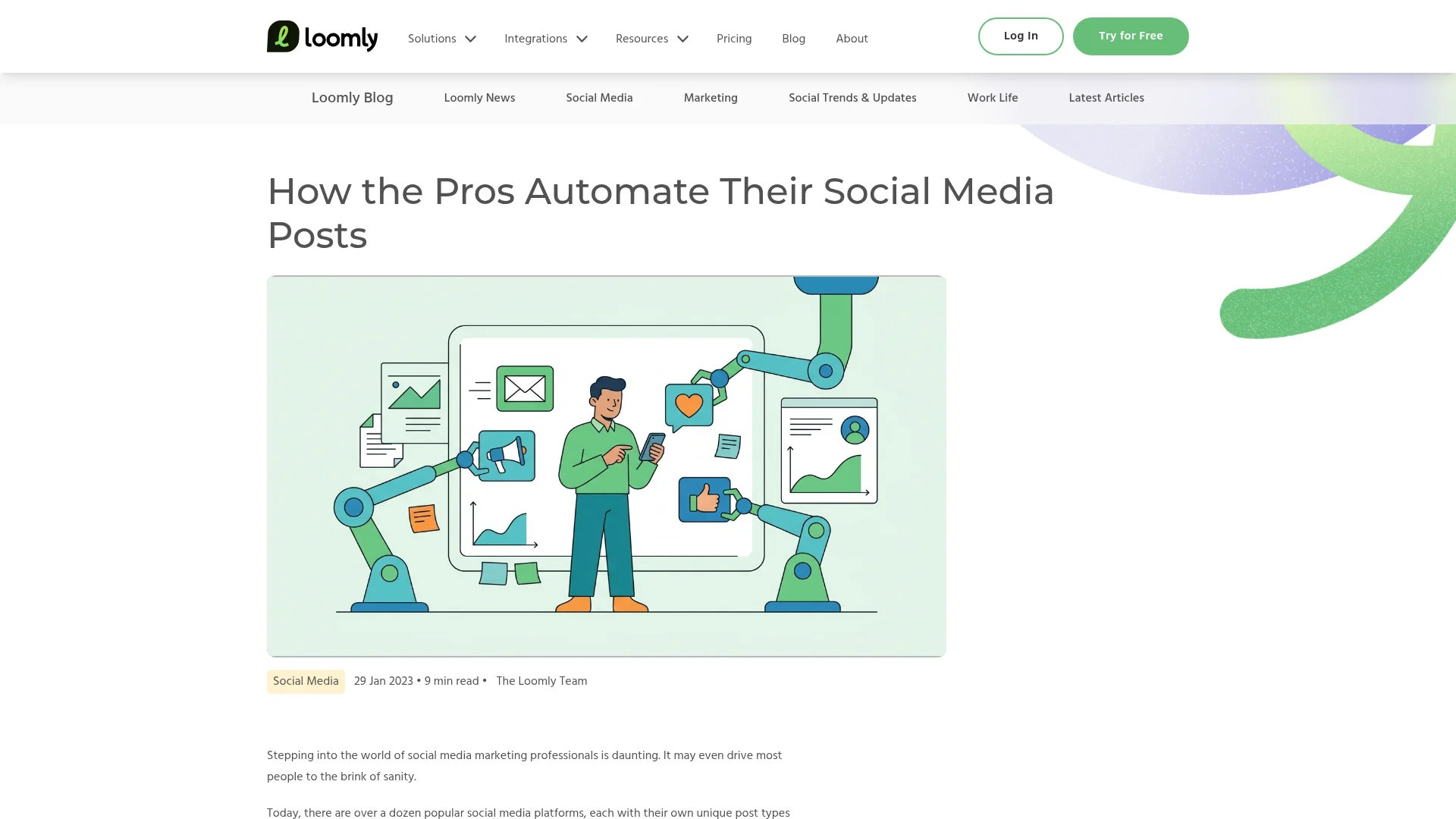
- How the Pros Automate Their Social Media Posts
/blog/automate-social-media-posts - 26 Best Marketing Tools for Small Business: Essentials + Add-ons (2025)
/blog/best-marketing-tools - Best Times to Post on Social Media: Days & Times for Every Platform
/blog/best-times-to-post-on-social-media - Digital Advertising vs Traditional Advertising for SMBs
/blog/digital-vs-traditional-advertising
Content Ideas & Creation (~25 Pages)
Post ideas, content ideas across platforms, caption writing, repurposing, hashtag strategies, content boosters. Idea-led content matches one of the most consistent recurring search intent signals in social media marketing ("what to post"), and Loomly publishes pages built around list formats ("12 low-effort, high impact content ideas") that perform well in both Google rankings and AI citations.
Sample pages:
- 12 Low-effort, High Impact Content Ideas to Boost Your Social Media Presence
/blog/12-ideas-to-boost-social-media - The Best Marketing Newsletters of 2024 (Free & Paid)
/blog/best-marketing-newsletters - 20 Best Marketing Podcasts of 2025
/blog/best-marketing-podcasts - The Best Social Media Scheduling Tools for Every Type of Business
/blog/best-social-media-scheduling-tools-for-every-type-of-business
Analytics, Workflows & Seasonal (~22 Pages)
Measurement, calendar workflows, and seasonal-campaign content folded into one sub-theme: KPIs, engagement metrics, ROI guides, audit frameworks, "how to fix a broken social media workflow," and the annual Black Friday / Cyber Monday / Christmas playbooks. Seasonal content runs on a republish cadence (same articles refreshed annually with new dates), which makes it among the most efficient evergreen surfaces in the library for a small content team.
Sample pages:
- 10 Winning Christmas Social Media Strategies (2023)
/blog/10-christmas-social-media-strategies - Your Guide to Black Friday Marketing in 2024 (Plus 10 Tactics to Try)
/blog/black-friday-marketing-strategies - Brand Performance: From Measurement To Improvement & Success
/blog/brand-performance - 8 Best Practices for Cyber Monday Marketing
/blog/cyber-monday-marketing
Careers & Agency Operations (~17 Pages)
What a social media manager / strategist / coordinator / specialist / community manager does, interview prep, first jobs, agency business operations, freelance-to-agency growth, client onboarding. Career-entry content covering specific roles sits alongside agency-business content. The audience here is split between junior practitioners ("how to land your first job in social media") and agency owners running small shops, both groups that Loomly's product serves directly.
Sample pages:
- How Does Your Advertising Agency Stack Up in 2018? [Infographic]
/blog/advertising-agency-infographic - Client-Agency Collaboration: 5 Best Practices For A Healthy, Productive Relationship
/blog/client-agency-collaboration - Freelancer Collaboration: 5 Ways Marketing Teams Can Effectively Collaborate With Contractors
/blog/freelancer-collaboration - How to Land Your First Job in Social Media
/blog/how-to-get-job-in-social-media
Team Collaboration & Community (~15 Pages)
Building marketing teams, cross-functional collaboration, team productivity, motivation, remote work, freelancer collaboration, community-building playbooks. Team-management content tied directly to Loomly's product story: the platform's collaboration features are one of its core differentiators, and editorial that frames collaboration as a discipline doubles as product-aligned content marketing.
Sample pages:
- Benefits Of Teamwork: 5 Ways To Empower Your Marketing Team Through Collaboration
/blog/benefits-of-teamwork - 11 Books On Collaboration, Teamwork And Management
/blog/books-on-collaboration-teamwork-and-management - How To Build A Happy Team (According To Real Team Members)
/blog/build-happy-team - Your Community Management Playbook for 2025
/blog/community-management
Strategy insight: Strategy & Planning (32 pages) plus Content Ideas & Creation (25 pages) together hold 51% of the cluster. The editorial bet is concentrated in TOF planning and ideation content that captures buyers before they have committed to any platform or tool. The Analytics, Workflows & Seasonal sub-theme at 22 pages is the most actionable expansion opportunity: measurement queries have meaningful intent, and Loomly's existing pillars rank well enough to support a long tail of supporting content.
3. Brand, Marketing Editorial & Glossary
Pages: 142 · Share of library: 29.5%
The largest cluster in the library. Broader brand-building and marketing editorial sits alongside the 62-URL Marketing Glossary that defines marketing roles, brand concepts, social platforms, organic metrics, and paid-media terminology. The cluster widens Loomly's audience past social media specialists toward marketing leaders, generalists, and category researchers using definitional searches to learn the vocabulary.
Content-type mix: Blog / Editorial 44% · Glossary / Definitions 44% · Case Studies / Customer Stories 8% · Podcast / Audio Series 4%
Micro-topics within this cluster
Brand Strategy & Marketing Disciplines (~40 Pages)
The largest sub-theme in the cluster combines brand-discipline content (awareness, trust, integrity, consistency, storytelling, governance, performance, purpose, relevance, safety) with definitive guides on adjacent marketing disciplines like SEO, email marketing, video marketing, influencer marketing, and growth hacking. The mix reads as horizontal marketing content rather than social-specific: content a director of marketing reads, not a social media coordinator. Each marketing-discipline piece extends Loomly's editorial surface beyond social, capturing search traffic from marketing-discipline queries that would not otherwise touch a social media management blog.
Sample pages:
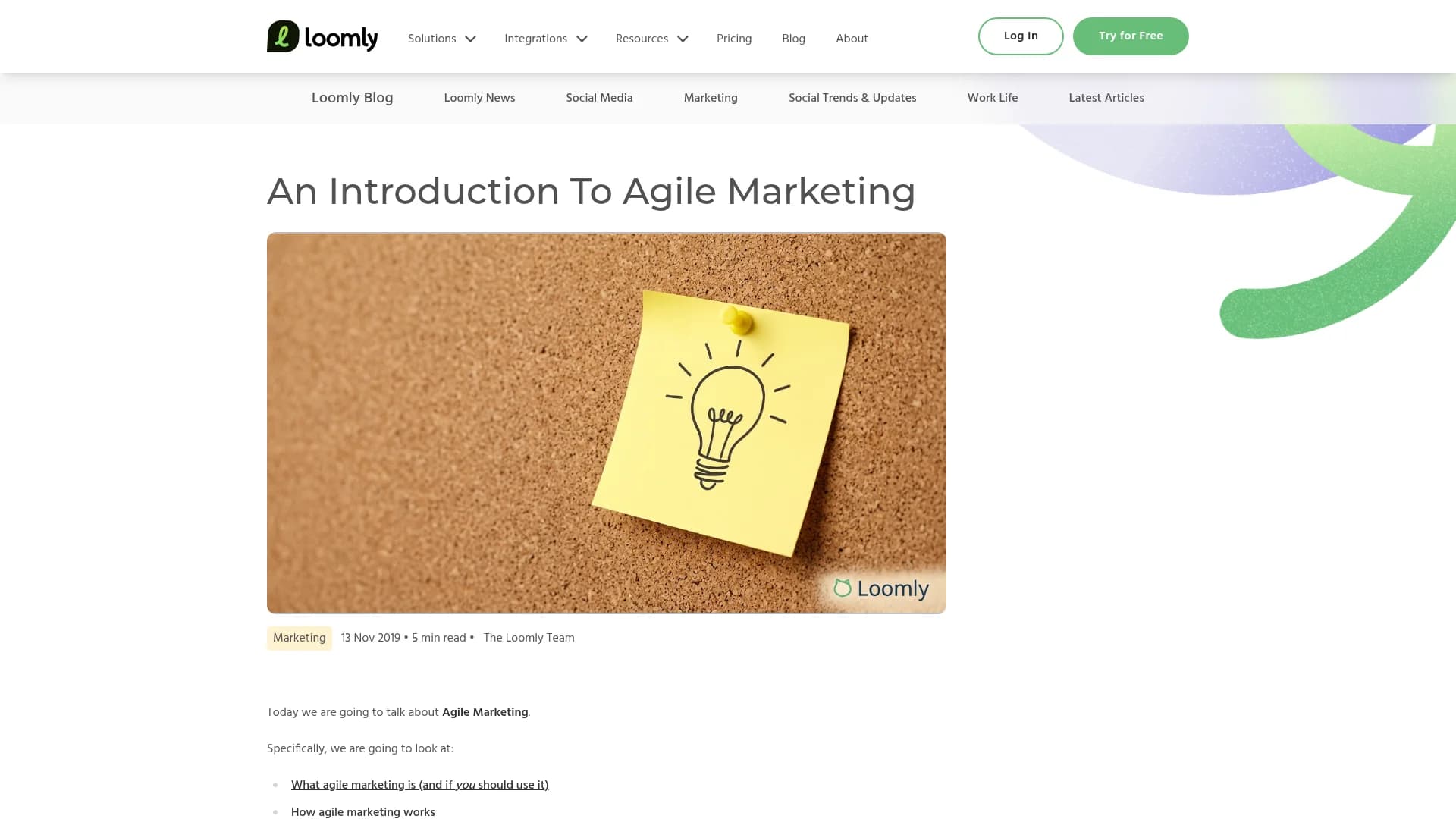
- An Introduction To Agile Marketing
/blog/agile-marketing - Brand Authority: The Definitive Guide
/blog/brand-authority - Brand Awareness: 20 Strategies To Make Your Brand Memorable
/blog/brand-awareness - Brand Consistency: The Art & Science Of Building Trust
/blog/brand-consistency
Customer, Growth Marketing & Customer Stories (~29 Pages)
Customer marketing, success, retention, B2B brand marketing, nurturing marketing, plus the 12 named Loomly Success Stories case studies. Growth- and customer-focused content distinct from brand strategy, paired with the proof-of-customer-success surface. Twelve case studies is the smallest customer-stories footprint in the cohort, but the consistency of the naming pattern ("Loomly Success Stories: [Customer Name]") and the alignment to the agencies/SMB audience makes the series legible. Every case study reinforces the same buyer-archetype narrative.
Sample pages:
- Loomly Case Studies | Loomly
/case-studies - Marketing Career Landscape Survey Results
/blog/2019-marketing-career-landscape-survey-results - B2B Brand Marketing: Why Business-To-Business Brands Matter More Than Ever
/blog/b2b-brand-marketing - Compassionate Marketing: Why Your Brand Should Embrace Benevolence
/blog/compassionate-marketing
Marketing Trends & Interview Series (~11 Pages)
Annual trends roundups (2020, 2021) plus emerging-tech pieces (AR, social tokens, digital clothing, passion economy, social commerce) alongside the Season 1 brand-themed expert interview series (Walter Faulstroh, Erik Huberman, Guillaume Lacroix, and others). The trend content is structurally fragile (last year's trends become this year's archive), and the absence of 2024 or 2025 trend posts suggests this is a sub-theme Loomly has deprioritized. The interview series stopping at six episodes is a missed compounding opportunity; peers running multi-year interview shows have a much harder asset for new entrants to replicate.
Sample pages:
- 2020 Marketing Trends That Will Give Your Team An Edge
/blog/2020-marketing-trends - 2021 Marketing Trends Your Brand Needs to Know
/blog/2021-marketing-trends - Augmented Reality: 8 Ways Your Brand Can Take Advantage of AR Right Now
/blog/augmented-reality - Brand Authority With Walter Faulstroh: Season 1 Episode 2
/blog/brand-authority-with-walter-faulstroh
Marketing Glossary: Roles & Brand Terms (~34 Pages)
Role definitions (CMO, Marketing Manager, Vlogger, Decision Maker), org-structure terms (Advertising Agency, In-house Agency), operational concepts (API, Workflow, Social Listening), and brand-term entries (Brand Awareness, Brand Performance, Brand Knowledge, Brand Penetration). The largest definitional sub-theme, and the one most aligned with how buyers research the social media management category before they know what tools exist. The glossary entries here often mirror titles of longer pillar pieces in the Brand Strategy sub-theme, creating an internal linking surface where the definition feeds traffic into the deeper editorial piece.
Sample pages:
- Advertising Agency Definition
/blog/advertising-agency-definition - API Definition
/blog/api-definition - Brand Awareness Definition
/blog/brand-awareness-definition - Brand Knowledge Definition
/blog/brand-knowledge-definition
Marketing Glossary: Platforms, Metrics & Paid Media (~28 Pages)
Definitions for social platforms (Instagram, YouTube, Messenger, Bitmoji, Snapchat geofilter), organic and engagement metrics (Likes, Followers, Organic Reach, Paid Reach, Viral Content, News Feed, Direct Messaging, Facebook Reactions), and paid-media concepts (Facebook Ads, Instagram Advertising, Twitter Advertising, Ad Copy, Ad Placement, Lookalike Audience, Affiliate Marketing). Definitional surfaces for the terms that show up in every social media analytics dashboard or ad manager, useful for capturing rep-level search intent from new social media managers learning the vocabulary.
Sample pages:
- Ad Copy Definition
/blog/ad-copy-definition - Ad Placement Definition
/blog/ad-placement-definition - What is Affiliate Marketing?
/blog/affiliate-marketing-definition - Bitmoji Definition
/blog/bitmoji-definition
Strategy insight: A 62-URL glossary representing 12.9% of a 482-page library is the highest definitional share in the social media management cohort. For a content library this small, that's a deliberate AEO bet. Definitional "What is X" content is what AI citation engines pull from when answering category-research queries. The brand and marketing-discipline editorial extends the audience past social specialists, and the customer case studies anchor the conversion narrative, but the cluster's largest pieces compete against publications with much larger libraries on the same horizontal-marketing terms.
4. Loomly Product, Launches & Resources
Pages: 117 · Share of library: 24.3%
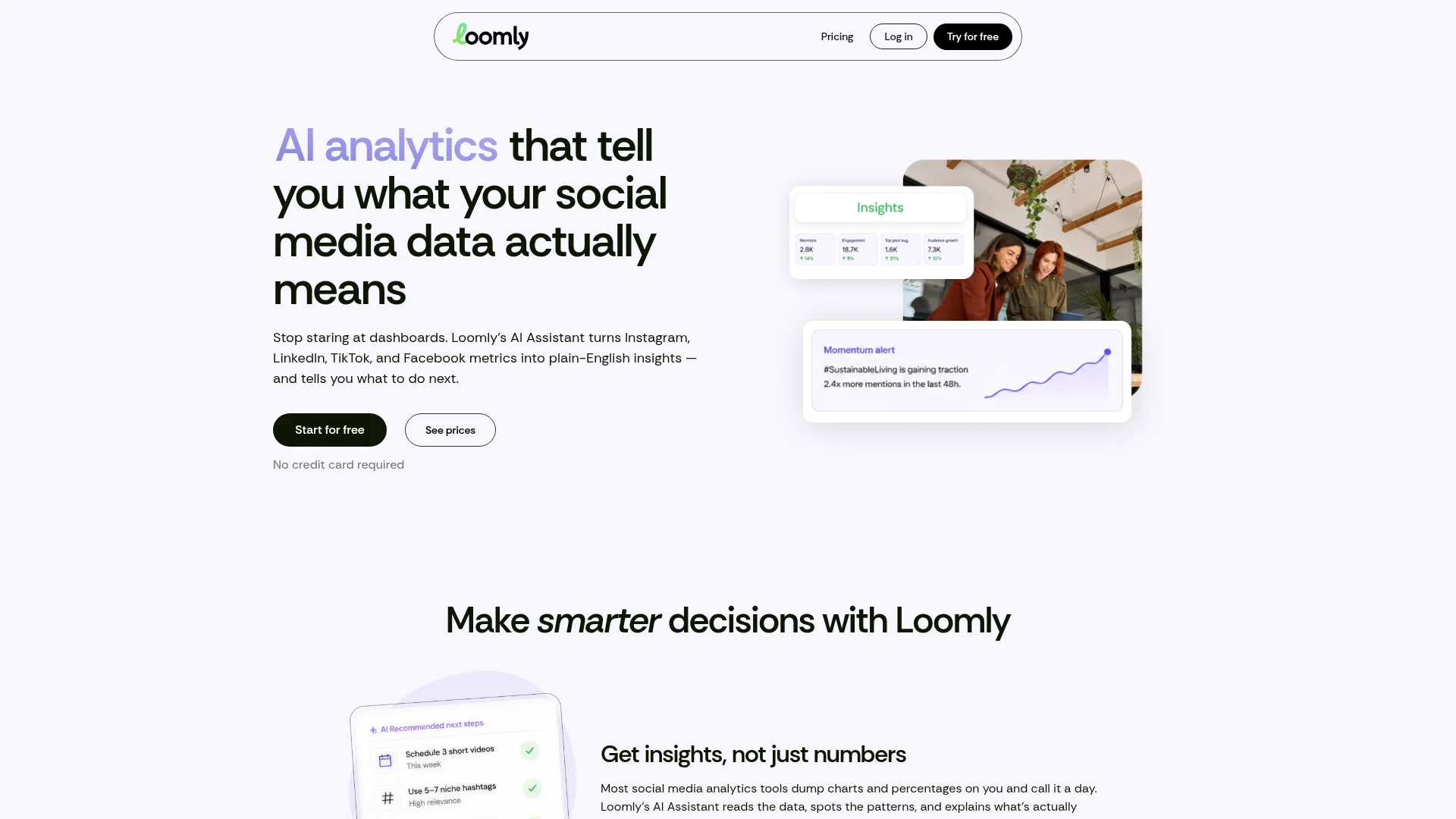
Everything that explains, sells, updates, or supports the Loomly product itself: feature and audience landing pages, competitor comparisons, corporate utility pages, the multi-year stream of mobile and collaboration release posts, third-party integration announcements, and downloadable templates, free tools, tutorials, and webinars. The cluster spans the full BOFU and customer-support surface.
Content-type mix: Blog / Editorial 51% · Product & Feature Pages 20% · Guides & Resources 14% · Other 8% · Comparison Pages 3% · Free Tools 3% · Events / Webinars / Sessions 2%
Micro-topics within this cluster
Product, Feature & Audience Pages (~23 Pages)
Core feature marketing pages cover the calendar, scheduling, analytics, collaboration, campaign management, AI tools, link-in-bio, social listening, and automated DMs. Audience-vertical pages sit under /who-uses-loomly/* covering agencies, freelancers, small businesses, non-profits, enterprises, franchises, marketing teams, brands, and creators. Pricing rounds out the surface. The /ai-analytics, /ai-content-creation, and /automated-dms URLs sit alongside the older feature surface, signaling AI capability layering as the active product narrative.
Sample pages:
- Social Media Management Platform | Loomly
/ - AI Analytics for Social Media | Loomly
/ai-analytics - AI Content Creation for Social Media | Loomly
/ai-content-creation - Automated DMs for Instagram, Facebook & More | Loomly
/automated-dms
Comparison & Company Pages (~13 Pages)
Loomly vs Buffer, Hootsuite, Sprout Social, and Later: one canonical head-to-head per major competitor under /why-loomly/*, paired with the corporate utility pages (About, Careers, Contact, Security, Terms, Privacy, DPA, vulnerability reporting policy). Four comparison pages is thin for a category where displacement campaigns ("Loomly alternatives," "Loomly vs X") have measurable search volume. The choice not to scale the comparison surface (no three-way comparisons, no "alternatives to X" pages, no head-to-head against smaller peers like Planable or SocialBee) leaves a defensible BOFU layer underbuilt.
Sample pages:
- About Loomly | Loomly
/about - Jobs | Bending Spoons
/careers - Data Processing Agreement | Loomly
/dpa - Loomly vs Buffer
/why-loomly/loomly-vs-buffer
Mobile, Platform & Feature Updates (~30 Pages)
Mobile app launches, dashboard updates, analytics releases, beta milestones, Loomly 3.0, "Loomly joins Traject" announcement, plus major standalone feature launches like Google My Business support and G2 recognition. Platform-level milestones rather than individual feature drops. This is where the company's product history gets documented. The 2021 Traject acquisition has its own post, and the back-catalog reads as a multi-year product diary that ranks moderately on long-tail "loomly [feature]" queries.
Sample pages:
- Track Your Success With Advanced Social Media Analytics
/blog/advanced-analytics - Introducing a Basic Analytics Dashboard for Base Plan Customers
/blog/basic-social-media-analytics - #Loomly Update: Duplicate Posts Across Multiple Calendars
/blog/duplicate-posts-across-multiple-calendars - Introducing Loomly For Google My Business
/blog/google-my-business
Collaboration & Third-Party Launches (~30 Pages)
Custom workflows, advanced collaboration features, commenting, post labeling, scheduling slots, multi-calendar publishing, email digests, asset view, bulk actions, plus the third-party integration launches with Canva, Slack, Microsoft Teams, Zapier, Giphy, Unsplash, Google Drive, Snapchat, TikTok, and YouTube. Collaboration is one of Loomly's anchor differentiators against Buffer-class scheduling tools, and the volume of launches here signals continuous investment in that surface. The integration-launch posts double as ecosystem signaling for buyers comparing platforms, and every integration name gets its own page rather than being consolidated into a single integrations directory.
Sample pages:
- 3 New Advanced Collaboration Features For Your Team
/blog/advanced-collaboration-features - Introducing Asset View
/blog/asset-view - Buffer Integration Sunset
/blog/buffer-integration-sunset - Introducing Bulk Actions
/blog/bulk-actions
Templates, Tools & Education (~21 Pages)
Downloadable templates and guides under /resources (carousel templates, case study templates, post ideas, social strategy guides, client onboarding, analytics report templates), the three standalone free tools (URL shortener, best-time-to-post calculator, link-in-bio), in-product tutorials, Loomly Courses, and webinars. The templates skew toward agency operations (client onboarding, case study templates) more than individual creators, matching Loomly's primary buyer segment. Three free tools is a thin Free Tools surface for a 482-page library; peers running calculator-led TOF content (Hootsuite, Sprout Social) have 20+ utility pages each.
Sample pages:
- Best Time to Post on Social Media | Loomly
/best-time-to-post - How to Collaborate | Loomly
/collaborate - Loomly Courses | Loomly
/courses - Create a Calendar Tutorial | Loomly
/create_calendar
Strategy insight: This cluster combines product marketing with the multi-year stream of release posts. The release content compounds: every platform-feature search ("schedule instagram reels," "linkedin polls scheduler") has a Loomly-branded dated page ready. The structural tension is that 60 release posts live in the same /blog feed as editorial tactics, and a category-leader-shaped library would split these into separate paths. The expansion opportunity is on either side: a fuller Free Tools layer at the BOFU surface and a deeper Comparison Pages footprint to defend the "Loomly alternatives" territory.
Key Observations
What Stands Out About Loomly's Content Strategy
The library is editorial-led but built on a lean-team operating model
482 indexable pages: the smallest in the social media management cohort by a significant margin (next-smallest is Planable at 600 URLs; cohort leader is Brandwatch at 7,000+). 69.7% of pages are Blog / Editorial. With 11-25 employees, Loomly cannot match peers on volume, and the architecture reflects that. Every page has to work harder, content types stay tight, and there is no locale expansion to inflate the URL count. The trade-off is per-URL traffic efficiency of ~84 visits per page, well above Agorapulse (43) and Brandwatch (76).
Product-update content lives inside the main blog, not a separate changelog
30 URLs in Mobile, Platform & Feature Updates plus 30 URLs in Collaboration & Third-Party Launches plus 37 in Channel Scheduling & Integration Launches: nearly 100 release posts spread across two clusters, the bulk of them under /blog rather than a dedicated /releases path. Loomly publishes feature announcements, scheduling launches, integration releases, and mobile updates as blog posts alongside editorial tactics. The cluster compounds: every platform-feature search ("schedule instagram reels," "linkedin polls scheduler") has a Loomly-branded dated page ready. It also dilutes the editorial blog's coherence and is the most visible signal of the lean-team trade-off. A larger company would split these into a dedicated /releases path.
The 62-URL Marketing Glossary punches above its weight
At 12.9% of the library, Loomly's per-term definitional content is the highest definitional share in the social media management cohort. 62 "What is X" pages spanning roles, brand, engagement metrics, platforms, and paid media is an unusually focused AEO bet for a 482-page library. Definitional content is what AI search engines pull from for category-research queries, and Loomly has more of it (proportionally) than peers running 5-10x larger libraries. The architectural caveat is that every glossary URL sits under /blog rather than a dedicated /glossary path, which limits how cleanly crawlers can recognize the asset as a structured reference set.
Top-10 ranking share is well below cohort leaders, but the 11-20 layer is actionable
12.66% of Loomly's 7,925 ranking positions sit in the top 10, meaningfully below Buffer (23.45%), Sprout Social (23.36%), and Hootsuite (22.32%). The biggest single position bucket is 11-20 with 1,572 positions (19.8% of total). For a library this size, focused on-page work targeting those page-2 rankings is the most direct lever. Converting even 20% of them to top-10 positions would meaningfully shift Loomly's overall traffic profile without requiring new content investment.
No first-party research franchise, the most visible authority gap
Zero URLs classified as Research / Reports. Peers like Buffer, Hootsuite, and Sprout Social each anchor editorial clusters with annual "State of Social" reports that compound backlinks year over year and earn citations in third-party industry coverage. Loomly has no equivalent: no annual benchmark, no proprietary survey, no recurring data drop. For a company positioned as a category voice (even at lean-team scale), this is the most natural authority-building addition. A single well-executed annual report would create a compounding linkable asset the existing editorial library cannot.
The /blog URL prefix does four jobs at once
415 of Loomly's 482 URLs (86%) sit under /blog, and that single path hosts four distinct content types: Blog / Editorial (336), Glossary / Definitions (62), Case Studies / Customer Stories (11), and Podcast / Audio Series (6), spanning all four topic clusters. The path-prefix overload makes it harder for crawlers to recognize Loomly's blog as having structured sub-sections, and harder for the Marketing Glossary specifically to be surfaced as a discrete reference asset. Splitting into /blog, /glossary, /case-studies, and /podcast would be a low-effort sitemap-clarity improvement that better signals section authority to search engines.
The Loomly vs X comparison-page footprint is thin for a defensible BOFU surface
Four canonical comparison pages (Buffer, Hootsuite, Sprout Social, Later) under /why-loomly/*. No three-way comparisons, no "Loomly alternatives" pages, no head-to-head against smaller peers like Planable or SocialBee. At 0.8% of the library, the comparison surface is one of the smallest in the cohort. The displacement campaigns competitors run against Loomly on long-tail comparison pages queries are largely unanswered by Loomly's own pages, which leaves a defensible BOFU layer underbuilt despite the low production cost (each comparison page is a templatable asset).
Library architecture concentrates investment across four roughly equal clusters
The four topic clusters land at 142, 117, 112, and 111 URLs, a 31-URL spread from largest to smallest. No single cluster dominates the library, and the top two combined (Brand, Marketing Editorial & Glossary + Loomly Product, Launches & Resources) hold 54% of the URLs. The balance reads as a deliberate breadth bet for a small team: cover every adjacent territory at moderate depth rather than dominate a narrower one. The trade-off is that no cluster anchors the library the way a "State of Social" report or a 200+ episode podcast anchors editorial clusters for category leaders.
More analyses in Social Media Management
Planable
How Planable uses 386 blog posts and 33 free AI content tools to drive 191K monthly visits in social media management. 600 pages, 5 clusters.
Sendible
How Sendible uses 536 blog posts, 133 product pages, and 41 case studies to drive 126K monthly visits in social media management. 770 pages, 6 clusters.
SocialBee
How SocialBee uses 838 blog posts, a 215-term glossary, and 34 free tools to drive 143K monthly visits in social media management. 1,238 pages, 6 clusters.
Sprout Social
How Sprout Social uses 1,519 blog posts and the annual Sprout Social Index to drive 2.2M monthly visits in social media management. 2,155 pages, 9 clusters.
Methodology: This analysis is based on Loomly's full public sitemap (482 URLs, sourced from robots.txt), enriched with each URL's title and meta description via lightweight HTTPS fetches. URLs were classified into a 12-bucket content type taxonomy and grouped into 4 topic clusters with 20 micro-topics using LLM-assisted classification. Company facts came from public web research across Crunchbase, LinkedIn, and the company's own About and blog pages. Traffic metrics (monthly organic visits, traffic value, ranking positions, position distribution) came from DataForSEO's domain rank overview, aggregated globally across 111 locale combinations. All counts reflect the Loomly sitemap as of 2026-05-25.