
Summary
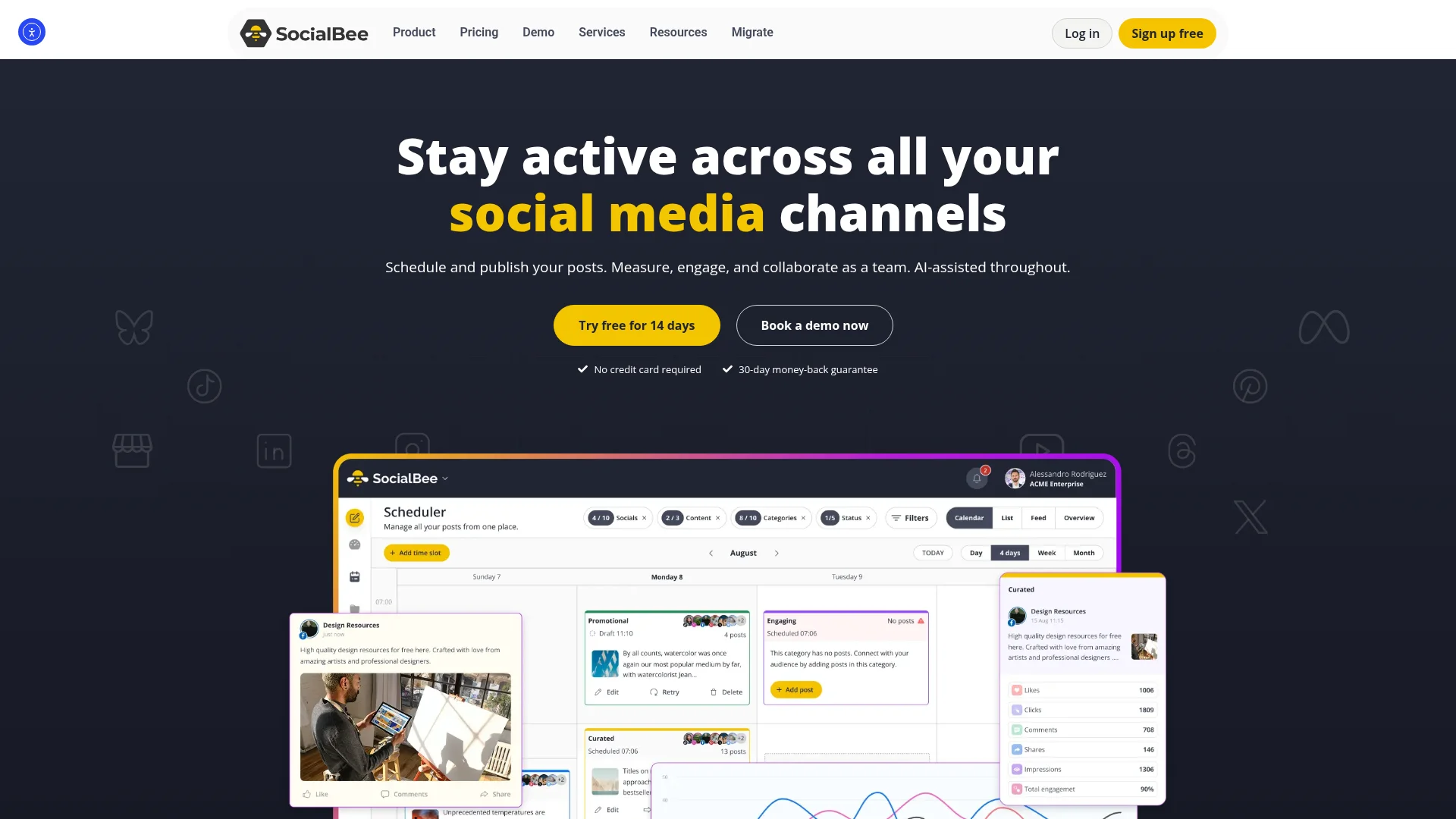
SocialBee drives 143,093 monthly organic visits with an editorial-led, Spanish-heavy content library. The library spans 1,238 indexable pages: a platform-by-platform blog, a 215-URL social media glossary, a 375-URL Spanish-language mirror, and a free-tools suite of 34 generators and calculators bundled inside a buyer-decision cluster. Content works as both a long-tail SEO surface and an AEO asset, with definitional glossary entries and free utilities sized like flagship investments alongside the blog. Top-10 ranking share sits at 7.1% across 32,654 positions in 117 indexed locale combinations. That's well below category peers like Buffer (23.5%) and Hootsuite (22.3%), and it reflects authority dilution from the heavy Spanish-language investment and a deep long tail of definitional pages.
Key facts:
- Library size: 1,238 indexable pages organized into 6 topic clusters; 67.7% blog/editorial, 17.4% glossary
- Largest cluster: Spanish-Language Content /es (375 URLs, 30.3% of library)
- Flagship content asset: Social Media Glossary, 215 definitional URLs covering social slang, marketing terms, platform vocabulary, and creator-economy concepts
- Search performance: 143K monthly visits across 32.7K ranking positions; 7.1% in top 10; ~116 visits per page
- Notable gap: No podcast (0 URLs), no annual research franchise (3 Research/Reports URLs total), only 12 case studies across the 1,238-page library
Company Overview
SocialBee at a Glance
| Company | SocialBee (SocialBee S.R.L.) |
| Founded | 2016 · Cluj-Napoca, Romania |
| Category | Social Media Management |
| What They Do | SocialBee is an AI-powered social media management platform that lets users create, schedule, publish, and analyze posts across all major social networks from one tool. It also offers content categorization, collaboration features, and an optional done-for-you ConciergeBee service. The audience spans solopreneurs, small businesses, and marketing agencies, plus NGOs, hospitals, schools, and government agencies looking for an affordable all-in-one social media management tool. |
| Funding | Bootstrapped (no disclosed venture funding). Acquired by WebPros (Luxembourg) on August 20, 2024; terms undisclosed. |
| Headcount | 10–50 (estimate) |
| Monthly Organic Visits | Traffic Value (PPC equiv.) | Ranking Positions |
|---|---|---|
| 143K | $285K | 32.7K |
Ranking positions reflect total positions across 117 indexed (location, language) combinations, not unique keywords. A keyword ranking in both US-en and ES-es counts twice.
SocialBee's content operation is unusually editorial-dense for a 10–50 person company. Across 1,238 indexable pages, the library leans 67.7% blog/editorial. Two structurally distinctive choices sit on top of that base: a 215-URL definitional glossary (the third-largest cluster) and a 375-URL Spanish-language blog mirror (the single largest cluster, at 30% of the library). Both are sized like flagship assets, not side projects. The company was bootstrapped in Romania, acquired by WebPros in August 2024, and continues to publish under the SocialBee brand.
Content Architecture
What Does SocialBee's Content Engine Look Like?
SocialBee's main website hosts 1,238 indexable pages organized into 6 topic clusters. The architecture reveals a small team running an editorial publication with two unusual surfaces bolted onto the standard SaaS content stack: a Spanish-language locale and a flagship-sized glossary.
Content Type Distribution
| Content Type | Count | Share | Notes |
|---|---|---|---|
| Blog / Editorial | 838 | 67.7% | Bulk of the library; spans platform-specific tactics, strategy, AI craft, and the full /es mirror |
| Glossary / Definitions | 215 | 17.4% | The /glossary library, a flagship-sized definitional AEO surface |
| Product & Feature Pages | 58 | 4.7% | Product, per-platform, ConciergeBee services, audience-targeted landing pages |
| Other | 39 | 3.2% | Legal, anniversary, booking calendars, partner/affiliate landings |
| Free Tools | 34 | 2.7% | Generators, hashtag tools, engagement calculators, mockups, grid planners |
| Comparison Pages | 26 | 2.1% | Alternatives roundups, vs comparisons, SocialBee-as-alternative pages |
| Case Studies / Customer Stories | 12 | 1.0% | /love persona pages, testimonial-style rather than full case studies |
| Events / Webinars / Sessions | 8 | 0.7% | Webinars, SocialBee University, partner co-marketing events |
| Guides & Resources | 5 | 0.4% | Sparse; no resource-hub investment at scale |
| Research / Reports | 3 | 0.2% | No annual "State of" franchise detected |
| Podcast / Audio Series | 0 | 0.0% | Not present in sitemap; no podcast operation |
| Documentation | 0 | 0.0% | Not present in www sitemap |
Key finding: Two content types do almost all the work. Blog/Editorial (68%) and Glossary (17%) together account for 85% of the library. The third-largest type, product and feature pages, comes in at only 4.7%. That's an editorial-and-definitions library with a thin product-marketing layer wrapped around it. Peers spread investment across guides, case studies, research, and tools more evenly.
Content Strategy Archetype
SocialBee operates an editorial-led, definitions-heavy publication model with a flagship locale. The primary content asset is the 838-URL English-and-Spanish blog targeting solopreneurs, small businesses, and agencies. A 215-URL glossary built for AI search engines and a 375-URL Spanish-language mirror (effectively a second blog) round it out. The free-tools suite of 34 generators and calculators functions as an interactive lead-magnet layer beneath the editorial, bundled together with comparisons and vertical playbooks inside a single buyer-decision cluster. The notable absence is audio: there's no podcast and no documentation in the main sitemap, which makes this a writing-and-utilities operation rather than a multi-format media property.
Locale & Translation Strategy
How SocialBee Publishes Across Markets
SocialBee publishes content across two locales: an English root and a Spanish /es subdirectory. The split materially shapes the library, with Spanish content representing 30% of all indexable pages.
| Locale | URLs | Share |
|---|---|---|
| root (English) | 863 | 69.7% |
| es (Spanish) | 375 | 30.3% |
The /es library is not a curated selection of top-performing English posts. It's a deep translation of the editorial blog, with dedicated Spanish micro-topics for strategy and AI tools (167 URLs), Instagram (60 URLs), other platforms (63 URLs), TikTok and Facebook combined (51 URLs), and LinkedIn and content craft combined (34 URLs). The volume mirrors the topical structure of the English blog rather than re-prioritizing for Spanish-language search behavior. Among the 10 peers in this category brief, SocialBee runs only 2 locales, but commits a higher share of total URLs to its non-root locale than any other multi-locale peer.
DataForSEO's 117 indexed (location, language) combinations reflect this two-locale footprint extended across geographies. Spanish content ranks across multiple Latin American and European Spanish-speaking markets. The headline ranking position count (32.7K) aggregates across all combinations, not unique keywords.
Strategy insight: The Spanish investment is the single most distinctive architectural choice on the page, and the most consequential. Translating 375 blog posts adds reach in a sizeable language market. It also dilutes per-URL authority, because Spanish translations compete for backlinks and search authority that English originals would otherwise consolidate. The 7.1% top-10 ranking share (vs. Buffer at 23.5% and Hootsuite at 22.3% in this cohort) is partly a function of this dilution: the library has to defend many more URLs across many more locales with the same backlink and authority profile. The strategic question for SocialBee: does the Spanish-language reach justify the per-URL authority cost, or would a curated 100-URL Spanish library outperform the full 375-URL mirror?
Search Performance Quality
Where SocialBee Ranks
The DataForSEO domain rank overview shows SocialBee ranking in 32,654 positions across 117 locale combinations. The position distribution skews long-tail. Most positions sit on pages 2–10 of search results, with a comparatively thin top-10 footprint.
| Position | Count | Share |
|---|---|---|
| #1 | 129 | 0.4% |
| #2–3 | 353 | 1.1% |
| #4–10 | 1,847 | 5.7% |
| #11–20 | 3,477 | 10.7% |
| #21–50 | 15,209 | 46.6% |
| #51–100 | 11,639 | 35.6% |
7.1% of SocialBee's ranking positions are in the top 10. That's meaningfully lower than category peers like Buffer (23.5%), Sprout Social (23.4%), Hootsuite (22.3%), and Later (21.8%). Per-URL traffic efficiency is high at ~116 visits per page, which is the inverse signal of the same data: SocialBee's smaller, more focused library works harder per page than peers running 4,000-to-10,000-URL libraries. The long tail of definitional and Spanish-language content keeps the top-10 share suppressed.
The most actionable slice of the distribution is the 3,477 positions in 11–20: content already on page 2 of Google that targeted optimization could push into the top 10. Roughly 10.7% of the library's positions sit one rank-jump away from materially more traffic, which is the size of opportunity an internal SEO sprint can realistically work through.
Content Deep Dive
What Is SocialBee Actually Publishing, and How?
SocialBee's content organizes around 6 primary topic clusters. Each cluster is described below with content-type composition, the micro-topics inside it, and concrete example URLs. Cluster and micro-topic groupings reflect a per-URL classification of the full sitemap. Counts are exact, not approximate.
1. Platform Playbooks
Pages: 251 · Share of library: 20.3%
Editorial tactics, feature explainers, scheduling guidance, and growth playbooks for the major social platforms SocialBee publishes to. The dense per-platform editorial coverage (Instagram, TikTok, Facebook, LinkedIn, plus Twitter/X, YouTube, Pinterest, Bluesky, Mastodon, Threads, and Google Business Profile) is the company's largest tactical surface and sits closest to the product's scheduling capabilities. Each platform gets its own dedicated body of work, with consistent shapes across them: best-time-to-post pages, algorithm explainers, feature how-tos, content idea lists, and platform-specific monetization tactics.
Content-type mix: Blog/Editorial 100%
Micro-topics within this cluster
Instagram Marketing & Growth (~73 Pages)
The cluster's single largest micro-topic and the most active acquisition surface for SocialBee's solopreneur and small-business audience. The cluster covers feed posts, Reels, Stories, captions, hashtags, growth tactics, monetization, and feature explainers in roughly equal proportion. Titles lean toward "how to get more X on Instagram" framings that capture rep-level search intent, with feature explainers like "What Is Instagram Creator Studio" serving the long tail of platform vocabulary.
Sample pages:
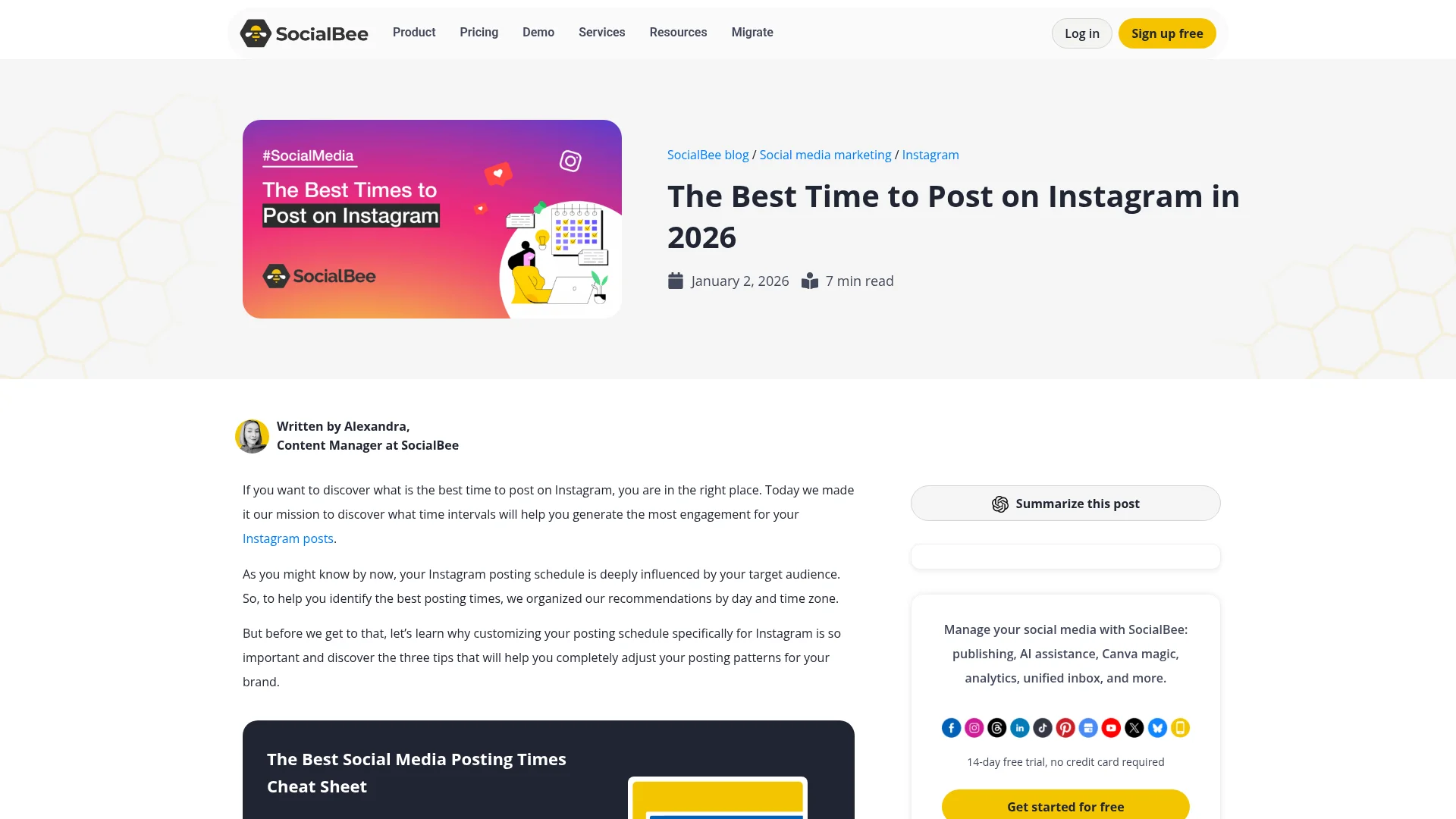
- The Best Time to Post on Instagram in 2026
/blog/best-time-to-post-on-instagram/ - What's the Best Time to Post Reels on Instagram in 2026?
/blog/best-time-to-post-reels-on-instagram/ - What is the difference between Facebook and Instagram?
/blog/difference-between-facebook-and-instagram/ - How to Maximize Instagram for Real Estate Agents
/blog/instagram-real-estate/
TikTok Marketing & Growth (~31 Pages)
Editorial guidance for TikTok: content ideas, trending sounds, ads, monetization, feature how-tos, video editing, and scheduling. The cluster mirrors the Instagram shape at smaller scale, with feature how-tos and scheduling-adjacent content sitting closest to the product's TikTok publishing surface. The TikTok scheduler roundup and "best times to post on TikTok" pieces are the highest-converting BOFU pages in the micro-topic.
Sample pages:
- The Best Times to Post on TikTok in 2026
/blog/best-times-to-post-on-tiktok/ - Decoding the TikTok algorithm for business success
/blog/tiktok-algorithm/ - How to Go Viral on TikTok: 10 Actionable Tips that Work
/blog/how-to-go-viral-on-tiktok/ - 10 TikTok Content Ideas for Better Engagement
/blog/tiktok-content-ideas/
Facebook Marketing & Pages (~28 Pages)
Editorial guidance for Facebook: Pages, Stories, Reels, Groups, ads, scheduling, analytics tools, and engagement tactics. Coverage spans the platform's full surface, with a distinctive Groups scheduling thread that maps to a product feature most competitors do not support. Facebook Ads is the structurally thinnest sub-thread for a platform where ads are the dominant commercial use case.
Sample pages:
- Discover the Best Time to Post on Facebook in 2026
/blog/best-time-to-post-on-facebook/ - How to schedule Facebook Stories: 2 simple ways
/blog/can-you-schedule-facebook-stories/ - Facebook algorithm explained: 2026 insights
/blog/facebook-algorithm/ - How to promote your brand in Facebook Groups
/blog/facebook-groups/
LinkedIn Marketing & B2B (~27 Pages)
The most B2B-leaning platform on SocialBee's editorial calendar, focused on personal brand and content strategy for small accounts rather than enterprise outbound. Coverage includes ads, automation, carousel formats, Sales Navigator, premium features, posts, and the algorithm. Lead-generation content stays narrow, consistent with SocialBee's solopreneur and small-business positioning.
Sample pages:
- What's the Best Time to Post on LinkedIn According to Experts
/blog/best-time-to-post-on-linkedin/ - How to automate LinkedIn messages & posts
/blog/linkedin-automation/ - LinkedIn Lead Generation: Tactics for Generating Target Leads
/blog/linkedin-lead-generation/ - The LinkedIn algorithm explained (2026 guide)
/blog/linkedin-algorithm/
Other Platforms & Cross-Publishing (~92 Pages)
The largest micro-topic in the cluster by URL count. Each individual platform here would not warrant its own cluster, but together they form a substantial body of work covering Twitter/X, YouTube, Pinterest, Bluesky, Mastodon, Threads, Google Business Profile, and cross-platform publishing workflows. A recurring monthly platform-news format (dated "(May 19) 2026 Bluesky news" entries) signals active republishing on emerging platforms category leaders typically leave open.
Sample pages:
- Best Bluesky accounts to follow & learn from
/blog/best-bluesky-accounts-to-follow/ - What Are the Best Times to Post on Twitter in 2026?
/blog/best-times-to-post-on-twitter/ - Best Times to Post on YouTube: Videos & Shorts
/blog/best-times-to-post-on-youtube/ - Leveraging Pinterest for Business Growth: An Ultimate Guide
/blog/pinterest-for-business/
Strategy insight: This cluster does the breadth-work of SocialBee's "we schedule everywhere" product claim. 251 URLs across 11+ platforms signals coverage no specialist competitor can credibly match, and the recurring monthly news format on emerging platforms (Bluesky, Threads, Mastodon) is the cluster's most editorially distinctive choice. The thin coverage of Reels inside the Instagram micro-topic and of Facebook Ads inside the Facebook micro-topic are the most actionable gaps. Both topics carry high commercial intent and modest product alignment, so widening either would lift the cluster's BOFU share without distorting the editorial calendar.
2. Strategy, AI & Content Operations
Pages: 176 · Share of library: 14.2%
Foundational social media strategy, planning frameworks, AI tooling, content craft, analytics, team workflows, calendars, automation, and branding. This is the company's main "how do you actually run social media" editorial surface, capturing the broad practitioner-level search intent that introduces SocialBee to the buyer before they know they want a tool.
Content-type mix: Blog/Editorial 95.5% · Guides & Resources 2.8% · Research/Reports 1.7%
Micro-topics within this cluster
Strategy Frameworks & Marketing Plans (~47 Pages)
The editorial backbone of the cluster, sized as the single largest sub-theme and aimed at practitioners building out a social strategy from scratch. Content covers buyer personas, marketing plans, content type taxonomies, project management, social commerce, and brand-building checklists. The micro-topic captures top-of-funnel discovery for "how to build a social media strategy" search intent.
Sample pages:
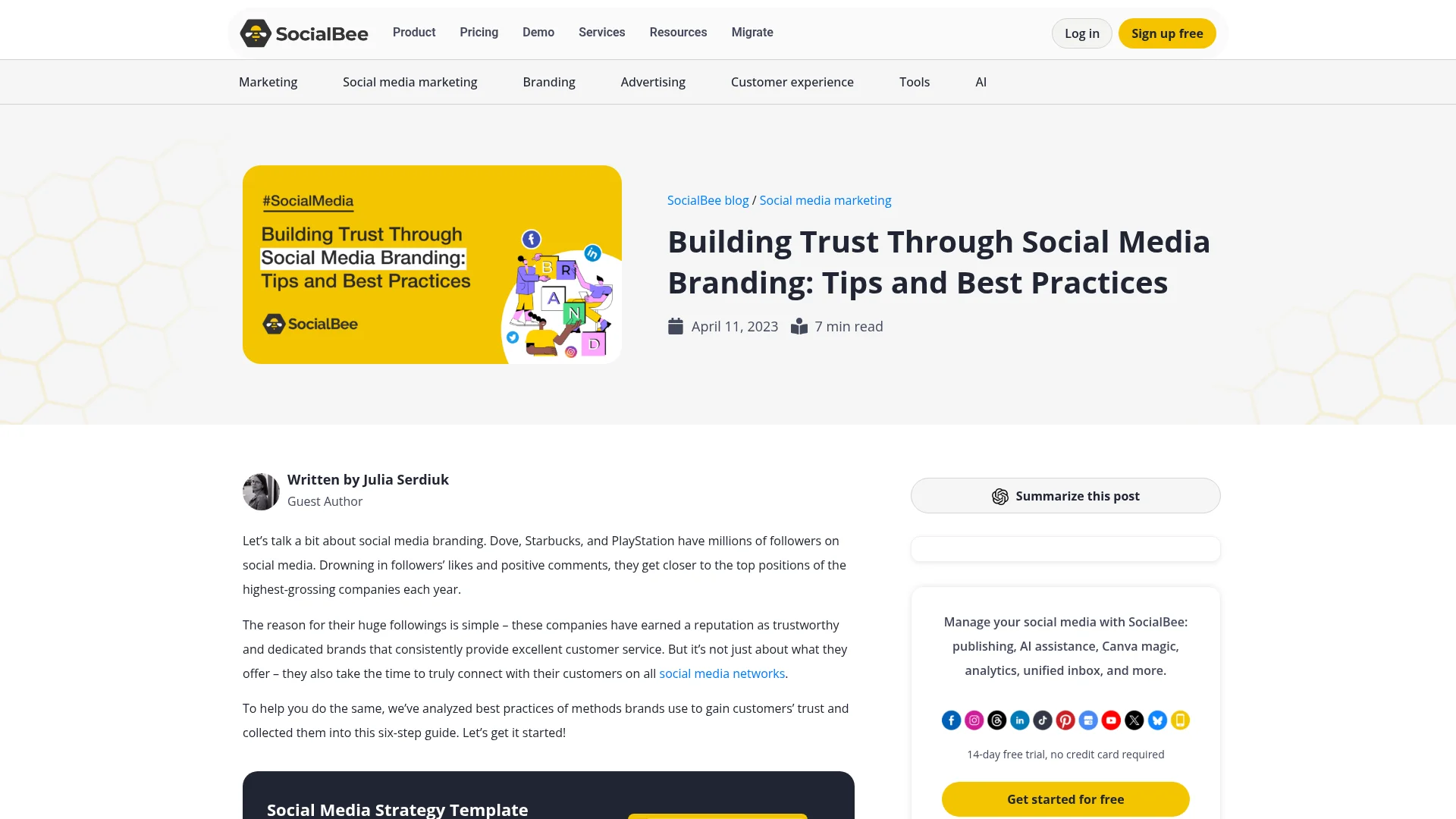
- Building Trust Through Social Media Branding: Tips & Best Practices
/branding-social-media/ - [GUIDE] What Is a Buyer Persona & How to Create One
/buyer-personas-social-media/ - Types of Content Marketing with Examples & Tips
/content-types/ - How to Do Social Media Project Management
/social-media-and-project-management/
Social Marketing Fundamentals (~46 Pages)
The cluster's top-of-funnel discovery surface, capturing the "what is" intent layer at a more strategic level than the glossary. Pieces cover affiliate vs influencer marketing, B2B channels, omnichannel vs multichannel, third-party tools, AI in marketing, creative briefs, recruitment, and restaurant-specific marketing. The vocabulary layer underneath strategy.
Sample pages:
- Does Using 3rd Party Social Tools Hurt Engagement?
/blog/3rd-party-social-media-tools/ - The Guide to Affiliate Marketing vs Influencer Marketing
/blog/affiliate-marketing-vs-influencer-marketing/ - Top 6 B2B Social Media Channels for Your Online Business
/blog/b2b-social-media/ - What Is Social Media Management? A Quick Guide
/blog/what-is-social-media-management/
Analytics, Reporting & Team Workflow (~27 Pages)
The measurement layer beneath strategy combined with the people-and-process workflow content aimed at agencies and growing in-house teams. Coverage includes reporting best practices, marketing metrics and KPIs, algorithm explainers, virality mechanics, team building, hiring, collaboration tools, and client management strategies.
Sample pages:
- 10 Client Management Strategies for Long-Term Success
/blog/client-management-strategies/ - Client Reporting: Best Practices for Effective Communication
/blog/client-reporting-best-practices/ - The 15+ Best Collaboration Tools for Teams in 2026
/blog/collaboration-tools/ - How to Create a Social Media Content Creation Workflow
/blog/content-creation-workflow/
AI, Content Craft & Ideas (~29 Pages)
Pairs AI feature explainers with classic content-craft editorial, which is the right shape for SocialBee's positioning as an AI-assisted tool for solopreneurs who still write their own posts. Coverage spans AI tools and post generators, copywriting frameworks and hook writing, visual design tactics, video production, and seasonal idea lists for Christmas, Halloween, and B2B content. The seasonal lists republish annually at near-zero incremental cost and earn evergreen long-tail traffic.
Sample pages:
- Top 10+ AI Content Creation Tools for Maximizing Social Media ROI
/blog/ai-content-creation-tools/ - A Beginner's Guide to Using AI in Content Marketing
/blog/ai-in-content-marketing/ - 100+ Christmas Social Media Post Ideas with Examples and Tips
/blog/christmas-posts-for-social-media/ - 10 B2B Social Media Content Ideas You're Probably Ignoring
/blog/b2b-social-media-content-ideas/
Calendars, Automation & Branding (~27 Pages)
The most product-aligned sub-theme in the cluster, covering the calendar, automation, and branding workflows that map directly to SocialBee's core scheduling and content-categorization features. Coverage includes content calendars, posting cadence, content batching, repurposing strategy, automation, Canva for social, brand voice, brand-partnership tactics, and brand-ambassador programs.
Sample pages:
- The Best Times to Post on Social Media for More Engagement
/blog/best-time-to-post-on-social-media/ - 2026 social media calendar template with ideas for the year
/blog/social-media-content-calendar/ - How to maintain brand consistency when outsourcing your social media?
/blog/brand-consistency/ - 7 Ways Canva Can Be Used For Social Media
/blog/canva-for-social-media/
Strategy insight: This is the cluster doing the most work per URL on the broad "how to do social media" search intent that introduces SocialBee to buyers before they know they want a tool. The two largest sub-themes (Strategy Frameworks at 47 URLs and Fundamentals at 46 URLs) together hold 53% of the cluster, and the most product-aligned sub-theme, Calendars, Automation & Branding, is materially smaller at 27 URLs. The cluster is calibrated for top-of-funnel discovery rather than conversion-stage product content. The most distinctive choice is the AI-and-content-craft pairing inside a single micro-topic. Most peers separate AI editorial from copywriting craft into different sections, while SocialBee treats them as one continuous editorial thread.
3. Vertical Playbooks, Tool Comparisons & Free Utilities
Pages: 103 · Share of library: 8.3%
Industry-specific social media playbooks, competitor comparison and alternatives content, and the free-tools suite of generators, calculators, and design utilities. Three editorial threads that share a buyer-decision purpose: vertical playbooks for industry-qualified search, comparison content for active tool evaluation, and free utilities that capture single-task search intent and convert it to product trials.
Content-type mix: Blog/Editorial 40.8% · Free Tools 33.0% · Comparison Pages 25.2% · Product & Feature Pages 1.0%
Micro-topics within this cluster
Industry & Audience Playbooks (~35 Pages)
Vertical-specific social tactics for real estate, dentists, writers, doctors, ecommerce, small business, NGOs, education, government, agencies, creators, authors, and other audience segments SocialBee targets. The vertical pattern maps directly to the company's audience-targeted product pages, so traffic on industry queries has a natural conversion path. Real estate and small business are the largest vertical sub-threads, matching SocialBee's most explicit ICP segments.
Sample pages:
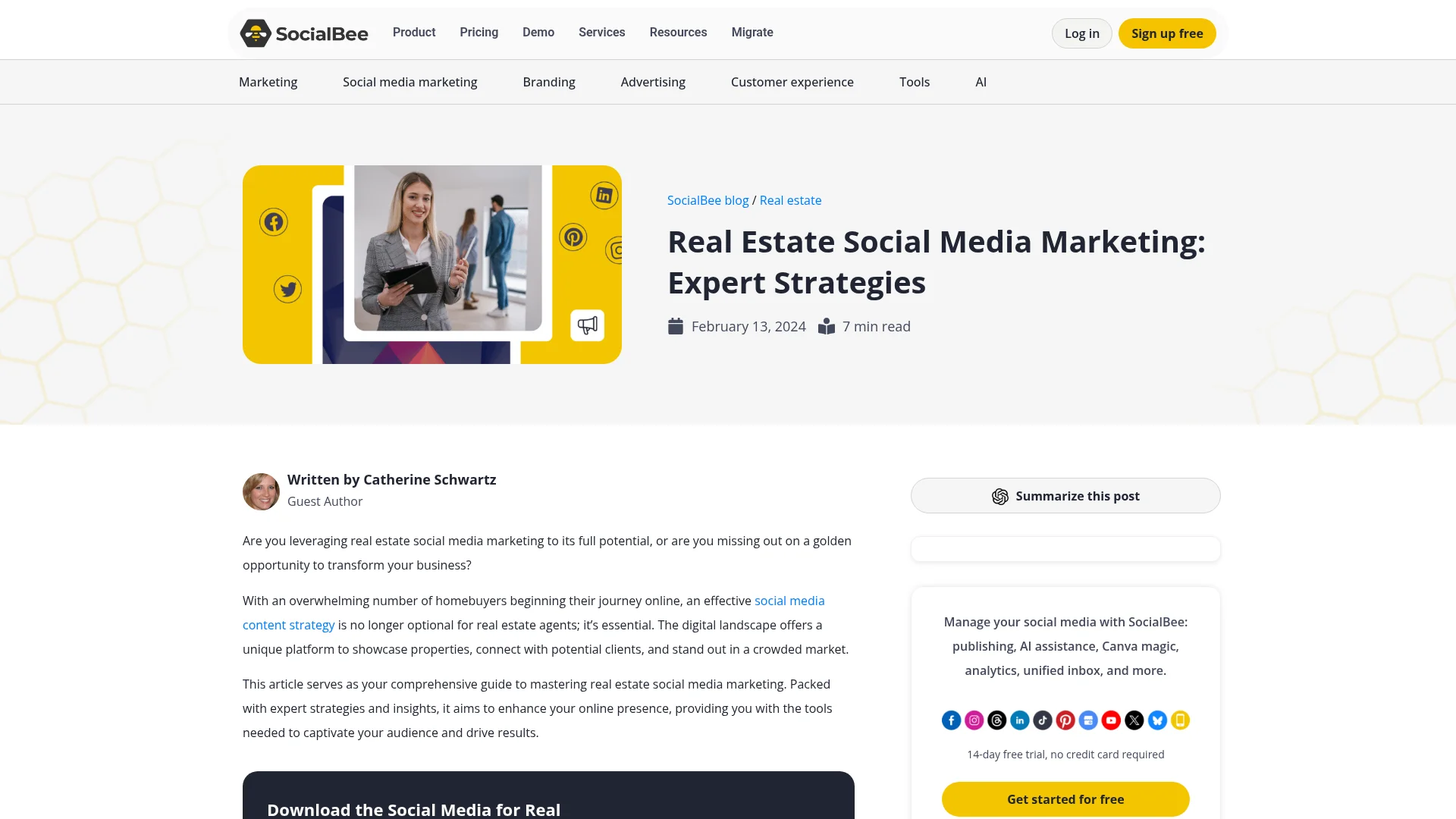
- Real Estate Social Media Marketing: Expert Strategies
/blog/real-estate-social-media-marketing/ - The Ultimate Guide to Social Media for Doctors
/blog/social-media-for-doctors/ - Content Marketing for Small Business: The Ultimate Guide
/blog/content-marketing-for-small-business/ - 10 Law Firm Social Media Post Ideas You Need to Try
/blog/law-firm-social-media-post-ideas/
Tool Comparisons & Alternatives (~33 Pages)
Competitor head-to-heads, "best alternatives to [tool]" listicles, category best-of roundups, and the root-level SocialBee-as-alternative landing pages. A BOFU-leaning surface that captures buyers actively comparison-shopping the category. The cluster covers all three layers of comparison content: roundups (BOFU discovery), head-to-heads (mid-funnel evaluation), and direct alternative positioning (conversion). Alternatives content for tools that have shut down, like Crowdfire, is a low-competition migration-intent opportunity competitors rarely pursue.
Sample pages:
- Crowdfire alternatives: 5 tools to use after Crowdfire shut down
/blog/crowdfire-alternatives/ - My honest take on the best Zoho Social alternatives
/blog/zoho-social-alternatives/ - SocialBee - Your affordable Hootsuite alternative
/hootsuite-alternative/ - My top picks after reviewing 10+ social media management tools
/blog/best-social-media-management-tools/
Free Tools & Generators (~35 Pages)
The library's main interactive lead-magnet surface, with per-platform variants that capture platform-qualified utility search intent generic competitors miss. The 35-URL suite covers AI post and caption generators, per-platform hashtag generators, engagement rate calculators, post mockup generators, image resizers, grid planners, and a UTM link builder. Buyers searching "Instagram hashtag generator" land on a platform-specific tool, not a generic one, which converts better than competing generators.
Sample pages:
- Free AI Social Media Post Generator
/ai-post-generator/ - FREE Instagram hashtag generator
/free-tools/instagram-hashtag-generator/ - FREE social media engagement rate calculator
/free-tools/engagement-rate-calculator/ - FREE editable Instagram post mockup generator
/free-tools/instagram-post-mockup/
Strategy insight: This cluster bundles three buyer-decision surfaces that other social media management peers usually split apart. The bundling is structurally sensible because the audience is the same: a small-business buyer evaluating tools, looking for vertical guidance, or capturing single-task utility value before signing up. The "no signup required" framing on most free tools is a deliberate friction-removal play. SocialBee gives the utility value first and asks for the signup later, when the user wants to schedule what they just generated. The thin agency coverage inside Industry Playbooks (2 URLs) is the most actionable gap. Agencies are one of SocialBee's most explicit product audiences, and a wider editorial library around agency workflows would address a buyer category that searches heavily for "social media tools for agencies."
4. Product & Company Pages
Pages: 118 · Share of library: 9.5%
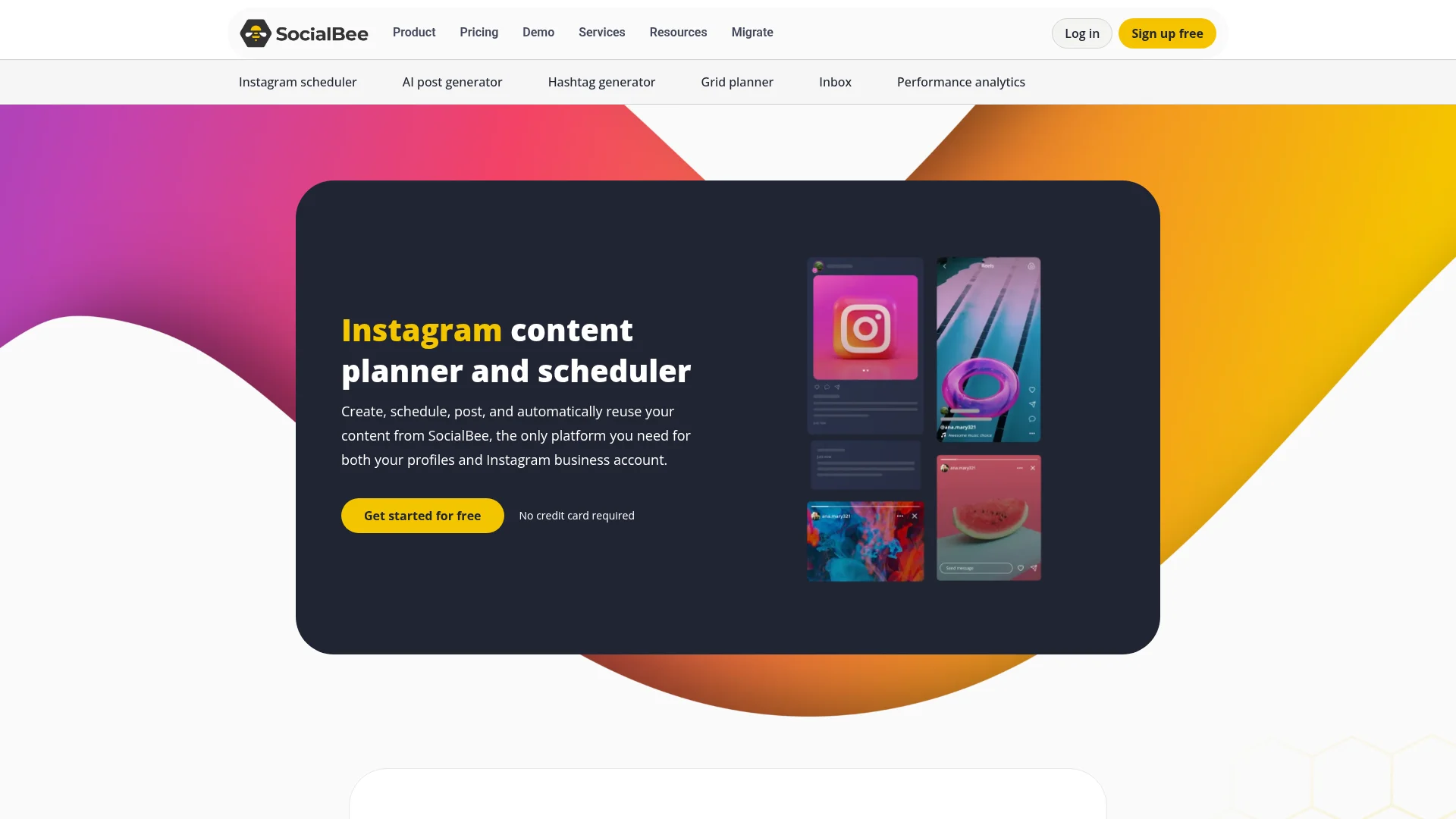
SocialBee's product surface: per-platform scheduling pages, core feature pages, ConciergeBee done-for-you services, audience-targeted product pages, customer testimonials, sales infrastructure, and company brand pages. The conversion-and-identity layer of the library, covering both the software product and the company-side pages that buyers visit during evaluation.
Content-type mix: Product & Feature Pages 48.3% · Other 33.1% · Case Studies/Customer Stories 10.2% · Events/Webinars 6.8% · Blog/Editorial 1.7%
Micro-topics within this cluster
Per-Platform Product Pages (~22 Pages)
Dedicated product pages for scheduling on each supported platform: Bluesky, Facebook, Google Business Profile, Instagram, LinkedIn, TikTok, Twitter/X, YouTube, Pinterest, Threads, and Mastodon. Each supported platform gets its own product surface to capture platform-qualified product search intent ("Instagram scheduler," "TikTok scheduler") and signal breadth to buyers comparing tools. The Instagram product surface goes further with sub-pages for Stories, Reels, Carousels, and collaborative posts.
Sample pages:
- SocialBee, your Instagram content planner and scheduler!
/instagram/ - Schedule Posts on Facebook with SocialBee!
/facebook/ - Post on Bluesky with SocialBee!
/bluesky/ - Manage Google Business Profile (formerly Google My Business) with SocialBee
/google-business-profile/
Core Features & Integrations (~17 Pages)
Standard SaaS product and ecosystem footprint, paired together because they are the cross-cutting feature and partner surface the buyer reaches outside of platform-qualified pages. Coverage includes Copilot, scheduling, publishing, analytics, content creation, engagement, collaboration, the integrations hub, partner programs, affiliate redirects, referral, and contributor pages.
Sample pages:
- Content Creation, Scheduling, Analytics, and Engage | SocialBee Features
/features/ - Social Media Analytics Tool | Monitor Your Performance with SocialBee
/social-media-analytics/ - Social media collaboration made easy with SocialBee
/social-media-collaboration/ - SocialBee Integrations | Content Creation, URL Shorteners and More
/integrations/
Audience-Targeted Pages & ConciergeBee Services (~17 Pages)
Pairs the company's vertical product surface (agencies, real estate, authors, entrepreneurs, NGOs, education, government) with its hybrid done-for-you services line, both of which widen the addressable market beyond pure self-serve software. ConciergeBee covers content writing, white label, video, graphic design, onboarding, and migration. Most peers in social media management are pure software; SocialBee runs a substantial done-for-you service line alongside it.
Sample pages:
- SocialBee for NGOs: Make a Positive Impact through Social Media
/ngo/ - Social Media Management Tool for Education
/education/ - ConciergeBee Services | Get Your Own Social Media Specialist
/services/ - Want to switch to SocialBee? Get our Migration service
/migrate/
Customer Love & Sales Touchpoints (~30 Pages)
The social-proof and sales-infrastructure layer, where persona-specific testimonial collages under /love (agencies, authors, brokers, coaches), public booking and call-scheduling calendars, demo bookings, webinars, SocialBee University course pages, and partner co-marketing events together do the trust-building and call-to-action work outside of the product pages. Naming individual reps in the booking URL set (Anca, Ramon, Julia) is unusual for a self-serve SaaS company at this scale.
Sample pages:
- SocialBee Reviews & Testimonials
/love/ - Why agencies love SocialBee
/love/agencies/ - Book a Call | Social Media Scheduling Tool
/book-a-call-with-us/ - SocialBee's Webinars | Live Demo Webinars and Themed Events
/building-a-winning-marketing-plan-roi-guaranteed/
Company, Pricing & Legal Pages (~32 Pages)
Standard company-identity and policy footprint plus the long tail of anniversary, co-marketing, and one-off utility URLs the marketing site has accumulated over nearly a decade of publishing. Includes homepage, about-us, media kit, the WebPros acquisition announcement, contact, pricing, year-by-year anniversary pages (4-years through 9-years live as separate URLs), legal pages including a dedicated child-safety standards policy, partner co-marketing landings, and a small number of one-off utility URLs.
Sample pages:
- SocialBee | AI-Powered Social Media Management Tool
/ - SocialBee Pricing | Feature Comparison
/pricing/ - WebPros Acquires SocialBee
/webpros-acquires-socialbee/ - Privacy Policy | Learn how we protect your Information
/privacy-policy/
Strategy insight: The cluster's most distinctive choice is the ConciergeBee services thread. Most social media management peers are pure software; SocialBee is software-plus-service, and that hybrid model widens the addressable market (small businesses without internal social capacity become a viable segment) and creates a higher-revenue product line per customer. The per-platform product pages are the second distinctive structural choice. They capture the long tail of platform-qualified product search intent that single product-page peers cede. The sitemap-hygiene flag inside this cluster is the year-by-year anniversary URL set: 4-years through 9-years all live as separate pages with overlapping content. A single rotating /anniversary/ canonical would consolidate backlink equity and cleaner up a long tail of duplicative URLs.
5. Social Media Glossary
Pages: 215 · Share of library: 17.4%
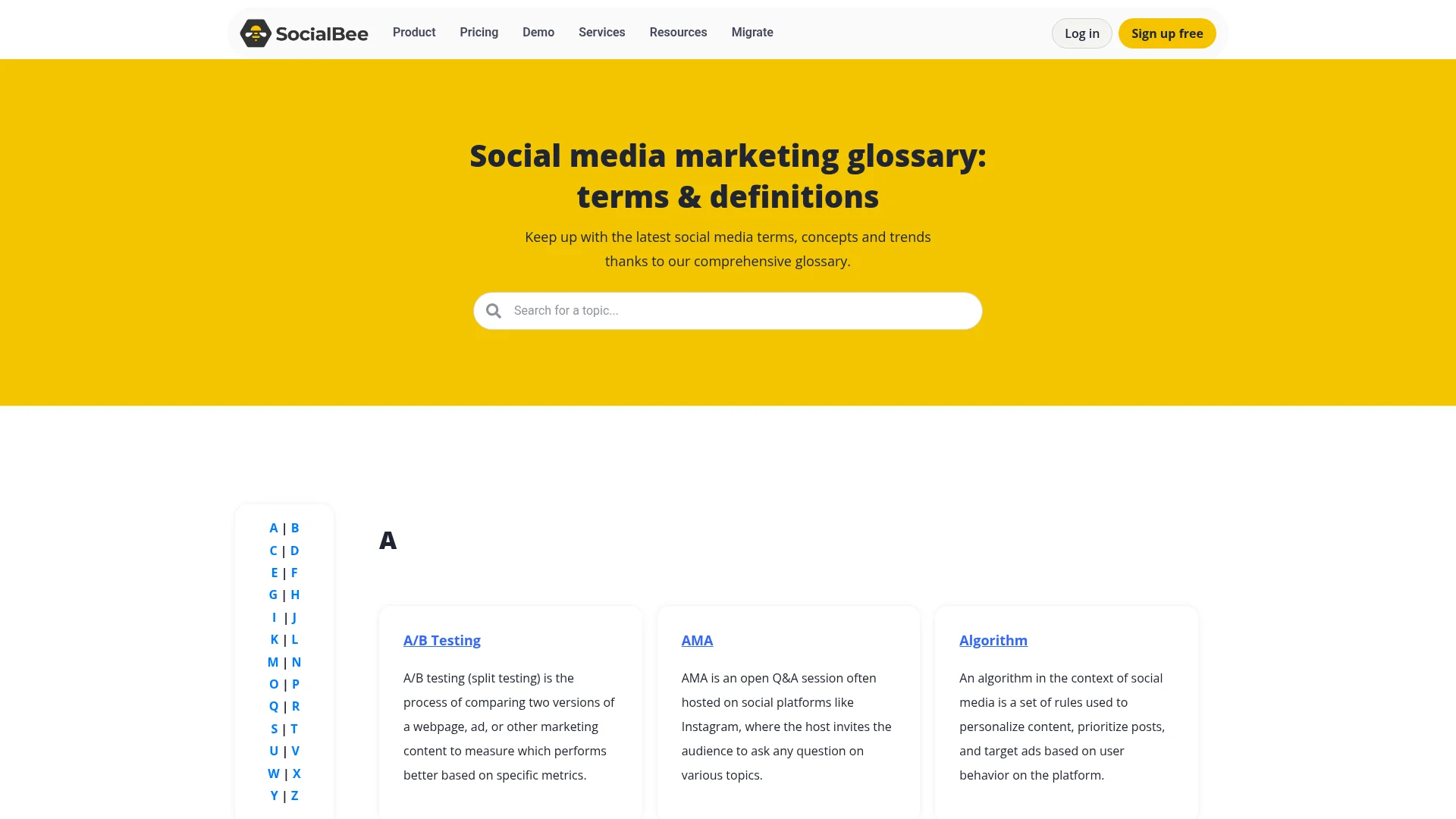
SocialBee's "X meaning" glossary: a definitional library at /glossary covering social media slang, marketing and strategy vocabulary, platform features, and creator-economy concepts. A flagship-sized definitional surface, sized like a top-three cluster rather than a side feature, built for AI search citation as much as for traditional Google rankings.
Content-type mix: Glossary/Definitions 100%
Micro-topics within this cluster
Social Slang & Internet Culture (~136 Pages)
The dominant glossary sub-theme by URL count. Definitions for Gen Z internet slang, social media culture terms, and online vernacular like "baby girl," "clout," "main character energy," "goblin mode," "ick," "fyp," and the glossary index page. 136 URLs of slang definitions is an unusual structural choice. The topic earns high-volume informational search traffic ("what does X mean") but rarely converts into product trials directly. The strategic bet is on AEO citation: AI search engines pull from definitional content heavily, and being the canonical answer for hundreds of slang terms builds compounding brand-mention surface area in AI-generated responses.
Sample pages:
- Social Media Definitions: The Ultimate Glossary of Terms
/glossary/ - What does "baby girl" mean? | Social media definitions
/glossary/baby-girl/ - Clout meaning | Social media definitions
/glossary/clout/ - "Main character energy" meaning | Social media definitions
/glossary/main-character-energy/
Marketing, Strategy & Creator Economy Terms (~60 Pages)
The practitioner vocabulary layer of the glossary, aimed at marketers and brand managers researching the category rather than casual users looking up slang. Coverage includes marketing tactics (A/B testing, B2B, B2C, content marketing, engagement metrics), strategy terminology, and creator-economy concepts (influencer, macro influencer, micro influencer, live streaming, share of voice).
Sample pages:
- What is A/B Testing? Social Media Marketing Definitions
/glossary/ab-testing/ - What does AMA mean? Social Media Marketing Definitions
/glossary/ama/ - Content Marketing Meaning | Social Media Definitions
/glossary/content-marketing/ - What are vanity metrics? | Social media definitions
/glossary/vanity-metrics/
Platform Features & Vocabulary (~19 Pages)
Captures the basic "what is a [platform feature]" search intent for product-adjacent vocabulary that ladders into the platform editorial clusters. Coverage includes algorithm, bio, boosted post, caption, handle, notifications, impressions, YouTube Shorts, FYP, verified, and tagged.
Sample pages:
- What is an algorithm? | Social media definitions
/glossary/algorithm/ - What is a Bio? Social Media Marketing Definitions
/glossary/bio/ - What is a Boosted Post? Social Media Marketing Definitions
/glossary/boosted-post/ - What does "FYP" mean? | Social media definitions
/glossary/fyp/
Strategy insight: This cluster is SocialBee's signature architectural choice. 215 definitional URLs sized as a single flagship asset is unusual in the social media management category. Most peers run small glossaries of 10-50 entries, treating definitions as a side feature. SocialBee has built it as a top-three cluster. The bet is on AI search citation: ChatGPT, Perplexity, and Google AI Overviews lift definitional answers verbatim, and being the canonical source for "what does [slang term] mean" generates brand mentions inside AI-generated responses with no click-through dependency. The 7.1% top-10 share is partly the price of this strategy. Definitional pages compete with Wikipedia, Urban Dictionary, and platform-native explanations, so traditional Google rankings stay long-tail even when AEO performance is strong.
6. Spanish-Language Content
Pages: 375 · Share of library: 30.3%
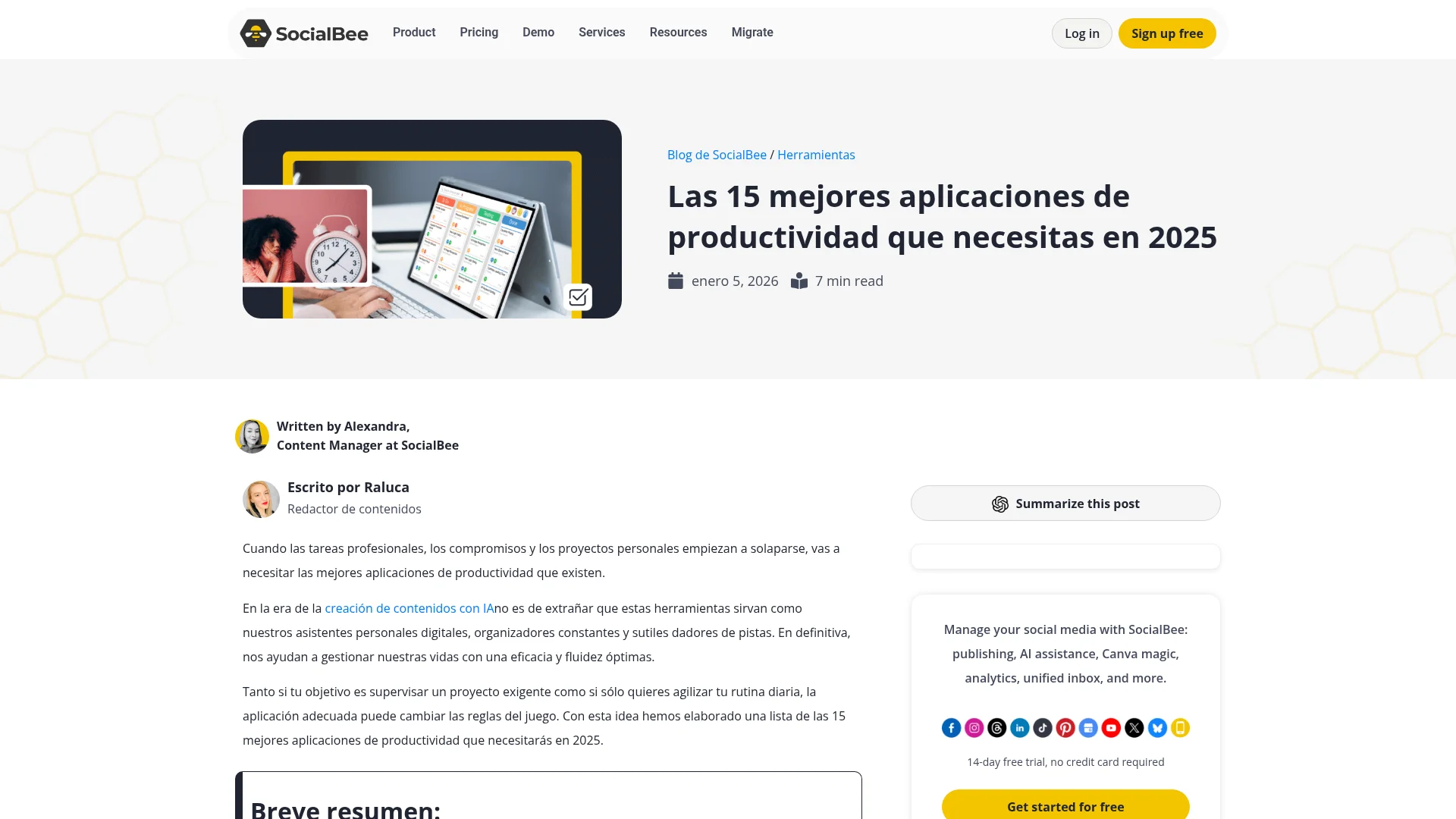
Spanish-language translations of SocialBee's editorial blog under /es, covering platforms, strategy, AI, content craft, and tool comparisons. The single largest cluster on the site and the most consequential locale investment, structured as a near-mirror of the English editorial rather than a curated subset.
Content-type mix: Blog/Editorial 100%
Micro-topics within this cluster
Spanish Strategy, AI & Tools (~167 Pages)
The largest sub-theme in the Spanish library, sized roughly equal to the entire English Strategy, AI & Content Operations cluster and indicating the Spanish coverage is a near-complete mirror of the English editorial. Coverage spans strategy posts, AI tools, scheduling, tool comparisons, productivity, and category roundups in Spanish.
Sample pages:
- Las 15 mejores aplicaciones de productividad que necesitas en 2025
/es/blog/15-mejores-apps-de-productividad/ - La Guía 2025 sobre Marketing de Afiliación vs Marketing de Influencers
/es/blog/affiliate-marketing-vs-influencer-marketing/ - Las mejores alternativas económicas a Agorapulse de 2025
/es/blog/agorapulse-alternativas/ - ¿Qué es el análisis DAFO de las redes sociales y cómo crearlo?
/es/blog/analisis-dafo-redes-sociales/
Spanish Instagram Content (~60 Pages)
Spanish-language Instagram marketing posts covering the algorithm, scheduling, captions, content calendars, growth tactics, and Reels. Instagram is the largest single-platform sub-theme in the Spanish library, mirroring the English Instagram coverage at near-parity and reflecting strong Instagram demand in Spanish-speaking markets.
Sample pages:
- Explicación del algoritmo de Instagram: Tu Guía 2025
/es/blog/algoritmo-de-instagram/ - Las 10 mejores aplicaciones de programación de Instagram para tu negocio
/es/blog/aplicaciones-de-programacion-de-instagram/ - [Plantilla] Crea tu calendario de contenidos para Instagram
/es/blog/calendario-de-contenidos-para-instagram/ - 15 formas de aumentar tu tasa de interacción en Instagram
/es/blog/interaccion-en-instagram/
Spanish Other Platforms Content (~63 Pages)
Spanish-language coverage of Twitter/X, YouTube, Pinterest, Bluesky, and Threads, plus the Spanish blog index page. Mirrors the English "other platforms" coverage at roughly two-thirds the volume, including emerging-platform content (Bluesky, Threads) most peers do not translate because the search volume is too thin to justify the production cost.
Sample pages:
- Blog | Artículos de Marketing en Redes Sociales
/es/blog/ - (24 de abril) Actualizaciones y noticias de 2026 X (Twitter)
/es/blog/actualizaciones-de-twitter/ - Cómo mejorar el SEO en Pinterest e impulsar el descubrimiento y los clics
/es/blog/seo-de-pinterest/ - Cómo hacer y publicar YouTube Shorts
/es/blog/youtube-shorts/
Spanish TikTok & Facebook Content (~51 Pages)
Spanish-language TikTok and Facebook marketing posts covering algorithms, content calendars, ads, scheduling, and platform-specific tactics. TikTok and Facebook coverage in Spanish mirrors the English clusters at roughly 85-90% volume, paired here because their topical shape and audience profile run in parallel.
Sample pages:
- (24 de abril) 2026 Meta y Facebook actualizaciones y noticias
/es/blog/actualizaciones-de-facebook/ - Descifrando el algoritmo de TikTok para el éxito empresarial
/es/blog/algoritmo-tiktok/ - Algoritmo de Facebook explicado: Perspectivas de 2025
/es/blog/algoritmo-de-facebook/ - Cómo crear una página de negocio en Facebook y consejos para el crecimiento
/es/blog/como-crear-una-pagina-de-negocio-en-facebook/
Spanish LinkedIn & Content Craft (~34 Pages)
Spanish-language LinkedIn posts and Spanish content-craft posts covering copywriting, hashtags, visuals, content calendars, and marketing planning. LinkedIn and content-craft coverage in Spanish runs at the lowest ratio relative to the English originals, reflecting smaller Spanish-language B2B and craft-content demand.
Sample pages:
- El algoritmo de LinkedIn explicado (guía 2026)
/es/blog/algoritmo-de-linkedin/ - Primeros pasos con los anuncios de LinkedIn: Una guía completa
/es/blog/anuncios-de-linkedin/ - Cómo programar las publicaciones de LinkedIn en los mejores momentos de 2025
/es/blog/como-programar-las-publicaciones-de-linkedin/ - Más de 100 ideas y ejemplos de publicaciones en LinkedIn para empresas
/es/blog/ideas-de-publicaciones-en-linkedin/
Strategy insight: This cluster is SocialBee's most ambitious content commitment and its biggest authority cost. 375 URLs of near-mirror Spanish translation, covering platforms, strategy, AI, copy, and even emerging social, is far heavier locale investment than any other peer in this category (peer locale counts in the brief: most run 1 locale; the largest, Hootsuite, runs 6 but with proportionally less content per locale). The strategic logic is sound for a Romania-based company with European market reach: the Spanish-speaking market is large, underserved by English-only competitors, and the editorial cost of translation is lower than original-content production. But the per-URL authority dilution is real. 30% of the library's URLs compete for backlinks and search authority that English originals would otherwise consolidate. The 7.1% top-10 ranking share (well below category peers in the 21-23% range) is the visible cost. The question for SocialBee: does the Spanish reach drive enough conversion to outweigh the authority cost across the full library, or would a curated 75-URL Spanish library focused on the highest-converting topics outperform the full mirror?
Key Observations
What Stands Out About SocialBee's Content Strategy
The library is editorial-led with a flagship-sized definitional layer underneath
67.7% of pages are Blog / Editorial and 17.4% are Glossary / Definitions: together, 85% of the 1,238-URL library. This is not the standard SaaS shape, where product, guides, and case studies typically share the load. SocialBee has chosen to invest the equivalent of a second content cluster (the 215-URL glossary) in definitional content built for AI search citation, treating AEO as a structural commitment rather than a side experiment. For a 10–50 person company in a category dominated by larger competitors, the bet makes sense. AI citation is one of the few surfaces where editorial discipline can outweigh domain authority.
The Spanish-language library is the single most consequential architectural choice
375 Spanish-language URLs at 30.3% of the library is the heaviest non-root locale commitment of any peer in this category cohort. The /es content is a near-mirror translation rather than a curated subset. Instagram, TikTok, Facebook, LinkedIn, AI, strategy, even emerging platforms all carry Spanish counterparts. The reach play is defensible for a Romania-based company with European market exposure, and the production cost of translation is lower than original content. But the per-URL authority cost is visible in the 7.1% top-10 ranking share, meaningfully below peers like Buffer (23.5%), Sprout Social (23.4%), and Hootsuite (22.3%). The strategic question is whether the Spanish reach drives enough qualified conversions to outweigh the per-URL authority dilution across the full 1,238-page library.
Per-URL efficiency is high; the library works harder per page than larger peers
At ~116 visits per URL across 1,238 pages, SocialBee's per-page efficiency is materially higher than peers running larger libraries and within range of bigger players. The smaller, more focused library is a competitive feature. Every URL has to earn its place when there are only 1,238 of them. Sustaining this at scale requires preserving the per-page bar: the temptation to add 500 thin AI-generated pages would collapse the efficiency advantage without proportional traffic gain. Per-URL efficiency also means the library has less of a buffer against traffic shocks than peers with 5x the page count, so a single algorithm shift hits harder.
3,477 ranking positions sit in 11-20, the most actionable optimization opportunity in the library
The position distribution shows 10.7% of positions on page 2 of search results: content already ranking but one step short of top-10 visibility. For a library where top-10 share is the visible weakness, focused optimization on those 3,477 positions is the most direct lever available. A typical SEO team could work through 200-300 of those URLs in a quarter, with the highest-priority candidates being the high-volume English platform tactical content (best-time-to-post, how-to-X) inside the Platform Playbooks cluster, where competing tool blogs already outrank SocialBee on similar queries.
No first-party research franchise, despite the category rewarding it
Only 3 URLs classified as Research / Reports and no annual "State of" series detected. Social media is one of the most research-friendly categories in B2B SaaS. Hootsuite's Social Media Trends, Sprout Social's Index, and Buffer's State of Remote Work all anchor editorial clusters and earn category-wide backlinks year after year. SocialBee's gap here is the most actionable compounding-asset opportunity on the page: a single annual benchmark report ("State of Social for Small Businesses" or "State of Social in Spanish-Speaking Markets") would create a defensible authority anchor that the editorial-led architecture doesn't currently have, and it would feed compounding citations into the Strategy, AI & Content Operations cluster on an ongoing basis.
Strategy, AI & Content Operations doubles as a category-capture play around AI vocabulary
176 pages in a cluster that pairs strategy frameworks with AI tooling and content craft is a deliberate move on emerging category vocabulary. While larger peers continue to treat AI as a separate sub-section bolted onto their strategy hub, SocialBee has built the AI-and-craft pairing as a single editorial thread (29 URLs inside the AI, Content Craft & Ideas micro-topic). The bet: claim the "AI for social" vocabulary before competitors settle on it. For a smaller challenger competing on agility rather than scale, that's the right play. The risk is that a category-vocabulary land-grab depends on consistent publishing cadence to defend, and a 29-URL footprint will erode quickly if the AI editorial pace slows while competitors catch up.
ConciergeBee is a hybrid software-plus-service play visible inside the product cluster
Most peers in social media management are pure software. SocialBee runs ConciergeBee: a done-for-you content writing, video production, graphic design, white-label, and onboarding service line bundled together with audience-targeted product pages inside a single micro-topic. The hybrid model widens the addressable market (small businesses without internal social capacity), creates a higher-revenue product line per customer, and gives the editorial cluster on outsourced social media (brand consistency, agency tools) a natural conversion path. Strategically distinctive, and rare enough in the category to be worth surfacing as a positioning lever. The structural question is whether ConciergeBee should get its own dedicated product cluster rather than sharing space with audience pages, since the service line is operationally distinct from the software product.
The /blog path overloads multiple content types, blurring section authority
489 URLs sit under /blog spanning four different content types (Blog / Editorial, Comparison Pages, Research / Reports, Other) and four clusters. Comparison pages and research reports share a path prefix with editorial blog content, which makes URL-based architecture analysis harder for search engines trying to assess section-level authority. The fix is a path restructure (/compare/ for comparisons, /reports/ for research), but the migration cost is real (redirects, link equity preservation), so this is a "fix when next replatforming" flag rather than an urgent issue.
More analyses in Social Media Management
Sprout Social
How Sprout Social uses 1,519 blog posts and the annual Sprout Social Index to drive 2.2M monthly visits in social media management. 2,155 pages, 9 clusters.
Agorapulse
How Agorapulse uses 2,872 blog posts and a 421-URL multi-podcast network to drive 175K monthly visits in social media management. 4,086 pages, 7 clusters.
Brandwatch
How Brandwatch uses 3,844 blog posts and a 453-URL research franchise to drive 534K monthly visits in social media management. 7,072 pages, 7 clusters.
Buffer
How Buffer uses 2,029 blog posts and the Open Buffer transparency library to drive 2.5M monthly visits in social media management. 2,982 pages, 7 clusters.
Methodology: This analysis is based on SocialBee's full public sitemap (1,238 URLs, sourced from robots.txt), enriched with each URL's title and meta description via lightweight HTTPS fetches. URLs were classified into a 12-bucket content type taxonomy and grouped into 6 topic clusters with 26 micro-topics using LLM-assisted classification. Company facts came from public web research across Crunchbase, LinkedIn, GetLatka, and the company's own About and acquisition-announcement pages. Traffic metrics (monthly organic visits, traffic value, ranking positions, position distribution) came from DataForSEO's domain rank overview, aggregated globally across 117 locale combinations. All counts reflect the SocialBee sitemap as of 2026-05-25.