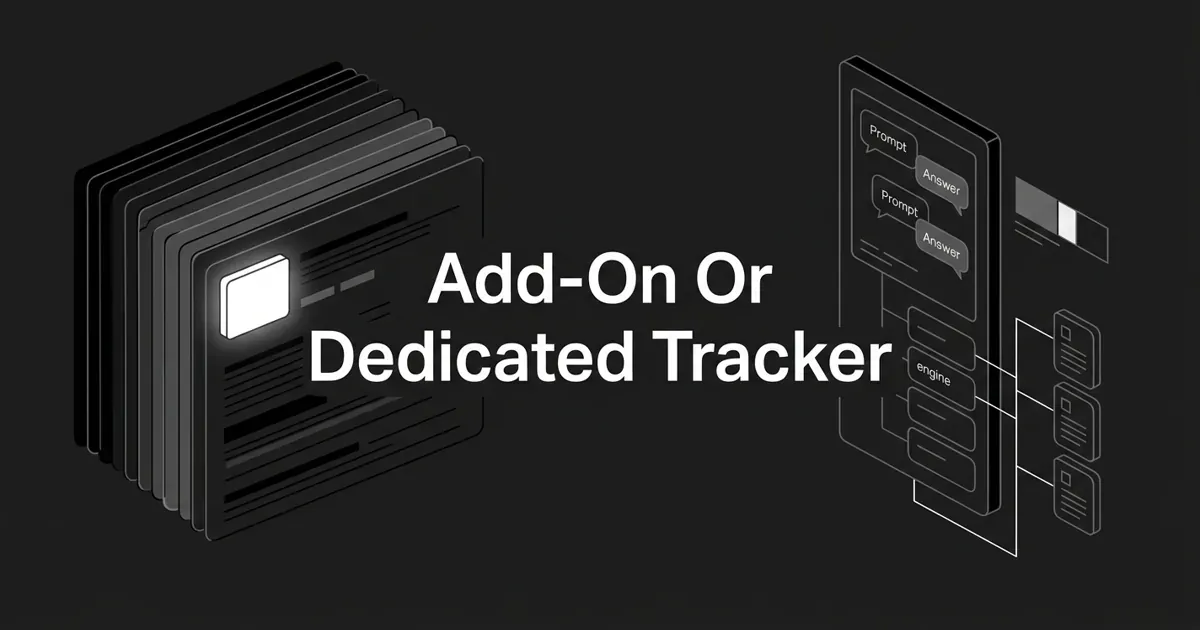
Most teams reaching the Ahrefs Brand Radar vs Profound decision are not starting from zero. An Ahrefs subscription is already approved, rank tracking is running, and someone in leadership has asked what the brand looks like inside AI answers. The incumbent has a ready response in Brand Radar, an add-on that switches on inside a tool the team already knows, billed against a vendor relationship finance has cleared. The alternative is a dedicated AEO tracker bought separately, with its own contract, security review, and interface. The question is not which product lists more features. It is whether a measurement layer built beside a backlink index covers the program a team intends to run, and whether the distance between what that add-on reports and what an AEO program consumes justifies a second line item.
The scope is deliberately narrow. This Ahrefs Brand Radar comparison assesses Brand Radar the feature against Profound the platform, not the full Ahrefs suite around it, and not the keyword research, backlink analysis, and technical audit tooling that no answer-engine product replaces. DeepSmith sits in the same table because it occupies a third position, tracking joined to production.
The three options at a glance
| Dimension | Ahrefs Brand Radar | Profound | DeepSmith |
|---|---|---|---|
| Product type | Add-on inside the Ahrefs suite | Standalone AEO platform | Standalone tracking plus content production |
| Published price | $199/mo single index, $699/mo all platforms | $99 Starter, $399 Growth, Enterprise custom | $99 Pro, $199 Grow, $399 Scale, Enterprise custom |
| Base subscription | Required: Ahrefs $129 to $1,499/mo | None | None |
| Realistic full-breadth entry | Roughly $828/mo (Lite plus all platforms) | $399 Growth for three engines, Enterprise for nine | $399 Scale for three engines, Enterprise for ten |
| Engines tracked | 6 default indexes, plus YouTube, Reddit, TikTok in beta | 1 at Starter, 3 at Growth, up to 9 at Enterprise | ChatGPT, plus Perplexity, plus Gemini by tier, all ten at Enterprise |
| Claude coverage | Custom prompts via the Claude API | Enterprise | Enterprise |
| Chatbot refresh | Monthly (AI Overviews every few days) | Daily to weekly | Scheduled per workspace |
| Prompt sourcing | Search-derived library, 218M to 405M+ | Prompt Volumes panel across US, UK, FR, DE, ES | Discover Prompts, from stored brand context |
| Sentiment | Three-class | Per-engine plus narrative trends | Tracked, with mention and citation rate |
| Crawler analytics | None | Agent Analytics on server logs | Not offered |
| Content production | None | Agents draft and publish | Content Studio and Autowrite, publish-ready |
| CMS publishing | None | WordPress, Sanity | WordPress, Webflow, Strapi, Sanity, Contentful, webhooks |
| Alerting | Ahrefs suite only | Slack, Teams, webhooks, API at Enterprise | Publishing integrations |
| Governance | Inherited from the Ahrefs account | SSO, SAML, SOC 2 at Enterprise | Per-workspace isolation |
| How it is bought | Self-serve | Demo-led, no self-serve signup | Self-serve, 7-day free trial |
Two things in that table decide most purchases. Profound carries the wider engine list, the fresher data, and an action layer Brand Radar does not attempt. Brand Radar carries the advantage no Ahrefs Brand Radar comparison can render in a cell, which is that for an existing customer it arrives without a new vendor, a new contract, or a new procurement cycle.
Ahrefs Brand Radar: measurement beside the backlink index

Brand Radar is sold as a paid add-on rather than a standalone product, so access requires an Ahrefs subscription first. That dependency is also the product's central commercial argument: for a customer base reported at more than a million paying accounts, AI visibility arrives as another tab in a familiar interface rather than as another vendor to onboard.
Coverage out of the box runs to six default AI indexes: Google AI Overviews, Google AI Mode, ChatGPT, Perplexity, Gemini, and Microsoft Copilot. YouTube, Reddit, and TikTok are tracked as supplementary visibility surfaces in beta, with coverage the vendor describes as incomplete. Claude is not among the default indexes, and tracking it requires configuring custom prompts through the Claude API, a materially different operation from native indexing.
The metric set is what a measurement buyer expects and slightly more: mentions, citations of the brand's URLs, AI Share of Voice against a named competitor set, three-class sentiment, a composite visibility score, and Impressions, defined as mentions weighted by the underlying Google search volume for the prompt. That last definition matters, because the weighting derives from search demand rather than AI engine call volume, which makes Impressions a proxy rather than a count of answers served.
The structural advantage is the prompt library, a search-derived corpus assembled from Google autocomplete, clickstream, and query-log data, reported between 218 million and 405 million prompts depending on the source consulted. No dedicated tracker publishes a comparable figure, and the scale is a real consequence of sitting beside a mature search index. The bound follows from the sourcing: search-derived prompts describe what people type into a search box, so conversational follow-ups and persona-shaped questions that exist only inside a chat window are absent unless they also surface in search data.
Three limitations recur across third-party reviews. Chatbot indexes refresh monthly, while AI Overviews and AI Mode refresh every few days and web visibility every few minutes, so the freshness a team experiences depends on which surface it watches. Crawler analytics are absent, so bot behavior on the site is invisible. There is no production layer and no public Slack, Teams, or webhook delivery, so findings leave the dashboard by export or by hand. For a team reporting quarterly on AI Overviews, none of these bite. In a category where competitors publish weekly, the monthly chatbot cadence is the constraint that surfaces first.
Profound: a dedicated AEO tracker with an action layer

Profound is not an add-on to anything. It was built for answer engines on the premise that AI search is a distinct channel with its own measurement and attribution mechanics, and the company raised a $96 million Series C in February 2026 at a reported $1 billion valuation, with Sequoia and Kleiner Perkins among the investors. That funding is evidence about category conviction, not measurement accuracy.
Published pricing runs three tiers. Starter at $99 per month covers one engine, ChatGPT, with 50 unique prompts and roughly 1,500 responses per month, one seat, and one language and region. Growth at $399 per month covers ChatGPT, Perplexity, and Google AI Overviews, with 100 unique prompts and roughly 9,000 responses per month, three seats, six optimized articles per month, and CSV and JSON export. Enterprise is custom, and is where the remaining engines, multiple tracked companies, SSO and SAML, SOC 2 compliance, API access, and a dedicated Slack channel arrive.
The module set is where the case for a second subscription is made. Answer Engine Insights reports mention and citation analytics per engine with historical trends and competitor leaderboards. Prompt Volumes estimates demand for specific prompts using opt-in consumer panel data across the United States, United Kingdom, France, Germany, and Spain, a demand-side signal rather than a query database. Shopping tracks product-level visibility inside AI shopping surfaces. Agent Analytics reads server logs to show how GPTBot, ClaudeBot, PerplexityBot, and similar crawlers hit the site and on which pages, with no counterpart in the surveyed alternatives. Agents is a workflow builder with native publishing to WordPress and Sanity, and Aim is a chat interface monitoring citations and sentiment in real time.
The limits are as specific as the strengths. Engine breadth is largely Enterprise-gated: Starter is single-engine and Growth stops at three, so Claude, Gemini, Grok, Meta AI, DeepSeek, and Copilot require a custom contract whose price is not published. The sales motion is demo-led with no public self-serve signup and no listed free trial, which lengthens the path from interest to data, though the free and ungated AEO Report gives any domain a benchmarking snapshot without an account. A team evaluating Profound as an Ahrefs Brand Radar alternative should price the Enterprise conversation into the timeline rather than assume the published tiers describe what it will end up buying.
DeepSmith: tracking joined to production

Both products above are instruments. One reports and stops; the other adds a workflow layer on top of reporting. Neither removes the work that follows a visibility gap, which is producing the page that closes it, and that distance between diagnosis and publication is where most AEO programs stall. A dashboard showing a competitor owns eleven of twenty prompts is useful only in proportion to the content a team can ship.
DeepSmith is built around that second half. It tracks mention rate, citation rate, share of voice, and sentiment across ten engines: ChatGPT, Gemini, Perplexity, Claude, Google AI Overviews, Google AI Mode, Grok, Meta AI, Microsoft Copilot, and DeepSeek. Coverage rises by tier, and Enterprise covers all ten. Discover Prompts builds a starter tracking set from stored product, persona, and buyer-stage context rather than a search corpus, and Content Studio turns the resulting gaps into publish-ready articles, researched, internally and externally linked, with a cover image and metadata. Autowrite runs that production on a schedule with no one in the app, publishing to WordPress, Webflow, Strapi, Sanity, Contentful, or custom webhooks.

Pro tracks ChatGPT only, with the wider list arriving by tier, though ChatGPT is where most category research begins, and crawler analytics are not part of the product: DeepSmith measures what engines answer, not what their bots fetch. What it adds instead is the layer neither tracker attempts. Opportunity Agents read your visibility data and your Content Map, a topic taxonomy covering your site plus unlimited competitor sites and refreshed every 24 hours, then return ideas with the data point that justifies each one attached, so the gap and the article that answers it come from the same stored context.

Engine coverage and where the prompts come from
On default coverage at the price a team pays first, Brand Radar leads. Six indexes including both Google AI surfaces and Copilot, available immediately on a self-serve purchase, is broader than Profound Starter's single engine or Growth's three, and the beta YouTube, Reddit, and TikTok surfaces have no equivalent. At the ceiling the order reverses: Profound Enterprise reaches up to nine engines including Claude, Gemini, Grok, Meta AI, and DeepSeek natively, while Brand Radar reaches Claude only through custom API prompts and does not index the others. DeepSmith Enterprise covers ten.
Which end of that range matters depends on where a brand's buyers work. For a company whose audience researches in ChatGPT and Google surfaces, the engines Profound adds at Enterprise are theoretical, and paying a custom contract to measure them is spending against a hypothesis. In a developer-tools or research-heavy segment where Claude or DeepSeek carries real usage, an unmeasured engine is a blind spot suite convenience cannot compensate for, and the Ahrefs Brand Radar alternative becomes necessary rather than optional.
Prompt sourcing is the less visible difference and the more consequential one. Brand Radar's corpus is search-derived at enormous scale, genuinely useful for mapping category demand and for aligning an AI tracking list with an existing keyword program. Profound's Prompt Volumes models demand from opt-in consumer panels in five markets, closer to how people phrase questions inside a chat interface but still a modeled estimate rather than engine telemetry. Neither measures what engines are actually being asked. A team whose tracking list is essentially a translated keyword list will find the search-derived method adequate; a team building its list from recorded buyer conversations will find it lossy at the high-intent end.
Refresh cadence, sentiment, and crawler visibility
Refresh cadence is where the two products separate most cleanly. Profound refreshes AI engine data daily to weekly. Brand Radar refreshes chatbot answers monthly, AI Overviews and AI Mode every few days, and web visibility metrics every few minutes. For a quarterly report the difference is immaterial, and for a team watching AI Overviews the gap nearly closes. For a team that ships a page and needs to know within two weeks whether anything moved in ChatGPT, a monthly snapshot makes the feedback loop longer than the publishing cycle it is meant to inform.
Brand Radar and Profound both classify sentiment, but not in the same way. Brand Radar applies a three-class classifier, answering whether the framing was broadly favorable. Profound layers per-engine sentiment with brand-narrative tracking over time, answering how the framing is changing and where. Neither is human-verified, so both are directional indicators rather than audited metrics, and listing them as equivalent rows understates the difference in depth.
Crawler analytics exist in exactly one product. Profound's Agent Analytics reads server logs and reports how often GPTBot, ClaudeBot, PerplexityBot, and similar agents crawl a site and which pages they take. Brand Radar has no equivalent, so a team using it cannot connect a visibility change to whether the relevant pages were fetched at all. For a B2B brand with a small site and stable infrastructure, this telemetry will rarely be opened. For a large site, or one behind a CDN or firewall that may be refusing AI crawlers, it is the difference between diagnosing a cause and guessing at one.
What each option actually costs
Brand Radar's headline SKUs are $199 per month for a single index and $699 per month for all platforms, the latter including 2,500 custom-prompt checks. Neither number is the cost, because both layer on an Ahrefs subscription that runs $129 per month for Lite, $249 for Standard, $449 for Advanced, and $1,499 for Enterprise. The realistic all-in figure for a team that wants every index is roughly $828 per month on a Lite base, rising with the tier, and custom-prompt overages add $50, $100, or $250 per month for 2,500, 7,000, or 25,000 additional checks. A buyer reading $699 as the total will be surprised, and some surfaces and custom-prompt capabilities are gated to higher Ahrefs tiers rather than unlocked by the add-on.
The arithmetic on Profound vs Ahrefs Brand Radar changes shape depending on what is already being paid. Against the full $828 bundle, Profound Growth at $399 per month is less than half the cost, covers three engines with daily-to-weekly refresh, and adds crawler analytics, deeper sentiment, and a publishing workflow. Against an Ahrefs subscription that exists regardless, the comparison is $199 or $699 in marginal spend against $399 in wholly new spend plus a second vendor review, which is why many teams choose the narrower product. Profound's Enterprise tier, where the wider engine list lives, carries no published price at all.
DeepSmith prices on the same shelf as Profound's published tiers, at $99, $199, and $399 per month, or $80, $160, and $299 billed annually, with custom Enterprise pricing above that. The relevant comparison is not tracker against tracker. A team buying Brand Radar or Profound and then paying writers or an agency to act on what either reports is carrying two costs, and DeepSmith consolidates them by producing the articles from the same context that produced the gap.
How each product is bought
Procurement differences are easy to overlook and frequently decisive. Brand Radar is self-serve: an existing customer adds the SKU and has data the same day, with no security review because the Ahrefs account cleared one already. There is no free trial, so the first look is a paid one.
Profound is demo-led, with no public self-serve signup on the paid tiers. That is normal for enterprise software, but the path from interest to first data runs through scheduling, a call, and a quote rather than a credit card. The free AEO Report partly offsets the friction. Governance runs the other way: Profound's SSO, SAML, and SOC 2 posture at Enterprise is a documented answer to a security questionnaire, while Brand Radar is sold as a feature and inherits whatever the parent account established.
DeepSmith is self-serve with a 7-day free trial and no long-term contracts, closer to Brand Radar on friction and closer to Profound on scope. Onboarding builds the workspace from the company website, so the brand brief, competitor set, starter prompts, and first ideas are populated before payment.
Which should you choose
Ahrefs Brand Radar fits a team already standardized on Ahrefs whose priority is baseline visibility across Google AI surfaces and the major chatbots, whose reporting rhythm is monthly or quarterly, and whose acting-on-findings workflow lives elsewhere. It gives the broadest default index list of the three, the largest prompt corpus in the category, and social surfaces nobody else tracks. Choosing it means accepting monthly chatbot refresh, no crawler analytics, no production layer, Claude only through custom API configuration, and an all-in cost near $828 per month that the add-on price does not reveal.
Profound fits a team treating AI search as a strategic channel with its own budget and its own operator. It is the right answer when the engine list must include Claude, Gemini, Grok, Meta AI, or DeepSeek, when prompt-level demand estimation drives prioritization, when crawler behavior needs to be visible, when product visibility in AI shopping surfaces matters, or when SSO, SAML, and SOC 2 are procurement preconditions. The costs are a demo-led sales cycle with no free trial, engine breadth gated behind unpublished Enterprise pricing, and a platform newer than the suites it displaces.
Reversed as Profound vs Ahrefs Brand Radar, the decision is usually about ambition rather than features. An incumbent add-on is often the correct first purchase for a program that does not yet exist, because the realistic alternative to a narrow tracker is frequently no tracker at all. A dedicated platform earns its separate line once the engine mix, the refresh cadence, or the crawler question has outgrown what an add-on measures.
DeepSmith fits the team whose bottleneck is not finding the gaps but closing them. Tracking across ten engines sits in the same platform that produces the on-brand articles those gaps require, which removes the handoff between the dashboard and the writing queue. Teams weighing an Ahrefs Brand Radar vs Profound purchase against a track-and-produce platform can start a DeepSmith free trial and run their own prompts for seven days before deciding.