You did the outreach. A podcast, two roundups, a review profile, a Reddit thread your team seeded honestly. Three months later, you ask ChatGPT the one question your buyers ask, and it names a competitor.
If that stings, it should. It also does not mean the work failed.
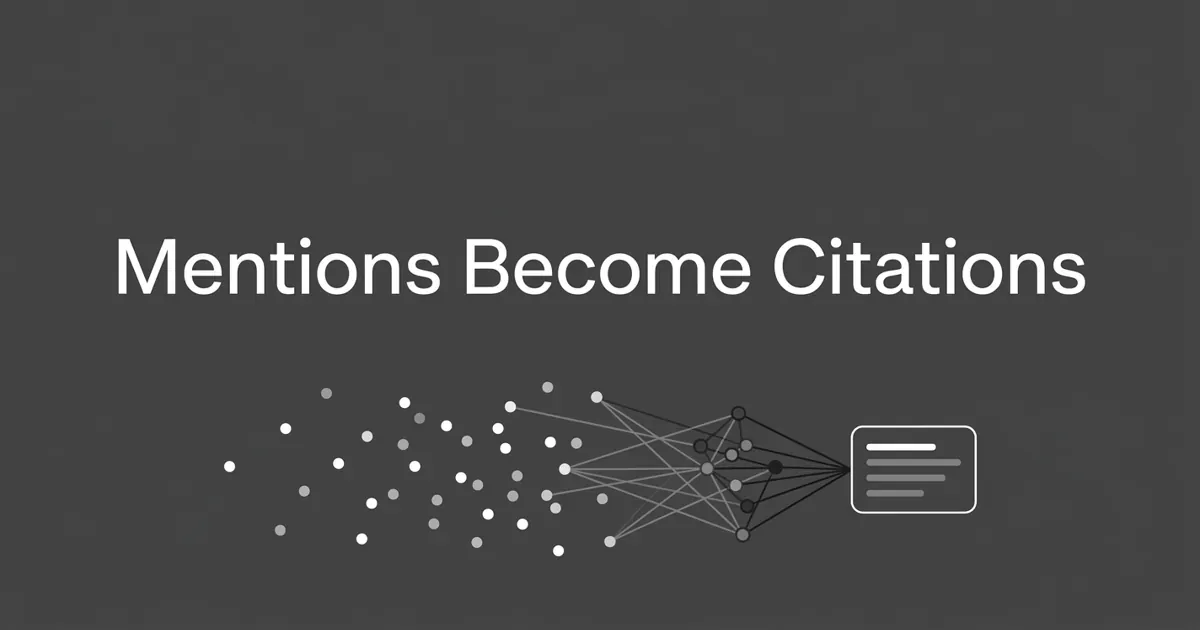
Here's what's actually happening. Offsite brand mentions AI engines can read are not votes that get counted the way backlinks were. They are evidence. Each one nudges a model's confidence about who you are and whether you're safe to name out loud. One piece of evidence is nothing. A stack of independent, consistent evidence is everything.
That stack takes months to build, and then it holds.
This piece is about the mechanism underneath that delay. Not the tactics for any one channel, and not how to measure it, but why a scattered set of third-party references eventually turns into your brand being cited by name. Once you understand the mechanism, you stop treating mentions as a one-off PR push and start treating them as an asset that compounds.
Take a breath. You're probably closer than the dashboard suggests.
AI Doesn't Rank Pages, It Aggregates Facts
Answer engines do not scan ten blue links and pick a winner. They build an internal picture of the world from everything they've read, then answer against that picture.
Two things feed the picture.
The first is parametric memory, the knowledge baked in during training. Roughly 60% of ChatGPT queries are answered from that memory alone, with no live lookup at all. If your brand isn't in there, no amount of on-site optimization changes the answer this week.
The second is retrieval. When the question is fresh or the model is unsure, it goes and fetches passages to ground its response. Perplexity indexes more than 200 billion URLs in real time to do exactly this.
This is not a fringe channel anymore. Around half of US consumers already use AI-powered search, and somewhere between a fifth and half of traditional search traffic is considered at risk of moving there.
Here's the part that reframes everything: your own website is one voice in that picture, and a self-interested one. Analysis of more than 21,000 brand mentions in AI search found about 85% of them come from third-party sources, and that brands are roughly 6.5 times more likely to be mentioned through someone else's content than through their own.
You are not the main character in the model's version of your category. The people writing about you are.
That's not a reason to stop publishing. It's a reason to stop expecting your site alone to carry the answer.
Your next step: write down the ten questions your buyers actually ask before they buy. Run three of them in ChatGPT this week and note who gets named. That list is your baseline, and it takes twenty minutes.
Why One Mention Is Noise and Five Is a Signal
Corroboration is the whole mechanism. A model will name and cite a brand when independent sources agree, and it hedges when they don't.
Think about why. These systems are penalized hard for being confidently wrong. When only one source says something, and that source is the brand's own homepage, the safest move is to soften the claim or skip it. When five unrelated sources say the same thing, repeating it is low risk.
So the rough shape looks like this:
- One mention is noise. It could be an ad, a fluke, a paid placement.
- Two mentions are a confirmation cue. Something might be real here.
- Five or more, across different publisher types, is consensus. Now the model has enough cover to name you and to link to a primary source.
Variety matters more than volume. Five Reddit threads are weaker than one Reddit thread plus one review-site profile plus one industry publication plus one directory entry plus one Wikipedia reference. Same count, completely different weight, because the brand consensus LLM systems build is measured in independent confirmations, not in raw mention totals.
This also explains the gap you're staring at. Mentions and citations are not the same event, and the difference between a mention and a citation is where most of the confusion lives. ChatGPT names brands about 3.2 times more often than it cites them, averaging 2.4 mentions per prompt against 0.74 citations. One study of AI answers found only 23.1% of brand mentions came with a citation attached.
You will almost always be mentioned before you are cited. That order is normal.
Your next step: list every distinct type of source that already mentions you. Publisher types, not URLs. If you can only name two, your goal this month is a third, not a tenth mention on the same site.
How AI Mentions Build Citations When There Is No Link
An unlinked mention still counts, just not in the way you'd hope. It builds the model's confidence in you. It does not hand the model a URL to point at.
Three flavors show up in the wild.
Linked mentions. A third-party page names you and links to you. Strongest form, because it works as corroboration and as a citation target at the same time.
Unlinked mentions. A page names you with no hyperlink. Still real evidence. Language models read the sentence around your name, not just the link graph, so a review that names your product in a paragraph about the best tools for distributed teams feeds the same retrieve-and-summarize step whether or not the words are clickable.
Co-occurrence. Your brand sits alongside your founder, your product line, your category, or your parent company inside structured records. No prose required. The relationship itself is the signal.
All three feed the machine. Stack enough of them and you can watch how AI mentions build citations in slow motion: the model gets confident enough to name you, then confident enough to point at a source.
That's why unlinked mentions AI search systems encounter still move the needle, and why chasing a link on every placement can waste leverage you already have.
One honest limit. An unlinked mention on a spam forum or an off-topic directory contributes nothing. The mechanism is third-party consensus in the right context, not mentions anywhere. Fit beats volume every single time.
Your next step: pull the last ten places you were mentioned without a link. Ask one question of each: is this source on-topic and credible? Keep the ones that pass, and stop chasing links on the ones that don't.
Offsite Mentions Feed an Entity Graph, Not a Link Score
Every mention does one specific job: it strengthens your position inside the structured map the model uses to understand entities.
That map knows "Acme" and "Acme Inc." and "Acme CRM" and "Acme's founder" are connected. It's assembled from public sources: encyclopedia entries, structured data records, company profiles, professional pages, review platforms, community forums, and consistent coverage in the press.
The connections are what matter. When someone asks for the best tool for a specific job, the model walks from category, to the brands attached to that category, to the attributes attached to each brand. No node, no walk. You aren't beaten in that moment, you're absent from it.
Which is why entity work and mention work are the same work. Every roundup, comparison page, expert quote, and directory listing draws another edge. Nothing dramatic happens on any single one. The map just gets a little more certain.
Three things make that certainty easier to build:
- Use one canonical identity. Same legal name, same product naming, same category language everywhere. Abbreviations without context create orphan records that never connect to you.
- Wire the connections explicitly. Organization markup on your site with a complete list of your official profiles elsewhere tells the model these records are all one company.
- Write claims that carry their own evidence. Not "we deploy fast." Instead, name the entity, the attribute, the concrete value, and the proof behind it. Models trained to avoid making things up treat that structure as safe to repeat.
Consistency across surfaces is unglamorous and it is load-bearing. If three sources describe your category three different ways, you've given the model three reasons to hedge.
Your next step: open the five external profiles you control (company directories, review sites, professional pages) and make the one-line description identical on all of them. That's a single afternoon, and it's the cheapest confidence you'll ever buy.
The Compounding Timeline: Month One to Month Six
Stable lift usually takes three to six months. Not because anything is broken in month one, but because consensus is cumulative by definition.
Here's the shape, based on tracking of offsite campaigns across a mix of B2B and B2C brands. Treat these as directional, not as a countdown clock.
Month one: placements land, citations flicker. Your brand appears, disappears, reappears. In one month-one sample, only about 30% of brands stayed visible across back-to-back AI responses. That volatility is the engine warming up, not the engine failing.
Month two: mentions start clustering. Growth shows up on the specific topics you concentrated on, roughly 15% mention growth on focused clusters in the same tracking. Notice the word focused. Scattered placements across ten unrelated topics compound far slower than five placements on one.
Month three: persistence. Citations start surviving from one check to the next instead of blinking on and off. Around 57% of brands that vanished from one response came back in a later run. The model now has enough corroboration to treat you as a default answer for that cluster.
Month six and beyond: it holds. You become a consistent presence on your target topics. At this stage, breadth of publisher types matters more than raw volume. One new authoritative mention can outweigh ten weak ones.
Two calibrations before you set expectations with your leadership team.
Category matters. A niche B2B space with four credible players consolidates fast, because the consensus pool is small. A crowded consumer category with constant churn takes longer.
Engine matters too. Cross-platform consistency research has found Gemini the steadiest, with 80% or better consistency in what it names, while ChatGPT swings enough that a 50 to 70% appearance rate can be a genuinely good result. Perplexity is the most volatile of the group. If you judge your progress by the most volatile engine on a Tuesday, you'll quit something that's working.
This is where brand mentions compound AI citations in a way you can finally see, and where most teams need two things at once: a tracking layer watching mention and citation rates per prompt and per platform, and a production layer shipping content on the topics where you're losing. DeepSmith puts both in one place, so what the analytics find on Monday becomes published work the same week rather than a backlog item.
Your next step: pick one topic cluster, not five. Give it two quarters. Check monthly, not daily.
Where the Compounding Actually Happens
Some surfaces carry far more weight than others, and the difference isn't subtle.
Reference and community sources dominate. Encyclopedia content accounts for roughly half of ChatGPT's top-cited factual sources. Community discussion is the other giant: Reddit sits around 16.7% of the most-cited websites in ChatGPT and about 46.7% of Perplexity's top-ten citations. Major business publications appear too, though at a much smaller share, with Forbes around 3.3%.
Earned coverage is the pattern behind all of it. Across repeated studies, earned media has driven somewhere between 82% and 89% of AI citations, with the most recent reading at 84%. And 58% of AI-cited brands had tier-one editorial coverage in the preceding two years, against just 11% of brands that weren't cited.
Read that comparison again. It is the clearest argument for patience you'll find.
Two more things worth knowing about where you invest.
Overlap between engines is smaller than people assume. Only around 11% of citation-source domains are shared between ChatGPT and Perplexity. Presence across four or more engines correlates with roughly 2.8 times the likelihood of being cited, so spread matters, but the load-bearing reference and community surfaces feed nearly all of them at once. Concentrate there and you build the kind of brand consensus LLM systems reward.
Freshness matters more than you'd think. Around 65% of AI bot traffic targets content published in the past year, and 79% targets material updated within two years. Only about 6% touches anything older than six years. A great mention from 2019 is doing less for you than a decent one from last quarter.
There's also a format effect on whichever pages do get retrieved. Models favor self-contained passages of roughly 50 to 150 words that answer the question in the first few lines, name concrete things, and carry a visible update date. That applies to your pages and to the third-party pages that mention you.
Your next step: name the two surfaces in your category that answer engines lean on most. Community threads? Review platforms? An industry publication? Aim your next quarter of effort at those two, and let the rest happen naturally.
When Mentions Work Against You
Consensus runs in both directions. The same accumulation that builds trust can build doubt.
Sentiment is the first risk. Old negative reviews and stale community complaints don't quietly expire. Models weigh current sentiment heavily and have no forgetting curve, so a cluster of unhappy threads from two years ago can suppress citations even while everything else you're doing works. The sentiment of a mention deserves as much attention as the count.
Fact drift is the second. When your pricing page says one thing, your directory profile says another, and a two-year-old roundup says a third, you've handed the model a contradiction. It resolves contradictions by hedging, and hedging reads to your buyer as uncertainty about you.
There's a third risk worth naming plainly. Research published in Nature Communications found that somewhere between 50% and 90% of citations generated by language models don't fully support the claims attached to them. Models use your offsite footprint without perfectly verifying it. An inaccurate mention out there can become a confidently wrong statement about you in an answer.
None of this is a reason to slow down. It's a reason to run a sweep.
Your next step: once a quarter, search your brand plus your category and read the first two pages as if you were a buyer. Correct what's wrong, update what's stale, and respond where a real complaint is sitting unanswered.
The Throughline: Mentions Are an Asset, Not a Campaign
Here's what to hold onto. Answer engines decide whether to name you by checking whether the world agrees you exist, what you do, and who you're for. Every offsite mention is one more piece of that agreement. No single one flips the switch, and that's fine, because the stack is what does the work.
Offsite brand mentions AI engines can verify will always outweigh the claims you make about yourself. That's not a slight. It's just how corroboration works.
The timeline is real too. The way brand mentions compound AI citations is slow first and obvious later. Months one and two feel like nothing. Month three starts to hold. Month six is where you stop refreshing dashboards and start pointing at a trend.
So the honest advice is boring and it works: pick one cluster, earn a handful of mentions across genuinely different source types, keep your facts identical everywhere, and check your sentiment quarterly. Then let it run.
If you'd rather see the whole loop in one place, that's what DeepSmith does. It tracks how AI engines answer the questions your buyers ask, shows where you're mentioned and where you're cited, and produces publish-ready articles on the gaps it finds. You can start a free 7-day trial and look at your own numbers before you decide anything.
You've already started building the stack. Keep stacking.