You opened this page because Peec is not quite the shape of your problem. Maybe the engine list stops short of where your buyers actually ask. Maybe you need competitor benchmarking that goes deeper than a chart. Maybe the budget conversation is coming and you want options.
That is a normal place to be. AI search tooling is young, and most teams switch once before they settle.
This roundup covers eight Peec alternatives, ranked by how well each one fits a real team with a real budget. Every alternative to Peec here is a live product with public pricing you can check today. Every entry names who it is for, what it costs, and where it stops. DeepSmith is first because measurement and production sit in the same workspace, and we make that case with the facts below rather than adjectives.
You do not need to read all eight. Read the criteria, scan the table, then read the two entries that match your situation. That is enough to shortlist.
How we picked these Peec alternatives
A roundup is only useful if you can see the filter. Here is ours. A tool made this list only if all five were true.
1. It is a dedicated AI search visibility product. Not a rank tracker with an AI tab bolted on. The main surface has to be monitoring how your brand shows up inside AI answers.
2. It tracks prompts and names its engines. You should be able to ask "what does AI say about us when someone asks this?" and get an answer, with a published list of which engines were checked.
3. It benchmarks competitors. Share of voice or citation share against named rivals, visible at the prompt or topic level. Your own numbers mean little without theirs beside them.
4. Pricing is public, or the custom path is stated plainly. Tiers, trial terms, and whether billing is monthly, annual, or credit-based should be readable without a sales call.
5. It is genuinely somebody's right answer. Each tool here is the better pick for some team, even where DeepSmith is not.
The best Peec AI alternatives clear all five, not four. Those filters are why the lineup mixes five dedicated AEO specialists with one credit-based technical tracker and one SEO-suite extension. Generic rank trackers, brief-writing tools, and PR platforms did not make it, because none of them measure prompt-level visibility.
One note on the incumbent before we start. Peec AI pricing is not published plan by plan in a way we could verify, so this roundup treats Peec as the context you already know rather than a set of numbers to compare against. What we can say is scope: Peec works across ChatGPT, Perplexity, and Gemini with visibility, position, and sentiment, plus prompt tags, multi-country support, an API, and a Looker Studio connector. It is a measurement platform, not a production one.
The 8 best Peec alternatives at a glance
| # | Tool | Best for | Public entry price | Engines at entry tier |
|---|---|---|---|---|
| 1 | DeepSmith | Teams that want measurement and production in one platform | $99/month Pro | ChatGPT at Pro, all 10 at Enterprise |
| 2 | Profound | Brands wanting agent-driven AEO with crawler analytics | $99/month Starter | ChatGPT only |
| 3 | Scrunch | Enterprises wanting the broadest LLM coverage | $250/month Core | 4 LLMs at Core, 9 at Enterprise |
| 4 | Otterly AI | Solo and small teams wanting a low-cost start | $29/month Lite | 4 included, 3 as add-ons |
| 5 | LLMrefs | Teams wanting one plan and keyword-based tracking | $79/month All-in-One | All major models listed |
| 6 | AthenaHQ | Teams wanting credit-based, action-oriented GEO | $295/month Starter | 10 engines |
| 7 | RankScale | Technical SEO teams wanting credit flexibility | $99/month Pro | 17+ engines |
| 8 | Ahrefs Brand Radar | Existing Ahrefs customers | $199/month per index | Up to 7 platforms in the bundle |
1. DeepSmith
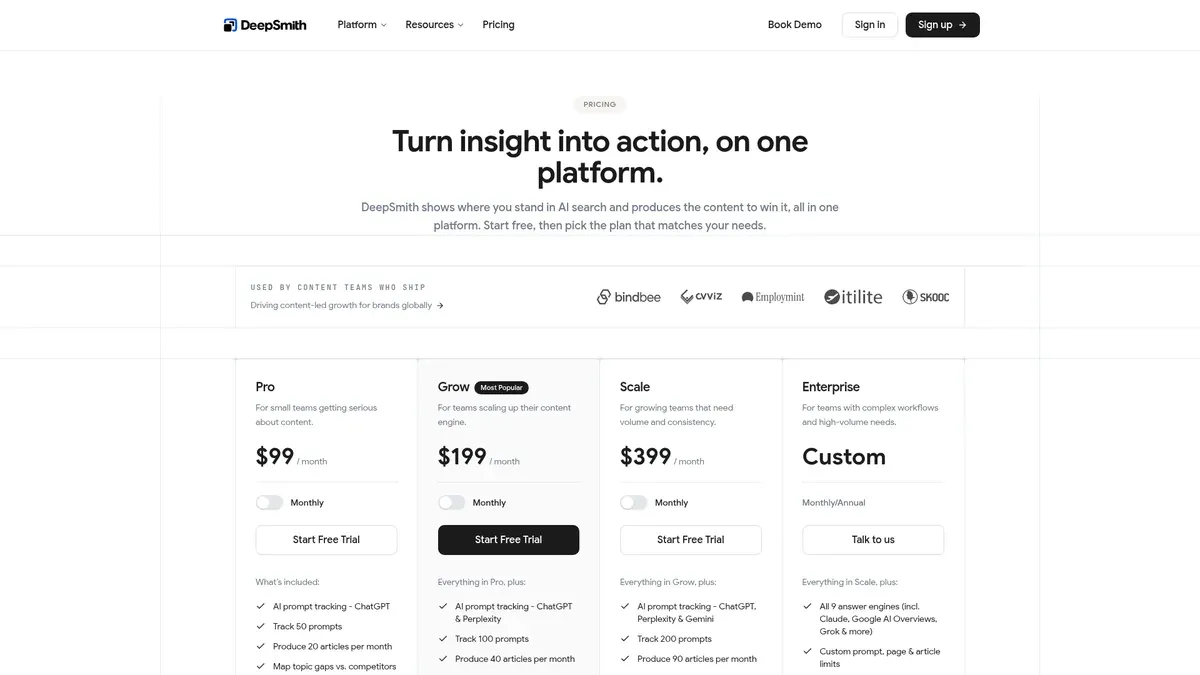
Best for: Marketing teams that need to know where AI cites them and then need the articles that close those gaps, without moving between two tools and two budgets.
Here is the gap most trackers leave you with. You learn that a competitor wins the citation for a prompt that matters. Then what? You still have to brief the article, write it, link it, and publish it. That handoff is where most AI visibility programs stall.
DeepSmith closes it. It is one platform for AI search analytics and content production, and both halves read from the same brand context layer.
That layer is Deep IQ. It stores your company positioning, products, buyer personas, brand voice, visual guidelines, and content type templates as structured data. Every other module reads from it. So the prompts you track, the ideas you get, and the drafts you publish all run on your real facts, not a generic guess.
What the measurement side gives you. Mention Rate, Citation Rate, Share of Voice, Sentiment, and Visibility Trend, with a per-platform breakdown and a competitor leaderboard. You see which of your pages actually earn AI citations, each page's share of your total, and the prompts driving them. The competitor view names who wins your prompts, on which exact pages, and on which platform. Discover Prompts builds a starter set from your product and persona context, so you are not staring at an empty prompt list on day one.

What the production side gives you. Content Map crawls your site and your competitors' sites onto one topic taxonomy, flagging coverage gaps and untapped topics. Opportunity Agents turn that data into content ideas, each carrying the data point that justifies it, so you can defend a backlog instead of guessing at one. Content Studio takes an idea to a finished article: researched, internally linked, with a cover image and publish-ready metadata. Autowrite runs it hands-off on a scheduled date. Produced Content publishes straight to WordPress, Webflow, Strapi, Sanity, or Contentful.
Then distribution. Every finished article arrives with social posts already written, and the Apps Library turns it into LinkedIn, X, Medium, Substack, newsletter, Reddit, and more.

Engines. Ten are covered: ChatGPT, Gemini, Perplexity, Claude, Google AI Overviews, Google AI Mode, Grok, Meta AI, Microsoft Copilot, and DeepSeek.
Pricing. Pro is $99 a month for 20 articles, 50 tracked prompts, 5 seats, and ChatGPT. Grow is $199 for 40 articles, 100 prompts, 7 seats, and adds Perplexity. Scale is $399 for 90 articles, 200 prompts, 10 seats, and adds Gemini. Enterprise is custom and covers all ten engines. Annual billing brings those to $80, $160, and $299. There is a 7-day free trial, no long-term contracts, and no cancellation fees.
The honest limitation. Engine coverage rises with tier. Pro tracks ChatGPT only, so if you need Claude or Google AI Overviews on day one, start at Grow or Scale rather than Pro. Enterprise covers all ten with custom limits.
Where DeepSmith is the fit. You already feel the production bottleneck. Writers churn, the backlog has thirty topics you cannot execute, and the true cost per article is higher than anyone wants to say out loud. You also need to know which engines cite you and which do not. No other tool on this list sells measurement, coverage analysis, and on-brand production together.
2. Profound
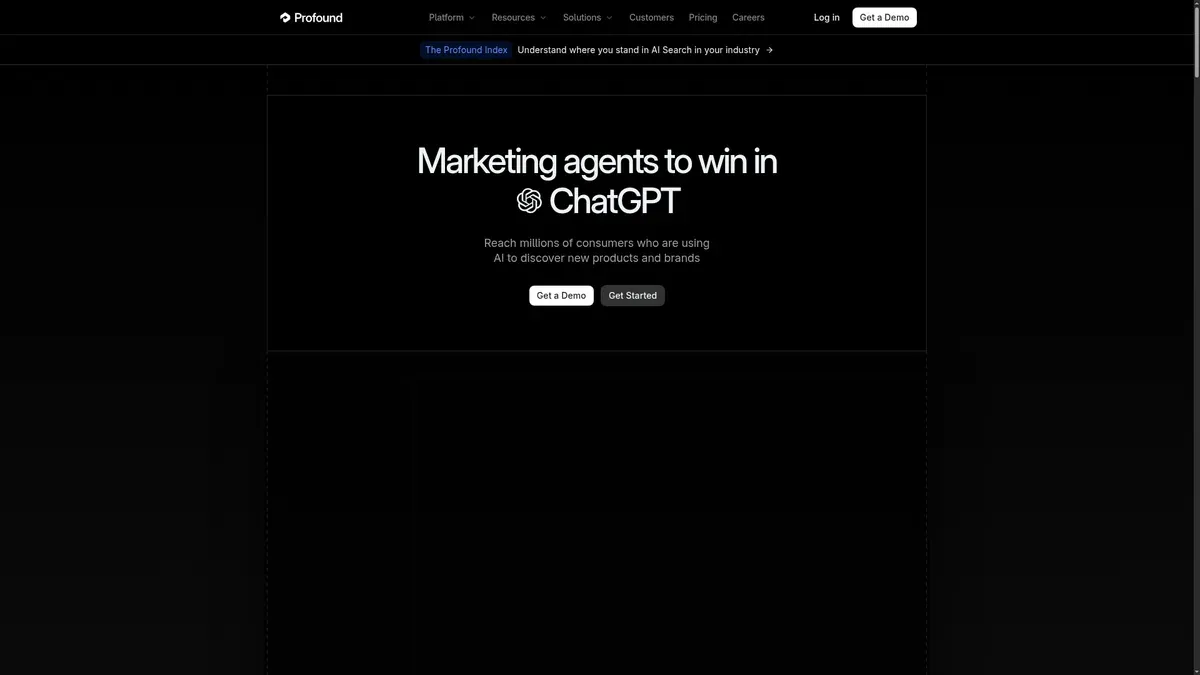
Best for: Brands and agencies that want agent-driven AEO with crawler analytics sitting on top of prompt-level visibility.
Profound goes deeper on the data-around-the-data than most. Its AEO Report covers AI Visibility, Source Citations, Brand Sentiment, and Content AEO. Answer Engine Insights shows how AI describes you across conversations, with share of voice by topic, average position, and citation share.
Two features stand out. Query Fanouts shows the variations behind each prompt with trend and share metrics. Agent Analytics is a server-side tracker that identifies AI user agents and reports how they use your site, which is a different question from what AI says about you.
Prompt Volumes rounds it out, estimating what millions of people ask AI engines at the topic level.
Pricing. Starter is $99 a month for 50 unique prompts, 1,500 monthly responses, ChatGPT only, and one seat. Growth is $399 for 100 prompts, 9,000 responses, three engines, and three seats. Enterprise is custom and covers up to nine answer engines. Starter and Growth are billed annually with two months free. There is a free AEO Report if you want to look before buying.
The honest limitation. Engines expand by tier rather than across the board, so needing Claude, Grok, or DeepSeek on day one puts you on custom Enterprise pricing. Exports are missing on Starter, and API access is Enterprise-only.
Pick Profound if prompt volume data and crawler analytics matter more to you than a production surface, and annual billing is fine.
3. Scrunch
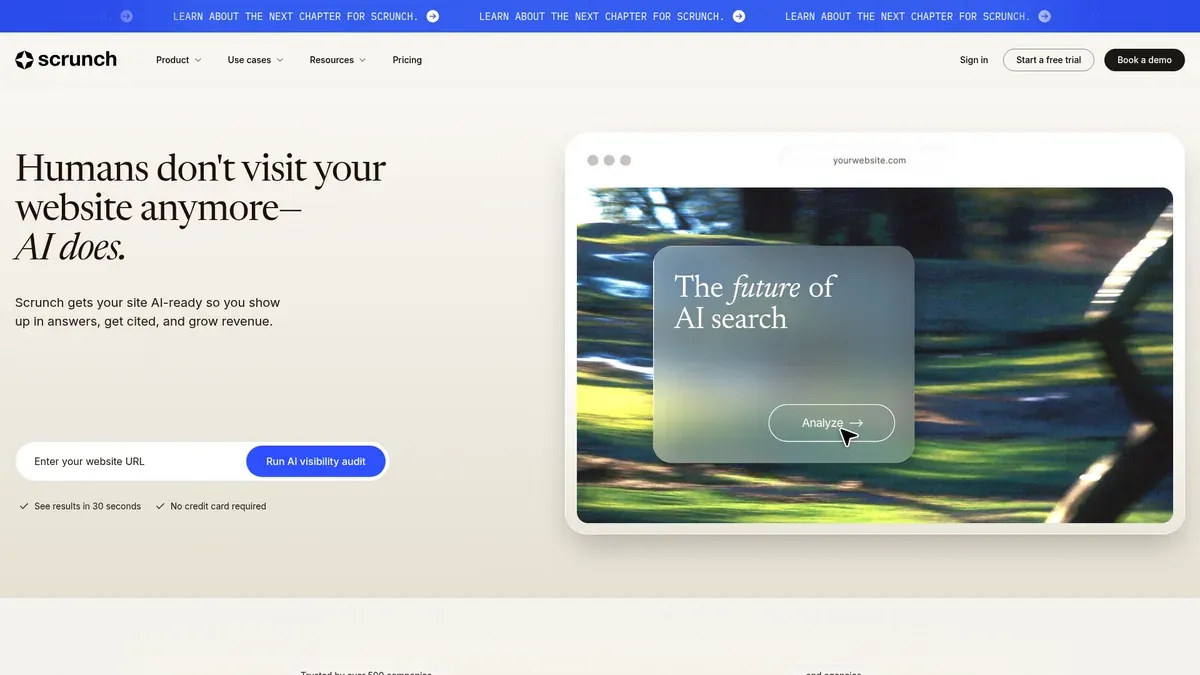
Best for: Mid-market brands and enterprises that want broad LLM coverage plus a sitemap-aware audit next to their monitoring.
Scrunch monitors prompt results, brand visibility over time, and authoritative citations at real scale. Its Trends dashboard estimates topic-level volume with momentum percentages, brand presence by topic, per-topic sentiment, competitive presence over time, and sample prompts and responses. Suggested Competitors auto-detects rivals you did not know were showing up beside you.
Pricing. Core is $250 a month for 125 unique prompts, one brand workspace, five users, and four LLMs (ChatGPT, Perplexity, Google AI Overviews, Copilot). Core also ships one country, three personas, two languages, five competitors, five site audits a month, and 25 sitemap pages. Enterprise is custom and covers nine LLMs. There is a 7-day free trial on Core, and a free AI visibility audit that returns results in about 30 seconds.
The honest limitation. Core stops at four LLMs. Claude, Gemini, Meta AI, Google AI Mode, and Grok all sit on Enterprise. So does a lot of the platform's real value: the Agent Experience Platform, Advanced API, MCP access, Looker Studio, SAML and OIDC SSO, and board reporting.
Pick Scrunch if you need nine LLMs, enterprise SSO, and executive reporting from the outset, and four LLMs is too narrow for your market.
4. Otterly AI

Best for: Solo marketers and small teams that want a fast, cheap start with real citation tracking underneath it.
If budget is the blocker, start here. Otterly tracks seven AI search engines and checks citations and link positions daily across every cited domain and URL. AI Prompt Research surfaces prompts, topics, and intent patterns from a brand, keyword, or URL. The Brand Report benchmarks your mentions, coverage, and domain citations against competitors. Content Audit adds crawlability checks, prioritized GEO recommendations, and content briefs.
Coverage spans more than 65 countries and multiple languages.
Pricing. Lite is $29 a month for 15 search prompts. Standard is $189 for 100. Premium is $489 for 400. Enterprise starts from $1,000. Annual billing takes 15 percent off, and the free trial needs no credit card. GEO URL audits run 1,000 a month on Lite, 5,000 on Standard, and 10,000 on Premium.
The honest limitation. Four engines are included (ChatGPT, Google AI Overviews, Perplexity, Copilot). Claude, Google AI Mode, and Gemini are paid add-ons. API access, MCP access, and Agent Analytics are all absent on Lite, so needing any of those means $189 a month, not $29.
Pick Otterly if you want the lowest published entry price, daily citation tracking, and GEO audits by the thousand, and you can live with three engines as add-ons.
5. LLMrefs
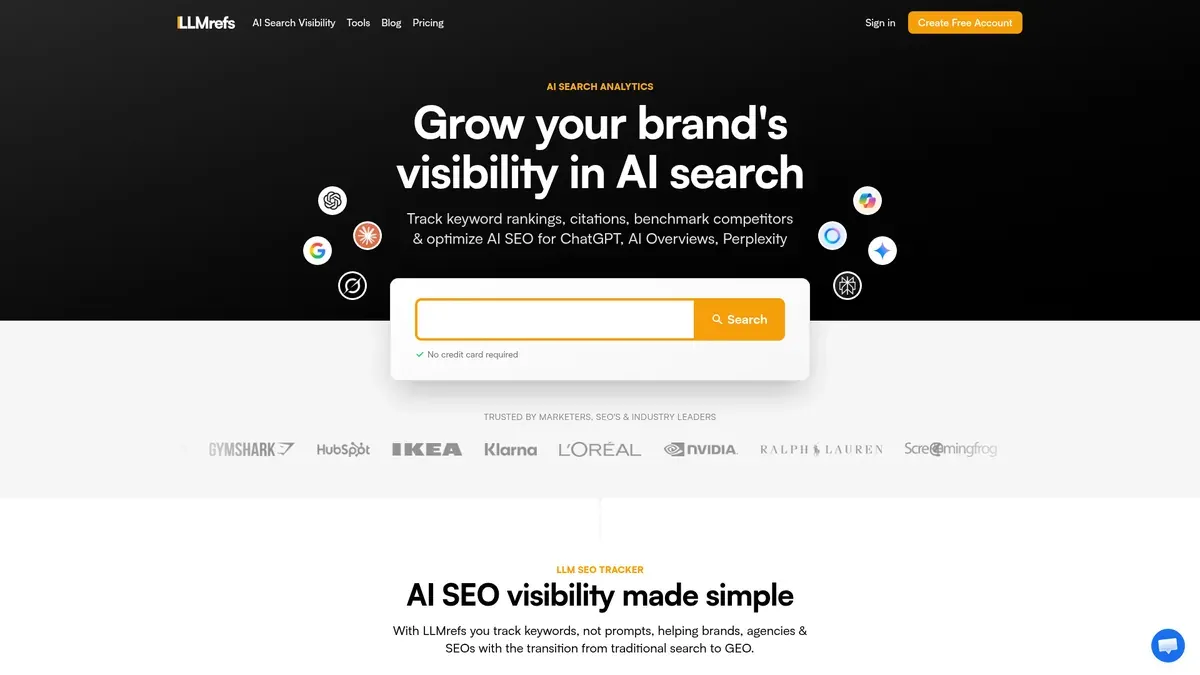
Best for: Agencies and teams that want one flat bill, unlimited projects, and tracking driven by keywords rather than hand-managed prompt lists.
LLMrefs takes a different angle. Instead of asking you to build and maintain a prompt library, it tracks keywords and reconstructs fan-out queries automatically, then aggregates and weights results per prompt so each keyword score is statistically meaningful. Share of voice comes back by keyword across brands.
Source discovery is a strength. You can see which generative engines cite which pages for which products, which doubles as an outreach list.
Pricing. One All-in-One plan at $79 a month, marked limited-time. It includes 500 prompts, unlimited team members, unlimited projects across all your domains, weekly AI visibility reports, CSV export, API access, and geo-targeting across 50-plus countries and 20-plus languages. Extras include an AI crawlability checker, a Reddit threads finder, and an LLMs.txt generator. The 7-day trial needs no credit card.
Engines in that single plan include ChatGPT, Google AI Overviews, AI Mode, Gemini, Perplexity, Claude, Copilot, and Meta.
The honest limitation. One published plan means the upgrade path is keyword purchases rather than a visible tier ladder. The $79 rate is advertised as limited-time, so check the live page. And if you want per-prompt tagging and history, the keyword model will feel indirect.
Pick LLMrefs if you run several brands or clients, want one small predictable bill, and prefer keyword-level share of voice to prompt-by-prompt management.
6. AthenaHQ

Best for: GEO teams that want an agent doing work alongside the dashboard, plus enterprise governance when they need it.
AthenaHQ tracks visibility, mentions, citations, sentiment, and competitive movement across platforms and markets. Citation rate comes with a share of voice breakdown, an AI search value estimate, a competitor visibility heatmap by topic, and the competitors named in each prompt. Source Intelligence surfaces what is actually shaping the answers.
The action layer is the differentiator. Content Creation, Citation Outreach, and Commerce Optimization workflows turn opportunities into governed work with owners and measurement. Brand-voice enforcement, required approved sources, and a two-step review flow ship by default.
Pricing. Credit-based, and one credit equals one AI response. Essential is free with 300 credits and five engines. Starter is $295 a month with 3,600 credits and ten engines, plus unlimited competitor tracking and benchmarking. Enterprise is custom. Annual billing is 17 percent off. Starter integrates with Shopify, Webflow, GA4, and Search Console.
The honest limitation. API access and extra credits are paid add-ons on top of Starter, and that add-on pricing is not published. The free tier stops at five engines. Most of the governance value (the Citation Engine, BI dashboards for Tableau, Power BI and Looker, SAML SSO, audit logs, multi-region support) sits on Enterprise.
Pick AthenaHQ if you want the Athena agent, citation outreach, and content recommendations, with enterprise security controls available when procurement asks.
7. RankScale
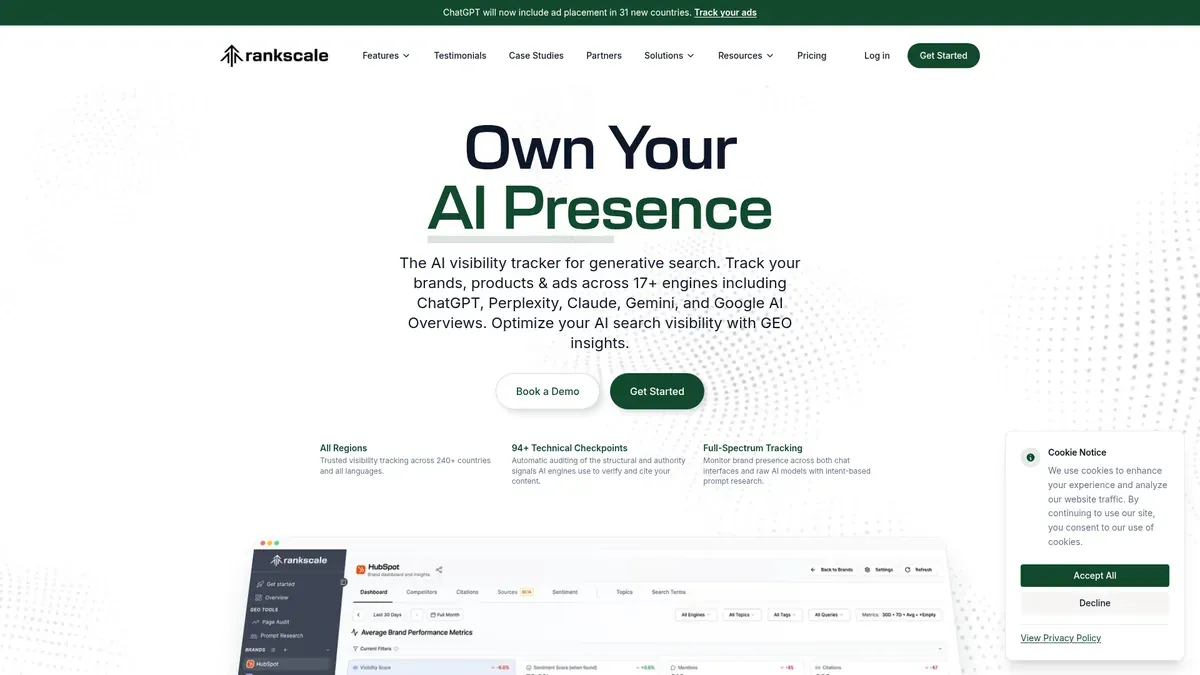
Best for: Technical SEO teams that want the widest engine list from the entry tier and are comfortable doing credit math.
RankScale tracks brands, products, and ads across 17-plus AI engines including ChatGPT, Perplexity, Claude, Gemini, Google AI Overviews, AI Mode, Copilot, DeepSeek, Mistral, and Grok. Coverage runs across 240-plus countries and all languages, with collection frequency from hourly to monthly.
The audit side is real work, not a checkbox. AI readiness audits rank issues by priority factor, covering AI bot crawlability, site hierarchy, and technical SEO signals, then hand back specific fixes. Competitors are auto-identified inside AI results with visibility scores, citations, and sentiment compared.
Pricing. Essentials starts at $20 a month. Pro is $99 with 1,200 credits (roughly 4,800 AI-engine answers), 10 brand dashboards, and 50 page audits. Growth is $385 with 5,500 credits and 200 audits. Enterprise is $780 with 12,000 credits. Yearly billing is 15 percent off, and Pro has a 7-day free trial. Search-term creation is unlimited, execution is what costs credits.
The honest limitation. That $20 Essentials tier ships with zero credits, zero dashboards, and zero audits, so the practical entry point is Pro at $99. Credit pricing also makes forecasting harder, because one prompt across several engines at high frequency burns credits fast.
Pick RankScale if you want the broadest engine coverage early, AI readiness audits beside monitoring, and you will actually model your credit burn before committing.
8. Ahrefs Brand Radar

Best for: SEO teams already living in Ahrefs who want AI visibility on the same brand surface as everything else.
Brand Radar tracks seven AI platforms with custom-prompt tracking across Google AI Overviews, Google AI Mode, ChatGPT, Perplexity, Gemini, and Copilot. What makes it distinct is the neighbours: it watches AI visibility alongside SEO, YouTube, Reddit, and TikTok, sitting on top of the Ahrefs prompt database. Citation tracking and competitor benchmarking work by brand, prompt group, AI overview context, and source. Reporting flows into Looker Studio through the Brand Radar Connector.
Pricing. Single platform access is $199 a month per AI index. The all-platform bundle is $699 a month and includes 2,500 custom prompt checks. Add-on packs stack on top: Basic at $50 for 2,500 checks, Growth at $100 for 7,000, Scale at $250 for 25,000, with overage from $0.010 to $0.020 per check.
The honest limitation. Per-index pricing scales fast, so full coverage really means the $699 bundle. Claude custom checks consume eight checks each, which means the 2,500-check bundle covers roughly 312 Claude prompts a month. Grok data collection has been temporarily unavailable for new data.
Pick Brand Radar if you are already an Ahrefs customer, the bundle fits your budget, and you want one brand surface across search, social, and AI.
How to choose your Peec alternative
Most alternatives to Peec look similar on a feature grid. Start instead with the question you cannot answer today. That points at the right tool much faster.
"I know where I am invisible, but I cannot produce the content to fix it." That is DeepSmith. Measurement, coverage gaps, and on-brand production run off one context layer, and articles publish straight into your CMS.
"I need to know how AI crawlers behave on my own site." That is Profound. Agent Analytics and Prompt Volumes are the reason to pay.
"Procurement needs SSO, board reporting, and nine LLMs." That is Scrunch Enterprise.
"I have $50 a month and need to start somewhere." That is Otterly Lite at $29, with the add-on engines noted.
"I run six client brands and want one bill." That is LLMrefs at $79 with unlimited projects.
"I want the tool to recommend and route the work, not just report it." That is AthenaHQ.
"I want every engine, and I am fine modelling credits." That is RankScale Pro.
"We already pay Ahrefs." That is Brand Radar.
One more filter, and it is the one teams skip. Ask what happens after the dashboard tells you something. If your team can already turn a gap into a published article inside a week, a pure tracker is enough. If that handoff is where things stall, buy the platform that carries it.
Not sure yet? Shortlist two, run both against the same ten prompts for a month, and compare what each one told you to do.
Try DeepSmith on your own data
You do not have to guess at this. Start a free trial, connect your site, and you will see real visibility data and real drafts inside the 7-day window. No contract, no cancellation fee.
Start with ten prompts your buyers actually type. That is a small enough first step to finish this week.