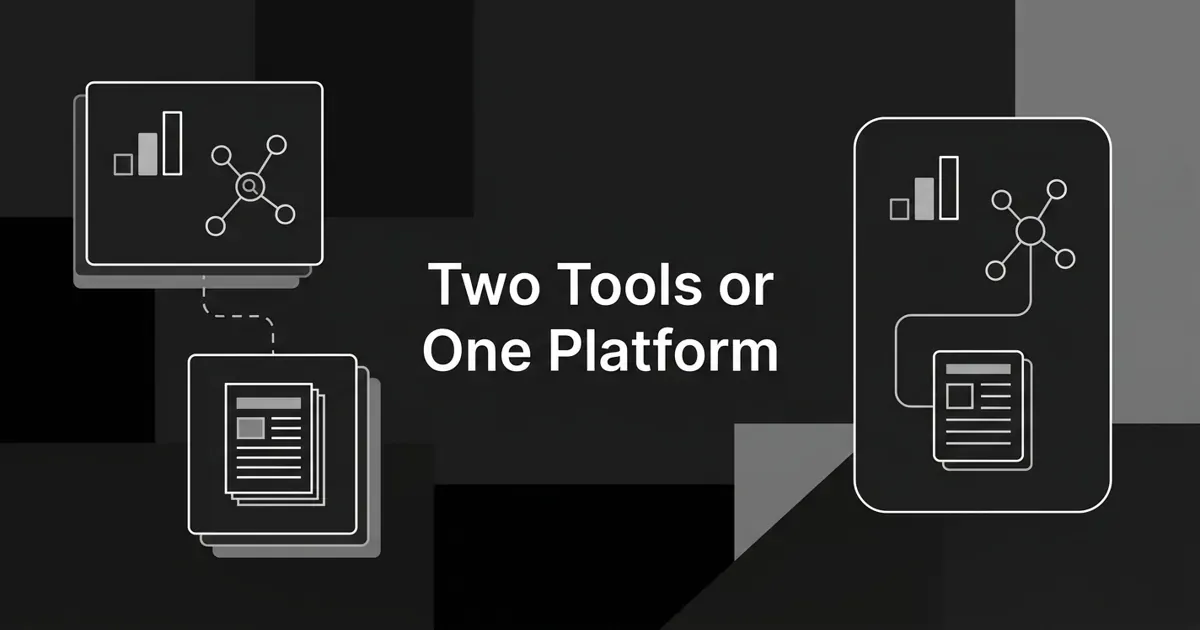
Teams weighing DeepSmith vs Peec vs Jasper are rarely comparing three interchangeable products. They are comparing two shapes of purchase. The first is a specialist stack, in which Peec measures how AI engines answer questions about the brand and Jasper drafts the content that responds. The second is a single platform, in which DeepSmith runs the measurement and the production off the same stored context. Peec does not write. Jasper does not track with the depth of a dedicated analytics tool. DeepSmith does both, with tier limits on how much of each. Any honest AEO content stack comparison therefore reduces to one question: whether the seam between insight and draft costs a mid-market team more than specialization saves it. That seam is where the real money sits, since it is paid in manual handoffs, extra subscriptions, and the weeks between noticing a visibility gap and publishing something that closes it.
DeepSmith vs Peec vs Jasper at a glance
The table below summarizes the three options on the dimensions that tend to decide a mid-market purchase. Peec publishes its prices in euros, and the figures here reflect the USD equivalents commonly reported by third-party reviewers rather than a vendor-published dollar list. Jasper's tiers are priced per seat, so the effective monthly cost depends on team size.
| Dimension | DeepSmith | Peec | Jasper |
|---|---|---|---|
| Category | AI search analytics plus content production | AI search analytics only | AI writing platform |
| Primary job | Track AI answers, find gaps, produce the articles that close them | Measure visibility and recommend actions | Generate marketing content across formats |
| Entry price | $99/mo (Pro), $80/mo annual | ~$89/mo (Starter), ~$80/mo annual | ~$59/seat/mo (Creator), ~$49 annual |
| Team tier | $199/mo (Grow), $160/mo annual | ~$245/mo (Pro), ~$205/mo annual | ~$69/seat/mo (Pro), ~$59 annual |
| Upper tier | $399/mo (Scale), $299/mo annual | ~$495/mo (Advanced), ~$420/mo annual | Business/Enterprise, custom |
| Pricing scales on | Articles per month and tracked prompts | Projects, prompts, regions, model coverage | Seats |
| Seats | 5, 7, 10, custom by tier | Unlimited on every plan | Per seat, no bundled allowance |
| Engines tracked | ChatGPT at Pro, Perplexity at Grow, Gemini at Scale, all ten at Enterprise | ChatGPT, Perplexity, Gemini at base; Claude and Google AI Overviews higher up | GEO module added June 2026; no dedicated tracker in the core product |
| Tracked prompts | 50, 100, 200, custom | Reviewers cite roughly 25, 100, and 300 or more by tier | Not applicable |
| Article output | 20, 40, 90 per month, publish-ready | None | Uncapped drafts, editing required |
| Internal linking | Up to 5 links inserted during generation | Not applicable | Manual, or Surfer integration for on-page |
| CMS publishing | WordPress, Webflow, Strapi, Sanity, Contentful, webhooks, plus exports | Not applicable | Webflow direct, otherwise Zapier or export |
| Repurposing | Apps Library across a dozen-plus channels | Not applicable | Short-form templates and agents |
| Brand context layer | Deep IQ: company, products, persona, voice, visuals, content types | Not a feature | Brand Voice, capped by tier |
| Free trial | 7 days | Available | 7 days |
The sections that follow take each product in turn, then examine the stack as a purchase in its own right.
Peec: measurement depth without production

Peec is a dedicated AI-search analytics tool. It tracks brand mentions, citations, visibility share, and share of voice across AI engines, monitors both the team's prompts and competitor prompts, and surfaces the sources those engines cite most often. Prompts can be tagged and categorized, sentiment and answer position are tracked over time, and a competitor leaderboard sits alongside the source analysis. The product also suggests publications worth pitching and content gaps worth filling.
Engine coverage spans ChatGPT, Perplexity, Gemini, Claude, and Google AI Overviews, with the pricing page anchoring on the first three as the base set and broader coverage positioned as a paid add-on or a higher-tier benefit. One published comparison notes that Peec covers four platforms against eight at an enterprise alternative, which is a fair characterization of its position: sufficient for most mid-market prompt sets, narrower than the top of the market.
Pricing runs at roughly $80 per month annually, or $89 monthly, for Starter, roughly $205 or $245 for Pro, and roughly $420 or $495 for Advanced. Seats are unlimited on every plan, which is a genuine structural advantage over per-seat and per-tier seat models when a reporting dashboard needs to reach a wide stakeholder group. Cost instead scales on projects, prompts, regions, and model coverage, which means the same advantage disappears for a team whose growth shows up as more tracked questions rather than more viewers.
Prompt caps are the constraint most likely to bite. Reviewers cite roughly 25 prompts at Starter, 100 at Pro, and 300 or more at Advanced, though the pricing page does not list explicit caps, so these figures should be confirmed with the vendor. A program covering five to ten product categories with ten to twenty-five buyer questions in each typically needs more than 100 prompts, which clears Starter comfortably but presses against Pro. Reviewers also observe that cost per tracked prompt can run higher than mid-tier competitors once volume rises.
The decisive limit is categorical rather than numeric. Peec produces no content. It identifies the gap, names the surfaces where the brand is losing, and hands the work to whatever the team uses to write.
Jasper: production depth without native measurement

Jasper is an AI writing platform built for marketing teams, and it is broader across formats than most content tools sold to the same buyer. It ships more than 100 specialized agents and templates covering blog posts, ad copy, email, and landing pages, a Brand Voice feature for encoding tone and style, Content Pipelines for repeatable idea-to-final workflows, Jasper Chat for conversational drafting, Canvas, Grid, and AI Studio for visual and collaborative work, and a Marketing Editor for long-form drafting. A Translation Agent added in 2026 extends the same output to multiple locales.
Jasper also launched a GEO and AI Optimization module in June 2026, covering visibility, citations, sentiment, and share of voice across AI platforms. The capability is real and it narrows the gap, though it is newer and less specialized than a dedicated tracker, and public documentation is ambiguous about whether it is bundled across paid tiers or sold separately. Treating it as an additional layer rather than a like-for-like replacement for Peec is the safer assumption at the time of writing.
Pricing is per seat: roughly $49 per seat monthly on annual billing for Creator and roughly $59 for Pro, with Business and Enterprise quoted custom. A 7-day free trial is offered. Per-seat economics reward small teams and penalize growing ones, since doubling the content team doubles the software line item.
Three production gaps matter for a team publishing long-form at volume. Internal linking and schema markup are not part of the drafting pipeline, so both are handled manually or through the Surfer SEO integration, which adds on-page suggestions at additional cost without inserting links during generation. Direct CMS publishing reaches Webflow only, and every other target runs through Zapier, an export, or copy-paste. Blog scheduling and auto-publishing are not native. Third-party reviews also report the common pattern of output starting on-voice and drifting as drafts lengthen, with Brand Voice capped at lower tiers, commonly described as one voice on Pro and three on Teams. Brand Voice is best treated as a guardrail rather than a guarantee, and editorial review stays in the plan.
DeepSmith: measurement wired into production

DeepSmith is one platform for AI search analytics and content production, and it is a production engine rather than a writing assistant. Output is a finished, on-brand article rather than a first draft to rescue. Seven modules run off context set up once from the website during onboarding, and that shared context is the mechanism the whole comparison turns on.
The AEO module reports mention rate, citation rate, share of voice, sentiment, and visibility trend, with per-platform breakdowns, a competitor leaderboard, prompt-level answer history, page-level citation attribution, and a view of which competitor pages win citations. Content Map decides what to write next by placing the brand's own site and an unlimited number of competitor sites onto a single topic taxonomy, so coverage gaps (topics where a competitor publishes more) and untapped topics (topics where a competitor publishes and the brand has nothing) are measured rather than guessed, with sitemaps re-checked every 24 hours so new pages fold in on their own. Opportunity Agents then read that data and return ideas with the evidence attached, each carrying the specific data point that justifies it, which is the step a tracker hands back to the marketer.

Content Studio turns those ideas into articles. The Writer produces a researched, internally and externally linked article with a cover image and publish-ready metadata, inserting up to five internal links during generation by reading the Content Map. Autowrite runs the same workflow on a schedule with no one in the app, landing the result in Produced Content for review, revision, and direct publishing to WordPress, Webflow, Strapi, Sanity, Contentful, or the team's own webhooks. Repurpose writes social posts at publish time, and the Apps Library adapts a finished article into platform-native versions for LinkedIn, X, Medium, Substack, newsletter and nurture email, Reddit, Instagram, Slack and Discord, and other channels. Deep IQ stores company positioning, per-product profiles, buyer personas, brand voice, visual guidelines, content types, and trusted sources, and every module reads from it.

Pricing is $99 per month for Pro, or $80 annually, with 20 articles, 50 tracked prompts, 5 seats, and ChatGPT tracking. Grow is $199 or $160 annually, with 40 articles, 100 prompts, 7 seats, and Perplexity added. Scale is $399 or $299 annually, with 90 articles, 200 prompts, 10 seats, and Gemini added. Enterprise is custom and covers all ten tracked engines: ChatGPT, Gemini, Perplexity, Claude, Google AI Overviews, Google AI Mode, Grok, Meta AI, Microsoft Copilot, and DeepSeek. A 7-day free trial applies, with no long-term contracts and no cancellation fees, and onboarding populates the brand brief, competitors, starter prompts, and a first batch of ideas before billing starts.
Two constraints are worth naming. Engine coverage is gated by tier, and Pro tracks ChatGPT only, which limits a team wanting breadth at the entry price, though ChatGPT sits on every tier and is where most buyer research starts, and coverage widens as tiers rise to all ten engines at Enterprise, a wider net than the five Peec spans at any price. Articles are capped per month, unlike an uncapped drafting tool, though a DeepSmith article arrives linked, formatted, and publishable, so the two counts do not measure the same unit of work.
Peec vs Jasper: two tools that do not overlap
The most useful thing to understand about Peec vs Jasper is that the two products do not compete. One measures and does not write. The other writes and, until the 2026 GEO module, did not measure. Buying both is not redundancy, it is assembly, and the assembly is the part no vendor sells.
No native integration between the two is confirmed. Both expose APIs, and Peec offers a Looker Studio connector, so a determined team can build a bridge. Absent that engineering, the workflow is manual in four places: a marketer reads a gap in Peec, opens Jasper and briefs it by hand, exports or copy-pastes the draft into a CMS that is not Webflow, and then reconciles Peec's share-of-voice movement against analytics and CRM data in a spreadsheet, because neither tool closes the loop from tracked prompt to published page to citation earned.
The cost of the two-tool stack
Every AEO content stack comparison eventually lands on the arithmetic. A realistic mid-market roll-up puts Peec Pro at roughly $205 per month on annual billing and Jasper Pro at roughly $59 per seat, or about $295 per month across five seats. That is close to $500 before anything else. Teams that want on-page optimization inside Jasper drafts commonly add Surfer at $79 or more per month, and teams publishing anywhere other than Webflow add a Zapier or Make bridge in the $20 to $50 range. All in, the stack lands roughly between $400 and $650 per month depending on seats and add-ons.
The dollar figure understates the load. Two vendors means two contracts, two renewal cycles, two admin models, and two security reviews. The switching cost between research and drafting is paid daily rather than annually, and the spreadsheet glue that connects prompt to citation to outcome is unpaid labor that tends to be dropped first when the team is busy.
DeepSmith Grow sits at $199 per month, or $160 annually, for 40 articles, 100 prompts, 7 seats, and ChatGPT plus Perplexity tracking. The comparison is not perfectly clean, since the stack imposes no monthly article ceiling. What Grow buys instead is the whole chain in one subscription, and the 40 articles it allows are finished pieces rather than drafts still needing links, metadata, a cover image, and a publishing route.
Jasper vs DeepSmith: what publish-ready changes
The clearest way to read Jasper vs DeepSmith is by counting what remains after each tool stops. Jasper stops at a draft in an editor. Internal links, schema, a cover image, metadata, and a publishing path are still open, and on a team publishing 20 to 40 pieces a month those steps are the bulk of the elapsed time rather than a rounding error. Jasper's advantage is genuine range: ad copy, email, landing pages, and short-form live in the same workspace, and no long-form-focused platform matches that spread. The limit adjacent to that strength is that the spread is optimized for variety of format rather than depth of pipeline on any single format.
DeepSmith stops at a published article with links inserted, structure formatted for citation, a cover image generated, and social versions written. Brand consistency comes from stored structured context rather than a per-project voice setting, which is what allows accuracy to hold as volume rises without re-briefing each piece. The scope difference is that DeepSmith is built around long-form and its distribution, so a team whose main need is ad copy variants is buying for a different job.
The handoff problem: where AI visibility plus writing pays off
The argument for AI visibility plus writing in one platform is mechanical rather than philosophical. When the Writer reads live AEO data and the Content Map, the article it produces targets a measured gap and links into existing coverage without anyone assembling a brief. When those functions sit in separate tools, that assembly is a person's afternoon, repeated per article, and it degrades under deadline pressure in a predictable order: linking first, then the gap analysis, then the measurement review entirely.
That mapped view of existing coverage is the part of AI visibility plus writing that neither Peec nor Jasper offers. Peec observes AI answers externally and does not read the brand's own pages. Jasper does not classify existing coverage for gap analysis. Without that layer, deduplication and internal linking depend on someone remembering what has already been published, which is workable at ten articles and unreliable at fifty.
When the Peec plus Jasper stack is the right purchase
The stack is a defensible buy in several situations, and pretending otherwise would not survive contact with a real evaluation.
- The team already runs Jasper. When Jasper is the operating system for ad copy, email, and short-form, adding Peec for tracking is cheaper than introducing a new editor and retraining a workflow. Switching costs are real and they favor the incumbent.
- Tracking and writing have different owners. When an SEO lead owns visibility reporting and a content lead owns drafting, two best-of-breed tools can be cleaner than one product whose workflows are deliberately intertwined.
- Engine breadth is needed at the lowest price point. Peec's base set spans three engines at Starter, where DeepSmith Pro tracks ChatGPT alone. Starter also caps at roughly 25 prompts and one project and produces no content, so the breadth is real but the program it supports is small.
- Surfer is already in the stack. Jasper plus Surfer plus Peec is a known configuration, and consolidating means retraining people who are currently productive.
- AEO is still being evaluated. Buying a tracker alone is a low-friction way to gather visibility data before committing to a content platform.
Which should you choose
The recommendation splits cleanly by team shape.
Small teams, under five people, fewer than 20 articles a month, a short prompt list. An integrated platform is likely overkill. A capable writing tool paired with a low-cost tracker covers the need until volume justifies more.
Mid-market teams of five to fifteen publishing 20 to 90 articles a month with multi-engine tracking. This is where the single platform usually wins, on both dollars and elapsed time. The stack costs more per month at comparable coverage and adds handoffs at every step. DeepSmith is the recommendation here.
Agencies and multi-brand operations. Per-seat pricing at Jasper and per-project pricing at Peec compound against each other. Workspaces with inclusive seats keep unit economics predictable, though a team that needs more viewers than DeepSmith's tier seat counts allow should weigh Peec's unlimited seats seriously.
Single-brand in-house teams with no existing Jasper investment. The integrated platform is the default. There is no incumbent workflow to protect and no reason to buy the seam.
Teams already standardized on Jasper for short-form. Stack Peec on top rather than ripping out a tool the team uses daily. Revisit when long-form volume, not short-form variety, becomes the constraint.
For a mid-market team that wants tracking and production to be one workflow, the fastest way to test the claim is to run it on real data. Start a DeepSmith free trial and see the prompts, gaps, and first articles populate before any commitment.