You searched your own service plus your city, and the answer block at the top named three businesses. None of them were yours.
That stings. It's also more fixable than it feels right now.
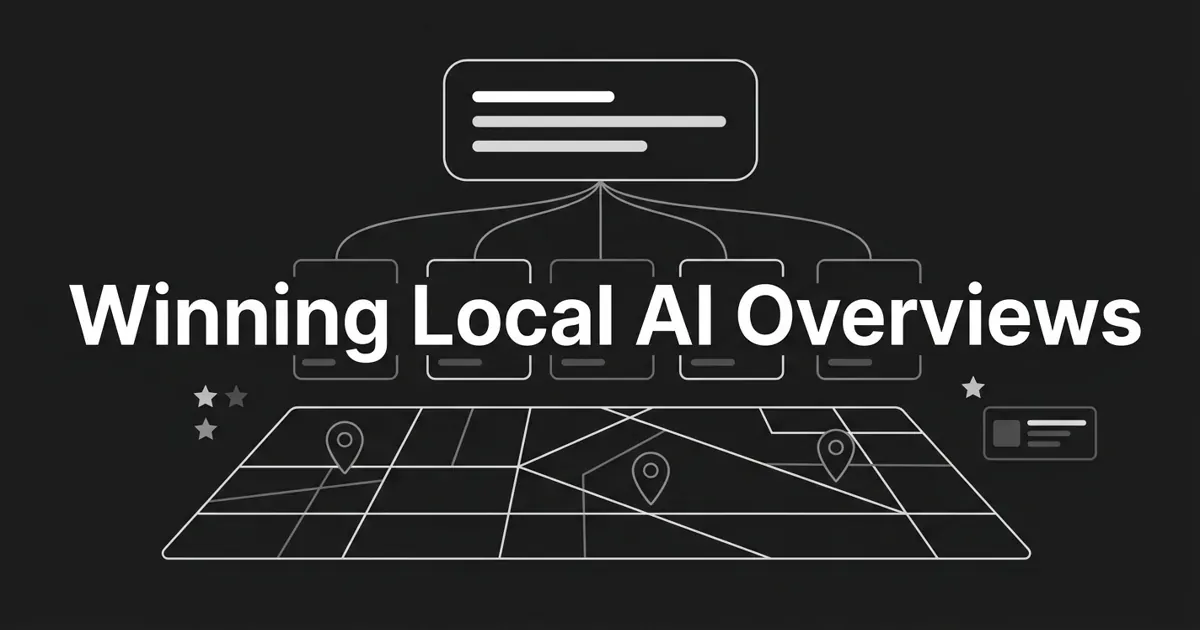
Here's what changed. AI Overviews local search results now sit above the map pack, and for plenty of near me AI Overviews the map barely gets a glance. One study across three US metros and six local verticals found an Overview firing on roughly two thirds of local-intent queries, while the local pack showed up on fewer than half. In about one in ten of those queries, the Overview replaced the map block entirely.
So the goal moved. You're no longer just fighting for a pin on a map. You're fighting to be one of the sources the Overview quotes.
This guide is for a marketing lead who owns multi-location ai search visibility and needs a system, not a one-time cleanup. Eight steps, in the order you should do them.
What you need before you start: access to your Google Business Profiles, someone who can edit the website, and a couple of hours a week. That's genuinely it.
Step 1: Learn what a local AI Overview actually rewards
Before you touch anything, understand where the Overview gets its answer. It saves you a quarter of wasted effort.
A local Overview is a synthesized paragraph or list, with a handful of citation cards attached. Those cards are the prize. And here is the part that surprises most teams: roughly 60% of citations inside local Overviews point at third-party publishers, not at the brand's own website. Yelp, Reddit, TripAdvisor, niche directories. Your site is one voice in a chorus.
The second surprise is that ranking is not the gate. Close to four in ten Overview citations come from URLs that don't sit in the classic organic top ten. Pages that would never win position one still get quoted.
So what does get cited in ai overviews local queries? Think in three tiers, and know that you need all three.
- Tier 1, what you own. A verified Google Business Profile per location, a real location page per site, visible hours, NAP, photos.
- Tier 2, what you earn on other platforms. Yelp, Apple Maps, Bing Places, Facebook, TripAdvisor, and the directory that matters in your vertical.
- Tier 3, what people say. Reddit threads, Q&A answers, local press, chamber listings, neighborhood blogs.
These are not alternatives. A brand with a spotless Tier 1 and no Tier 2 loses to a competitor with an active Yelp and Reddit footprint. A brand with strong Tier 2 and 3 but no location pages gives the parser nothing solid to anchor the entity to.
Why does the answer lean so hard on other people's sites? Because a near me question is a recommendation question. The engine isn't looking for your sales copy. It's looking for corroboration: several independent sources agreeing that you exist at this address, do this work, and do it well. Your own page proves the first two. Only other people prove the third.
That reframes the job in a useful way. You're not writing to persuade an engine. You're building enough agreement across enough places that the engine has an easy answer to give.
It also helps to know where the weight sits in local ranking generally, because those same signals feed the Overview's picture of you:
| Signal group | Approximate weight |
|---|---|
| Google Business Profile | 24% |
| Reviews | 16% |
| On-page (NAP, schema, local content) | 15% |
| Links | 15% |
| Citations across directories | 13% |
| Behavioral | 9% |
| Personalization | 8% |
| Social | 4% |
Notice what's at the top. Two of the three heaviest signals are things you can fix this month without a single backlink.
Step 2: Build one master location record and lock your canonical NAP
This is the unglamorous foundation of local AEO Google work, and skipping it is why most programs stall.
Create one place where every location lives as a single row. Spreadsheet is fine. What matters is that it exists and has one owner.
Each row holds: legal name, trading name, street address, suite, city, region, postal code, country, latitude, longitude, primary phone, primary category, secondary categories, URL slug, Google Business Profile link, hours, manager, and status.
Then pick one canonical NAP format and write it down. Not "roughly the same." Identical, character for character. Same street suffix every time, St or Street, pick one. Same suite label, Ste or Suite, pick one. Same phone formatting with country code.
From then on, every edit anywhere pulls from this record. Google Business Profile, Apple Business Connect, Bing Places, Yelp, Facebook, your website. All of them read from the sheet, none of them invent their own version.
Done means: one row per location, a written canonical NAP anyone can copy, and every location either linked to a verified profile or flagged with a reason it isn't.
Common mistake: letting regional or franchise managers edit listings directly. Consistency almost never breaks in a big dramatic way. It breaks when one manager types a phone number differently.
Step 3: Verify and keep feeding every Google Business Profile
Your profile is the single heaviest local signal, and it rewards attention, not perfection.
Start with verification. Every location, no exceptions. Then choose the most specific primary category you can, and layer on the relevant secondary ones. Category selection is one of the highest-leverage fields in the whole profile.
Now fill everything. Hours, including holiday and special hours. Phone. Website. Appointment URL. Services with real descriptions. Products or menu where it applies. Attributes like wheelchair accessible, women-owned, free Wi-Fi. Opening date. Service area.
Then keep it alive:
- Add photos weekly. Exterior with signage, interior, team at work, actual jobs. Geotag before you upload.
- Post weekly. An offer, an event, a what's-new. Posts carry a freshness signal.
- Seed the Q&A. Plant three to five questions you can answer in your own words, and reply to real user questions within a day.
- Reply to every review inside 48 hours, using the person's name and something specific they mentioned.
Done means: 100% verified, every field populated, photos refreshed in the last 30 days, and a posting rhythm that survives someone going on leave.
Common mistake: treating the profile as a setup task. Stale hours, old photos, and silent posting all pull your citation frequency down within weeks. If you only automate one thing this quarter, automate the weekly post.
Step 4: Give every location its own real page
One location, one URL. That's the rule, and near me AI Overviews are strict about it.
Use a predictable pattern like brand.com/locations/{city-neighborhood} or brand.com/{service}/{city}. Then build each page with the same anatomy:
- An H1 with the service and the city or neighborhood.
- An opening paragraph of 50 to 80 words that answers the implicit question straight away. Price range, hours, what to expect, who it suits.
- An embedded map pinned to the real address.
- A NAP block visible high on the page, repeated in the footer.
- Real photos of that site. Storefront, team, vehicles, uniforms. Geotagged.
- Local proof. Testimonials from that area, neighborhood press, awards, before-and-after work.
- Genuinely local content. Parking notes, transit tips, permit quirks, climate issues, FAQs only that neighborhood would ask.
- Internal links to every sister location and your main service pages.
Templates are allowed. Share your header, footer, NAP block, and schema across pages. What can't be shared is the variable content: intro, FAQs, photos, testimonials, neighborhood notes. Those are unique per site or the page is filler.
Done means: every location has its own URL with 500 to 800 words of content that could only have been written about that place, and every page is linked from its siblings.
Pro tip: write the local FAQs from real questions your front desk answers every week. Ten minutes on the phone with a branch manager beats an hour of keyword research.
Producing that much genuinely local supporting content is where lean teams run out of road. That's one spot where DeepSmith earns its place: Deep IQ stores your positioning, products, personas, brand voice, and content formats as structured context, so the neighborhood guides and service explainers that support your location pages come out grounded in your real business instead of re-briefed from scratch every time.
Step 5: Mark up every location page with LocalBusiness schema
Schema won't rank you. It tells the parser exactly what this page is, which is what you want when an engine is deciding whether your page is the canonical source for a place.
Add JSON-LD LocalBusiness on every location page, or a more specific subtype if one fits: Restaurant, Store, AutoRepair, and so on.
Required fields: name and a full PostalAddress with streetAddress, addressLocality, addressRegion, postalCode, and addressCountry.
Recommended and worth doing: image, telephone, priceRange, geo coordinates, openingHoursSpecification, url, and sameAs pointing at your Google Business Profile, Yelp, Facebook, and Apple Maps entries.
Three more pieces complete the picture:
- Organization schema on your brand root, naming the parent company with logo, socials, and contact.
- BreadcrumbList on every location page.
- FAQPage schema on your location FAQs.
Pay special attention to sameAs. Those links are how you tell an engine that this page, that Google Business Profile, and that Yelp listing are all the same real place. Get them right and the corroboration from Step 6 attaches to the right entity. Leave them out and you're asking the engine to guess.
Validate with the Rich Results Test and Search Console URL Inspection before you publish, not three weeks later when something looks off. Run one page through, fix the template, then roll it out. Fixing schema across 40 location pages after the fact is a bad week.
Common mistake: adding aggregateRating or review markup when your site doesn't actually aggregate its own reviews. That breaks Google's guidelines and can earn a manual action. Borrowed star ratings are not worth the risk.
Step 6: Get listed everywhere that matters, with identical details
Remember that most local Overview citations point somewhere other than your domain. This step is how you show up in that majority.
Push the canonical NAP from Step 2 out in priority order:
- Yelp first. It holds an outsized share of citations in local Overviews, so a complete, active Yelp profile is not optional.
- Apple Business Connect, Bing Places, Facebook, and TripAdvisor if hospitality applies.
- Your vertical's directory. Avvo for legal, Healthgrades and Zocdoc for medical, Houzz for home services, OpenTable for restaurants, RepairPal for auto, Thumbtack for trades.
- The top data aggregators, then the long tail through a citation-management tool.
Then hunt duplicates. Two listings for one location split your equity and leave the parser unsure which record is real. It's the quietest way to lose. Merge or suppress them.
Tier 3 is where teams get shy, and it's genuinely valuable. Reddit threads carry real weight in Overviews for local questions. So do chamber of commerce pages, license-board listings, sponsor pages, event listings, and local press. Pitch one neighborhood story, sponsor one local event, publish one small piece of original local data per quarter. That is enough to keep the pipeline warm.
Pro tip: audit citations quarterly, not annually. NAP drifts the moment a phone number changes or a platform redesigns its dashboard.
Turning one good local asset into the Reddit hook, the LinkedIn post, and the newsletter section is usually the part that gets dropped when the week gets busy. DeepSmith's Apps Library handles that step: every finished article converts into platform-native versions for LinkedIn, X, Reddit, Substack, newsletter, and more, adapted to each channel's tone and length, so distribution stops being a separate project you never get to.
Step 7: Build a review engine that runs itself
Reviews are the second-heaviest local signal, and Overviews quote them directly. They are content, not a scoreboard number.
Make the ask a fixed step in the customer journey, not something someone remembers to do. A service-completion text. A receipt email. A QR code at the counter. Whatever it is, it should be one tap to the review form.
Spread the asks across platforms. Google Business Profile carries the most weight, and Yelp, TripAdvisor, Facebook, and your vertical sites all feed the answer too.
Aim for a steady few per week per location rather than a burst followed by silence. Hold an average at or above 4.3 stars. Respond to every single review within 48 hours.
Three things to never do: buy reviews, gate them so only happy customers get asked, or stuff keywords into reviewer names. Each one risks ranking penalties or profile suspension.
Common mistake: treating reviews only as a KPI. Mine them. The phrases customers repeat become your location page FAQs, your local proof points, and the quotes an Overview can lift. A review that says "they had parking behind the building" just wrote a line of your page for you.
Step 8: Measure share of citation, not rank
Rank trackers won't tell you this story. You need to watch who gets quoted.
Build clusters first: category plus city. "Emergency plumber Austin." "Family dentist Brooklyn Heights." Ten to twenty clusters is plenty to start.
For each cluster, capture the citation set and record which domains appear. Then segment them by type:
- Your own domain
- Your Google Business Profile
- Review platforms
- Third-party publishers and directories
- Reddit and community threads
Now count. Of the three to seven cited domains in a cluster, how many do you control or influence? Aim for at least one owned asset and one earned asset in every cluster. That is a target you can actually move.
Track it weekly, review it monthly, and report it quarterly. Movement usually shows up eight to twelve weeks after profiles, pages, schema, and reviews line up, so give the work time before you judge it.
Common mistake: reporting rank and traffic to leadership while the citation landscape stays invisible. If the Overview answers the question and nobody clicks, your traffic chart will look flat even when you're winning. Share of citation is the number that shows the work landing.
This is also where tooling stops being optional, because AI Overviews local search citations are not in your rank tracker. DeepSmith's AI Visibility tracks which prompts and which competitor pages earn citations across ChatGPT, Gemini, Perplexity, Claude, and Google AI Mode, then turns those gaps into ideas your pipeline can actually produce. Seeing who wins your category, on which exact pages, is what makes the next month's work obvious.
What to do next
You don't need all eight steps this week. Pick the two heaviest signals and start there.
Week one, build the master location record and lock your NAP. Week two, verify and fully complete every Google Business Profile. Those two alone move more than half the weighting, and they cost you time rather than budget.
Then work down: location pages, schema, listings, reviews, measurement. A local AEO Google program is mostly maintenance once it's standing. The hard part is the first pass.
One more thing worth saying, because it's easy to lose heart in month two. Nothing here is a trick, and nothing here expires when the next model ships. Accurate details, real local pages, honest reviews, and a presence on the platforms people trust are what ai overviews local search has rewarded from the start. You're building something that keeps paying.
Take it one location at a time. Momentum matters more than a perfect rollout.
If you want to see where you currently stand in AI answers before you spend a quarter on this, start a free DeepSmith trial and check the prompts your buyers actually ask. Real data before you commit the roadmap.