
Summary
Planable drives 190,700 monthly organic visits from a relatively compact 600-page library. The library is editorial-led at 64.3% blog content, anchored by a 124-URL Tools, Comparisons & Alternatives cluster and a dedicated 33-page Free AI Content Tools suite that sits inside the broader Customer Proof, Education & AI Content Tools cluster. It produces ~318 visits per URL, well above mid-size category peers like Agorapulse (43 visits/URL) and Loomly (84). Every page is pulling weight. 15.55% of 13,493 ranking positions sit in the top 10, below the category's top-10-share leaders, but 2,022 positions sit in the 11-20 band, the most actionable optimization slot in the data. The architecture reads as a challenger's playbook: a smaller library with sharper bottom-funnel investment, not a category leader's editorial firehose.
Key facts:
- Library size: 600 indexable pages organized into 5 topic clusters; 64.3% blog/editorial
- Largest cluster: Product, Audience & Site Architecture (141 URLs, 23.5% of library), with Social Media Strategy & Agency Workflows (128, 21.3%) and Tools, Comparisons & Alternatives (124, 20.7%) close behind
- Flagship content asset: Free AI Content Tools suite of 33 standalone AI generator pages (captions, hashtags, comments, scripts, repurposing) hosted at the root, each on its own URL outside /blog
- Search performance: 190.7K monthly visits across 13,493 ranking positions; 15.55% in top 10 (~318 visits per page, high per-URL efficiency)
- Notable gap: Zero URLs classified as Glossary / Definitions or Comparison Pages, both categories where peers like Later (281 glossary URLs) and SocialBee (215) have built substantial definitional surfaces
Company Overview
Planable at a Glance
| Company | Planable, Inc. |
| Founded | 2016 · Chișinău, Moldova (operational HQ); Delaware, USA (legal entity) |
| Category | Social Media Management / Collaboration |
| What They Do | Planable is a collaboration-first social media management platform that lets marketing teams and agencies plan, review, approve, and schedule content across major social channels in one workspace. The product is built around multi-step approval workflows that replace screenshot-based feedback between marketers and clients or stakeholders. Notable customers include Hyundai, Christian Louboutin, Viber, the United Nations, Royal Canin, and KFC. |
| Funding | $5.3M raised; last round Series A (Jan 2023, $4.5M, led by henQ with Flashpoint Venture Capital and TechAngels Romania). Acquired by SE Ranking in August 2025 (terms undisclosed). |
| Headcount | 50–100 (LinkedIn band) |
| Monthly Organic Visits | Traffic Value (PPC equiv.) | Ranking Positions |
|---|---|---|
| 190.7K | $364K | 13.5K |
Ranking positions reflect total positions across 116 indexed (location, language) combinations, not unique keywords. A keyword ranking in both US-en and DE counts twice.
Planable's content operation is small relative to its peers. 600 indexable pages versus Hootsuite's, Brandwatch's, or Buffer's thousands. But it is doing a meaningful amount of work per page. The library is editorial-led (64.3% blog content), anchored by a 124-URL Tools, Comparisons & Alternatives cluster and a 33-URL Free AI Content Tools suite. It shows the structural signs of a recently-acquired (August 2025, by SE Ranking) challenger choosing where to compete rather than trying to cover every surface.
Content Architecture
What Does Planable's Content Engine Look Like?
Planable's main website hosts 600 indexable pages organized into 5 topic clusters. The architecture is editorial-led with an unusually heavy bottom-funnel content layer for a library of this size. Comparison and alternatives content is a top-three cluster.
Content Type Distribution
| Content Type | Count | Share | Notes |
|---|---|---|---|
| Blog / Editorial | 386 | 64.3% | Dominant type; spans strategy, per-platform playbooks, comparison listicles |
| Other | 108 | 18.0% | Legal pages, locale roots, 404, processors, ambassador and brand-utility URLs |
| Product & Feature Pages | 39 | 6.5% | Product overview, channel-specific feature pages, audience/use-case pages |
| Free Tools | 33 | 5.5% | Standalone AI generators at the root: caption, hashtag, script, repurpose |
| Guides & Resources | 14 | 2.3% | Hosted at /guides: feature walkthroughs and integration guides |
| Events / Webinars / Sessions | 11 | 1.8% | /webinars library plus the Content Workflow Academy |
| Case Studies / Customer Stories | 6 | 1.0% | /customers/[brand] pages: small library, named brands |
| Research / Reports | 3 | 0.5% | /resources: Social Teams 100, eBooks; no annual franchise marker |
| Podcast / Audio Series | 0 | 0.0% | Not present |
| Documentation | 0 | 0.0% | Not present in main sitemap |
| Comparison Pages | 0 | 0.0% | No dedicated /compare path; comparisons live inside blog listicles |
| Glossary / Definitions | 0 | 0.0% | No definitional layer at all |
Key finding: The shape is editorial-led plus a deliberate utility shelf. 64.3% of pages are blog content, but the most distinctive structural choice is the 33-URL Free AI Content Tools layer hosted at the root of planable.io. Each generator sits on its own URL, outside /blog. The absences are equally informative: zero Glossary, zero Comparison Pages, and zero Documentation. Comparisons happen inside blog listicles (the 124-URL Tools cluster), and there is no definitional surface anchoring "what is X" search at all.
Content Strategy Archetype
Planable operates an editorial-led, free-tool-anchored challenger model. The primary asset is a blog targeting in-house social teams and agencies, supplemented by a focused product surface, a 33-page suite of free AI generators that double as standalone SEO landing pages, and a top-three cluster of competitor-alternatives and best-of listicles. The combination of editorial breadth, free-tool depth, and aggressive bottom-funnel comparison content is the shape of a smaller library competing against larger, broader peers by being structurally sharper rather than larger.
Locale & Translation Strategy
How Planable Publishes Across Markets
Planable publishes content across four locales (root English plus German, French, and Spanish), but the non-English footprint is small and selectively curated.
| Locale | URLs | Share |
|---|---|---|
| root (en) | 564 | 94.0% |
| de | 14 | 2.3% |
| fr | 14 | 2.3% |
| es | 8 | 1.3% |
The non-root locales together account for 36 URLs (6% of the library). The translated pages skew toward conversion surfaces and the highest-traffic editorial. Product, pricing, and homepage have de/fr/es variants, plus a handful of Hootsuite-alternatives, Agorapulse-alternatives, and Instagram-scheduling translations. There is no attempt at full library translation. This looks like a deliberate choice to translate only the pages with provable demand in each market.
DataForSEO's 116 indexed (location, language) combinations confirm the wide footprint, but the headline ranking-positions count (13,493) reflects total positions across those combinations, not unique keywords. The same article ranking in 10 locales is counted 10 times.
Strategy insight: The locale strategy is the opposite of peers like Hootsuite (6 locales, much heavier translation) or Agorapulse (5 locales). Planable's 4-locale split with a 94% root concentration says the team is translating only when the underlying English page is already winning enough search intent to justify the production cost. For a 600-page library at challenger scale, this is the right posture. Full-library translation would more than triple the maintenance burden without clearly compounding traffic.
Search Performance Quality
Where Planable Ranks
The DataForSEO domain rank overview shows Planable ranking in 13,493 positions across 116 locales. The distribution is broad-and-shallow: a thin head, a meaningful 11-20 band, and a long mid-tail in positions 21-50.
| Position | Count | Share |
|---|---|---|
| #1 | 208 | 1.5% |
| #2–3 | 328 | 2.4% |
| #4–10 | 1,562 | 11.6% |
| #11–20 | 2,022 | 15.0% |
| #21–50 | 6,042 | 44.8% |
| #51–100 | 3,331 | 24.7% |
15.55% of Planable's ranking positions are in the top 10, meaningfully lower than category top-10-share leader Buffer at 23.45% and the cluster of peers (Sprout Social 23.36%, Hootsuite 22.32%, Later 21.79%, Agorapulse 21.77%) sitting around 22%. The shape is a healthy mid-tail with a thin head: another 15% of positions sit in 11-20, and 44.8% in 21-50.
The actionable read is in the 11-20 band. 2,022 positions are one click of search-result momentum away from page one, and the 21-50 band represents the next layer of recovery work. Combined, that's 8,064 positions that are ranking but not yet earning page-one traffic. Per-URL efficiency is high at ~318 visits per page (well above peers like Agorapulse at 43, Loomly at 84, and Brandwatch at 76, though below the truly traffic-dense players like Later at 2,269 and Sprout Social at 1,015), which suggests the library is working hard on the ranking positions it does have.
Content Deep Dive
What Is Planable Actually Publishing, and How?
Planable's content organizes around 5 primary topic clusters. Each cluster is described below with content-type composition, the micro-topics inside it, and concrete example URLs.
1. Product, Audience & Site Architecture
Pages: 141 · Share of library: 23.5%
The conversion-and-utility cluster: top-level product surfaces, per-channel feature pages, buyer-segment landings, pricing and demo flows, brand assets, localized product pages, and the legal and utility footprint that ships with any B2B SaaS website. The cluster's URL count is inflated by the 95 legal and utility pages that account for two-thirds of the total. Behind that footprint sit about 46 substantive content URLs that do the actual conversion work.
Content-type mix: Other 72.3% · Product & Feature Pages 27.7%
Micro-topics within this cluster
Product, Audience & Channel Pages (~20 Pages)
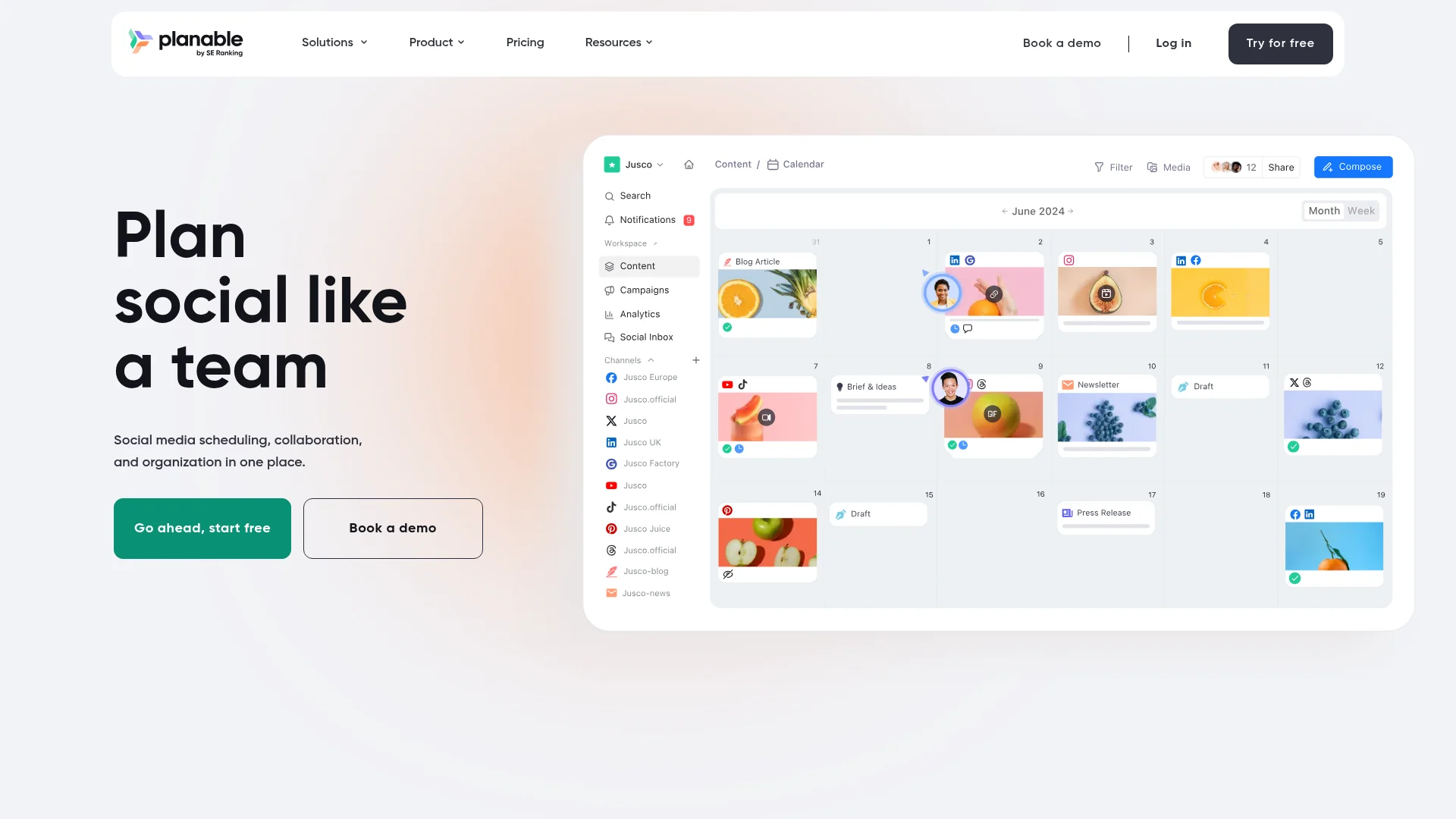
The core product surfaces, the per-channel landing pages for each supported social platform, and the audience-segmented pages for agencies, multi-brand companies, multi-location brands, and enterprise. Page titles consistently lead with collaboration language ("collaboration-first social media management tool," "social media insights & client reporting"), which signals that Planable wants the product positioning conversation to start with workflow, not with publishing. The audience-routing pages match this: each one calls out the actual workflow problem its segment has, like multi-client approvals for agencies and multi-location publishing for franchise brands. The per-channel pages use the same "Plan, review, and approve [channel] content" template across Facebook, Instagram, LinkedIn, TikTok, and the rest, which turns every per-channel branded search into a ranking surface.
Sample pages:
- Planable: collaboration-first social media management tool
/ - Social media management for agencies: plan, approve, publish across every client
/agencies/ - Planable Analytics: social media insights & client reporting
/analytics/ - Plan & run social media campaigns in one place with Planable
/campaigns/
Pricing, Demo, Company & Brand (~15 Pages)
Pricing, demo booking, the plan-recommendation quiz, About, careers, brand guidelines, the Planable Ambassadors program, Planathon, and seasonal campaigns like Black Friday and the "good-riddance-campaign" launch. The pricing quiz is the interesting tell. Most peers route directly to a plan grid; Planable interposes a recommendation flow that both qualifies the buyer and creates a conversation pattern leading into demo booking. The Ambassadors program is the other unusual element: a community-building investment most challengers skip in favor of paid acquisition, generating third-party content (ambassador-authored posts and social proof) that compounds without the company writing every word.
Sample pages:
- About Planable | The social media tool for agencies & teams
/about/ - Become a Planable Ambassador
/ambassadors/ - See Planable in action: book a free demo
/book-a-demo/ - Good riddance to agency chaos — see what Planable just shipped
/good-riddance-campaign/
Localized Product & Pricing Surfaces (~11 Pages)
Spanish, German, and French translations of the homepage, product, pricing, and demo pages. A targeted set. Only the highest-converting surfaces get translated. This matches the broader locale strategy: translate where there's measurable demand, not as a default.
Sample pages:
- Planable | Content planen, freigeben und zusammenarbeiten
/de/ - Planable | Planificación y aprobación de contenido + colaboración
/es/ - Planable | Planification de contenus, validation et collaboration
/fr/ - Preise - Planable | Kostenlose Planung, Genehmigung und Zusammenarbeit bei Inhalten
/de/preise/
Legal, Privacy & Site Utility (~95 Pages)
Privacy, terms, cookies, processors, 404 pages, and similar utility URLs. Two-thirds of the cluster is legal and utility infrastructure. Standard B2B SaaS footprint, but the count materially inflates the cluster's apparent size and tells you why the headline "biggest cluster" framing can be misleading. The substantive content investment in this cluster is much smaller than the URL count suggests.
Sample pages:
- Privacy Statement - Planable | Social Media Collaboration Platform
/privacy/ - Cookie Policy - Planable | Social Media Collaboration Platform
/cookies/ - Privacy Policy - Planable | Social Media Collaboration Platform
/processors/ - Page not found — but Planable is still here
/404page/
Strategy insight: The cluster reads as deliberately compact. Only about 46 substantive content URLs sit behind the 95-URL legal and utility footprint. The channel-specific feature pages and audience pages are template-driven (fast to maintain, modest differentiation per page); the unique investments are the Ambassadors program and the pricing quiz, both of which create flywheels that don't require ongoing editorial production. For a 50-100 person company, this is the right architecture: minimize maintenance, maximize the few surfaces that compound. The localized product surfaces follow the same logic, translated only where the underlying English page already converts.
2. Customer Proof, Education & AI Content Tools
Pages: 103 · Share of library: 17.2%
The credibility-and-education layer plus the standalone Free AI Content Tools suite. Customer case studies, expert webinars, the Content Workflow Academy, downloadable reports, /guides product walkthroughs, the 33-page AI generator suite, plus localized editorial and AI-perspective posts. The cluster is mixed by content type (Free Tools 32%, Blog 29%, Guides 14%, Webinars 11%, Case Studies 6%) and that mix is itself the story: this is where Planable's non-blog investments concentrate.
Content-type mix: Free Tools 32.0% · Blog / Editorial 29.1% · Guides & Resources 13.6% · Events / Webinars / Sessions 10.7% · Case Studies 5.8% · Other 5.8% · Research / Reports 2.9%
Micro-topics within this cluster
AI Caption & Hashtag Generators (~14 Pages)
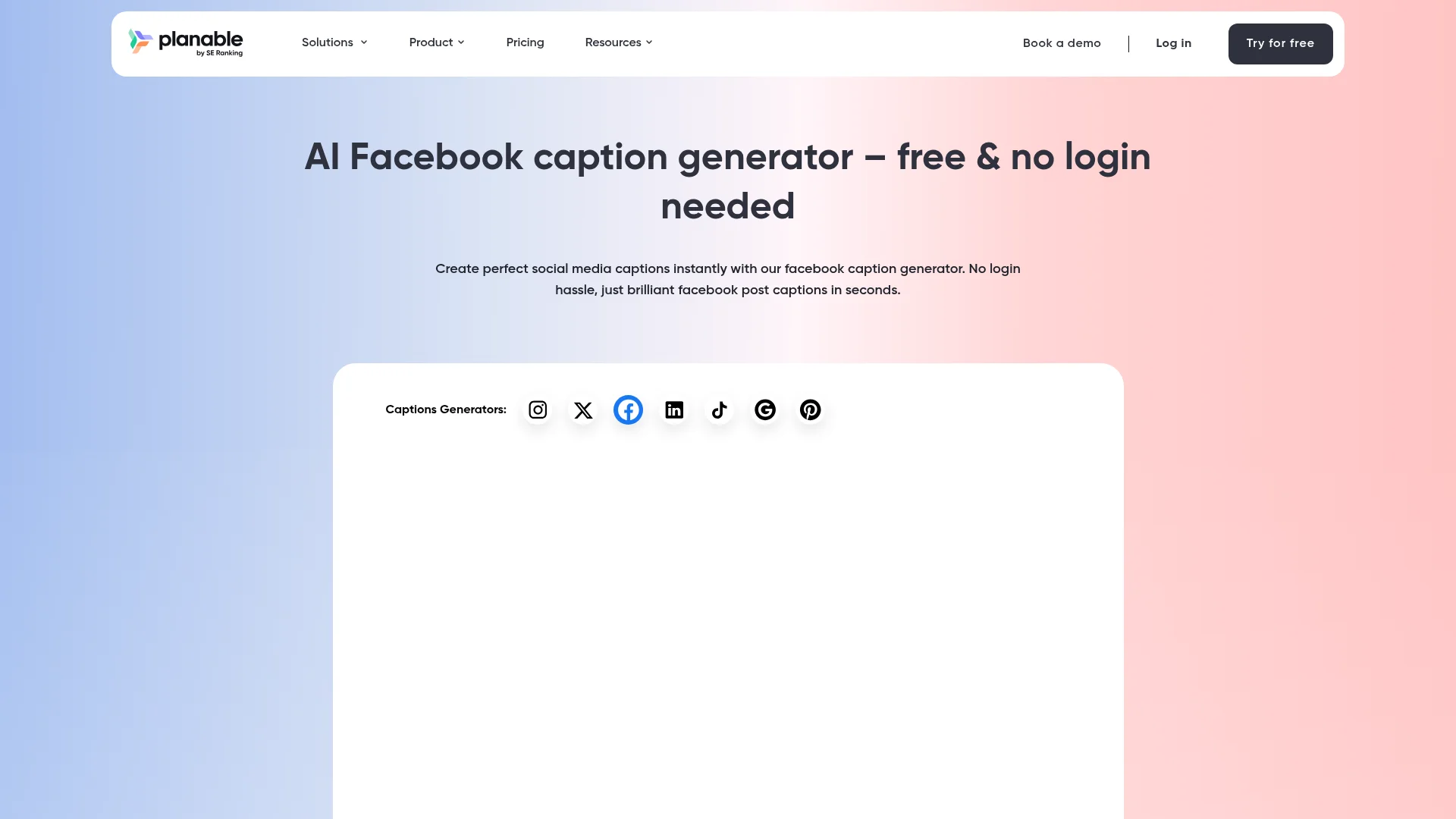
One caption generator and one hashtag generator per major platform: Instagram, TikTok, LinkedIn, Twitter/X, Facebook, Pinterest, and Google Business Profile. Each URL is a standalone SEO landing page targeting head-term intent like "Instagram caption generator" and "LinkedIn hashtag generator." The per-platform structure is the strategic move. Instead of one generic generator competing against ChatGPT, fourteen channel-specific generators compete against narrower, higher-intent queries where a free utility ranks above paywalled product pages. Hashtag intent is even more channel-specific than caption intent (TikTok hashtag rules differ materially from LinkedIn's), and the paired structure captures the long-tail platform-by-platform.
Sample pages:
- Facebook Caption Generator (Free AI Tool) - Planable
/facebook-caption-generator/ - Free AI Facebook hashtag generator - Planable
/facebook-hashtag-generator/ - AI Google My Business Caption Generator (Free Tool) - Planable
/google-my-business-caption-generator/ - Free AI Instagram Caption Generator - No Login
/instagram-caption-generator/
AI Engagement, Script & Utility Generators (~19 Pages)
The other half of the Free AI Tools suite: comment generators for the major platforms, reply tools, video and TikTok script generators, content repurposers (blog to newsletter, blog to social, social to blog), the AI Content Humanizer, a Quora answer generator, and the /ai-tools index. The comment and reply set targets a different workflow than the caption generators: not creating original content, but responding to existing content. That maps directly to Planable's Engagement product surface, which means the cluster doubles as a long-tail demand-generation funnel for users who don't yet know they need a social inbox tool. The Content Humanizer is the most interesting single tool: it targets the specific anxiety of users who already use AI generators and worry about detection or quality, which makes it a natural complement to every other tool in the suite.
Sample pages:
- AI Content Humanizer (Free Tool) - Planable
/ai-humanizer/ - AI Tools That Make Work Easier (and a Lot More Fun)
/ai-tools/ - AI email response generator - free email reply tool by Planable
/email-response-generator/ - Free AI Facebook comment generator - Planable
/facebook-comment-generator/
Customer Stories, Webinars & First-Party Resources (~22 Pages)
Six named customer case studies (Attractive Media, Cairngorm Coffee, Olympus, Public Alliance, and others), the customers hub, expert webinars on community management and agency growth, the Content Workflow Academy landing page, and a small set of downloadable resources hosted at /resources/ including Social Teams 100 and the Marketing Teams of the Future eBook. The asymmetry inside this sub-theme is the story. Six case studies for a customer base that includes Hyundai, KFC, the United Nations, and Christian Louboutin is well below the credibility-signal threshold the customer logos suggest. The webinar selection skews sharply toward agency growth and feedback workflows that map to Planable's core product wedge, rather than general social-media-101 content, which is webinar programming as buyer education for a specific persona, not as broad lead-gen.
Sample pages:
- The Free Content Workflow Academy – Planable
/academy-episodes/ - How agencies and brands use Planable: real stories, real results
/customers/ - Free social media resources for agencies and marketing teams
/resources/ - Webinars | Actionable Insights for Marketing & Social Media
/webinars/
Product Guides & Integration Walkthroughs (~14 Pages)
Step-by-step feature walkthroughs hosted at /guides/: workspaces, approvals, campaigns, analytics, social inbox, media library, and collaboration flows, plus integration tutorials for Slack, Canva, Zapier, and per-channel workflows for TikTok and Pinterest. /guides/ is doing the work that technical documentation would do for a developer-targeted platform: explaining how features work for buyers who want to understand the product before committing. The integration count is the more interesting limit. Five integration guides is light for a B2B SaaS product, but the chosen integrations (Slack, Canva, Zapier) are the ones most directly tied to creative-team workflows, which matches Planable's collaboration positioning.
Sample pages:
- Planable Features, Updates & How Tos
/guides/ - Planable Analytics: cross-platform social media reports
/guides/analytics-features/ - Campaigns in Planable: briefs, assets, approvals & analytics in one place
/guides/campaigns-in-planable/ - Planable x Canva integration: design to social publishing flow
/guides/canva-planable-integration/
Localized Editorial & AI Perspective (~34 Pages)
The two adjacent expansion layers: German, French, and Spanish translations of high-performing editorial (mostly Hootsuite and Agorapulse alternatives plus core scheduling content), and English-language perspective posts on AI prompts, AI workflows, and the future of AI in marketing. The translation pattern is striking and consistent: alternatives content first, then high-traffic editorial. That alternatives content gets the prioritized translation tells you what's working in those markets. Buyers searching in French and German for Hootsuite alternatives are clearly converting, so the team translates those before anything else. The English-language AI perspective posts run thinner than peers, suggesting Planable is deliberately under-indexing on AI editorial in favor of the 33-page Free AI Tools utility surface, which captures the same audience more directly through a different door.
Sample pages:
- Planable Blog | Content Collaboration & Social Media in One Single Place
/de/blog/ - Produkt | Planable | Kostenloses Social-Media-Content-Kalender-Tool
/de/produkt/ - Planable Blog | Content Collaboration & Social Media in One Single Place
/fr/blog/ - 3 KOSTENLOSE Wege, Facebook-Posts zeitlich zu planen [2026]
/de/blog/facebook-posts-planen/
Strategy insight: This cluster carries most of the library's non-blog investment in one place: free tools, customer proof, webinars, guides, and the localized expansion layer. The 33-URL Free AI Tools sub-group inside it is the most distinctive structural choice in Planable's library. Each tool is a standalone SEO landing page targeting high-intent, no-login search behavior where a free utility outranks paywalled product pages. The cluster effectively gives Planable an "AI generators" surface adjacent to the social-management product, captured at the URL level and discoverable independently of the company's core positioning. It is also the closest thing in the library to a compounding asset: tools don't decay the way time-stamped editorial does. The under-investment elsewhere in the cluster, six case studies against a roster of enterprise logos, three downloadable reports with no annual franchise, is the cleanest expansion area in the library.
3. Tools, Comparisons & Alternatives
Pages: 124 · Share of library: 20.7%
Tool roundups, comparison posts, alternatives lists, head-to-head posts, and software-category explainers. The library's third-largest cluster and the most bottom-funnel cluster by a wide margin.
Content-type mix: Blog / Editorial 100%
Micro-topics within this cluster
General Marketing & Workflow Tool Roundups (~49 Pages)
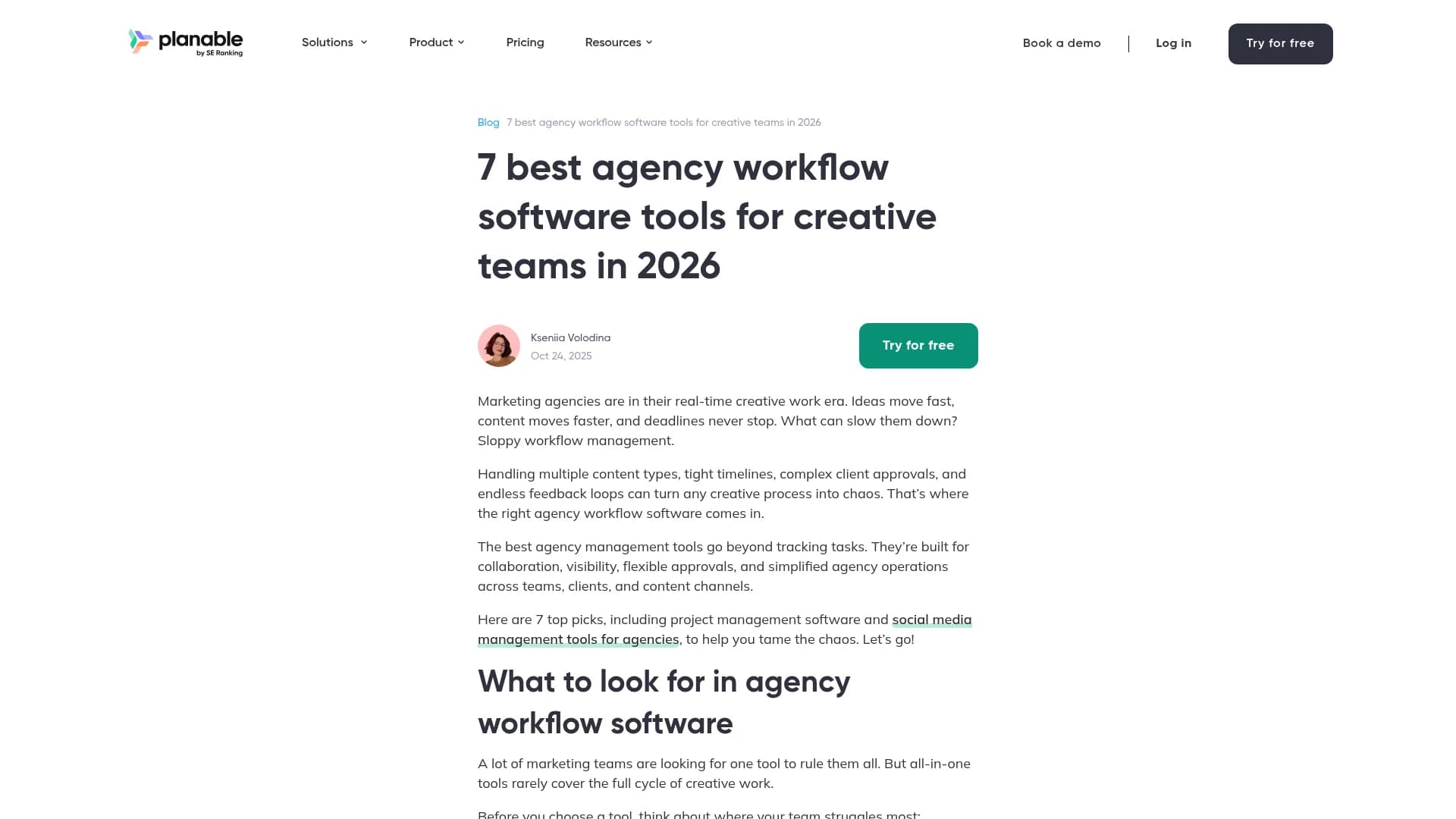
Best-of listicles covering broad software categories: project management tools, content workflow software, marketing operations, AI marketing tools, agency software, and collaboration platforms. The sub-theme captures broad-evaluation search intent ("best social media management tools," "best AI marketing tools," "best agency workflow software") that sits one step above named-competitor queries. The roundups are where Planable's first listing in its own articles becomes the conversion path. Every "best social media management tools 2026" article lists Planable, by definition, and 49 pages of category breadth means the team owns a wide surface area of best-of search behavior across both adjacent and core categories.
Sample pages:
- agency-workflow-software
/blog/agency-workflow-software/ - ai-content-creation-tools
/blog/ai-content-creation-tools/ - ai-copywriting-tools
/blog/ai-copywriting-tools/ - ai-marketing-tools
/blog/ai-marketing-tools/
Per-Platform Tool Roundups (~18 Pages)
Best-of listicles scoped to a single social network: Instagram tools, Facebook tools, TikTok tools, LinkedIn tools, YouTube analytics tools, and similar channel-specific roundups. The sub-theme targets the buyer who already knows which platform they need help managing, which is a different (and often warmer) search intent than the broader category roundups. 18 pages is enough to cover the major social platforms without thinning out per page. Pairs naturally with the Per-Platform Playbooks cluster, since the same buyer behavior (channel-specific search) drives both.
Sample pages:
- best-analytics-tools-for-facebook-ads-integration
/blog/best-analytics-tools-for-facebook-ads-integration/ - facebook-analytics-tools
/blog/facebook-analytics-tools/ - facebook-management-tools
/blog/facebook-management-tools/ - facebook-marketing-tools
/blog/facebook-marketing-tools/
Competitor Alternatives & Direct Comparisons (~57 Pages)
"Best alternatives to X" listicles covering Hootsuite, Buffer, Later, Agorapulse, Sprout Social, Brandwatch, Asana, and adjacent categories, plus a handful of direct A vs B head-to-head posts (Hootsuite vs Buffer, Hootsuite vs Sprout Social), migration guides, and category pricing breakdowns. The bread-and-butter SaaS SEO play: capturing displacement-intent search behavior when a buyer is unhappy with their current tool. 57 alternatives and comparison posts for a 600-page library is unusually heavy investment, and the breadth (covering not just direct competitors but adjacent categories like Asana) suggests Planable is competing on this surface aggressively rather than defensively. The mix bias toward alternatives listicles over head-to-head comparison pages is the commercial bet: capture buyers searching for alternatives to category leaders (where Planable can list itself first) rather than fight named-vs comparison searches where the buyer already has a brand in mind.
Sample pages:
- agorapulse-alternatives
/blog/agorapulse-alternatives/ - asana-alternatives
/blog/asana-alternatives/ - brandwatch-alternatives
/blog/brandwatch-alternatives/ - buffer-alternatives
/blog/buffer-alternatives/
Strategy insight: This is the single most distinctive cluster in Planable's library by strategic posture. 124 URLs of comparison and alternatives content in a 600-page library (20.7% of everything) is challenger-aggressive. The structural choice is bias toward alternatives listicles (57) and best-of roundups (49 general + 18 per-platform) rather than dedicated head-to-head comparison pages. For a 50-100 person company competing against Hootsuite, Buffer, Sprout Social, and Later, this is the right wedge. The library is set up to intercept buyers at the moment they're evaluating tools, with comparison work embedded inside blog listicles rather than on a separate /compare path, a different positioning choice with different SEO and citation implications.
4. Social Media Strategy & Agency Workflows
Pages: 128 · Share of library: 21.3%
The largest single editorial theme: cross-platform strategy guides, planning frameworks, content calendars, listening and audits, engagement and community management, campaigns and creative execution, analytics and reporting, and the agency-specific workflows that wrap around all of it. Pure editorial cluster.
Content-type mix: Blog / Editorial 100%
Micro-topics within this cluster
Strategy Playbooks & Plans (~49 Pages)
The largest sub-theme in the cluster: comprehensive strategy guides, plan templates, marketing plans, goal frameworks, and broader cross-platform strategy posts. The volume here (more than a third of the cluster) reflects the highest-altitude search intent in the library. Someone searching "social media strategy template" is upstream of platform-specific tactics, and 49 pages is enough to cover the major variants (B2B, e-commerce, agency, multi-brand) without thinning out per page. The sub-theme also serves as the connective tissue between the cluster's other sub-themes: a strategy post often touches on planning, engagement, and analytics in the same article, which gives the cluster its internal coherence even though the URL count is concentrated in one micro-topic.
Sample pages:
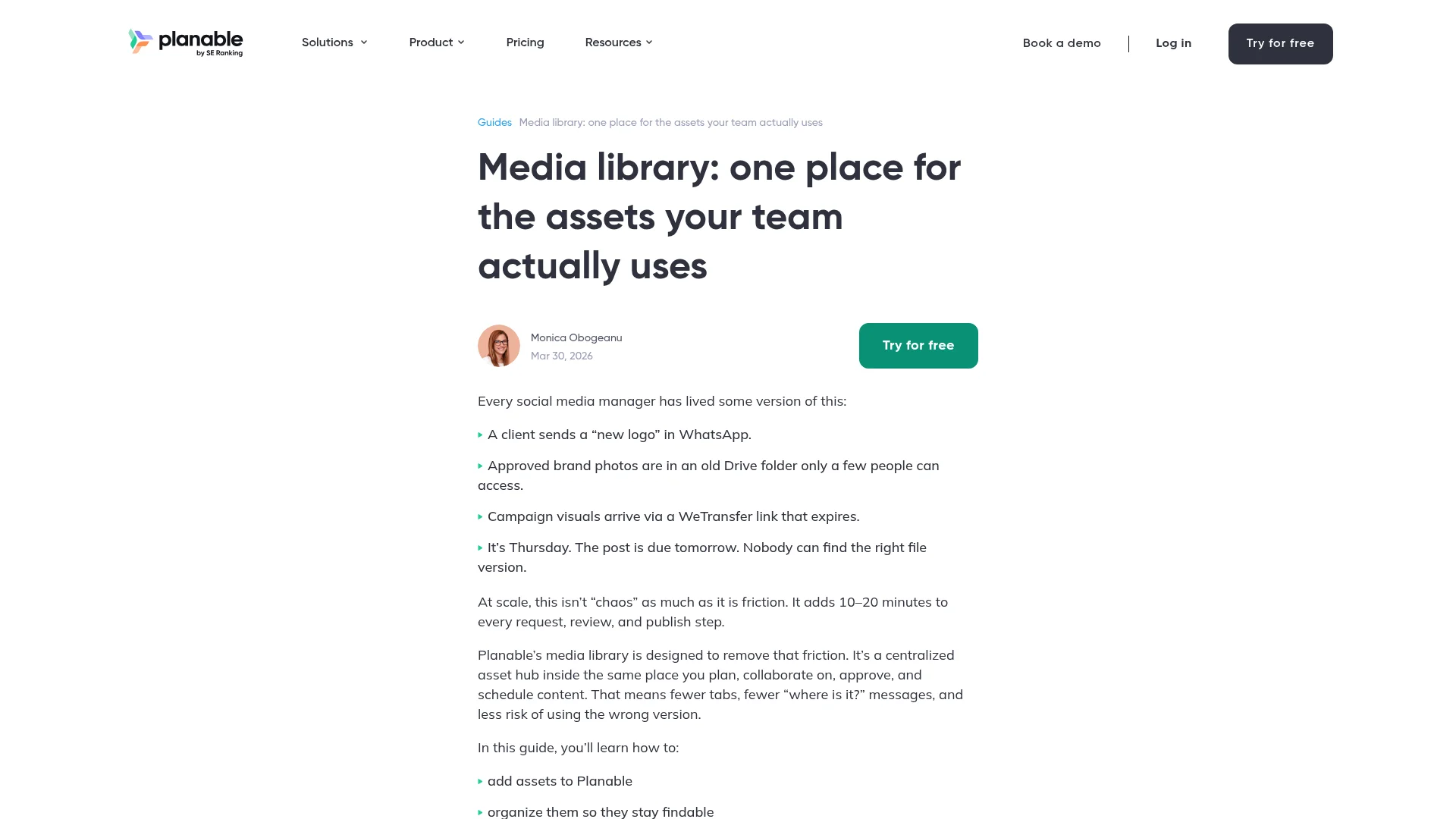
- Planable media library: organize social media assets in one place
/blog/auto-crop-images/ - Planable x Canva integration: design to social publishing flow
/blog/canva-planable-integration/ - Planable x Canva integration: design to social publishing flow
/blog/how-we-launched-planable-canva-integration/ - b2b-content-marketing
/blog/b2b-content-marketing/
Planning, Calendars & Audits (~24 Pages)
Editorial calendars, scheduling cadence, content pillars, planning frameworks, social audits, listening, sentiment analysis, competitor benchmarks, and social media statistics. Planning is the entry-point search behavior for new social media managers. "How to build a content calendar" is the question every first-time hire asks. The audit and listening side adjacent to it sits at the intersection of social and competitive intelligence, which is also adjacent to Planable's parent company SE Ranking's core business. Worth watching whether Planable's editorial here starts to converge with SE Ranking's listening-tool content over the next year.
Sample pages:
- Planable blog index
/blog/ - blog-content-calendar
/blog/blog-content-calendar/ - communications-calendar
/blog/communications-calendar/ - how-to-conduct-a-social-media-audit-in-7-easy-steps
/blog/how-to-conduct-a-social-media-audit-in-7-easy-steps/
Engagement, Community & Analytics (~23 Pages)
Comment management, DMs, community building, moderation, social inbox, KPIs, engagement rate, reporting to stakeholders, and proving social media ROI. The "reporting to stakeholders" angle is the analytically interesting one. Most analytics content focuses on what to measure, but a meaningful share of Planable's posts focus on how to present findings to clients and executives. That matches the agency-collaboration positioning: agencies need reporting content that helps them defend retainers, not just measure outcomes. The engagement side maps directly to Planable's Engagement product surface, which means the cluster and the product story reinforce each other.
Sample pages:
- Planable Analytics: cross-platform social media reports
/blog/analytics-features/ - Planable Analytics: cross-platform social media reports
/blog/introducing-analytics/ - Planable Analytics: cross-platform social media reports
/blog/planable-analytics/ - audience-engagement
/blog/audience-engagement/
Campaigns & Creative Execution (~13 Pages)
Campaign planning, creative formats, copywriting, design, humor, hooks, and creative workflow management. The cluster's most production-side sub-theme: content for the people running campaigns rather than the people planning calendars. The presence of campaign-workflow and creative-project-management posts indicates Planable is positioning Campaigns (the product surface) as a campaign-execution tool, not just a content scheduler. The titles also reach for craft topics (humor, hooks, copywriting), which is where social-media editorial gets shareable beyond the "how to schedule" head terms.
Sample pages:
- brand-management
/blog/brand-management/ - creative-project-management
/blog/creative-project-management/ - creative-workflow-management
/blog/creative-workflow-management/ - humor-social-media-campaigns
/blog/humor-social-media-campaigns/
Agency Workflows & Client Collaboration (~19 Pages)
Agency growth and operations, retainers, team structure, profitability, client onboarding, approval flows, feedback cultures, and a proposal template. The agency-persona editorial that ties the operational realities of running an agency to the approvals workflow Planable's product sells. The agency-founders-top and agency-profit-margins-report posts suggest Planable is producing benchmark-style content the agency owner can use as ammunition in internal planning, which is the right hook for a buyer whose decision criteria include "does this make my agency more profitable." The approval-workflow content is the Planable-native sub-group: approvals are the core of the product pitch, and these posts are where editorial and product positioning converge most tightly.
Sample pages:
- agency-client-collaboration
/blog/agency-client-collaboration/ - agency-founders-top
/blog/agency-founders-top/ - agency-profit-margins-report
/blog/agency-profit-margins-report/ - agency-workflow
/blog/agency-workflow/
Strategy insight: Strategy Playbooks & Plans (49 pages) dwarfs every other sub-theme. That's where the editorial weight sits, capturing top-of-funnel strategic search intent. The cluster as a whole maps almost 1:1 to Planable's product surface area: Planning content backs the calendar product, Engagement content backs the Engagement product, Analytics content backs Analytics, Campaigns content backs Campaigns, and Agency Workflows content backs the agency-collaboration positioning. That symmetry between editorial and product is unusual at this scale and suggests deliberate editorial planning rather than opportunistic publishing. The Agency Workflows sub-theme is the strategic glue: the only single sub-group that runs across all five product surfaces because every product capability is sold against an agency-collaboration use case.
5. Per-Platform Playbooks & Content Operations
Pages: 104 · Share of library: 17.3%
Editorial playbooks for individual social platforms (Instagram, Facebook, LinkedIn, TikTok, YouTube, Twitter, Pinterest, Threads) plus broader content marketing practice, distribution, asset management, and marketing operations content. The execution-layer editorial paired with the cross-functional content practice that complements it.
Content-type mix: Blog / Editorial 100%
Micro-topics within this cluster
Instagram & Visual Platform Playbooks (~28 Pages)
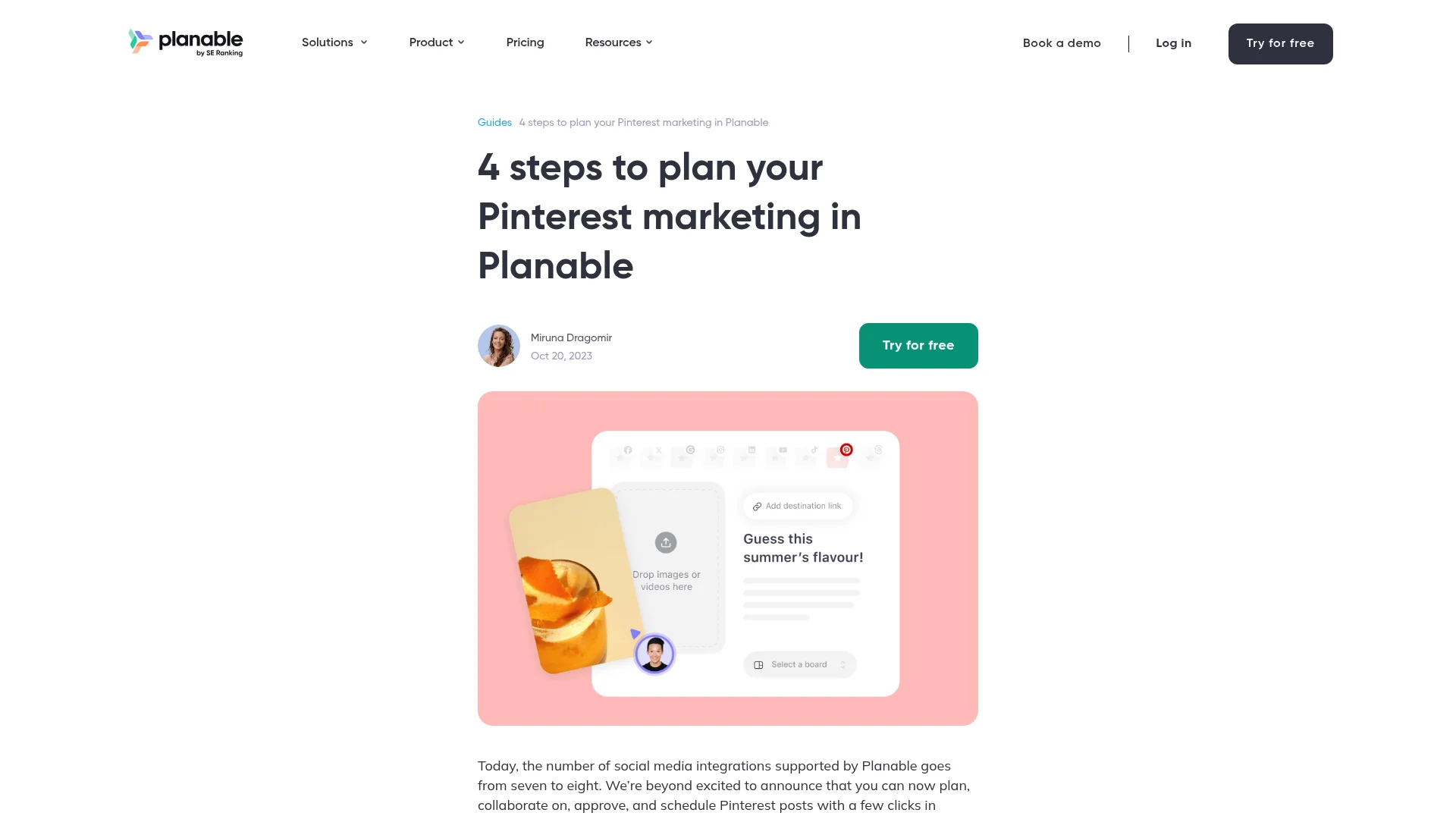
The largest single-platform sub-group: Instagram posting, Reels, Stories, scheduling, captions, hashtags, selling, and business use cases, plus Pinterest pinning and scheduling. 28 pages is meaningful editorial concentration and reflects Instagram's outsized share of social-management search volume, with Pinterest grouped in as a sibling visual-search platform. The titles cover both the head ("how to use Instagram for business") and the long tail ("how to download a Reel," "best time to post"), which is the right mix for a platform where the keyword universe is dense and intent-varied. Pinterest sits as a smaller adjacency with its own discovery mechanics (boards, evergreen pins, search-driven), and the three Pinterest posts are enough to surface the topic for buyers who need it without overcommitting against specialist publishers.
Sample pages:
- 4 steps to plan your Pinterest marketing in Planable
/blog/plan-pinterest-marketing-planable/ - best-time-to-post-on-instagram
/blog/best-time-to-post-on-instagram/ - how-to-download-a-reel-from-instagram
/blog/how-to-download-a-reel-from-instagram/ - how-to-sell-on-instagram
/blog/how-to-sell-on-instagram/
Facebook, LinkedIn & B2B Channel Playbooks (~16 Pages)
Facebook posting and scheduling, Meta Business Suite, ads targeting, LinkedIn personal brand, company page tactics, scheduling, analytics, and B2B social strategy. The two B2B-adjacent channels grouped together. Facebook content trends toward operational (account management, scheduling, carousel posting) rather than strategic, which matches Facebook's place in most social teams' workflows as a maintained but not foregrounded channel. LinkedIn sits at the boundary between social media management and B2B content marketing, and the titles foreground planning vocabulary rather than tactical execution. Pairs naturally with the Agency Workflows sub-theme in cluster 4, since LinkedIn is where most agency new-business search behavior happens.
Sample pages:
- facebook-marketing-strategy
/blog/facebook-marketing-strategy/ - facebook-post-ideas
/blog/facebook-post-ideas/ - how-to-plan-linkedin-funnel
/blog/how-to-plan-linkedin-funnel/ - how-to-post-a-carousel-on-facebook
/blog/how-to-post-a-carousel-on-facebook/
Video Platform & Emerging Channel Playbooks (~13 Pages)
TikTok scheduling, content formats, captions, calendars, and growth; YouTube scheduling, Shorts, content calendars, and channel strategy; one Twitter/X post on managing multiple accounts; one Threads scheduling post. The video-first platforms get sensible coverage proportional to their place in buyer workflows. The Twitter and Threads thinness is the story: choosing one operational post per platform is a defensible editorial bet against platforms whose user behavior is in flux. YouTube sits adjacent to but outside the typical social-management buyer's day-to-day, and over-investing here would dilute editorial focus; the chosen depth matches the agencies that increasingly handle YouTube as part of a multi-channel client retainer.
Sample pages:
- Manage your TikTok workflow in Planable | From ideas to analytics
/blog/manage-tiktok-in-planable/ - how-to-schedule-youtube-shorts
/blog/how-to-schedule-youtube-shorts/ - manage-multiple-twitter-accounts
/blog/manage-multiple-twitter-accounts/ - repurpose-tiktok-videos
/blog/repurpose-tiktok-videos/
Content Marketing Practice (~30 Pages)
Content strategy frameworks, content distribution, repurposing assets, media library and asset management, newsletters and email content, branded content, and user-generated content. The sub-theme stretches Planable's editorial territory beyond social into broader content marketing, useful for the marketing leader buyer who runs a multi-channel content function. 30 pages is enough to anchor the topic and feed adjacent product surfaces. Repurposing is where this sub-theme overlaps with both the Free AI Content Tools cluster (the repurposing generators) and the product itself (Universal Content). The newsletter content is more opportunistic than strategic, capturing search volume in an adjacency that doesn't directly tie to a product surface.
Sample pages:
- aspiring-content-strategy-template-for-entrepreneurs
/blog/aspiring-content-strategy-template-for-entrepreneurs/ - blog-content-strategy
/blog/blog-content-strategy/ - branded-content
/blog/branded-content/ - content-curation
/blog/content-curation/
Productivity, Roles & Marketing Operations (~17 Pages)
General productivity, project management for marketers, remote work, time zones, team workflows, plus social-media-manager career paths, hiring, role descriptions, and skill development. The presence of remote-work and time-zone content reflects Planable's own distributed-team posture (Moldova HQ, distributed contributors) and lines up with the buyer's reality, since most modern social teams are at least partly distributed. The career and hiring content captures both sides of the hiring conversation: the practitioner (who buys the tool eventually) and the hiring manager (who buys it sooner). The sub-theme reads as content the team writes from experience, not just for SEO.
Sample pages:
- Planable + Slack integration: Planable notifications in Slack
/blog/planable-slack-integration/ - content-workflow
/blog/content-workflow/ - how-to-become-a-social-media-manager
/blog/how-to-become-a-social-media-manager/ - how-to-hire-social-media-manager
/blog/how-to-hire-social-media-manager/
Strategy insight: Instagram and visual platforms absorb 28 of the cluster's 104 pages; Facebook, LinkedIn, TikTok, YouTube, and the emerging-channels group hold 29 between them; content marketing practice and operations together hold the remaining 47. The shape mirrors how most social teams actually allocate their attention: Instagram-dominant on the channel side, with a substantial cross-functional content-operations layer that addresses the marketing leader rather than the practitioner. For a 600-page library, this is exactly the right level of platform coverage. Over-investing in the long tail of channels would trade away the per-page efficiency that makes this library work, while the content-operations sub-themes extend Planable's reach to the buyer above the social media manager.
Key Observations
What Stands Out About Planable's Content Strategy
The library is editorial-led but structurally lean, every page is pulling weight
64.3% of Planable's 600 pages are Blog / Editorial content, which makes the architecture editorial-first. The more interesting number is per-URL efficiency: 318 monthly visits per page across the full library. That's roughly seven times Agorapulse's 43, four times Brandwatch's 76, and well above Loomly's 84. For a 50-100 person company, this is the right shape: a smaller, sharper library where every page has to justify its presence. The editorial focus also concentrates rather than spreads: 64% in one content type means the team writes one kind of thing well rather than three kinds of things adequately.
Comparison and alternatives content is a top-three cluster, challenger-aggressive bottom-funnel posture
The Tools, Comparisons & Alternatives cluster holds 124 URLs, 20.7% of the library, third-largest after Product, Audience & Site Architecture and Social Media Strategy & Agency Workflows. Inside it, 57 alternatives and direct-comparison posts cover Hootsuite, Buffer, Later, Agorapulse, Sprout Social, Brandwatch, and adjacents like Asana. 49 general roundups capture broader category search ("best AI marketing tools," "best agency workflow software"), and 18 per-platform roundups target buyers who already know which channel they need help managing. The mix bias toward alternatives over named-vs head-to-head comparison is the commercial bet: capture buyers searching for alternatives to category leaders (where Planable can list itself first) rather than fight named-vs comparison searches where the buyer already has a brand in mind. For a challenger competing against companies five to ten times larger, this is the right wedge.
The Free AI Content Tools suite is a structurally distinctive compounding asset
33 standalone AI generator pages hosted at the root, caption generators (7 channel-specific URLs), hashtag generators (7), comment and reply generators (9), script generators (4), repurposing tools (3), writing utilities (3), sit as a dedicated sub-group inside the Customer Proof, Education & AI Content Tools cluster, outside /blog. The structure matters: each tool is a standalone SEO landing page targeting high-intent, no-login search behavior where a free utility outranks paywalled product pages. The suite effectively gives Planable an "AI generators" surface adjacent to the social-management product, captured at the URL level and discoverable independently of the company's core positioning. It is also the closest thing in the library to a compounding asset. Tools don't decay the way time-stamped editorial does.
Top-10 search share is meaningfully below peers, but the 11-20 band is the actionable opportunity
15.55% of Planable's 13,493 ranking positions are in the top 10, below category top-10-share leader Buffer at 23.45% and the cluster of peers (Sprout Social 23.36%, Hootsuite 22.32%, Later 21.79%, Agorapulse 21.77%) sitting around 22%. The headline reads as an authority gap. The actionable read is in the 11-20 band: 2,022 positions are one click of search-result momentum away from page one, and the 21-50 band holds another 6,042 positions. The library has the surface area to compete. The work is page-by-page optimization on URLs that already rank, not net-new content, and that's a meaningfully cheaper expansion path than building a new editorial layer from scratch.
Zero Glossary URLs, zero Comparison Pages, zero Documentation, three structural absences
Three of the 12 content-type buckets are empty in Planable's library. Zero Glossary / Definitions means no definitional layer for the dozens of "what is X" queries in social media management (searches like "what is a content calendar," "what is community management," "what is a social media audit") that anchor both traditional SEO and AI citation. Peer libraries here look very different: Later runs 281 glossary URLs, SocialBee 215, Sprout Social 112, Buffer 116. Zero Comparison Pages in a conventional /compare path; the comparison work lives inside blog listicles instead, which is a different positioning choice with different SEO implications. Zero Documentation in the main sitemap, which is appropriate for a buyer-targeted (rather than developer-targeted) platform. The glossary gap is the most actionable of the three. A library of 50-100 well-structured "what is X" pages would close the AEO surface that peers already own.
Case studies are the clearest under-investment relative to the customer roster
Six customer case studies for a customer base that includes Hyundai, Christian Louboutin, Viber, the United Nations, Royal Canin, and KFC is the clearest under-investment in the library. The customers exist; the proof artifacts are missing. For a buyer evaluating Planable against Hootsuite or Sprout Social, the case study count is one of the first credibility signals, and 6 is well below the threshold where the library demonstrates enterprise traction at the scale the customer logos suggest. The category leaders run case study libraries an order of magnitude larger. Expanding the case study program to even 20-30 named studies, prioritizing the enterprise logos already in the customer list, would close the single most defensible gap in the library.
No first-party research franchise, the biggest soft asset gap
Only 3 URLs in the library are classified as Research / Reports, and none carries an annual-series marker. Social Teams 100 is closer to community recognition than to original research. Peers with annual reports (a "State of X" series, an industry benchmark) have a compounding asset that anchors editorial clusters, earns backlinks year over year, and gives the sales team a credibility artifact to point to. For a company recently acquired by SE Ranking, which produces its own research, there is a natural opportunity to launch a joint research franchise (social media + SEO crossover data) that neither company currently owns alone.
Editorial-to-product symmetry is unusual at this scale
The Social Media Strategy & Agency Workflows cluster maps almost 1:1 to Planable's product surface area. Planning content backs the calendar product. Engagement content backs the Engagement product. Analytics content backs Analytics. Campaigns content backs Campaigns. Agency Workflows content backs the agency-collaboration positioning. Most challenger libraries publish opportunistically against search volume; Planable's editorial reads as deliberately shaped to mirror what the product does, which means the blog and the product reinforce each other rather than competing for attention. For a 50-100 person company, this is a sign of editorial discipline that scales better than headcount.
More analyses in Social Media Management
Sendible
How Sendible uses 536 blog posts, 133 product pages, and 41 case studies to drive 126K monthly visits in social media management. 770 pages, 6 clusters.
SocialBee
How SocialBee uses 838 blog posts, a 215-term glossary, and 34 free tools to drive 143K monthly visits in social media management. 1,238 pages, 6 clusters.
Sprout Social
How Sprout Social uses 1,519 blog posts and the annual Sprout Social Index to drive 2.2M monthly visits in social media management. 2,155 pages, 9 clusters.
Agorapulse
How Agorapulse uses 2,872 blog posts and a 421-URL multi-podcast network to drive 175K monthly visits in social media management. 4,086 pages, 7 clusters.
Methodology: This analysis is based on Planable's full public sitemap (600 URLs, sourced from robots-txt), enriched with each URL's title and meta description. URLs were classified into a 12-bucket content type taxonomy and grouped into 5 topic clusters with 22 micro-topics using LLM-assisted classification. Company facts came from public web research across Crunchbase, LinkedIn, and the company's own About and blog pages. Traffic metrics (monthly organic visits, traffic value, ranking positions, position distribution) came from DataForSEO's domain rank overview, aggregated globally across 116 locale combinations. All counts reflect the Planable sitemap as of 2026-05-25.