If you run content for a large organization, you probably already have thousands of pages, several teams touching them, and a leadership question you cannot fully answer yet: what is our AI search strategy large sites can actually sustain. A page by page fix does not work at this size. What works is a portfolio approach, where you treat the whole site as a set of topic clusters, prioritize them by citation value, and give every team the same map and the same scorecard to work from. This guide walks through that system, from defining the questions buyers ask through reviewing results and reallocating effort, so you can build an enterprise AEO strategy that holds together across a large site and multiple owners. Along the way you will see what scaling AEO across teams looks like in practice, not just in theory.
Before getting into the steps, it helps to be precise about the terms, because teams that mix them up end up measuring the wrong thing. AEO, or answer engine optimization, is the practice of increasing the odds that an answer engine names your brand, cites your pages, or draws on your content to support an answer. GEO, generative engine optimization, is the wider practice of shaping content so generative search systems can retrieve, interpret, and present it well. AI search visibility is the measurable presence of your brand or your pages inside AI generated answers, and it is not the same thing as your organic ranking. A page can rank well for a query and still be left out of the AI answer, and a page can get cited even when it does not sit in the traditional top ten for that exact query.
That gap between ranking and citation is also why you need to hold a few metrics apart instead of folding them into one number. Mention rate is the share of tracked answers where your brand gets named. Citation rate is the share of tracked answers that link to one of your pages as a source. Share of voice is your visibility relative to named competitors on the same set of prompts. Sentiment or description accuracy tells you whether the answer describes your brand fairly. Visibility trend is simply the direction of these numbers over time. None of these is a click, a ranking position, an authority score, or a conversion, and treating a citation as proof of authority is one of the more common mistakes teams make once they start tracking this.
Define the buyer prompts that matter
Start with the questions your buyers actually ask, not with the pages your site already has. If you start from your existing page list, you will just rebuild your current search strategy and miss the questions where a competitor is getting cited or where AI systems misunderstand your brand.
This is the starting point of any AI visibility strategy enterprise teams can actually run day to day, rather than one that lives in a single strategist's head. Build a prompt inventory organized by persona, funnel stage (awareness, consideration, decision), product category, core problem, and the competitor or alternative a buyer might be weighing. Add the question type too: definition, comparison, recommendation, implementation, troubleshooting, cost, risk, or proof. It helps to think in a hierarchy rather than a flat keyword list: a broad theme breaks into a handful of clusters, each cluster breaks into related prompt families, and each family narrows to the specific prompts you track and the page meant to answer them.
You do not need to track every possible wording of a question. AI systems understand synonyms and general meaning, so your job is representing the topic and the intent, not producing a page for every phrasing.
You know the prompt inventory is ready when every major buyer problem has representative prompts, each prompt sits in a funnel stage and a cluster, branded and non-branded questions are both covered, and every prompt has either an intended answer page or a documented gap. If the list is too long to review consistently, it is too long to be useful.
Common mistake: building the prompt list entirely from current keyword rankings. That approach reproduces what you already do and skips the questions where you are actually losing.
DeepSmith's AI Visibility module gives you a place to operationalize this rather than build it in a spreadsheet: its Prompts area stores the tracked questions along with per-prompt mention and citation rates and answer history, and Discover Prompts can generate a starting set from your product, persona, and buyer stage context. Treat it as the operational layer under a decision you still make yourself, not a replacement for judgment about which prompts actually matter to the business.
Map your site into topic clusters
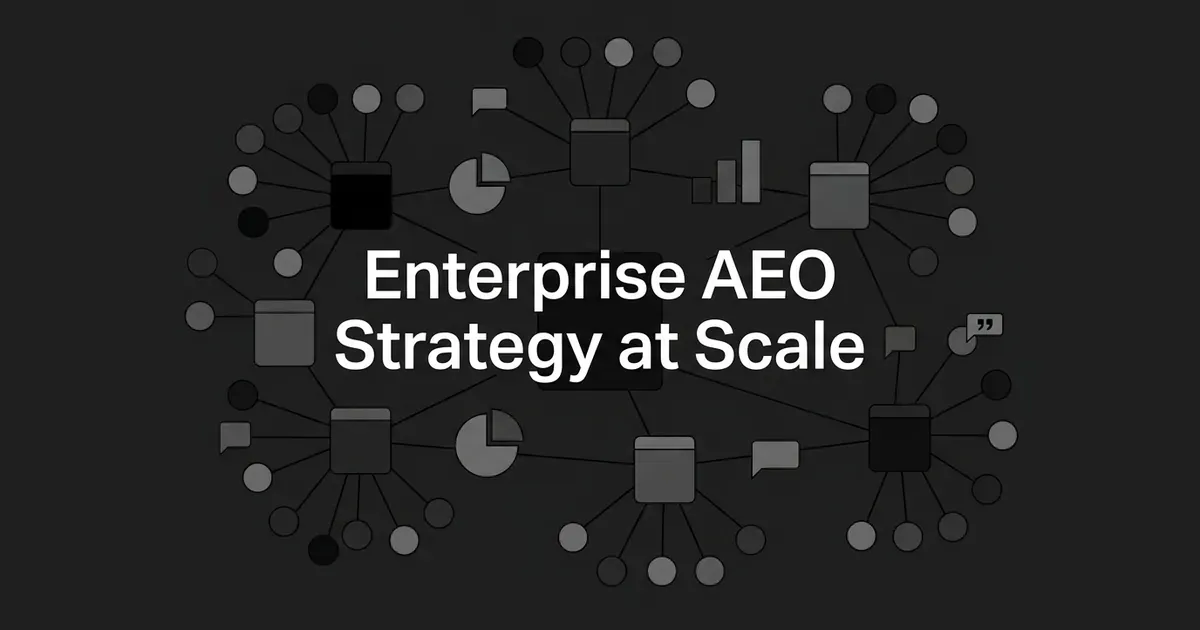
Once you know the questions, turn your site into an architecture that answers them as a connected set rather than as isolated pages. Build one shared taxonomy every team can use: primary topic, subtopic, buyer stage, audience, product or use case, page role (pillar, spoke, comparison, reference, product), current owner, and the prompt family each page is meant to serve.
A complete cluster has a pillar page that gives the broad overview, spoke pages that each answer one specific subtopic, and contextual links connecting the pillar to its spokes and related spokes to each other. Coverage should span the funnel intentionally rather than by accident, so a cluster that only speaks to awareness stage readers is missing its decision stage half.
Sort every gap you find into one of three buckets. A missing topic has no meaningful coverage at all. A thin cluster has a pillar or a few pages but important subtopics or funnel stages are absent. A disconnected cluster has the relevant pages, but they are not linked together or assigned a shared topic, so neither readers nor AI systems can see them as one thing. While you are mapping, flag cannibalization too: if several pages answer the same question with no distinct role, that is a call to consolidate or differentiate, not a reason to add a fourth page to the pile.
You will know the map is usable once every strategic page sits in one primary cluster, every cluster has a designated pillar or a documented decision not to build one, gaps are visible by topic and stage instead of buried in separate team spreadsheets, and an owner can see the cluster context before proposing yet another page.
Pro tip: the most useful taxonomy is not the one with the most labels. It is the one that lets a leader answer three questions fast: which buyer problem does this page serve, which other pages should support it, and what evidence would show the cluster is gaining visibility.
DeepSmith's Content Map does this classification work directly: it crawls your site and your competitors' sites, sorts everything into the same topic and funnel taxonomy, and separates coverage gaps from topics you have not touched at all, with sitemaps rechecked every 24 hours. The strategic value here is the shared map itself, not the crawling mechanics behind it.

Baseline mentions, citations, and competitor wins
Before you prioritize anything, record where you actually stand today. Your baseline should cover mention rate, citation rate, and share of voice broken out by platform, prompt, topic, and funnel stage, plus which of your pages get cited and which competitor pages get cited instead of yours.
It is worth separating three states that often get blurred together. Mention without citation means the brand gets named but the answer is not backed by your own page. Citation without strategic coverage means a page is cited, but it is not the page you actually want buyers to find. No mention and no citation means the topic is simply invisible for that prompt. A baseline table with one row per prompt, and columns for platform, mention, citation, cited URL, competitor cited, topic, funnel stage, and next action, makes these differences visible instead of anecdotal.
Keep the measurement caveats in mind. Citation tracking tools report a sample of activity, refreshed with some processing delay, not a complete log of every AI answer ever generated, and low frequency citation activity may not show up at all. Google also reports AI feature visibility inside its overall web search type in Search Console, so treat AI visibility data as one input alongside ordinary search performance and business analytics, not a fully separate channel.
The baseline is complete once leadership can answer where you are visible today, which topics produce citations, which competitors win the prompts that matter, where you are mentioned but unsupported, and which platforms are strategically important but currently unmeasured.
DeepSmith's AI Visibility overview tracks mention rate, citation rate, share of voice, and trend by platform, with a competitor leaderboard and the sources AI cites most, and its Pages view shows which of your URLs earn citations and which prompts drive them. Use it to build the baseline and surface candidate clusters, but do not treat the dashboard as a complete record of every AI answer that was ever generated.
Score opportunities by citation value
With a baseline in hand, resist the pull to prioritize by search volume alone, or by how easy a page is to publish, or by how many pages a competitor happens to have. Score each candidate cluster and page against a shared rubric so every team is weighing the same things.
A workable score combines five questions: does the prompt influence a real business decision (buyer value), is the brand absent or losing the citation to a competitor (citation gap), is a competitor weakly established here or strongly dug in (competitive opportunity), will this page strengthen a pillar or unlock related spokes (cluster leverage), and can you actually back the page with first-hand expertise, data, or a useful comparison (evidence and differentiation). Add these up for a rough priority score, then apply a feasibility check on top, since a high score with no credible path to a genuinely useful page is not actually a priority.
Sort the results into four queues. Protect covers pages and clusters that are already cited and still matter commercially. Convert covers pages that earn mentions but not citations yet. Take covers prompts a competitor currently owns where you have a real edge. Build covers missing or thin clusters with high buyer value and strong evidence potential.
You will know the system is working when every candidate has a visible reason for its score, a low volume but high decision prompt can beat a high volume but low value keyword, and the backlog includes refresh and consolidation work alongside new pages rather than only net new ones.
Common mistake: turning the score into a disguised page quota. A cluster with ten pages is not automatically stronger than one with four. The real question is whether the pages together cover the prompt family without repeating each other, and whether the intended pillar and spokes are gaining visibility.
DeepSmith's Opportunity Agents turn AI Visibility and Content Map data into evidence-backed ideas for exactly these queues: getting cited for a tracked prompt, converting a mention into a citation, taking a competitor's citation, and closing awareness, consideration, or decision stage gaps. Each idea carries the data point behind it, which is useful for defending a backlog to leadership, but the agent output is still an input to your prioritization, not a replacement for it.
Complete the highest-value clusters
Sequence the work so each release makes the next one more valuable, rather than scattering effort across many half-built clusters at once. This is where an AI search strategy large sites can sustain actually starts to compound. Start with the strategic cluster that has high buyer value, a visible citation gap, and enough internal expertise to say something genuinely different. Select or strengthen the pillar so it explains the topic broadly enough for the spokes to make sense as parts of one subject, then list the spokes the prompt data, competitor citations, and funnel analysis reveal as missing.
Fill the highest-value missing spoke first, favoring one that answers a decision stage question or supports several tracked prompts at once, then add or repair the contextual internal links between pillar and spokes and among related spokes. Review the finished cluster as a unit rather than page by page, checking whether it answers the prompt family without repetition, and plan to revisit it again after you have measurement to act on.
Internal links matter here for a concrete reason: they help search and retrieval systems understand relevance and find new pages to crawl, so crawlable links with descriptive, natural anchor text pull real weight. There is no magic number of links to hit. A cluster does not need to be a rigid silo either. A page can belong to one primary cluster for reporting purposes while linking out to genuinely related material elsewhere.
A cluster is ready to call complete when the pillar clearly answers the broad question, each spoke owns one distinct subtopic, awareness through decision coverage is intentional rather than accidental, every important page is reachable through a crawlable link, and there is no obvious duplicate competing with another page for the same purpose. Tighter internal linking and a more orderly architecture are well established as good SEO practice. Treat that as reasonable support for the AEO case, not proof that internal linking by itself wins citations, since retrieval systems still decide what to surface.
Set citation-ready standards without creating thin pages
Give every team a shared standard for page quality instead of letting each group invent its own rules, and keep the standard about substance rather than a single writing style. A strong page answers the primary question clearly near the top, states its purpose and audience, uses headings that expose the structure of the answer, defines specialized terms, and distinguishes similar concepts explicitly. It includes real evidence rather than generic assertion, states its qualifications and limitations honestly, shows its relationship to the larger cluster through contextual links, and carries a clear expectation for when it should be reviewed again.
None of this should turn into a formula for gaming a model. Unique, genuinely useful, expert-led content matters more than adopting some AI-specific writing style, and since these systems understand synonyms and general meaning, you do not need a page for every possible wording of a question. Research on generative engine optimization, the discipline enterprise generative engine optimization work draws on, backs a few specific moves as the strongest levers: citing sources, adding direct quotations, and adding statistics. The same research found little benefit from keyword stuffing and no meaningful gain from simply writing in a more persuasive or authoritative tone.
A standard is working when reviewers can honestly say yes to whether the page answers a real question, whether the answer is easy to find without reading the whole page, whether it includes evidence instead of generic claims, whether it fits a named cluster and funnel stage, and whether a reader would find it useful even if no AI system ever cited it.
Scaling content production does not mean producing more pages without adding value. Generating a large volume of pages that add nothing new to what already exists on the topic is treated by search systems as abuse, not as coverage, so enterprise scale should mean scalable standards applied consistently, not indiscriminate output.
Align teams around one AI visibility scorecard
At enterprise size, the real risk is not that any one team does bad work. It is that the blog, the documentation team, product marketing, and regional sites each run their own separate AEO effort with different definitions, so leadership cannot see the whole picture and nobody can tell which team's work is actually moving the needle. Use one enterprise scorecard with team-level views instead.
The shared scorecard should carry priority prompt families, the primary topic and cluster, funnel stage, intended pillar and spoke pages, current mention and citation status, which competitor currently owns the citation if any, the current page owner, and the planned action: create, refresh, consolidate, link, clarify, or monitor. Set goals at a level each team can actually influence. Documentation might own decision stage support pages, product marketing might own comparison content, and a regional team might own localized prompt families, while leadership still evaluates everyone against the same enterprise outcomes: visibility for priority prompt families, citation share, and cluster completion.
Keep the enterprise objectives small in number: increase citation coverage for the priority prompt families, reduce competitor-owned gaps in your highest value clusters, grow the number of genuinely complete clusters, and improve how accurately AI systems describe your brand. Raw page count should never be the primary goal, since it can rise while actual visibility and usefulness go down.
You have real alignment when every strategic prompt family has one enterprise-wide classification, teams use identical definitions for mention and citation, a page has exactly one primary cluster, and leadership reviews outcomes by topic and buyer stage rather than by team output alone.
DeepSmith's Content Map supplies the shared topic and funnel taxonomy, and AI Visibility supplies the prompt, page, and competitor data underneath the scorecard, so every team is looking at the same numbers instead of reconciling separate spreadsheets before a leadership review. This is what scaling AEO across teams actually means in day to day terms: one map, one set of numbers, and separate ownership on top of it.
Review results and re-sequence the portfolio
Treat this whole system as a recurring review, not a one-time audit you run once and file away. At each review, ask which priority prompts gained or lost mentions and citations, which URLs actually got cited and whether they were the ones you intended, which competitors gained ground, whether a cluster grew in breadth or funnel balance, and whether citations are piling up on one page when several pages should be sharing that load.
Land on one of four calls for each item. Keep it if the page or cluster is performing and still matters strategically. Improve it if it is relevant but not earning the citations or description you want. Connect it if the content already exists but needs better placement in the cluster or stronger internal links. Retire or consolidate it if it is redundant, stale, or competing against a stronger page you already have.
Keep an answer history for your important prompts, because AI responses and the way engines expand a query into related searches can shift over time. Compare trends across a review period rather than reacting to a single answer you happened to see today.
This loop is mature once every review ends in an explicit keep, improve, connect, or retire decision measured against a real baseline, once your teams can tell a genuine content change apart from a shift in how the model itself is behaving, and once the backlog gets continuously re-ranked by new evidence instead of sitting fixed for a quarter. DeepSmith's Opportunity Agents can rerun against a 30, 90, or 180 day window and return evidence-backed ideas with the run kept as a record, which is useful for a scheduled review, though the final call on what to prioritize still belongs with the marketing or SEO leader running the program.

None of this needs to be complicated to be effective. It just needs to be consistent, which is the whole point of treating enterprise generative engine optimization as a standing portfolio process rather than a one-off project with an end date. Pick one priority cluster this week, build its baseline, score its opportunities against your rubric, and set the date for its first review. If you want a single place to run the prompt tracking, the cluster mapping, and the opportunity scoring described here, start a free trial of DeepSmith and bring your first cluster in to test the workflow against your own data.